
Suction spinner toys have become one of the most popular sensory toys for babies and toddlers. They are simple, affordable, and genuinely engaging. But like any baby product, the experience depends heavily on how you use it.
A suction spinner toy is simple to use, but using it correctly helps create a safer and more enjoyable experience for babies and toddlers. Parents who understand the correct setup, the right surfaces, and the basic safety habits get far more value from the toy — and far fewer frustrations.
This guide walks you through everything: what the toy is, how to attach it properly, how to use it during mealtime and sensory play, how to clean it, and the common mistakes that lead to poor suction or unsafe play. If you want to understand the toy itself first, the complete guide to what a suction spinner toy is and how it works covers the fundamentals.
What Is a Suction Spinner Toy and How Does It Work?
A suction spinner toy is a sensory toy with a suction cup base and one or more rotating elements on top. You press the base onto a smooth surface, and it stays attached while your baby pushes, taps, and spins the blades. The complete guide to baby suction spinner toys explains the design variations in more detail.
Understanding the parts helps you use the toy correctly. Each component plays a specific role in both function and safety.
1. Suction Cup Base
The suction cup creates the attachment. It works by pressing against a smooth surface and pushing out air to form a vacuum seal. The quality of the seal depends entirely on the surface and how clean it is.
2. Spinner Blades
These rotate when touched. The smooth-bearing mechanism allows even a light push from small hands to produce satisfying motion. This is the core of the cause-and-effect learning experience.
3. Textured Surface
Varied ridges, bumps, and smooth areas provide different tactile experiences. This supports sensory exploration and gives babies multiple ways to interact with the toy.
4. Center Design
Often shaped like a colorful animal or flower. The visual appeal draws attention and encourages engagement.
Parts of a Safe Suction Spinner Toy
Hover or tap each card to explore the components
Safety Starts With Design
Every part plays a role in safe, engaging play
Strong Suction Base
Secure attachment on smooth surfaces
Rotating Blades
Creates interactive movement
Textured Areas
Encourages touch exploration
Baby-Friendly Shape
Designed for small hands
Step-by-Step Guide: How to Attach a Suction Spinner Toy Correctly
Correct attachment is the single most important factor in safe use. A poorly attached toy can fall, frustrate your baby, and create unnecessary risk. Follow these steps every time.
Use smooth, non-porous surfaces. Avoid fabric, carpet, rough wood, and uneven areas.
Remove dust, food particles, and moisture. Dry completely. A clean surface creates better suction contact.
Place the base flat. Press firmly in the center. Hold for a few seconds to let the seal form.
Spin gently. Check stability. Confirm attachment with a light tug before handing it over.
Recommended Surfaces
- ✅ High chair tray
- ✅ Glass surface
- ✅ Smooth table
- ✅ Clean plastic surface
Surfaces to Avoid
- ❌ Fabric
- ❌ Carpet
- ❌ Rough wood
- ❌ Uneven surfaces
✅ Correct Setup
- Clean surface
- Flat area
- Adult supervision
- Firm suction
❌ Incorrect Setup
- Dirty surface
- Soft materials
- Unstable areas
- Loose attachment
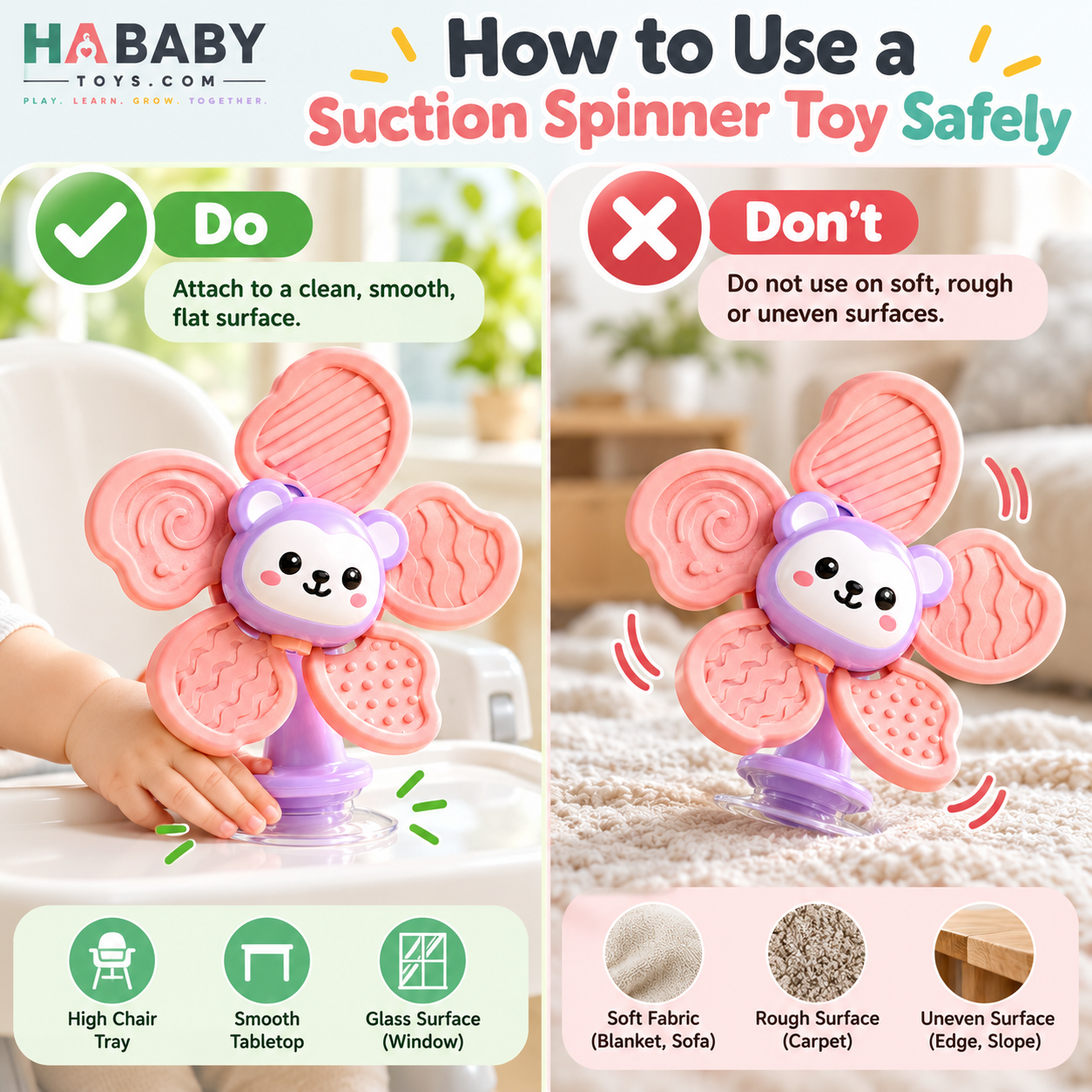
The HA BABY TOYS Baby Fidget Spinner supports hand movement practice and coordination in a safe, supervised setup.
How to Use a Suction Spinner Toy During Mealtime
Mealtime is one of the most common use cases for a suction spinner. It keeps your baby engaged while you prepare food, manage siblings, or simply take a breath. But it should never replace feeding interaction.
Why Parents Use It
- Keeps baby engaged during meal prep
- Makes high chair time easier
- Provides activity during waiting
Safety Points
- Keep the toy within reach at all times
- Always supervise your baby during use
- Do not use it to replace feeding interaction
- Remove the toy before cleaning the tray to avoid food buildup under the suction cup
During meal preparation, a suction spinner can provide a simple activity while parents complete nearby tasks. The key word is nearby. The toy is a distraction aid, not a babysitter.
How to Use a Suction Spinner Toy for Sensory Play
Beyond mealtime, the spinner is a dedicated sensory tool. Here is how to make the most of it.
Touch Exploration
Guide your baby’s fingers across the different textures. Let them explore the smooth areas, ridges, and bumps at their own pace. This builds tactile awareness and finger dexterity.
Visual Tracking
Spin the blades slowly and let your baby follow the motion with their eyes. Visual tracking is a foundational skill for reading and hand-eye coordination later on.
Cause and Effect Learning
The core lesson is simple: “I push, it spins.” This is one of the earliest forms of causal reasoning, and the spinner delivers it in a clean, repeatable way.
Parents interested in understanding the deeper developmental benefits can explore our guide about the benefits of buying a baby suction spinner toy, which breaks down sensory, motor, and engagement value in detail.
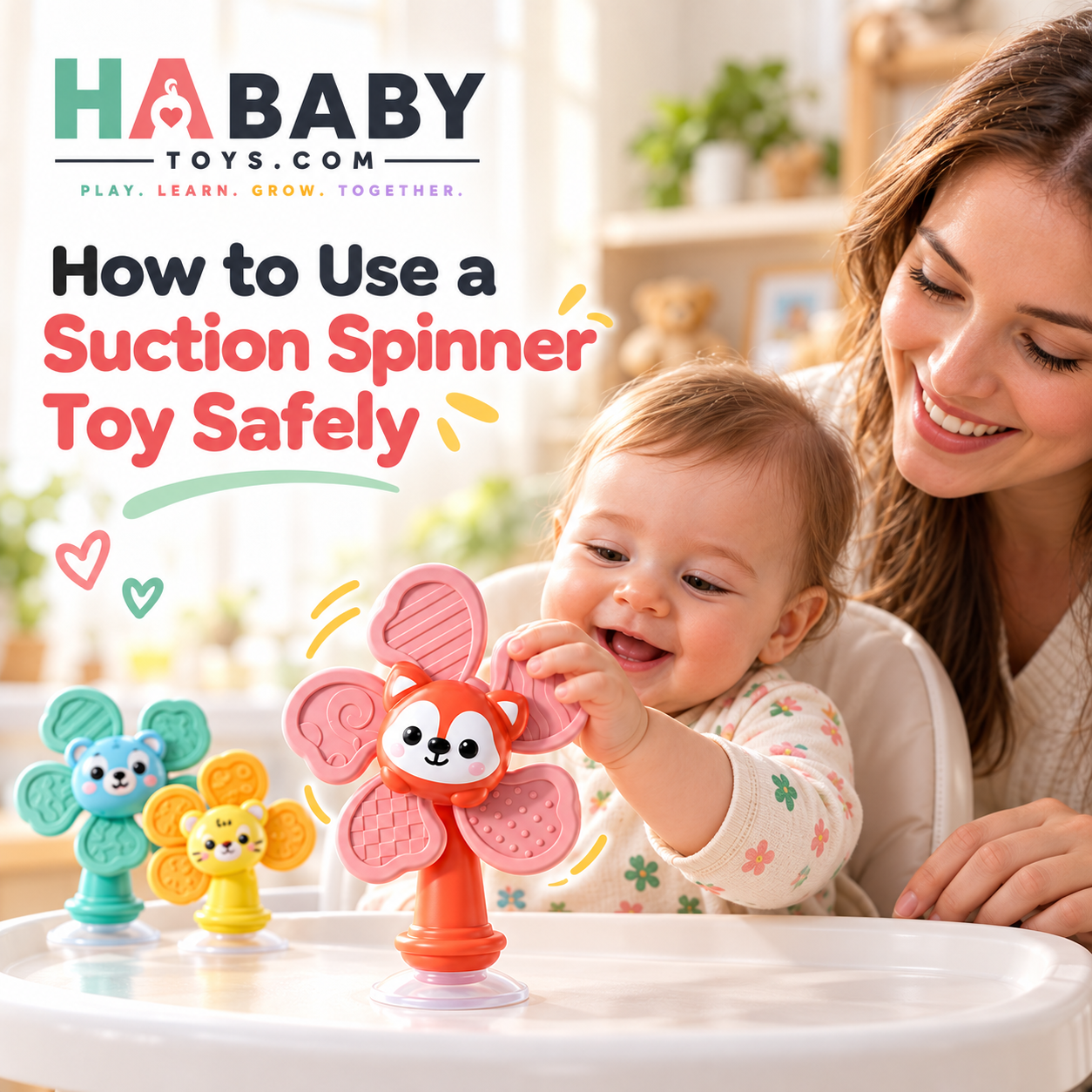
The Toddler Suction Spinner encourages independent exploration during safe, supervised playtime.
Best Places to Use a Suction Spinner Toy Safely
High Chair
The classic use case. Attach to a clean, smooth tray before meals. It keeps little hands busy and reduces mealtime frustration. Always supervise.
Play Table
A smooth play table or plastic mat gives your baby a dedicated space for independent activity. The spinner becomes part of a broader sensory routine.
Travel
Airplane tray tables, restaurant tables, and hotel room surfaces all work. The compact design fits easily in a diaper bag. No batteries means no last-minute scrambling.
Home Learning Area
Set it up on a smooth floor tile or plastic play mat for daily sensory play. It becomes a predictable part of your baby’s routine.
Cleaning and Maintenance Guide
Cleaning is not just about hygiene. Dust, oil, and food residue directly reduce suction strength. A clean toy is a safer toy.
After Use
- Remove the toy carefully by lifting the edge of the suction cup — do not yank it off
- Wash according to the material instructions (warm soapy water or baby-safe wipe)
- Dry completely before reattaching or storing
Regular Checks
Inspect the toy regularly. Look for:
- ✅ Suction cup condition (cracks, stiffness, or misshaping)
- ✅ Spinner movement (smooth rotation, no grinding)
- ✅ Cracks or damage anywhere on the toy
If any part is damaged, stop using the toy. The U.S. Consumer Product Safety Commission maintains recall information and safety standards for children’s products, and any damaged toy should be replaced rather than repaired.
Common Mistakes Parents Should Avoid
Most problems with suction spinner toys come down to a handful of avoidable mistakes. Here are the four most common.
Mistake 1: Using on Unsuitable Surfaces
Carpet, fabric, rough wood, and curved surfaces cannot form a proper seal. Poor suction can cause the toy to fall, which frustrates your baby and creates unnecessary risk. Always test the surface with your hand before attaching.
Mistake 2: Skipping Cleaning
Dust and oils from fingers reduce suction. A quick rinse and dry restores grip. Make cleaning part of the routine after every use.
Mistake 3: Leaving Baby Unattended
No toy replaces your presence. Adult supervision is important at all times during play. Stay within arm’s reach.
Mistake 4: Ignoring Product Condition
A cracked suction cup or a loose spinning mechanism is a sign the toy needs to be replaced. Inspect before each use and discard anything damaged.
Safety Tips Every Parent Should Know
These habits apply to any suction spinner toy, regardless of brand or design.
- ✅ Choose age-appropriate toys
- ✅ Follow manufacturer instructions
- ✅ Supervise during play
- ✅ Keep the toy clean
- ✅ Store properly after use
The American Academy of Pediatrics recommends toys that are soft, easy to grasp, lightweight, nonflammable, washable, nontoxic, and shatterproof. These principles apply directly to suction spinner toys.
For developmental context, the CDC child development resources help parents understand what skills their baby is working on at each stage — which makes it easier to choose the right toy and use it appropriately.
Broader child development guidance from the Zero to Three organization and the Harvard Center on the Developing Child reinforces the value of simple, open-ended play in early learning.
Suction Spinner Toy Safety Comparison
A quick reference to help you stay on the safe side.
| Feature | Safe Usage | Unsafe Usage |
|---|---|---|
| Surface | Smooth table | Carpet |
| Cleaning | Regular cleaning | Dirty surface |
| Supervision | Adult nearby | Alone play |
| Attachment | Firm suction | Loose attachment |
Frequently Asked Questions
Clean the surface first and dry it completely. Place the suction base flat, press firmly in the center, and hold for a few seconds to let the seal form. Test with a gentle tug before letting your baby use it.
Smooth, non-porous surfaces work best. This includes plastic high chair trays, glass tabletops, smooth plastic play tables, window glass, refrigerator doors, and bathtub sides. Textured, curved, or dusty surfaces will not hold suction reliably.
Yes, with supervision. Attach it to a clean, smooth high chair tray before meals. It gives little hands a job while waiting for the next bite. It should never replace feeding interaction, and you should always stay nearby.
Clean it after every use, especially if it has been attached to a high chair tray during meals. A quick wipe with a baby-safe disinfectant or a wash in warm soapy water is enough. Dry completely before reattaching.
The most common causes are a dirty surface, a dirty suction cup, or an unsuitable surface. Fabric, carpet, rough wood, and curved surfaces cannot form a proper seal. Clean both the cup and the surface, then test again.
Yes, with supervision. Toddlers can continue to enjoy the spinner as their skills develop. Always follow the manufacturer’s age recommendations, inspect the toy regularly for wear, and stay nearby during play.
Yes. The compact design makes it a practical travel toy. It attaches to airplane tray tables, restaurant tables, and hotel room surfaces. Always check that the surface is clean and smooth before attaching.
Safe Play Starts With Simple Steps
Using a suction spinner toy safely comes down to a handful of simple habits: choose the right surface, clean before and after use, press firmly to create a proper seal, test before handing it to your baby, and stay nearby during play.
Correct setup improves the entire experience. The toy stays attached, your baby stays engaged, and you avoid the small frustrations that turn a good toy into a forgotten one. Safety habits matter, and they take only seconds to build into your routine.
Suction spinner toys are simple but effective. Used correctly, they support sensory development, fine motor skills, and independent play — all without batteries, screens, or complicated setup.
Explore More Baby-Friendly Products
Discover sensory toys, educational products, and practical baby items designed for safe, everyday play.
Visit the HA BABY TOYS ShopExplore more baby-friendly products at HA BABY TOYS. You can also browse the HA BABY TOYS blog for more guides on sensory play, child development, and practical parenting strategies.
Trusted Resources Referenced in This Guide
- American Academy of Pediatrics (AAP) — Toy safety tips and developmental guidance
- U.S. Consumer Product Safety Commission (CPSC) — Toy safety standards and recall information
- CDC Child Development — Age-by-age milestone tracking
- Zero to Three — Child development and parenting resources
- Harvard Center on the Developing Child — Science of early brain development
- UNICEF Early Childhood Development — The role of play in early learning
- World Health Organization — Child health and development guidance
- NAEYC — Early childhood learning resources
- KidsHealth — Parenting and child wellness resources
- The Toy Association — Toy safety and industry standards
One Response