
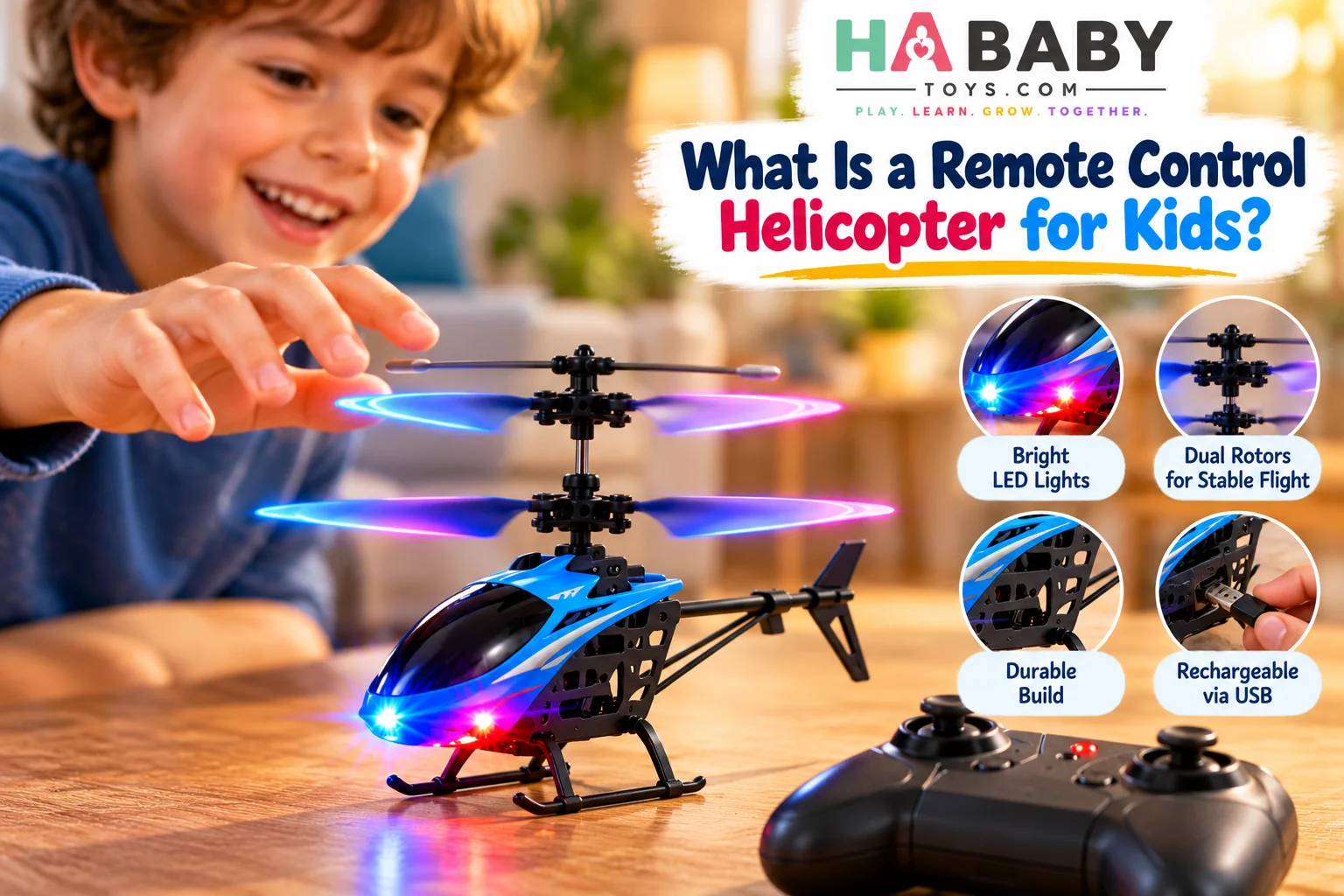
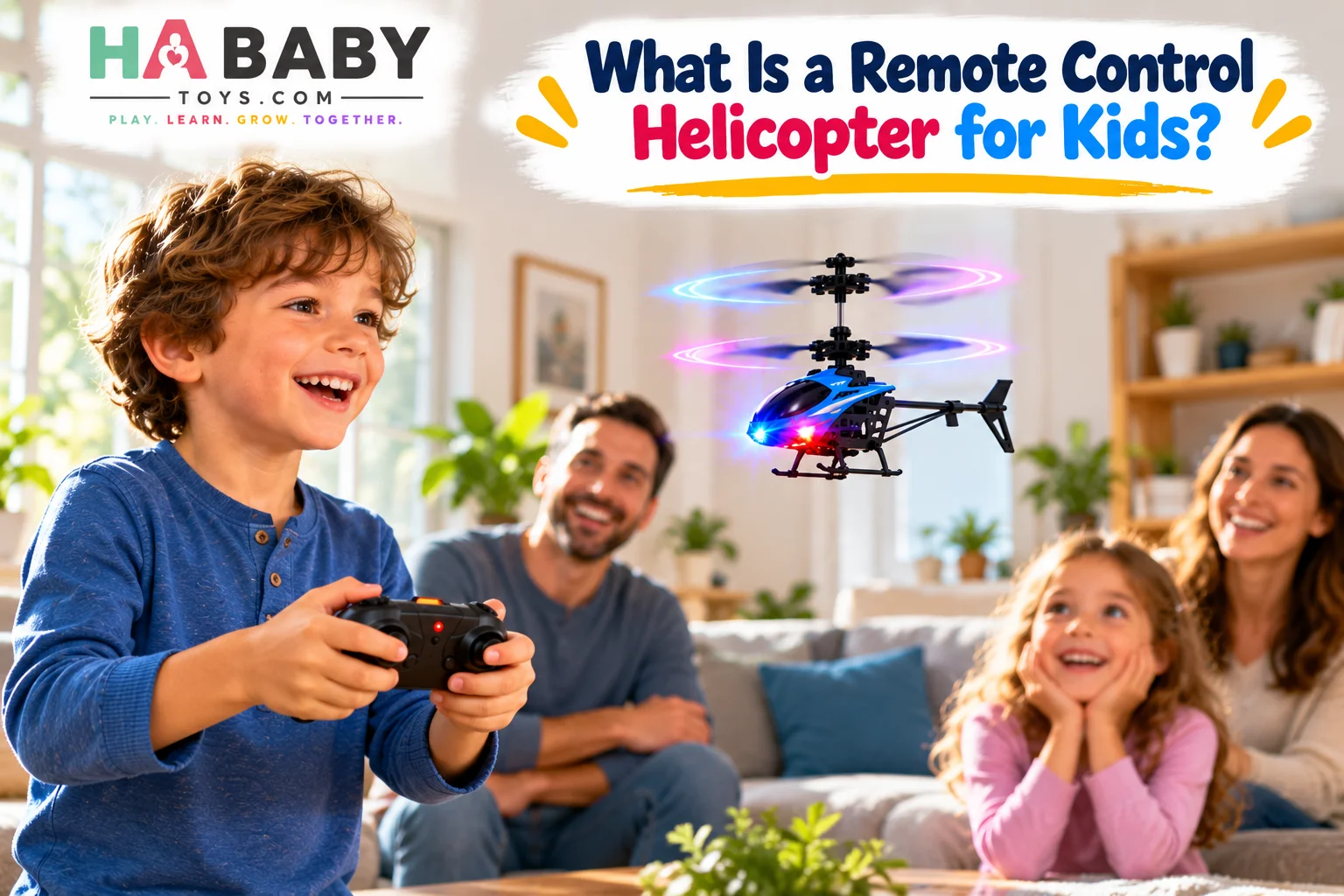
A remote control helicopter for kids is a small electric flying toy designed for simple indoor or beginner-friendly flight. Depending on the model, it may use a handheld remote, induction or hover sensors, rechargeable power, LED lights, and protective features that make it easier to use than more advanced hobby aircraft.
If you are comparing one of these against a mini drone, a hover toy, or a hobby-grade RC helicopter, the honest question is: what does the kids version actually offer? This guide answers that clearly. The HA Baby Toys Remote Control Helicopter is a good example of the category — a small, rechargeable, LED-lit flying toy aimed at beginners.
What Is a Kids RC Helicopter?
A remote control helicopter for kids is typically:
- A small electric flying toy
- Controlled by a remote or simple sensor system
- Rechargeable or battery-powered
- Designed for indoor or light recreational use
- Often fitted with LED lights
- Smaller and simpler than hobby-grade RC aircraft
Hobby RC helicopter: more advanced, faster, more skill required
Power → Lift → Hover → Control → Land
The five-stage flight cycle behind every session
Kids RC Helicopter
Small, rechargeable, beginner-friendly
Power
The motor receives power from the battery.
Lift
The rotor spins to create upward force.
Hover
The toy remains in the air for short controlled play.
Control
The remote or sensor system changes movement.
Land
The helicopter returns safely to the floor.
Power → Lift → Hover → Control → Land
What Exactly Is a Remote Control Helicopter?
In simple terms, it is a flying toy. It uses electric motors, usually has one or more spinning rotors, and is directed by a remote. Some models include auto-hover or induction features that make flight easier for beginners.
Parents who want the practical side of setting one up can read the guide on how to use a kids RC helicopter safely.
How Does It Fly?
The rotor blades spin quickly and move air downward. This creates lift, allowing the helicopter to rise. Small changes in rotor speed or control input can affect height and direction.
A simple way to think about it:
Motor → Rotor spin → Air down → Lift up
You do not need to understand aerodynamics to fly one. What matters is that the toy produces lift by pushing air downward, and that the controller adjusts the direction of that lift.
How Flight Happens
Four steps from battery to lift
Motor
The electric motor spins up when power is applied.
Rotor Spin
The blades turn at high speed.
Air Down
The rotor pushes air toward the floor.
Lift Up
The helicopter rises into the air.
Motor → Rotor → Air Down → Lift Up
What Is an Induction Hover Helicopter?
Some mini flying toys use a downward-facing sensor to detect nearby surfaces and adjust height automatically. This is often described as “induction” or “hover sensing.”
The exact behaviour depends on the model, so do not assume full autonomous flight. Most induction-style toys simply help stabilise the hover height — they do not fly themselves.
Remote Control vs Hand-Induction Control
| Feature | Remote Control | Induction or Hover Control |
|---|---|---|
| Direction control | More direct | More automatic |
| Beginner-friendly | Depends on controls | Often simpler |
| Hover assistance | Possible | Often central feature |
| Precision | Usually higher | More limited |
| Best for | Guided flying | Simple hovering play |
RC Helicopter vs Mini Drone
RC helicopter
- Helicopter-style body
- Rotor-based lift
- Often simpler, more toy-like controls
- Strong role-play appeal
Mini drone
- Multiple propellers
- More stable hovering in some models
- Often more advanced control systems
- Typically less character-oriented design
Balanced comparison: neither is universally better. A helicopter-style toy tends to feel more like a character toy; a mini drone tends to offer more advanced controls.
For general recreational flying context in the United States, the Federal Aviation Administration (FAA) publishes guidance on recreational drones and model aircraft. Most small toy helicopters are designed for indoor play and are not subject to the same rules, but it is worth checking if you plan to fly outdoors.
Is It an Indoor Flying Toy?
Yes, if the manufacturer permits it and the space is appropriate. Good indoor conditions:
- Clear room
- No ceiling fans
- No pets moving around
- No fragile objects
- No open stairwell
- Enough vertical space
Indoor flying works best in a clear, calm room — not in a crowded bedroom or near ceiling fans.
Can It Be Used Outdoors?
Possible outdoor use depends on:
- Wind
- Toy weight
- Manufacturer guidance
- Control range
- Surface conditions
Lightweight mini helicopters can be difficult to control outdoors in wind, so indoor use may be more suitable unless the product specifically supports outdoor flight. Check the manual before taking it outside.
Rechargeable Toy Helicopter — What Does That Mean?
Rechargeable means the helicopter’s built-in battery can be recharged rather than replaced after every use. That is usually more convenient than buying replacement batteries continuously.
Do not assume specific battery chemistry, charge time, flight time, or USB type unless the product listing confirms them. Those details vary between models. Parents comparing options can also read why choose a rechargeable toy helicopter for a fuller view.
LED Light-Up Features
If the helicopter includes LEDs:
- More visible in dim rooms
- Adds visual appeal
- Makes flight look more exciting
- Can help track the toy
Keep enough room lighting to see walls, furniture, and people clearly. Do not recommend flying in complete darkness.
Kids Toy Helicopter vs Hobby RC Helicopter
| Feature | Kids Toy Helicopter | Hobby RC Helicopter |
|---|---|---|
| Controls | Simpler | More complex |
| Speed | Usually lower | Often higher |
| Cost | Lower | Higher |
| Skill required | Beginner | Intermediate or advanced |
| Maintenance | Simpler | More involved |
| Indoor suitability | Often stronger | Depends on model |
What Can Kids Do With It?
Basic hover
Try to keep it steady for a few seconds.
Takeoff and landing
Practice controlled starts and stops.
Gentle direction changes
Move carefully in open space.
LED flight
Use light effects in a safely lit room.
Parent-child turns
Take turns controlling it.
Landing challenge
Try to land on a marked spot on the floor.
Avoid obstacle-course suggestions that encourage risky flying near objects, faces, or pets.
Beginner Flight Path
Five stages from takeoff to safe landing
Takeoff
Start from a clear, flat floor area.
↓
Hover
Let the toy rise and hover steady in place.
↓
Move Forward
Gently direct it toward open space.
↓
Turn
Slowly change direction without abrupt moves.
↓
Land
Reduce power and let it settle on the floor.
This path is a learning sequence, not a full flight manual. Exact controls and behaviour vary by model.
Is It Difficult to Learn?
Difficulty depends on the control system, size, hover assistance, and the child’s coordination. Models with simpler controls or hover assistance may be easier for beginners.
It is not realistic to promise that the toy is “easy for all children.” Some children pick it up in a few flights; others need several sessions and more supervision.
What Age Is It For?
Always follow the manufacturer’s stated age recommendation. Flying toys can involve moving rotors, small parts, batteries, and control skills that make age guidance important.
The CDC developmental milestone resources and the NHS baby development guidance both note that children develop at different rates. Age labels are a starting point, not a guarantee of suitability.
Safety Around Rotors
- Keep fingers away from spinning blades
- Do not grab the helicopter while rotors are moving
- Turn it off before handling
- Keep hair away
- Keep pets away
- Stop use if blades are cracked or bent
These rules are essential for a flying toy with moving parts. For broader toy safety guidance, the U.S. Consumer Product Safety Commission publishes age labeling and recall information, and Safe Kids Worldwide covers injury prevention for children’s toys in general.
Safe Flight Zone
A simple layout for indoor flying
Takeoff Zone
A flat, clear floor area in the middle of the room.
↓
Clear Flight Space
Open air above, with no furniture directly nearby.
↓
No-Person Zone
Nobody stands directly under or beside the flight path.
↓
Furniture Boundary & Ceiling Fan Warning
Avoid rooms with ceiling fans, glass cabinets, or low-hanging lamps.
What “Fall-Resistant” Really Means
“Fall-resistant” usually means the toy is designed to tolerate some light impacts better than a fragile hobby aircraft, but it does not mean it cannot break.
Repeated hard crashes can still damage rotors, body panels, motors, or electronics. A fall-resistant toy is more forgiving, not indestructible.
What Parents Should Check Before Buying
Look for:
- Manufacturer age guidance
- Control method
- Hover-assist feature
- Rechargeable battery
- Charging method
- LED lights
- Rotor guards if present
- Spare rotor availability
- Indoor and outdoor guidance
- Size and weight
- Flight-control simplicity
- Safety instructions
For additional safety guidance, HealthyChildren.org from the American Academy of Pediatrics covers choosing age-appropriate toys, and Safe Kids Worldwide publishes injury-prevention resources that apply to flying toys as well.
What the Toy Is Not
A kids RC helicopter is not:
- A professional drone
- A camera drone unless specified
- Indestructible
- Meant to be flown near faces
- Suitable for uncontrolled outdoor wind
- Safe to modify for more speed or power
What it can offer:
- Beginner-friendly flight
- Simple controls
- Indoor play value
- LED visual interest
- Parent-child turn-taking
Who Is This Product Best For?
Families with children in the right age range can also explore the 3+ Years category for related toys.
Who Might Prefer Something Else?
Another toy may be better if:
- You have no clear indoor flight space
- Your child dislikes noisy or moving toys
- You want very long outdoor range
- You want camera features
- You need a non-electronic toy
- You want zero adult supervision
This is not a weakness of the product — it is simply a boundary of when it is most useful.
Choose a Kids RC Helicopter If:
- You have clear indoor space
- Your child enjoys flying toys
- You want a rechargeable electronic toy
- You are comfortable supervising first flights
- You want a simpler alternative to a hobby drone
- LED lights add value for you
- The manufacturer’s age guidance fits
- You understand that crashes can still cause damage
If that sounds like a good fit, explore the HA Baby Toys Remote Control Helicopter.
Ready for a beginner-friendly RC helicopter?
Explore the HA Baby Toys Shop →Frequently Asked Questions
What is a remote control helicopter for kids?
It is a small electric flying toy controlled by a remote or simple sensor system. Kids versions are typically rechargeable, LED-lit, and designed for indoor or light recreational use. They are simpler than hobby-grade RC helicopters.
How does a kids RC helicopter fly?
The rotor blades spin and push air downward, creating lift. Small changes in rotor speed or control input affect height and direction. You do not need to understand aerodynamics to fly one.
What is induction hover control?
Some mini flying toys use a downward-facing sensor to detect surfaces and help stabilise hover height. It is often described as “induction” or “hover sensing.” The exact behaviour depends on the model, so do not assume fully autonomous flight.
Is an RC helicopter the same as a drone?
No. An RC helicopter typically has a helicopter-style body with a rotor-based lift, while a mini drone usually has multiple propellers and often more advanced control systems. Both are flying toys, but they are designed differently.
Can it be flown indoors?
Yes, if the manufacturer permits it and the space is appropriate. Choose a clear room with no ceiling fans, no pets moving around, no fragile objects, and no open stairwell. Indoor flying works best in a clear, calm room.
Can it be flown outdoors?
Possible outdoor use depends on wind, toy weight, manufacturer guidance, control range, and surface conditions. Lightweight mini helicopters are difficult to control outdoors in wind, so indoor use is often more suitable. For general recreational flying context in the United States, the FAA publishes guidance on model aircraft.
Does it need charging?
Most kids RC helicopters are rechargeable. That means the built-in battery can be recharged rather than replaced after every use. Check the product listing for the correct charging method and time.
How long does it fly?
Flight time varies by model, battery condition, and usage. Check the product listing for the specific flight time of the helicopter you are considering.
Does it have LED lights?
Many kids RC helicopters include LED lights for visibility and visual appeal. Check the product listing for the specific features on your model. Keep enough room lighting to see walls, furniture, and people clearly during flight.
Is it suitable for beginners?
Difficulty depends on the control system, size, hover assistance, and the child’s coordination. Models with simpler controls or hover assistance may be easier for beginners. It is realistic to expect a short learning curve.
Are the rotor blades safe?
Rotor blades spin quickly and can cause injury if touched. Keep fingers, hair, and pets away from spinning blades, turn the helicopter off before handling, and stop using it if blades are cracked or bent. The U.S. Consumer Product Safety Commission publishes toy safety guidance and recall information.
What should I do after a crash?
Turn the helicopter off, inspect it for cracks, loose parts, or bent rotors, and check that nothing has come loose near the battery compartment. If there is damage, stop using it until it is properly checked. Do not attempt home repairs on electronic components.
What does fall-resistant mean?
“Fall-resistant” usually means the toy is designed to tolerate some light impacts better than a fragile hobby aircraft. It does not mean it cannot break. Repeated hard crashes can still damage rotors, body panels, motors, or electronics.
What should parents check before buying?
Check the manufacturer’s age guidance, control method, hover-assist feature, rechargeable battery, charging method, LED lights, rotor guards, spare rotor availability, indoor and outdoor guidance, size and weight, and flight-control simplicity. The HA Baby Toys FAQ also answers common product and ordering questions.
Where can I buy the HA Baby Toys remote control helicopter?
Visit the HA Baby Toys shop to see the remote control helicopter and other flying toys. Families can also browse the 3+ Years category for related products. Retailers and larger buyers can request a quote from HA Baby Toys.
The Short Version for Busy Parents
A kids RC helicopter is not a hobby aircraft and not a drone. It is a small, rechargeable flying toy with beginner-friendly controls and optional hover assistance, designed for indoor or light recreational play.
If your child enjoys flying toys, if you have a clear room with no ceiling fans or fragile objects, and if you are ready to supervise the first flights, it can be a genuinely exciting addition to the toy cupboard. If you have very limited indoor space, if your child dislikes moving toys, or if you want a completely non-electronic option, another choice will serve better.
For more family-friendly toys and parent guides, HA Baby Toys offers products designed around everyday play. You can also browse the HA Baby Toys blog for more ideas on safe active play and screen-free activities.
2 Responses