
An interactive toy phone can give children a familiar phone-like play experience without real calls, apps, social media, or internet access. Buttons, sounds, music, and pretend conversations can make the toy more engaging than a simple plastic phone while still keeping the experience centered on play rather than real smartphone use.
If you are comparing one of these against a plain pretend phone, a toy tablet, or simply handing over your real smartphone, the honest question is: what does the interactive version actually offer? This guide answers that clearly. If you are unfamiliar with the category, start with what a kids toy phone is.
Why Parents May Choose an Interactive Toy Phone
- Gives children their own pretend phone
- Adds buttons, sounds, or music
- Supports pretend conversations
- Can encourage parent-child role-play
- Offers phone-themed play without real apps or social media
- Compact for indoor or travel play
- Can be used for numbers, sounds, and simple games
- May be more engaging than a non-interactive pretend phone
Press → Respond → Pretend → Talk → Replay
The five-stage interaction loop behind every session
Interactive Toy Phone
Buttons, sounds, and pretend conversation
Press
The child chooses a button or feature.
Respond
The phone gives a sound, light, phrase, or musical response.
Pretend
The child imagines making a real call.
Talk
Parents or siblings can join the conversation.
Replay
The same toy can support many different pretend scenarios.
Press → Respond → Pretend → Talk → Replay
Benefit 1: More Engaging Than a Plain Pretend Phone
A basic pretend phone may only offer shape, buttons, and visual imitation. An interactive toy phone may add:
- Sounds
- Music
- Talking responses
- Lights
- Cause-and-effect feedback
The extra responses can make the toy feel more interactive, but more features do not automatically make it more educational. The value is in how the toy is used during play.
Benefit 2: Gives Children a Phone of Their Own
Children often see adults using smartphones. A toy phone provides a separate object for:
- Pretend calling
- Copying familiar routines
- Role-play
- Family games
A dedicated toy phone can give children a safer play object to imitate everyday phone use without handing over a real smartphone.
Interactive Toy Phone vs Real Smartphone
| Feature | Interactive Toy Phone | Real Smartphone |
|---|---|---|
| Real calls | No | Yes |
| Internet | No, or typically not | Yes |
| Social media | No | Possible |
| Pretend play | Strong | Possible |
| Child-focused controls | Usually | Not primarily |
| Simple buttons and sounds | Often | Yes, but more complex |
| Screen exposure | Lower or none, model-dependent | Usually higher |
| Parental setup | Simpler | More involved |
Toy Phone vs Real Phone
Two very different objects, two very different purposes
Interactive Toy Phone
- Play
- Press
- Pretend
- Talk
Real Smartphone
- Apps
- Messages
- Web
- Media
They serve very different purposes: one is a play object, the other is a communication device.
Benefit 3: Can Support Pretend Conversation
Children can practice play routines such as:
- “Hello”
- “Who is this?”
- “How are you?”
- “See you later”
- “Goodbye”
Pretend calls can create opportunities for conversational turn-taking during parent-child play. This is a prompt for talking, not a promise of speech development. The Reading Rockets organization offers practical guidance on how conversational routines support early language.
Benefit 4: Parent-Child Play Is Easy to Start
Simple game ideas that need almost no setup:
The Call Me Game
Child presses a pretend-call button, parent pretends to answer, child says hello, parent asks one simple question, child ends the call.
Find the Animal
Child calls a pretend animal and the parent makes the sound.
Goodnight Call
One short pretend call before bedtime to say goodnight to a family member.
Order the Food
Child calls a pretend restaurant and places an order for a teddy bear.
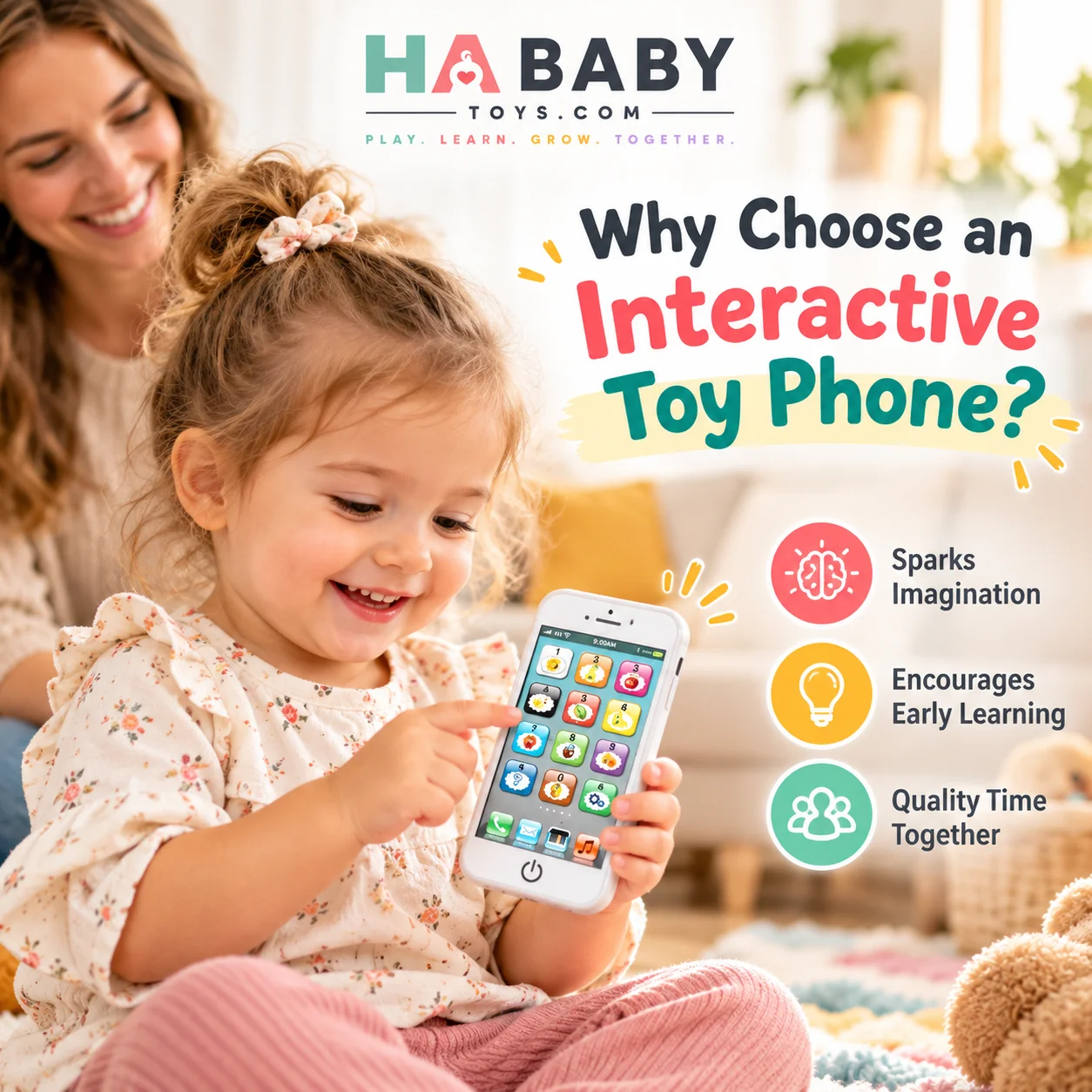
One Phone, Many Conversations
Eight pretend-call prompts that work with any toy phone
Call Grandma
“Hello Grandma! What are you doing today?”
Call Teddy
“Teddy, what would you like for lunch?”
Call a Friend
“Can you come out to play?”
Order Food
“I’d like pasta and a juice, please.”
Call the Toy Shop
“Do you have the blue dinosaur?”
Doctor Pretend
“Teddy needs an appointment, please.”
Goodnight Call
“Goodnight! I’ll see you tomorrow.”
Story Character Call
“Is Goldilocks there, please?”
Benefit 5: Buttons Give Immediate Feedback
If supported by the model, buttons can produce:
- Sounds
- Songs
- Phrases
- Light effects
- Pretend dialing responses
Pressing a button and hearing a response can make the toy easy for young children to understand and revisit. It is classic cause-and-effect play — the simplest kind of interactivity a toddler can grasp.
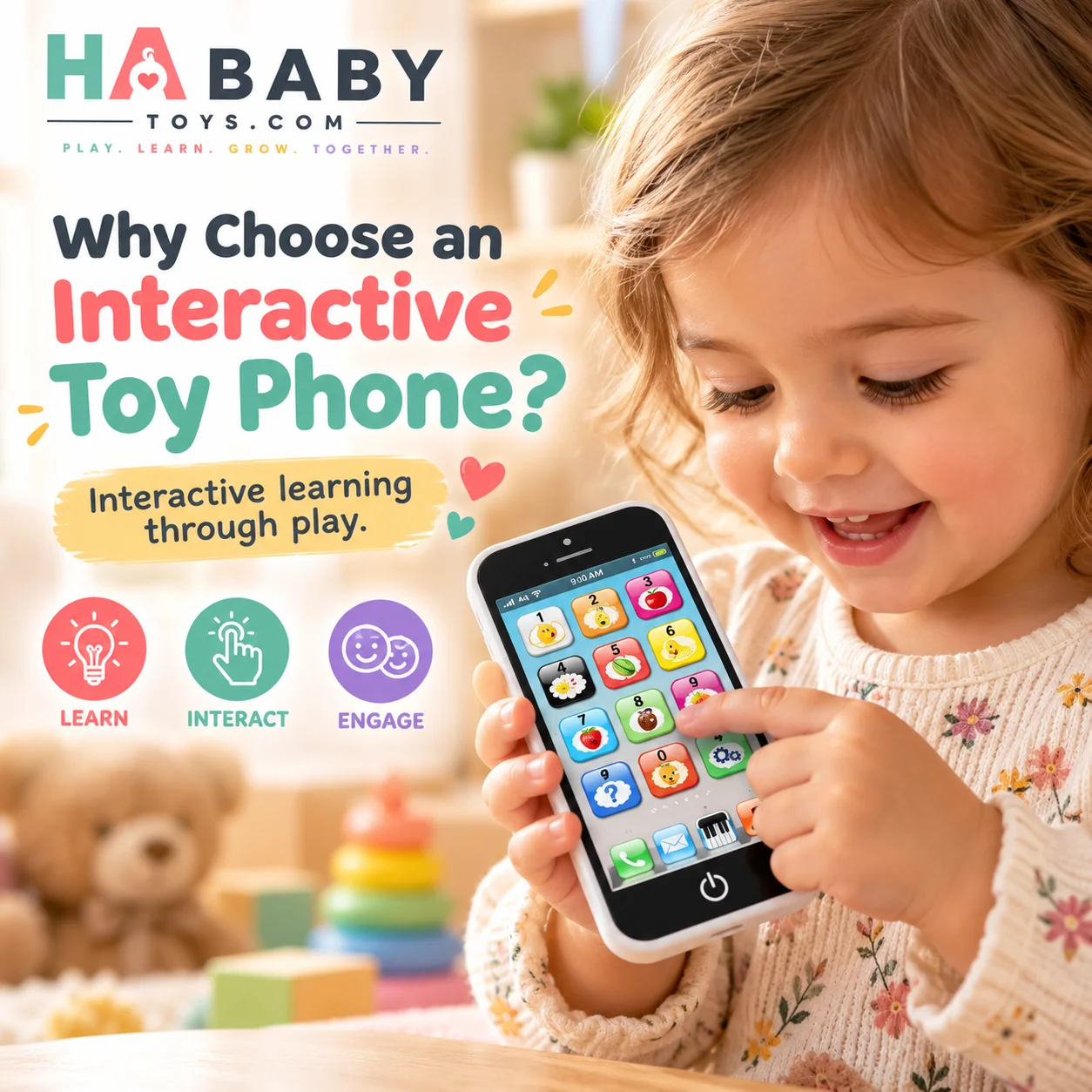
Benefit 6: Musical Features Add Variety
If the phone includes music:
Short listening sessions
Stop the music after a few seconds and talk about it.
Clap-along play
Clap in time with the beat.
Freeze movement game
Move while the music plays, freeze when it stops.
Singing with a caregiver
Sing the tune together.
Avoid claiming music automatically improves intelligence or memory. It adds variety and enjoyment, which is valuable in itself.
Benefit 7: Talking Features Can Make Role-Play Feel More Real
A talking toy phone for toddlers may provide:
- Greetings
- Pretend voices
- Short phrases
- Sound effects
This can make the phone feel more responsive than a silent toy. The talking element gives children a natural conversation partner — or at least the illusion of one — which is often enough to spark more pretend dialogue.
Benefit 8: Can Introduce Simple Number Play
If numeric buttons are included, parents can ask:
- “Can you find 1?”
- “Where is 3?”
- “Press 2.”
- “How many fingers?”
Number buttons can provide casual opportunities for number recognition during play. They do not teach math on their own, and that distinction matters for realistic buyer expectations.
Benefit 9: Can Be Used for Short, Low-Setup Play
A toy phone can be useful when parents want something quick. Examples:
- Five-minute pretend call
- Waiting-room activity
- Travel play
- Quiet indoor play
- Parent-child role-play
This makes it especially useful for busy households where longer play setups are not realistic.
Benefit 10: Easy to Include in Other Pretend Games
The toy phone can become part of:
- Pretend shop
- Doctor game
- Restaurant game
- Family house game
- Office game
- Delivery game
This gives it replay value beyond “phone play.” The National Association for the Education of Young Children (NAEYC) highlights pretend play as a core part of early learning, and a phone prop slots into almost any scene.
Interactive Toy Phone vs Plain Toy Phone
Interactive Phone
- Responds to buttons
- May include music
- May include lights
- More immediate feedback
- Often battery-powered
Plain Toy Phone
- Simpler
- No batteries
- Quieter
- Mostly imagination-driven
Neither is universally better. A plain toy phone suits families who want quiet, battery-free play; an interactive phone suits families who want buttons and sounds.
Interactive Toy Phone vs Toy Tablet
Toy phone
- Strong pretend-call focus
- Compact
- Good for conversational role-play
Toy tablet
- Larger interface
- Often game-focused
- May have more learning-style activities
This helps buyers decide what type of toy fits their goal. A phone is for imitation; a tablet is for structured activity.
Interactive Toy Phone vs Passive Electronic Toy
Interactive toy phone
Requires child input: press → respond → pretend → talk.
Passive musical toy
May simply play music when activated, without requiring ongoing child participation.
This helps position the toy as more participatory. The child is the engine of the play, not just the audience.
Is It Better Than Giving a Toddler a Real Phone?
For families who only want phone-themed pretend play, a toy phone can be more appropriate than handing over a real smartphone because it usually avoids real apps, calls, notifications, and internet access.
But it does not guarantee that a child will stop asking for the real phone. Curiosity about the real device is normal, and a toy phone is not a screen-management solution on its own. For broader guidance, see Common Sense Media and the American Academy of Pediatrics.
Can It Support Screen-Free Play?
If the product does not use a conventional screen, a non-screen interactive toy phone can offer familiar phone-style play without app-based entertainment.
Screen exposure depends on the specific model. If the exact product has a display, phrase this as “screen-light” rather than “screen-free.” Do not make an unsupported screen-free claim.
Is It Really an Educational Toy?
Possible opportunities include:
- Number recognition
- Listening
- Pretend conversation
- Turn-taking
- Everyday-role imitation
“Educational toy phone” should describe the kinds of play opportunities the toy may support, not a guaranteed learning result. The difference matters for realistic expectations.
Who Is This Toy Best For?
Who Might Prefer Something Else?
Another toy may be better if:
- You want a silent toy
- You do not want batteries
- Your child dislikes sound
- You want outdoor active play
- You prefer completely open-ended toys
- The manufacturer’s age guidance does not fit
This is not a weakness of the product — it is simply a boundary of when it is most useful.
What Parents Should Check Before Buying
Check:
- Manufacturer age guidance
- Button size
- Battery compartment
- Sound level
- Volume control, if present
- Number of music and sound modes
- On and off switch
- Build quality
- Smooth edges
- Whether it uses a real screen
- Whether any parts detach
- Whether batteries are included
For broader toy safety guidance, the U.S. Consumer Product Safety Commission publishes age labeling and recall information, and HealthyChildren.org from the American Academy of Pediatrics covers age-appropriate toy selection.
Battery and Sound Safety
- Keep the battery compartment secured
- Keep loose batteries away from children
- Follow battery instructions
- Check for leakage
- Avoid excessive sound close to the ear
- Stop using damaged toys
For practical setup and play guidance, read how to use a toy phone for toddlers. For battery safety, Safe Kids Worldwide publishes guidance on button batteries and small parts.
What the Toy Cannot Do
An interactive toy phone does not:
- Make real calls
- Replace caregiver conversation
- Guarantee language development
- Automatically teach numbers
- Necessarily replace screen interest
- Suit every age
What it can provide:
- Pretend play
- Button interaction
- Sounds and music
- Parent-child role-play
- Familiar everyday imitation
Common Buyer Expectations vs Reality
Expectations
- “It will stop my toddler asking for my phone.”
- “Interactive means educational.”
- “More sounds means a better toy.”
- “It works like a real smartphone.”
Reality
- It may redirect some pretend-phone play, but curiosity about real devices can remain.
- Interactive simply means the toy responds to the child; learning depends on how it is used.
- Some children prefer simpler, quieter toys.
- It is primarily a pretend-play toy.
Choose an Interactive Toy Phone If:
- Your child enjoys pretend calling
- They like buttons, sounds, or music
- You want a dedicated alternative to your real phone
- You want quick parent-child role-play
- Compact indoor play matters
- You are comfortable with an electronic toy
- Sound level and battery compartment are appropriate
- The manufacturer’s age guidance fits
If those priorities match your family, explore the HA Baby Toys Kids Toy Phone.
Ready for an interactive toy phone that supports pretend play?
Explore the HA Baby Toys Shop →Frequently Asked Questions
Why choose an interactive toy phone?
Because it gives children a phone-like play experience with buttons, sounds, and pretend conversation, without real calls, apps, social media, or internet access. It is more interactive than a plain pretend phone and more child-focused than a real smartphone.
Is an interactive toy phone better than a plain toy phone?
Not universally better, but different. A plain toy phone is simpler and battery-free. An interactive phone adds sounds, music, lights, and button responses that many children find more engaging.
Can toddlers make real calls with it?
No. An interactive toy phone is designed for pretend play. It does not connect to a network or make real calls.
Is a toy phone better than giving a child a real smartphone?
For phone-themed pretend play, yes — a toy phone usually avoids real apps, calls, notifications, and internet access. It does not guarantee your child will stop asking for the real phone, and it is not a screen-management solution on its own.
Can it be used for pretend conversations?
Yes. Pretend calls can create opportunities for conversational turn-taking during parent-child play. Try “Hello,” “How are you?”, and “Goodbye” as a simple routine.
Does it help children learn numbers?
If the toy includes number buttons, it can provide casual opportunities for number recognition during play. It does not teach math on its own.
What is a talking toy phone?
It is a toy phone that plays recorded phrases, words, sounds, or voice-like responses when buttons are pressed. Content varies by model.
What is a musical toy phone?
It is a toy phone that includes songs, melodies, or sound effects. Music adds variety and enjoyment — it does not automatically improve intelligence or memory.
Can siblings use one together?
Yes. One child can call while the other answers, then they switch roles. Pretend office, shop, and story-call games work well for two children.
Is it good for travel?
If compact enough, yes. It works as a car-seat activity, waiting-room toy, or hotel-room play. Keep the sound level appropriate in shared spaces.
Does an interactive toy phone count as screen time?
That depends on the specific model. If the toy does not have a conventional screen, it is screen-light or screen-free pretend play. If it has a small display, treat it as light screen use.
What should parents check before buying one?
Check the manufacturer’s age guidance, button size, battery compartment, sound level, volume control, number of music and sound modes, build quality, smooth edges, and whether the toy has a real screen or any detachable parts. The U.S. Consumer Product Safety Commission publishes toy safety guidance and recall information.
How loud should a toy phone be?
Keep the volume comfortable and treat the toy as a speaker, not a real phone receiver. Avoid holding the speaker directly against the ear. Check whether the model has volume control.
Does it require batteries?
Most interactive toy phones are battery-powered, but the exact battery type and count vary by model. Check the product listing or manual. The HA Baby Toys FAQ also answers common product and ordering questions.
Where can I buy the HA Baby Toys Kids Toy Phone?
Visit the HA Baby Toys shop to see the kids toy phone and other pretend-play toys. Families can also browse the 3+ Years category for related products. Retailers and larger buyers can request a quote from HA Baby Toys.
The Buyer’s Bottom Line
An interactive toy phone is not a real phone and not a teaching device. It is a pretend-play object with a specific advantage: it adds buttons, sounds, and simple responses to a familiar everyday shape, making phone-themed role-play more engaging than a plain plastic phone.
If your child enjoys pretend calling, buttons, and simple conversation routines, and if you want a dedicated alternative to handing over your real smartphone, it can be a genuinely useful addition to the toy cupboard. If you want a silent, battery-free toy, or if you need a real learning tablet, another option will serve better.
For more family-friendly pretend-play toys and parent guides, HA Baby Toys offers products designed around everyday play. You can also browse the HA Baby Toys blog for more ideas on pretend play and screen-free activities.
One Response