
Montessori Floating Ball Toy: How It Works
Have you ever seen a small ball floating above a wooden toy without strings, magnets, or anyone holding it? Discover the simple science behind this mesmerizing effect and how it turns everyday curiosity into a hands-on learning experience.
Expertly reviewed by the HA’BABY Child Development Team. We combine educational play insights with a passion for making science accessible to young minds.
Table of Contents
- 1. Hero — How Can a Ball Float Without Being Held?
- 2. What Is a Montessori Floating Ball Toy?
- 3. How Does a Montessori Floating Ball Toy Work?
- 4. The Science Behind the Floating Ball
- 5. Step-by-Step — How to Use a Wooden Floating Ball Blower
- 6. What Can Children Learn from a Floating Ball Toy?
- 7. Fun Floating Ball Experiments for Children
- 8. Floating Ball Toy vs. Ordinary Educational Toys
- 9. Common Mistakes When Using a Floating Ball Toy
- 10. How to Choose the Right Floating Ball Blower
- 11. HA’BABY Product Spotlight — Wooden Suspension Ball Blower
- 12. Who May Enjoy a Floating Ball Blower?
- 13. Parent and Educator Guidance — Making Science Easy to Understand
- 14. Floating Ball Toy Safety — What Parents Should Check
- 15. Frequently Asked Questions
- 16. Conclusion — A Small Demonstration with a Big Science Question
A Montessori floating ball toy uses a stream of moving air to keep a lightweight ball suspended above a blower. As air flows around the ball, aerodynamic forces help keep it within the air stream. Children can observe this surprising effect while exploring basic ideas about airflow, movement, balance, and cause and effect.
Hero — How Can a Ball Float Without Being Held?
Have you ever seen a small ball floating above a wooden toy without strings, magnets, or anyone holding it? It looks almost like magic. The first time a child sees it, their eyes widen, and the question comes instantly: “How does it do that?” This is the perfect moment for discovery.
The Montessori Floating Ball Toy is a playful way to observe moving air. When the blower is activated, a lightweight ball rises and hovers above the wooden base. Children notice the ball’s movement, its stability, and what happens when the airflow changes. Parents find the toy interesting because it combines entertainment with an opportunity to introduce scientific curiosity. When you explore HA’BABY educational toys, you will find options designed to spark this kind of wonder.
This guide will explain exactly how the floating ball effect works, the science behind it, how to use the toy step by step, and what children can learn. You can also explore the wooden ball blower and fun activities for kids for more ideas after reading this. Let’s uncover the science behind the floating ball.
What Is a Montessori Floating Ball Toy?
A Montessori floating ball toy is a simple, hands-on educational toy that demonstrates the power of moving air. The set typically consists of a wooden blower (or air outlet) and a lightweight ball. When the blower is activated, an upward stream of air is produced. The ball is positioned above this airflow, and instead of falling, it floats.
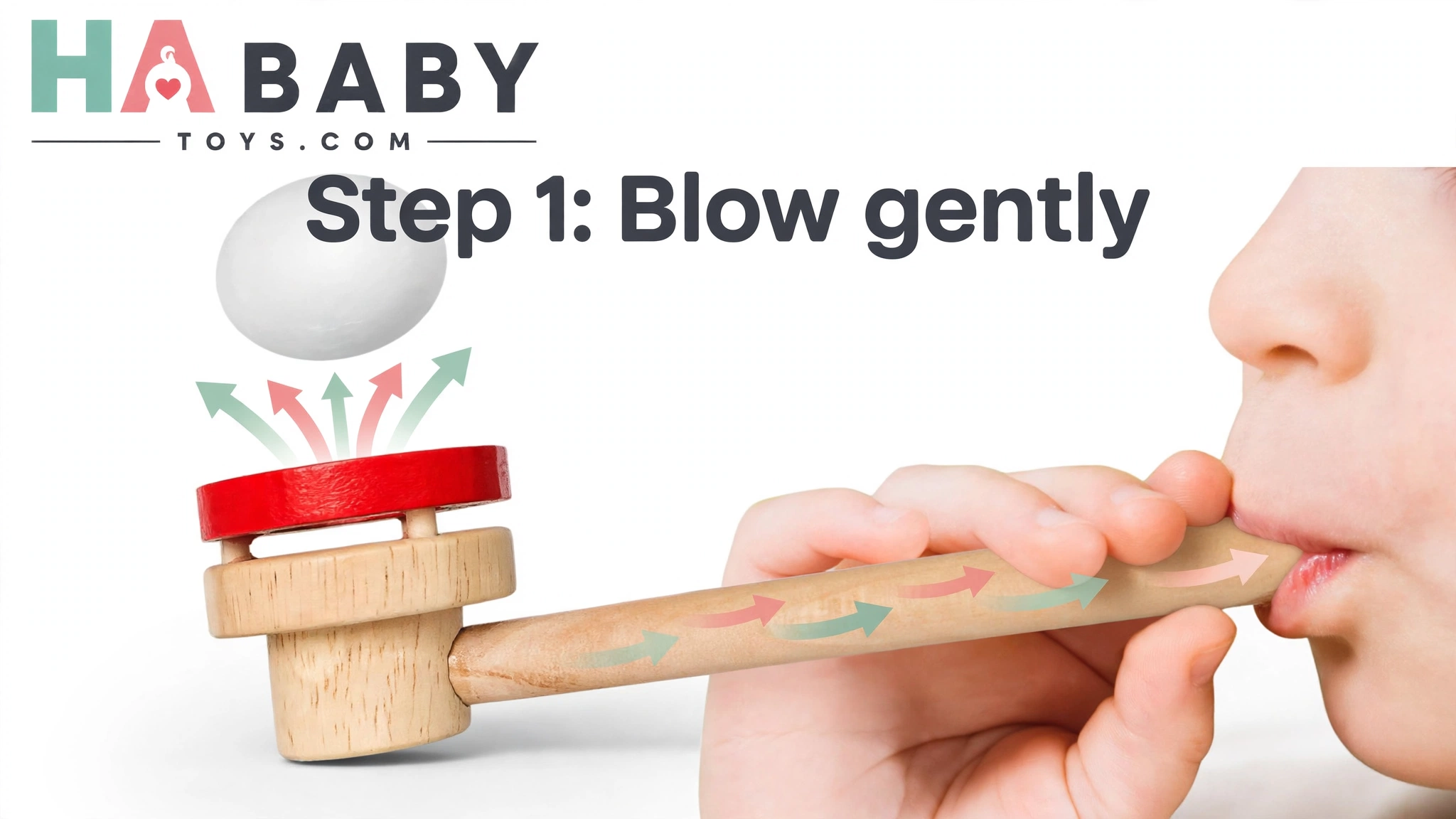
What makes this toy different from an ordinary ball or a conventional blower? The combination of the air source and the lightweight ball creates a visible, interactive demonstration of physics. The child is not just watching; they are observing, predicting, and experimenting. The word “Montessori” is often used commercially for hands-on educational toys. It is important to note that unless a product is verified as an officially Montessori-certified teaching material, it is more accurate to describe it as Montessori-inspired.
To see how other floating ball games work in a family context, you can read about the floating ball game and parent-child learning. The core appeal remains the same: a simple demonstration that sparks a big question.
How Does a Montessori Floating Ball Toy Work?
This is the most important section. Let’s break down the process into simple steps.
Step 1 — Air Begins to Move
The blower produces an upward stream of air that reaches the lightweight ball. Even though you cannot see the air, it is moving with force. This is the first step in the demonstration.
Step 2 — The Air Supports the Ball
The upward airflow exerts a force on the ball. When the upward force balances the ball’s weight, it can remain suspended. Imagine holding a ball on your palm; your hand supports it against gravity. In this toy, the moving air acts like a supporting hand.
Step 3 — The Ball Stays Within the Airflow
The shape and direction of the airflow, together with aerodynamic forces, help keep the ball near the stream instead of immediately falling away. This is where the physics becomes fascinating. The air does not just push up; it also helps stabilize the ball, keeping it centered within the flow.
Step 4 — What Happens When the Airflow Changes?
A child may observe what happens when the airflow becomes weaker, stronger, or interrupted. When the blower stops, the upward force disappears, and gravity pulls the ball down. When the airflow is stronger, the ball may rise higher. These observations are the foundation of scientific thinking.
Why Doesn’t the Ball Simply Fly Away?
The ball does not fly away because the airflow pattern and the forces acting on it keep it in a stable position. The air moving around the ball creates a region of lower pressure that helps pull the ball back toward the center of the stream. This is a simplified explanation, but it captures the essential idea. For a deeper look at the forces involved, university physics demonstrations like the Yale University Physics Demonstration and the University of Iowa’s Coanda Effect demonstration provide excellent visual explanations.
The Science Behind the Floating Ball
The floating ball demonstration introduces several scientific ideas in a simple, visual way.
- Airflow: Air is moving even though it cannot normally be seen. The blower creates a stream of moving air that travels upward.
- Air Pressure: Moving air and pressure differences help explain aerodynamic behaviour. The pressure around the moving air stream is lower than the surrounding still air, which helps keep the ball in place.
- Gravity: The ball is still pulled downward by gravity. This is a constant force that the airflow must overcome.
- Force and Balance: The upward aerodynamic force can counter the ball’s weight. When the two forces are balanced, the ball remains suspended.
- Stability: Airflow and the shape of the stream help keep the ball in position. The ball does not just float; it is actively kept in the center of the air stream.
A simple comparison: A ball resting on a table is supported by the table. A floating ball in this toy is supported by forces produced by moving air. To understand the nuances of this effect, you can refer to the Harvard Natural Sciences Lecture Demonstrations and the University of Colorado State’s Floating Ball resources.
Step-by-Step — How to Use a Wooden Floating Ball Blower
Follow this practical demonstration guide to get the most out of the toy. Always refer to the manufacturer’s instructions for the exact setup and operating method.
- Place the blower on a stable surface. Ensure it is on a flat, secure table or floor.
- Check the toy and ball for visible damage. Look for cracks, splinters, or loose parts.
- Position the ball as directed by the manufacturer’s instructions. Usually, it rests gently above the air outlet.
- Activate the blower using the intended method. This may involve blowing into a tube or using a mechanical mechanism.
- Observe how the ball responds to the airflow. Watch it rise and hover.
- Allow the child to repeat the demonstration with adult supervision. Encourage them to try it themselves.
- Switch off the blower and store the components safely. Keep the ball in a secure place to avoid loss.
Do not assume the toy uses a particular power source or operating mechanism without checking the listing. The CPSC Toy Safety guidelines are a useful reference for safe operation.
What Can Children Learn from a Floating Ball Toy?
The educational value of this toy lies in the opportunities for exploration rather than guaranteed developmental improvements.
Early Science Curiosity
Children can observe an unexpected result and ask why it happens. The floating ball is a natural conversation starter about the invisible world of air.
Cause and Effect
They can notice that changing or stopping the airflow changes the ball’s movement. This is a direct, observable lesson in cause and effect.
Observation Skills
They can watch the ball’s position and movement, noticing small changes and patterns. This builds attention to detail.
Early Physics Concepts
Introduce gravity, force, air movement, and balance through a visible demonstration. These abstract concepts become tangible and understandable.
Parent-Child Interaction
Parents can explain the demonstration, ask questions, and encourage children to make observations. This shared experience strengthens bonds and learning.
Learning Through Repetition
Repeating the demonstration can help children compare what happens under different conditions. This is a fundamental scientific method.
Fun Floating Ball Experiments for Children
Make the most of the toy with these simple, safe activities.
- Observe and describe: Ask the child what happens when the ball is placed in the airflow.
- Predict the result: Ask whether the ball will rise, fall, or move when the airflow stops.
- Compare movement: Observe how the ball behaves at different positions, following the manufacturer’s instructions.
- Cause-and-effect demonstration: Switch the airflow off and observe what happens.
- Draw the experiment: Let children draw the ball and the air moving beneath it.
- Explain it in their own words: Ask the child to describe why the ball appears to float.
Do not suggest unsafe modifications, covering air outlets, placing fingers inside moving mechanisms, or using additional objects not approved by the manufacturer. For more interactive ideas, explore the floating ball game and parent-child learning article.
Floating Ball Toy vs. Ordinary Educational Toys
It is helpful to understand how a floating ball toy compares to other educational toys.
| Floating ball blower | Traditional educational toys |
|---|---|
| Demonstrates moving air and suspension | May focus on sorting, stacking, or matching |
| Makes airflow visible through ball movement | Often demonstrates different concepts |
| Encourages observation and prediction | Can encourage construction and problem-solving |
| Offers a focused science demonstration | May offer broader forms of play |
The floating ball toy can complement building blocks, puzzles, books, and other hands-on learning activities. It does not need to replace them.
Common Mistakes When Using a Floating Ball Toy
Avoid these common pitfalls to ensure a safe and enjoyable experience.
- Placing the ball incorrectly.
- Not following the manufacturer’s operating instructions.
- Expecting the ball to float without the required airflow.
- Using the toy on an unstable surface.
- Allowing children to operate it without suitable supervision.
- Using damaged or unsuitable balls.
- Blocking or modifying the air outlet.
- Assuming every floating ball toy works in exactly the same way.
If the ball does not float, check the setup and ensure the blower is working correctly. Do not dismantle or modify the product. For safety guidance, refer to the CPSC Small Parts and Choking Hazard FAQs.
How to Choose the Right Floating Ball Blower
This section helps parents make an informed decision. The CPSC Toy Safety FAQ is a useful reference.
- Age suitability: Check the manufacturer’s recommendations and warnings.
- Construction quality: Look for sturdy wooden construction and smooth edges.
- Stability of the wooden base: Ensure it will not tip over easily.
- Quality and condition of the ball: Check that it is lightweight and free from damage.
- Ease of setup and operation: Consider how simple it is to use.
- Clear operating instructions: Make sure the product comes with guidance.
- Appropriate safety warnings: Look for age and small-part warnings.
- Storage and maintenance: Consider how to keep the toy in good condition.
- Whether the toy suits the child’s interests: Match it to their curiosity.
Buyer insight: Choose based on safe construction, clear instructions, and a meaningful play experience—not just the word Montessori or the number of advertised benefits. To compare options, you can browse educational toys.
HA’BABY Product Spotlight — Wooden Suspension Ball Blower
If you are looking for a hands-on way to introduce your child to the fascinating world of airflow, the HA’BABY Wooden Suspension Ball Blower is a practical choice. This product is designed to demonstrate the floating-ball effect through a simple, engaging setup.
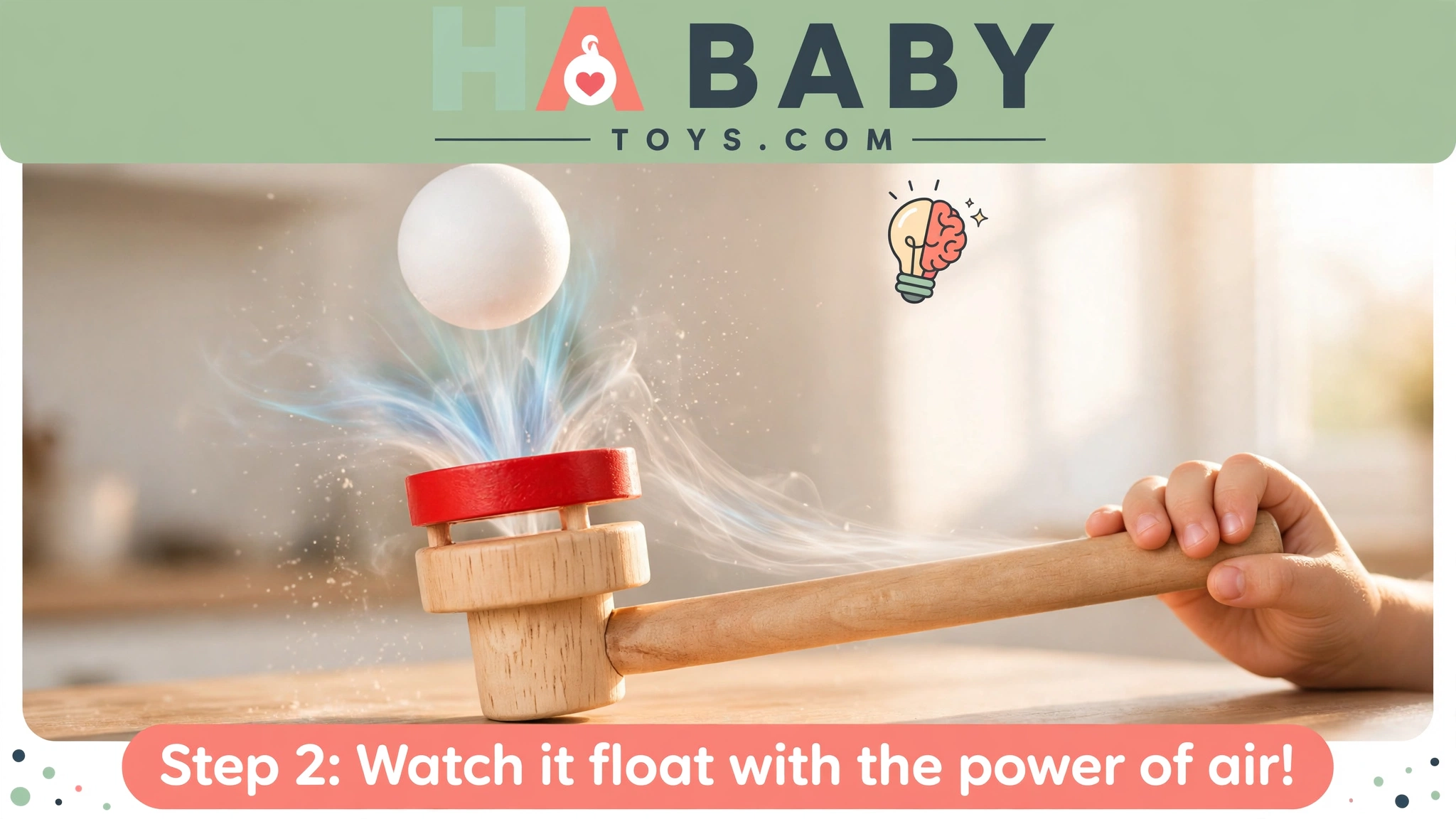
The toy uses a stream of moving air to suspend a lightweight ball, allowing children to observe the principles of airflow, gravity, and balance in action. Parents can use it for supervised demonstrations, asking questions and encouraging observation.
What to check before ordering: Review the verified construction details, dimensions, and age recommendations on the product listing. If you have questions, visit the HA’BABY frequently asked questions page for more information.
Note: Always verify the actual product features and safety details on the live listing before purchasing.
Explore the HA’BABY Wooden Suspension Ball BlowerWho May Enjoy a Floating Ball Blower?
This toy appeals to a range of audiences.
- Curious children: Those interested in movement, balls, and simple demonstrations.
- Early science learners: Children beginning to explore basic concepts such as gravity and airflow.
- Parents and caregivers: Adults looking for an activity they can demonstrate and discuss with children.
- Teachers and educators: People who want a visual introduction to simple physics concepts.
- Gift buyers: People looking for something different from conventional toys.
Suitability depends on the actual product’s age guidance, ball size, construction, and supervision requirements. Always check the product listing before purchasing.
Parent and Educator Guidance — Making Science Easy to Understand
Adults can make the most of this toy by following a simple, observation-first approach.
- Start with observation instead of a complicated explanation.
- Ask children what they think will happen.
- Demonstrate the floating effect.
- Introduce one scientific idea at a time.
- Connect the demonstration to everyday experiences with moving air.
- Encourage children to explain what they observed.
Consider this example:
Parent: “What do you think will happen if we turn off the air?”
Child: “The ball will fall!”
Parent: “Let’s observe what happens. What was holding it up?”
This makes the toy an opportunity for conversation and scientific curiosity. For more detailed physics explanations, you can refer to the Simon Fraser University Floating Ball demonstration and the UCAR Center for Science Education.
Floating Ball Toy Safety — What Parents Should Check
Because the toy includes a lightweight ball and an airflow mechanism, safety is paramount.
- Follow the manufacturer’s age recommendations.
- Check the ball size and choking-risk warnings.
- Keep small balls away from children who may put objects in their mouths.
- Inspect the wooden structure for damage or splinters.
- Check that the ball and other components are suitable for the intended use.
- Keep fingers and foreign objects away from moving or powered mechanisms.
- Use the toy on a stable surface.
- Follow the operating and cleaning instructions.
- Store loose components safely after play.
The US Consumer Product Safety Commission provides useful guidance on toy age labels, small parts, and choking hazards.
How Does a Ball Float on Air?
1. Airflow Begins
Air moves upward from the blower, creating a stream of moving air.
2. Ball Meets Airflow
The moving air exerts an upward force on the lightweight ball.
3. Gravity Pulls Downward
The ball’s weight acts in the opposite direction, pulled by gravity.
4. Forces Balance
When the upward force balances the ball’s weight, it remains suspended.
5. Airflow Maintains Stability
Aerodynamic effects help keep the ball within the stream of air.
6. What Happens When Air Stops?
Without the upward force, gravity pulls the ball down.
Frequently Asked Questions
How does a Montessori floating ball toy work?
A Montessori floating ball toy works by producing an upward stream of air from a blower. The moving air exerts an upward force on the lightweight ball. When this upward force balances the ball’s weight, the ball remains suspended. The shape of the airflow also helps keep the ball positioned within the stream.
Why doesn’t the floating ball fall immediately?
The moving air provides an upward force that can balance the ball’s weight. While gravity pulls the ball down, the airflow pushes it up, and aerodynamic effects help keep it within the air stream. When these forces are in balance, the ball stays suspended.
What scientific principle does a floating ball blower demonstrate?
A floating ball blower demonstrates airflow, aerodynamic forces, and the balance of forces. While often associated with Bernoulli’s principle, the precise explanation involves multiple aerodynamic effects, including the Coanda effect, which helps keep the ball within the air stream. The exact forces depend on the toy’s design.
What age is suitable for a wooden floating ball blower?
Suitability depends on the manufacturer’s age recommendation and safety warnings. Parents should always check the product listing for specific age guidance and any small-part warnings before purchasing for a child.
What can children learn from a floating ball toy?
Children can learn about observation, cause and effect, airflow, gravity, and simple experimentation. The toy provides a hands-on way to explore basic physics concepts in an engaging and accessible manner.
Why does the ball fall when the blower stops?
When the blower stops, the upward airflow ceases. Without the upward aerodynamic force to balance gravity, the ball falls. This demonstrates the direct relationship between airflow and the floating effect.
Is a wooden suspension ball blower a good educational gift?
It can be a thoughtful educational gift for children interested in science and hands-on discovery. Consider the child’s age, interests, and the product’s safety details before purchasing. You can also visit the HA’BABY FAQ page for more information.
Conclusion — A Small Demonstration with a Big Science Question
How can a ball float without being held? The answer lies in the invisible world of moving air. The upward airflow creates forces that support and stabilize the lightweight ball, allowing it to hover in place. When the air stops, gravity takes over, and the ball falls.
This simple demonstration gives children and adults a chance to observe an everyday scientific phenomenon together. It sparks curiosity, encourages questions, and makes abstract concepts tangible. Ready to explore further? Browse educational toys to compare options, or contact HA’BABY for product enquiries if you have specific questions. For more hands-on play inspiration, visit the HA’BABY blog.
Explore the HA’BABY Wooden Suspension Ball Blower
One Response