
Wooden Ball Blower: Fun Breathing Activities for Kids
What if a simple stream of air could turn an ordinary ball into a fascinating playtime experiment? A wooden ball blower gives children an opportunity to observe, predict, and discover while enjoying a hands-on activity with an adult.
Expertly reviewed by the HA’BABY Child Development Team. We combine educational play insights with a passion for making science accessible to young minds.
Table of Contents
- 1. Hero — Turn a Simple Floating Ball into Playtime
- 2. What Is a Wooden Ball Blower and How Does It Work?
- 3. Why Children Enjoy Floating Ball Activities
- 4. Seven Fun Wooden Ball Blower Activities for Kids
- 5. Simple Science Concepts Children Can Explore
- 6. Are Floating Ball Activities Really Breathing Exercises?
- 7. Parent-Child Games Using a Wooden Ball Blower
- 8. Wooden Ball Blower vs. Other Educational Activities
- 9. How to Introduce the Toy to Children
- 10. Common Mistakes Parents Should Avoid
- 11. How to Choose a Good Wooden Ball Blower
- 12. HA’BABY Product Spotlight — Wooden Suspension Ball Blower
- 13. Safety Tips for Floating Ball Play
- 14. Frequently Asked Questions
- 15. Conclusion — Make Science Part of Playtime
A wooden ball blower is an educational toy that uses moving air to suspend a lightweight ball above an air outlet. Children can explore the floating effect through supervised games, simple predictions, observation activities, and playful experiments that introduce airflow, movement, and cause and effect.
Hero — Turn a Simple Floating Ball into Playtime
Parents often want activities that are different from ordinary screen-based entertainment. Something that sparks curiosity, encourages interaction, and maybe even teaches a little science along the way. A Wooden Ball Blower offers exactly that: a visual demonstration that can make children curious as a lightweight ball appears to float above a stream of moving air.
What makes this toy special is not just the floating effect; it is what happens next. Children start predicting, observing, and asking questions. The simple demonstration becomes a parent-child activity filled with discovery. When you explore HA’BABY educational toys, you will find options designed to support this kind of interactive play.
This guide will show you seven fun activities to try, explain the simple science concepts involved, and help you choose the right toy. If you want a deeper explanation of the physics, you can read our article on how a Montessori floating ball toy works. Let’s turn a simple floating ball into playtime.
What Is a Wooden Ball Blower and How Does It Work?
A wooden ball blower is a simple, hands-on educational toy. It typically consists of a wooden blower (or air outlet) and a lightweight ball. When the blower is activated, an upward stream of air is produced. The ball is positioned above this airflow, and instead of falling, it floats.
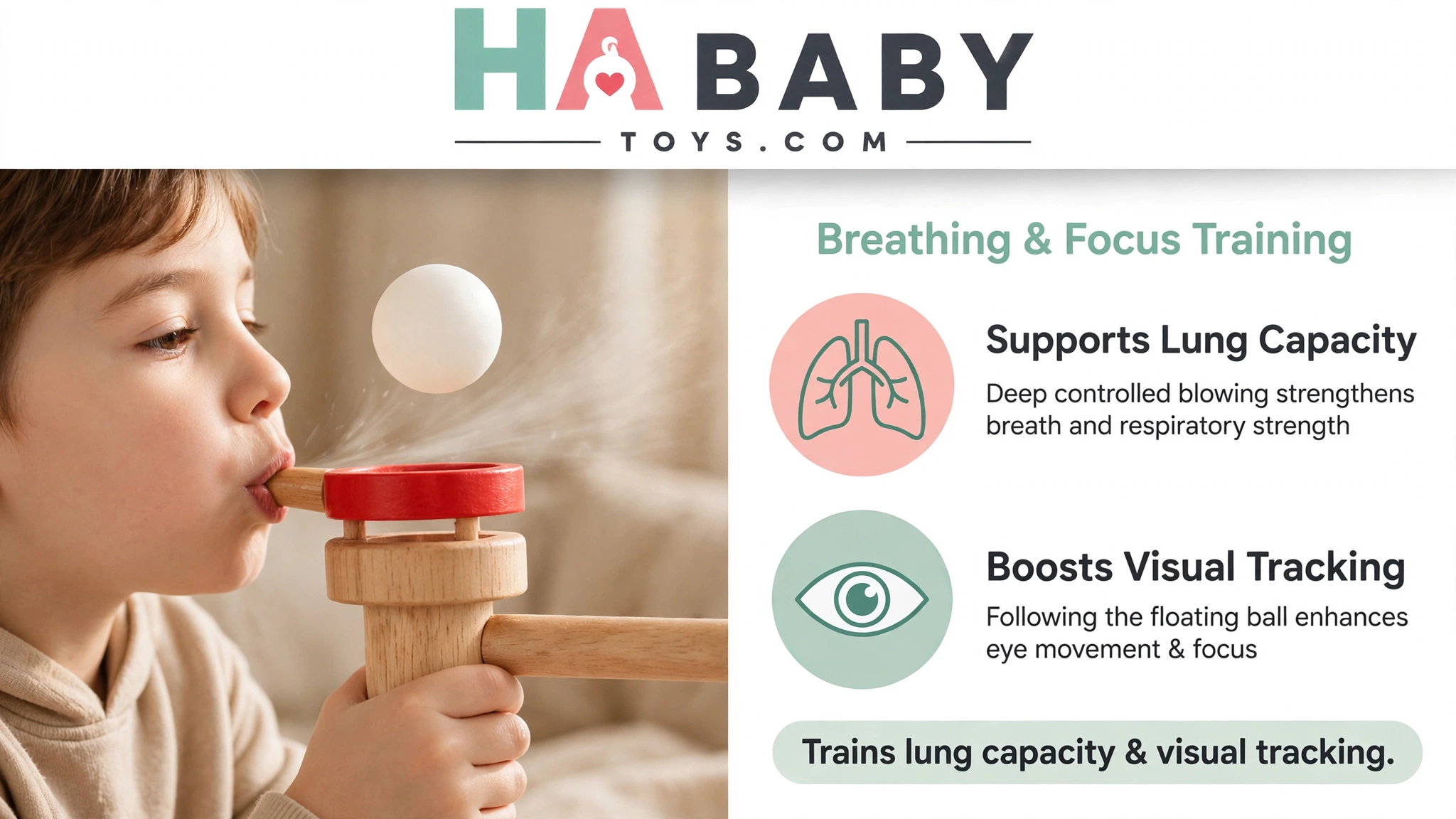
The moving air supports the ball, balancing the downward pull of gravity. When the airflow stops, the ball falls. This simple cause-and-effect relationship is the foundation of the toy’s appeal. For a more detailed breakdown of the forces at play, refer to the Yale University Physics Demonstration.
Why Children Enjoy Floating Ball Activities
Children are naturally drawn to the floating ball for several reasons.
The Surprise of a Floating Ball
Seeing an object remain suspended in mid-air can capture attention instantly. It looks like magic, which makes children want to investigate.
Curiosity and Prediction
Children may wonder what will happen before the blower is activated. “Will it float? Will it fall?” This prediction is an early form of scientific thinking.
Watching Movement
The ball’s changing position gives children something visible to observe. They can track it, describe it, and notice small changes.
Repetition and Discovery
Repeating a demonstration allows children to compare what happens. They might notice that the ball rises higher when the airflow is stronger, or falls when it stops.
Shared Parent-Child Enjoyment
Parents can participate by asking questions, demonstrating the activity, and encouraging children to describe what they see. This shared experience is where the real value lies.
Seven Fun Wooden Ball Blower Activities for Kids
This is the main attraction. Here are seven activities you can try with your child.
Activity 1: Watch the Floating Ball
Position the ball as instructed and activate the blower. Invite the child to watch the ball and ask what they notice. Learning opportunity: Observation and curiosity.
Activity 2: Predict What Happens Next
Before activating the blower, ask the child whether the ball will rise, fall, or remain in position. Then perform the demonstration and compare the prediction with the result. Learning opportunity: Prediction and simple scientific thinking.
Activity 3: The Airflow Stop-and-Start Game
With an adult operating the blower, switch the airflow on and off according to the manufacturer’s instructions. Ask the child to observe the ball’s movement. Learning opportunity: Cause and effect.
Activity 4: Describe the Ball’s Movement
Encourage the child to describe what the ball does using words such as up, down, float, move, and fall. Learning opportunity: Observation and language practice.
Activity 5: Draw What You See
After the demonstration, let the child draw the ball and the airflow beneath it. Learning opportunity: Connecting an observation with creative expression.
Activity 6: Parent and Child Take Turns
An adult demonstrates the activity and invites the child to make predictions or describe the results. Allow the child to operate the toy only if the product’s age guidance and operating instructions permit it. Learning opportunity: Shared play and turn-taking.
Activity 7: Explain the Floating Ball
Ask the child to explain what they think keeps the ball in the air. Introduce a simple explanation involving moving air and gravity. Learning opportunity: Early science communication.
Do not describe these activities as exercises for increasing lung capacity or improving respiratory health. They are playful airflow activities, not medical exercises.
Simple Science Concepts Children Can Explore
The floating ball demonstration introduces several scientific ideas in a simple, accessible way.
Airflow
Air is moving from the blower toward the ball. Even though you cannot see it, it is there and it is moving.
Gravity
Gravity pulls the ball downward. This is a constant force that the airflow must overcome.
Force and Balance
Moving air creates an upward force that can balance the ball’s weight. When the two forces are balanced, the ball remains suspended.
Movement and Stability
Aerodynamic effects help keep the ball within the airflow. The ball does not just float; it is actively kept in the center of the air stream.
Cause and Effect
When the airflow changes, the ball’s behaviour changes too. This direct relationship is easy for children to observe.
A simple everyday comparison: just as a table supports a ball resting on it, moving air can support a lightweight ball above the blower. For a more detailed explanation, you can refer to the Harvard Natural Sciences Lecture Demonstrations and the University of Iowa’s Coanda Effect demonstration.
Are Floating Ball Activities Really Breathing Exercises?
This is an important clarification. The keyword “breathing activities” can create confusion, so let’s be clear about what this toy is and what it is not.
- A wooden ball blower is primarily an educational play toy. It demonstrates moving air and the floating effect.
- Its airflow demonstration should not automatically be called a breathing exercise. The toy does not require the child to blow into it unless the instructions specifically say so.
- Do not assume a child needs to blow into the toy; follow the actual product’s operating instructions.
- Do not make claims about lung capacity, respiratory muscle strength, asthma, or other health outcomes. These claims are not supported by reliable clinical evidence.
- If a child has a medical breathing concern, parents should seek advice from an appropriate healthcare professional rather than relying on a toy.
This toy is about curiosity, observation, and play. It is not a medical device. For general toy safety guidance, refer to the CPSC Toy Safety FAQ.
Parent-Child Games Using a Wooden Ball Blower
Make the activity more interactive with these simple games.
Guess and Discover
Ask the child to predict the ball’s movement before the demonstration.
Describe the Result
Encourage the child to explain what happened. This builds language and observation skills.
Science Question Time
Ask simple questions: What makes the ball rise? What happens when the air stops? Why does the ball move?
Draw the Experiment
Create a simple picture of the floating ball. This connects observation with creativity.
Tell the Science Story
Let the child explain the demonstration in their own words. This is a powerful way to reinforce understanding.
Family Demonstration
Allow different family members to predict and describe the same experiment. This makes it a shared family activity.
The goal is not to test the child. It is to create an enjoyable opportunity for shared discovery. For more ideas, you can read about the floating ball game and parent-child learning.
Wooden Ball Blower vs. Other Educational Activities
It is helpful to compare different types of play. This is not about claiming one is better; it is about recognizing different learning experiences.
| Wooden ball blower | Other educational toys |
|---|---|
| Demonstrates moving air | May focus on shapes, numbers, or patterns |
| Offers a visual floating-ball effect | May involve construction or matching |
| Encourages prediction and observation | May encourage sorting or creative building |
| Provides a focused science demonstration | Can offer a wider range of play experiences |
These toys complement one another. A wooden ball blower does not need to replace puzzles, books, building blocks, or outdoor activities.
How to Introduce the Toy to Children
Follow this simple introduction routine.
- Choose a stable, uncluttered surface.
- Check the toy and ball before use.
- Read the operating instructions.
- Demonstrate the floating-ball effect.
- Ask the child what they observe.
- Introduce one activity at a time.
- Allow questions and predictions.
- Switch off and store the toy safely.
Consider this example: A parent shows the child the floating ball and asks, “What do you think is keeping it up?” Instead of immediately giving the answer, the parent encourages the child to observe the airflow and describe what happens. The CPSC Toy Safety guidelines are a useful reference for safe operation.
Common Mistakes Parents Should Avoid
- Treating the toy as medical breathing equipment.
- Expecting children to understand the science immediately.
- Turning a playful activity into a test.
- Ignoring the recommended age.
- Using the toy without reading its instructions.
- Allowing unsupervised access to small balls or detachable components.
- Modifying or blocking the air outlet.
- Continuing to use damaged parts.
- Expecting the ball to float when the blower is not operating correctly.
Make the experience enjoyable without forcing participation. If the ball does not float, check the setup and ensure the blower is working correctly. Do not dismantle or modify the product.
How to Choose a Good Wooden Ball Blower
This section helps parents make an informed decision. The CPSC Small Parts and Choking Hazard FAQs are a useful reference.
- Construction and finish: Look for smooth, well-finished wood.
- Stability of the wooden base: Ensure it will not tip over easily.
- Ball size and suitability: Check that the ball is appropriately sized and free from damage.
- Securely fitted components: Look for parts that stay in place during use.
- Ease of setup: Consider how simple it is to use.
- Clarity of instructions: Make sure the product comes with clear guidance.
- Age recommendation and warnings: Follow the manufacturer’s guidance.
- Storage and maintenance: Consider how to keep the toy in good condition.
- Whether the demonstration is suitable for the intended child: Match it to their interests.
Buying tip: Do not buy a floating-ball toy simply because it is labelled educational or Montessori-inspired. Look at its actual construction, instructions, age suitability, and the play experience it offers. To compare options, you can explore HA’BABY educational toys.
HA’BABY Product Spotlight — Wooden Suspension Ball Blower
If you are looking for a hands-on way to bring science into playtime, the HA’BABY Wooden Suspension Ball Blower is a practical choice. This product is designed to demonstrate the floating-ball effect through a simple, engaging setup.
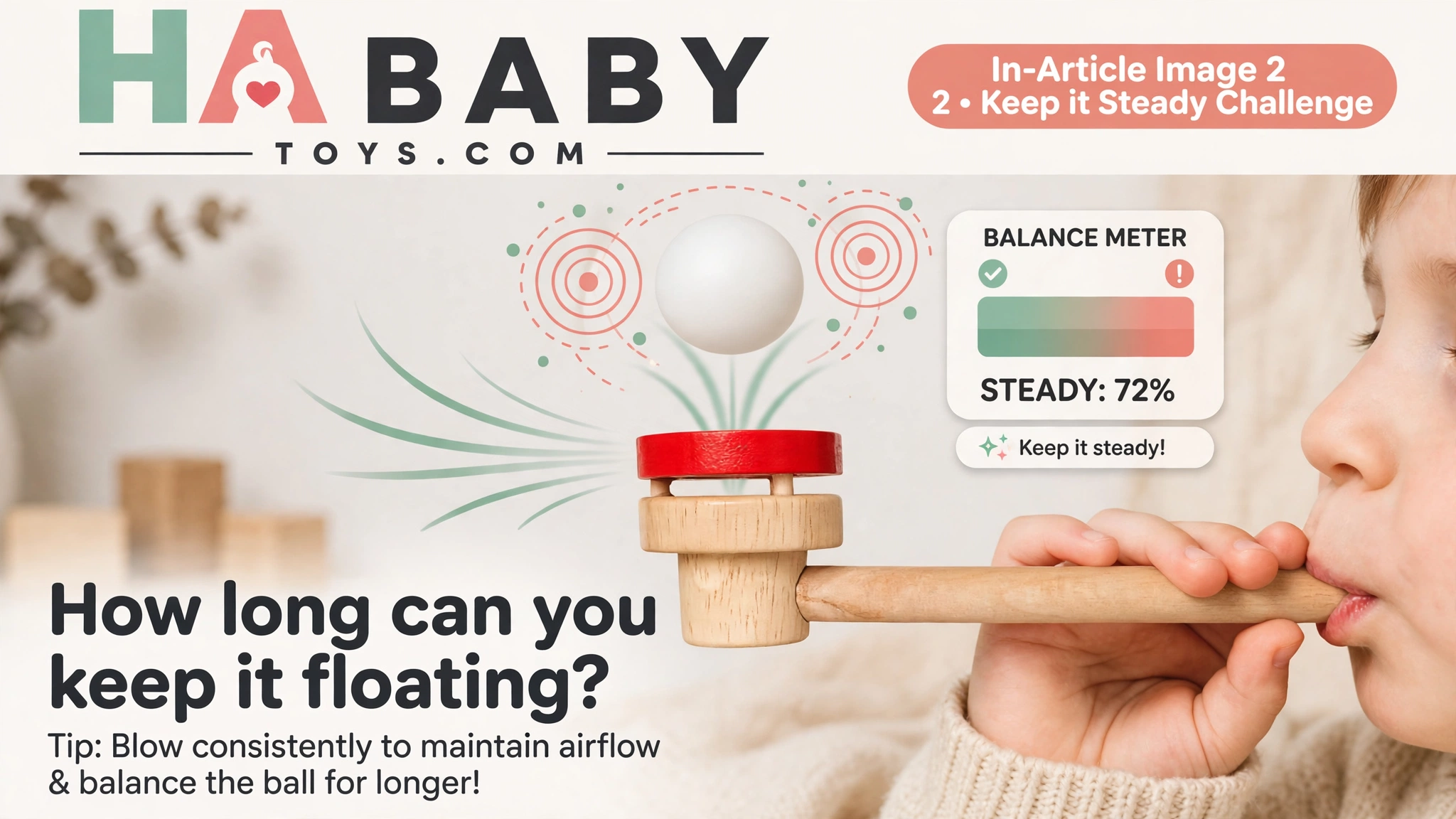
It can be used for all the activities described above: watching, predicting, observing airflow changes, describing movement, drawing the experiment, taking turns, and explaining the floating ball. Parents can introduce it during supervised play and encourage questions and predictions.
What to check before ordering: Review the confirmed construction details, components, and age recommendations on the product listing. If you have questions, visit the HA’BABY frequently asked questions page for more information.
Note: Always verify the actual product features and safety details on the live listing before purchasing.
Explore the HA’BABY Wooden Suspension Ball BlowerSafety Tips for Floating Ball Play
Because the toy includes a lightweight ball and an airflow mechanism, safety is paramount.
- Follow the manufacturer’s recommended age.
- Check whether the ball presents a choking risk.
- Keep small components away from young children who may put objects in their mouths.
- Inspect the wooden base for damage or splinters.
- Use the toy on a stable surface.
- Keep fingers and foreign objects away from moving or powered mechanisms.
- Supervise children during play.
- Follow cleaning and storage instructions.
The US Consumer Product Safety Commission provides authoritative guidance on small parts and age labels.
7 Fun Ways to Explore a Floating Ball
1. Watch the Floating Ball
Observe the ball hovering above the air stream.
2. Predict What Happens Next
Ask: will it rise, fall, or stay in position?
3. Observe Airflow Changes
Notice what happens when the air stops and starts.
4. Describe the Ball’s Movement
Use words like up, down, float, move, and fall.
5. Draw the Experiment
Create a picture of the ball and the air beneath it.
6. Take Turns with a Parent
Share the demonstration and the discoveries.
7. Explain Why the Ball Floats
Talk about moving air and gravity together.
Frequently Asked Questions
What is a wooden ball blower toy?
A wooden ball blower toy is an educational toy consisting of a wooden blower (or air outlet) and a lightweight ball. When the blower is activated, it produces a stream of moving air that suspends the ball above the outlet, creating a floating effect.
How does a wooden ball blower work?
The blower produces an upward stream of air. The moving air exerts an upward force on the lightweight ball. When this upward force balances the ball’s weight, the ball remains suspended. Aerodynamic effects help keep the ball stable within the air stream.
What activities can children do with a floating ball blower?
Children can watch the floating ball, predict what happens before activation, observe the effect of stopping and starting the airflow, describe the ball’s movement, draw the experiment, take turns with a parent, and explain why the ball floats.
Does a wooden ball blower improve lung capacity?
A wooden ball blower should be treated as an educational toy, not a proven lung-strengthening or respiratory therapy device. It demonstrates moving air but is not designed to improve lung capacity. Parents with health concerns should consult a healthcare professional.
At what age can children use a wooden ball blower?
Suitability depends on the manufacturer’s age recommendation and safety warnings. Parents should check the product listing for specific age guidance and small-part choking hazard information before purchasing.
Is a wooden ball blower safe for children?
Safety depends on age suitability, secure construction, choking hazards, and proper supervision. Always check the ball size, inspect the wooden base for damage, and follow the manufacturer’s instructions during use.
Is a wooden ball blower a good educational gift?
It can be a thoughtful gift for children interested in simple science demonstrations and hands-on discovery. Consider the child’s age, interests, and the product’s safety details before purchasing. You can also visit the HA’BABY FAQ page for more information.
Conclusion — Make Science Part of Playtime
A simple floating-ball demonstration can give children an enjoyable opportunity to observe, predict, ask questions, and explore basic science. The real value is not in promises of medical or developmental results; it is in the shared experience of discovery between you and your child.
Ready to bring this experience home? Explore HA’BABY educational toys to compare options, or contact HA’BABY for product enquiries if you have specific questions. For more hands-on play inspiration, visit the HA’BABY blog.
Explore the HA’BABY Wooden Suspension Ball Blower