
STEM Toys for Kids: How Microscope Science Kits Encourage Future Scientists
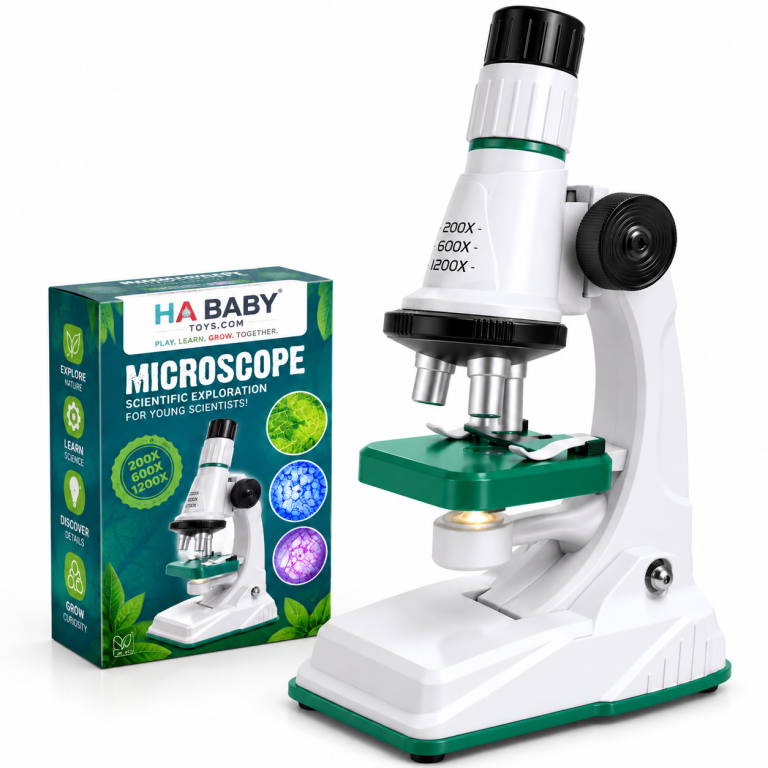
Building tomorrow’s scientists through STEM learning. Every child has curiosity — they ask questions about nature, animals, plants, and the world around them. But curiosity needs the right tools to grow. Many parents search for toys that provide more than entertainment. They want products that help children learn skills they can use in school and life. STEM toys for kids are designed to combine learning with exploration — and a microscope science kit lets children become young researchers by observing hidden details, asking scientific questions, testing ideas, and discovering answers.
Parents looking for educational products can explore more learning toys at HA BABY Toys.
What This Guide Covers
- What Are STEM Toys?
- Why Microscope Kits Are Powerful
- Encouraging Scientific Curiosity
- 8 STEM Skills Children Develop
- What Young Scientists Can Explore
- Preparing Children for Future Learning
- STEM Toys vs Entertainment Toys
- How Parents Can Encourage Science
- HA BABY Kids Microscope Kit
- Great Educational Gift
- Interactive FAQ
What Are STEM Toys and Why Are They Important for Kids?
STEM stands for Science, Technology, Engineering, and Mathematics — four subjects that work together to help children understand and shape the world. STEM toys encourage children to learn through action instead of only reading or memorizing.
🔬 Science
Understanding the natural world through observation and investigation.
💻 Technology
Using tools and equipment to extend what we can do and see.
⚙️ Engineering
Creating solutions and testing ideas against reality.
📐 Mathematics
Understanding measurements, patterns, and relationships.
The benefits of STEM toys extend far beyond science: hands-on learning, problem-solving, creativity, and logical thinking. The importance of STEM education is recognized by educational organizations. Parents can learn more from the U.S. Department of Education STEM resources.
Why Microscope Science Kits Are Powerful STEM Learning Tools
A microscope connects children with real science — not abstract concepts, but the actual physical world. Through observation, children learn biology (exploring plants and natural structures), materials science (understanding different materials), and investigation (comparing and analyzing objects).
A microscope teaches the scientific process: Observation → Question → Experiment → Discovery. That sequence is the same one real scientists use every day. For a full breakdown, see Kids Microscope Kit Guide: How a 1200X Children’s Microscope Helps Young Explorers Discover Science.
How Microscope Kits Encourage Scientific Curiosity
Scientists begin with curiosity. A microscope encourages children to ask: “Why does this look different?” “What is hidden inside this object?” “How does nature create these patterns?”
A leaf becomes a biology lesson. A fabric piece becomes a material science experiment. A flower becomes a nature investigation. Learn more in our guide: How a Kids Microscope Kit Builds Curiosity, Creativity, and Scientific Thinking.
8 STEM Skills Children Develop Through Microscope Exploration
A microscope doesn’t just teach science — it builds eight transferable skills that support every area of future learning.
Observation Skills
Children learn to notice details that others miss — a foundational scientific skill.
Critical Thinking
They analyze what they see — comparing, contrasting, and asking “why?”
Problem Solving
They test different ideas and adjust their approach based on results.
Research Skills
They collect information systematically — building genuine research habits.
Patience
They learn careful investigation takes time — and that it’s worth it.
Creativity
They create their own experiments — deciding what to observe and how.
Communication
They explain discoveries to parents and peers — building language skills.
Confidence
They become independent learners — able to find answers on their own.
The NAEYC emphasizes that hands-on exploration is the most effective way young children learn — and each of these eight skills develops naturally through microscope play.
What Young Scientists Can Explore With a Microscope Kit
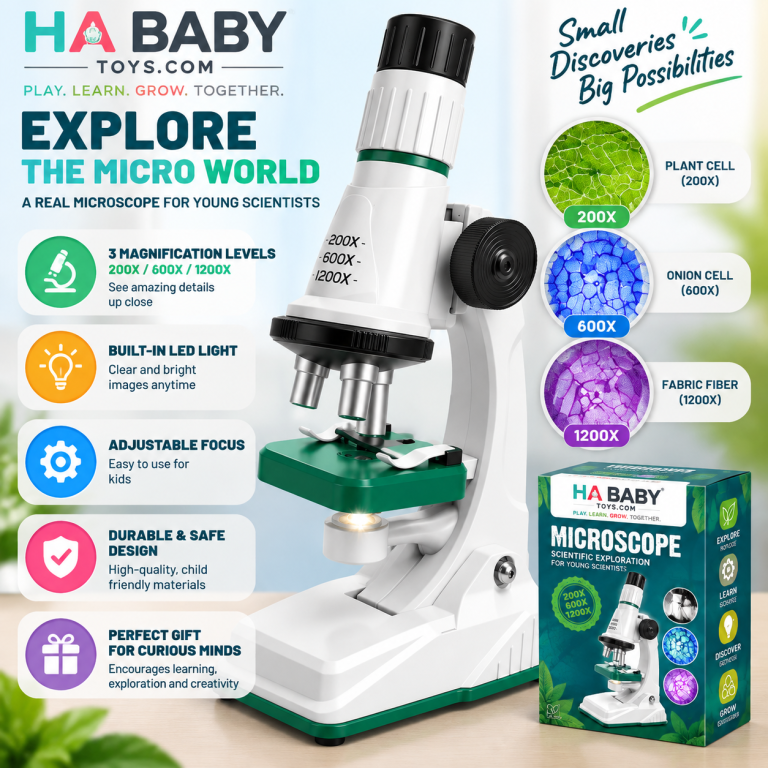
The samples are everywhere. Here are the three most engaging discovery categories.
Plant Science
Explore leaves, flowers, and seeds — discovering plant structures and natural patterns.
Material Science
Explore fabric fibers, paper, and different surfaces — understanding materials at a deeper level.
Nature Investigation
Explore safe natural samples and prepared slides — building real scientific observation skills.
Learn more in our guide: How Children’s Microscope Toys Introduce Kids to Biology and the Hidden World. The National Geographic Kids resources offer endless inspiration for what to explore next.
How STEM Toys Prepare Children for Future Learning
Early science experiences help children develop confidence with science concepts, analytical thinking, research habits, and curiosity. A microscope does not make every child a scientist — but it creates opportunities to explore science in a meaningful way.
The National Science Foundation emphasizes that early STEM exposure shapes the way children approach every future learning challenge. The Smithsonian Science Education Center also highlights the value of inquiry-based learning from an early age.
STEM Toys vs Traditional Entertainment Toys
Both types of toys can have value — but STEM toys add educational experiences that traditional entertainment toys can’t match.
| Entertainment Toys | STEM Microscope Kits |
|---|---|
| Fun focused | Learning focused |
| Passive play | Active discovery |
| Limited questions | Scientific investigation |
| Short activities | Continuous exploration |
For a detailed comparison, see Kids Microscope Kit vs Traditional Toys: Why Science Toys Create Better Learning Experiences.
How Parents Can Encourage Scientific Thinking at Home
Three simple habits turn STEM toys into a genuine family science practice.
Ask Questions
Instead of explaining everything, ask: “What do you notice?”
Create Science Projects
Nature collection, observation journal, comparison experiments.
Explore Together
Parent involvement increases learning — curiosity is contagious.
The NASA Kids’ Club and National Geographic Kids both offer excellent free resources for extending science learning beyond the microscope.
The STEM Scientist Journey
Tap each stage to follow the journey from curiosity to young scientist
Observe
Look deeper
Think
Ask questions
Experiment
Test ideas
Analyze
Understand results
Discover
Become a young scientist
Observe — Look Deeper
Every scientific journey starts with careful observation. A microscope gives children something worth looking at closely — and the tools to actually see it. Even a leaf from the sidewalk becomes a subject of real study.
HA BABY Kids Microscope Kit: A STEM Learning Companion for Young Explorers
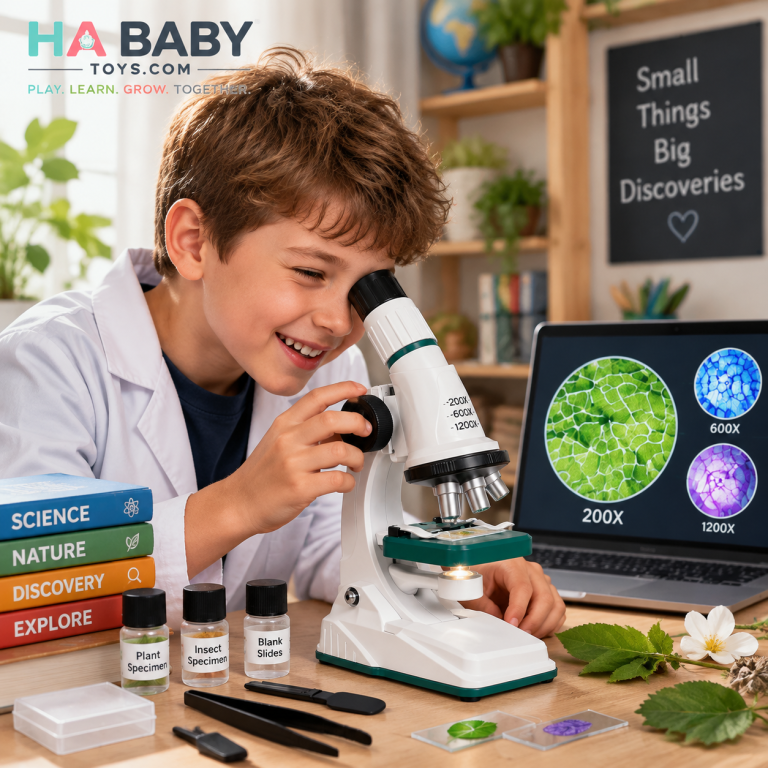
The HA BABY Kids Microscope Kit is designed to introduce children to science through exploration and observation — combining real STEM learning with beginner-friendly design.
HA BABY Kids Microscope Kit
- 1200X magnification for detailed exploration
- Hands-on experiments built into every session
- Beginner-friendly design with simple controls
- Scientific exploration across biology and materials
- Creative discovery — active, screen-free STEM play
- Safe, durable construction for young explorers
- Complete kit with slides and accessories
For readers who want to compare the wider range of educational products, the full shop is a useful next step. The HA Baby Toys blog also covers every aspect of science learning and early education.
Why Microscope Science Kits Make Great Educational Gifts
A STEM microscope kit is perfect for birthdays, school rewards, science-loving children, and holiday gifts. Unlike ordinary toys that get forgotten, a STEM toy creates memories because children discover something new every time they use it.
For more on this, see Why a 1200X Children’s Microscope Is the Perfect Educational Gift for Young Explorers. The UNESCO Education resources also emphasize the importance of early science engagement globally.
Frequently Asked Questions
STEM toys for kids are educational toys that combine Science, Technology, Engineering, and Mathematics through hands-on play. They encourage children to learn through doing — observing, experimenting, and solving problems — rather than passively consuming information. Examples include microscope kits, building sets, chemistry kits, and coding toys.
A microscope kit supports STEM learning by integrating all four subjects at once: science (exploring biology and materials), technology (using scientific tools), engineering (testing ideas and designing experiments), and mathematics (comparing patterns and sizes). The U.S. Department of Education STEM resources emphasize early STEM exposure as foundational for future learning.
Yes — early exposure to real science experiences shapes how children feel about science for years. A microscope lets children see real evidence of scientific concepts rather than just reading about them, which builds genuine interest. The National Science Foundation emphasizes that early STEM exposure is foundational for future learning.
With supervision, STEM microscope toys are suitable from around age 5. Ages 5–7 do best with basic observation and simple magnification. Ages 8–10 can handle simple experiments and recording findings. Ages 10+ can use higher magnification for detailed exploration. The CDC Child Development resources provide useful reference points for what children can understand at different ages.
Children develop observation, critical thinking, problem-solving, research skills, patience, creativity, communication, and confidence. These eight skills extend far beyond science — they shape how children approach every future learning challenge. The NAEYC emphasizes that hands-on exploration is the most effective way young children develop foundational thinking skills.
It depends on what you want from a toy. Normal toys provide entertainment; a microscope provides learning plus entertainment. STEM toys add real developmental value — curiosity, observation, critical thinking, and hands-on skill building. For a detailed comparison, see Kids Microscope Kit vs Traditional Toys.
Children can explore nature (leaves, flowers, insects, seeds) and materials (fabric, paper, salt crystals). They can also investigate prepared biology slides. What they can see depends on the magnification level and the sample. The National Geographic Kids resources offer endless inspiration for what to explore next.
Every Future Scientist Begins With Curiosity
A microscope science kit gives children the tools to explore, question, and discover the world around them. Observe → Think → Experiment → Analyze → Discover
The Bottom Line: STEM Toys That Build Real Skills
STEM toys for kids aren’t just educational products — they’re investments in how a child approaches learning. A microscope science kit delivers that investment through hands-on discovery, real scientific tools, and eight transferable skills that shape every future learning experience.
Whether you’re a parent encouraging a science-loving child, a homeschool family building a science curriculum, or a gift buyer looking for something genuinely meaningful, a microscope science kit is one of the smartest choices available. It turns curiosity into discovery — and discovery into a lifelong love of science.
For parents ready to explore one, the HA BABY Kids Microscope Kit product page is the natural next step. For deeper guidance on science learning and early education, explore the full HA Baby Toys blog library.