
Kids Microscope Kit vs Traditional Toys: Why Science Toys Create Better Learning Experiences
Choosing between fun and learning: why parents are looking beyond traditional toys. Every parent wants their child to enjoy playtime, but many also want toys that provide learning value. Children today have access to countless toys, but parents often wonder: “Which toys actually help my child grow?” Traditional toys can provide imagination and entertainment, while science toys like a kids microscope kit introduce exploration, observation, and problem-solving. This guide explains the difference — fairly and without bias.
Explore more educational products designed for curious children at HA BABY Toys.
What This Guide Covers
- What Are Traditional vs Science Toys?
- Learning Experience Comparison
- Why Science Toys Encourage Curiosity
- How Microscope Kits Build Skills
- STEM Learning & Future Skills
- Traditional Toys Still Matter
- Better Long-Term Engagement
- Why Educational Toys Are Popular
- HA BABY Kids Microscope Kit
- Science Learning at Home
- Interactive FAQ
What Are Traditional Toys and What Are Science Toys?
Before comparing, let’s define both categories fairly. Neither is “better” in every situation — they serve different purposes.
🎲 Traditional Toys
Examples: building blocks, dolls, cars, action figures, board games.
Benefits: imagination, creativity, social play, entertainment.
🔬 Science Toys
Examples: microscope kits, chemistry sets, science experiment toys.
Benefits: investigation, discovery, problem-solving, STEM learning.
Both types of toys have value — but science toys add a deeper learning experience. Where a traditional toy provides a story to play out, a science toy provides a mystery to solve.
Kids Microscope Kit vs Traditional Toys: Learning Experience Comparison
Here’s an honest, side-by-side look at how the two compare on the features that matter most for development.
| Feature | Traditional Toys | Kids Microscope Kit |
|---|---|---|
| Main Purpose | Entertainment | Learning + discovery |
| Activity Style | Play-based | Investigation-based |
| Curiosity | Moderate | High |
| Observation Skills | Limited | Strong |
| Scientific Thinking | Low | Developed |
| Long-Term Learning | Depends on toy | Continuous exploration |
Parents can learn more about microscope-based learning in: Kids Microscope Kit Guide: How a 1200X Children’s Microscope Helps Young Explorers Discover Science.
Why Science Toys Encourage Curiosity Better
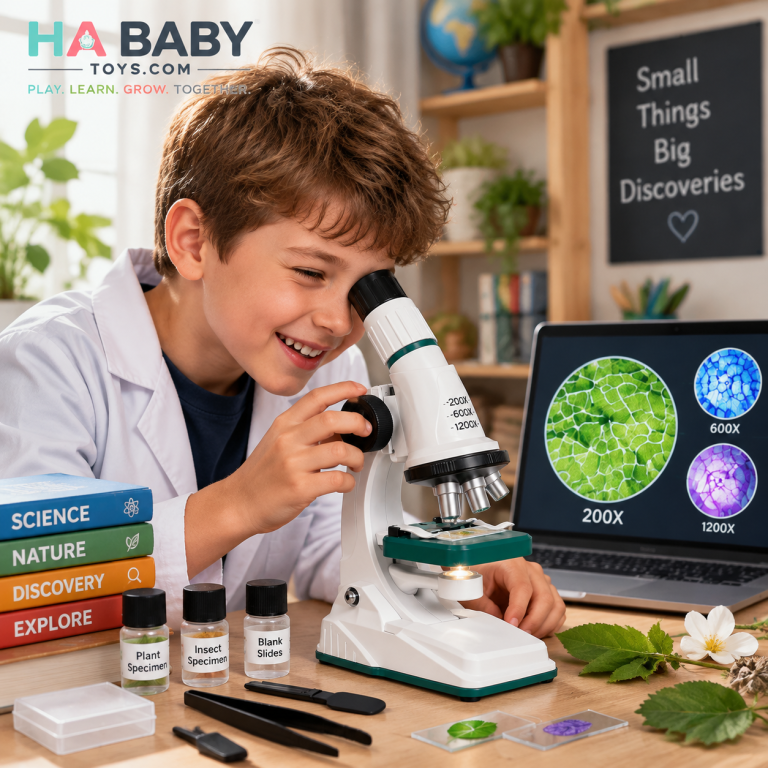
Children are naturally curious. A microscope changes everyday objects into discoveries. A leaf is not just a leaf anymore — through a microscope, children discover patterns, textures, and structures they never imagined existed.
Science toys encourage children to ask: Why? How? What happens if? These questions aren’t side effects of using a microscope — they’re the whole point. Learn more in our guide: How a Kids Microscope Kit Builds Curiosity, Creativity, and Scientific Thinking.
How Kids Microscope Kits Build Real-World Skills
A microscope kit develops four foundational skills that transfer far beyond the science table.
👀 Observation
Children learn to notice details that others miss.
🧠 Critical Thinking
They analyze what they see and compare it to what they know.
💡 Problem Solving
They test ideas and adjust their approach as they learn.
⏳ Patience
They learn that careful observation takes time — and that it pays off.
These skills are useful in school and daily life. The NAEYC emphasizes the importance of exploration-based learning for young children, noting that hands-on discovery is how foundational thinking skills develop.
Science Toys and STEM Learning: Preparing Children for the Future
STEM learning integrates science, technology, engineering, and mathematics — and a microscope introduces all four through a single activity. A microscope introduces scientific tools, research thinking, and experiment methods.
The U.S. Department of Education STEM Resources emphasize early STEM exposure as foundational for future learning. For a deeper look, see STEM Toys for Kids: How Microscope Science Kits Encourage Future Scientists.
Why Traditional Toys Still Matter But Science Toys Add More Value
This is where honesty matters. Traditional toys are not “lesser” — they simply serve a different purpose.
🎲 Traditional Toys Help With
- ✅ Creativity
- ✅ Imagination
- ✅ Role play
- ✅ Social interaction
🔬 Science Toys Add
- ✅ Exploration
- ✅ Research skills
- ✅ Scientific understanding
- ✅ Hands-on discovery
The goal is not replacing traditional toys but adding variety. A balanced toy collection can support different areas of development — and that’s where most parents land when they think it through.
Which Toy Provides Better Long-Term Engagement?
Many traditional toys are used repeatedly in the same way. A microscope provides new discoveries because children can explore different objects — day after day, month after month.
One day: leaf exploration. Another day: fabric comparison. Another day: nature investigation. The novelty doesn’t run out because the samples don’t run out. For a deeper look, see Microscope Science Toy for Kids: A Complete Guide to Hands-On STEM Learning.
Traditional Play vs Scientific Discovery
The best learning happens through meaningful play — both sides have value
🎲 Traditional Toy Play
- Imagination
- Creativity
- Fun
- Social interaction
🔬 Microscope Science Play
- Curiosity
- Observation
- STEM Skills
- Discovery
“Best Learning Happens Through Meaningful Play”
Why Educational Toys Are Becoming Popular Among Parents
Modern parenting concerns have shifted. Parents want less screen time, meaningful activities, learning through play, and better value from their purchases. Educational toys combine fun and development — which is exactly what these parents are looking for.
The CDC Child Development resources highlight hands-on, guided discovery as central to healthy early development. The UNESCO Education resources also emphasize the importance of early science engagement globally.
How HA BABY Kids Microscope Kit Creates a Better Learning Experience
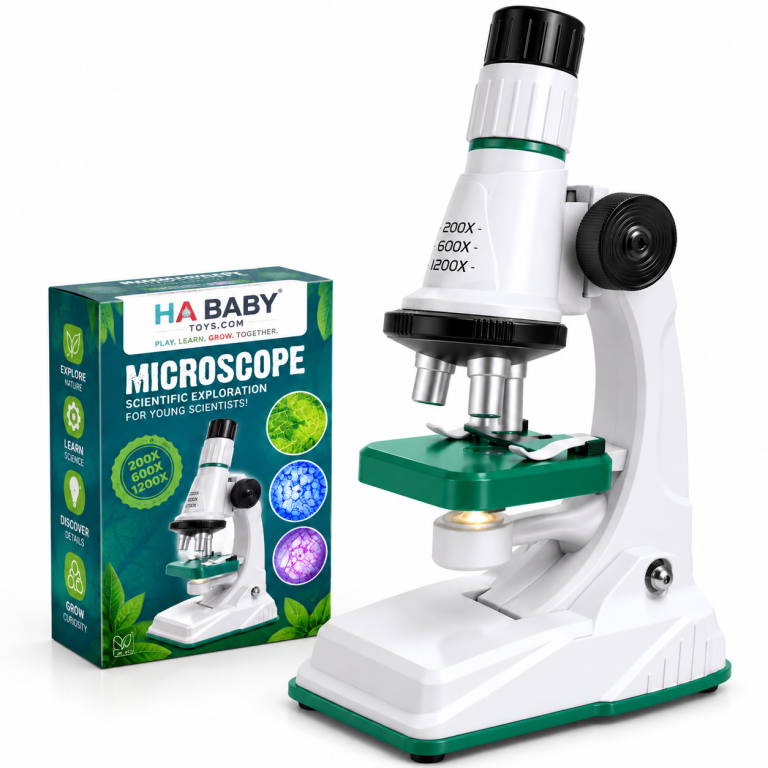
The HA BABY Kids Microscope Kit helps children experience science through active exploration — combining beginner-friendly operation with genuine scientific discovery.
HA BABY Kids Microscope Kit
- Science exploration built for beginners
- Beginner-friendly operation with simple controls
- 1200X magnification for detailed observation
- Hands-on discovery — active, screen-free play
- STEM learning support across all four subjects
- Safe, durable construction for young explorers
- Complete kit with slides and accessories
For readers who want to compare the wider range of educational products, the full shop is a useful next step. The HA Baby Toys blog also covers every aspect of science learning and early education.
How Parents Can Make Science Learning Fun at Home
Three simple habits turn a microscope into a genuine family science practice.
Discovery Challenges
“Find three objects and compare them.”
Science Journal
Children record drawings, observations, and questions.
Explore Together
Parents ask: “What do you notice?” — and learning deepens.
For more hands-on ideas, see Fun Science Experiments Kids Can Try With a Microscope Kit at Home. The National Geographic Kids and NASA Kids’ Club sites offer endless inspiration for what to explore next.
Frequently Asked Questions
Not universally — they serve different purposes. Traditional toys excel at imagination, creativity, and social play. Science toys excel at investigation, discovery, and STEM learning. Many families use both. The right choice depends on what type of development you want to support at a given time.
A kids microscope kit delivers real educational benefits: it builds curiosity, develops observation skills, encourages STEM learning, improves focus and patience, and creates long-term engagement through continuous discovery. It’s not just a toy — it’s a learning tool that grows with your child.
Children develop observation, curiosity, critical thinking, problem-solving, patience, and communication. They also build fine motor skills through handling slides and adjusting focus, and they practice scientific thinking — observe, question, test, conclude — through every session. The CDC Child Development resources highlight hands-on discovery as foundational to healthy early development.
Yes — provided they’re designed for beginners. Beginner-friendly microscopes have simple controls, easy focusing, comfortable viewing, and multiple magnification settings so children can start simple and grow. For a full breakdown, see Beginner Microscope for Kids: A Parent’s Guide to Choosing the Right Science Toy.
Yes — a microscope provides hands-on activities that keep children genuinely engaged without screens. Unlike passive entertainment, microscope work is active, tactile, and full of discovery. Many parents use it as a meaningful alternative to tablets and video games during meal prep, after school, or on weekends.
Kids can explore nature (leaves, flowers, insects, seeds) and household objects (fabric fibers, paper texture, salt crystals). They can also investigate prepared biology slides. What they can see depends on the magnification level and the sample. The National Geographic Kids resources offer endless inspiration for what to explore.
Yes — a microscope makes an excellent educational gift. It works beautifully for birthdays, school projects, and curious children. Unlike ordinary gifts that lose appeal quickly, a microscope keeps giving: every observation leads to new questions. For more on this, see Why a 1200X Children’s Microscope Is the Perfect Educational Gift.
Choosing the Right Toy Is About More Than Keeping Children Busy
It’s about helping them discover, learn, and grow. A kids microscope kit turns playtime into a journey of exploration. Play → Discover → Learn → Grow
The Bottom Line: Both Have Value — But Science Toys Add Learning
Traditional toys and science toys aren’t competitors — they’re complements. Traditional toys build imagination, creativity, and social play. Science toys add investigation, discovery, and STEM learning. Together, they support the full range of a child’s development.
That said, when a parent wants a toy that combines entertainment with real skill-building, a kids microscope kit stands out. It offers longer engagement, deeper learning, and a path from curiosity to scientific thinking — all through play.
For parents ready to explore one, the HA BABY Kids Microscope Kit product page is the natural next step. For deeper guidance on science learning and early education, explore the full HA Baby Toys blog library.
One Response