
The best way to use a kids audio story player is not to treat it as a single activity, but to build it into moments that already exist in your day: bedtime, quiet time, and travel. That way it becomes a routine tool rather than another gadget.
If you need the basic setup first — charging, choosing a card, adjusting volume — the step-by-step guide on how to use a kids audio story player for screen-free listening covers all of that. This article focuses on something different: which routines work best at which times of day, how to rotate 96 cards without losing them, and what realistic expectations look like.
Quick Start
- Choose one card.
- Start playback.
- Set the volume low and keep the player close.
- Listen together or nearby.
- End the session before frustration.
The Listening Routine Loop
Five stages that repeat across every session
HA Baby Toys Kids Story Player
Gramophone music toy with 96 story cards
Choose
Parent or child picks one card.
Listen
Playback starts at a low, comfortable volume.
Imagine
No screen — the child pictures the story.
Talk
A simple question or comment connects the story to real life.
Repeat
Replay a favorite or choose a new card next time.
Choose → Listen → Imagine → Talk → Repeat
Bedtime Listening Routine
Bedtime is one of the strongest use cases for a story player, because the device can become part of an already-established wind-down sequence.
Dim the lights
Reduce visual stimulation before listening begins.
Choose one familiar card
Familiar content is usually more calming than a brand-new story at bedtime.
Keep the volume low
Quiet audio reinforces the wind-down signal rather than waking the child up.
Sit together
Co-listening adds comfort and closeness at the end of the day.
Listen to one story
One story, then done, keeps the routine predictable and finite.
Put the player away
Ending the session signals that bedtime has arrived.
Audio does not make every child fall asleep, and it is not a sleep training method. A predictable story routine may help make bedtime feel more familiar and structured, but every child is different.
Quiet-Time Routine
Quiet time is different from bedtime. The goal is not sleep — it is a calm, screen-free activity that a child can do while a parent handles something else nearby.
Good quiet-time content
- Short stories
- Calm narration
- Familiar favorites
- Softer songs
Practical setup
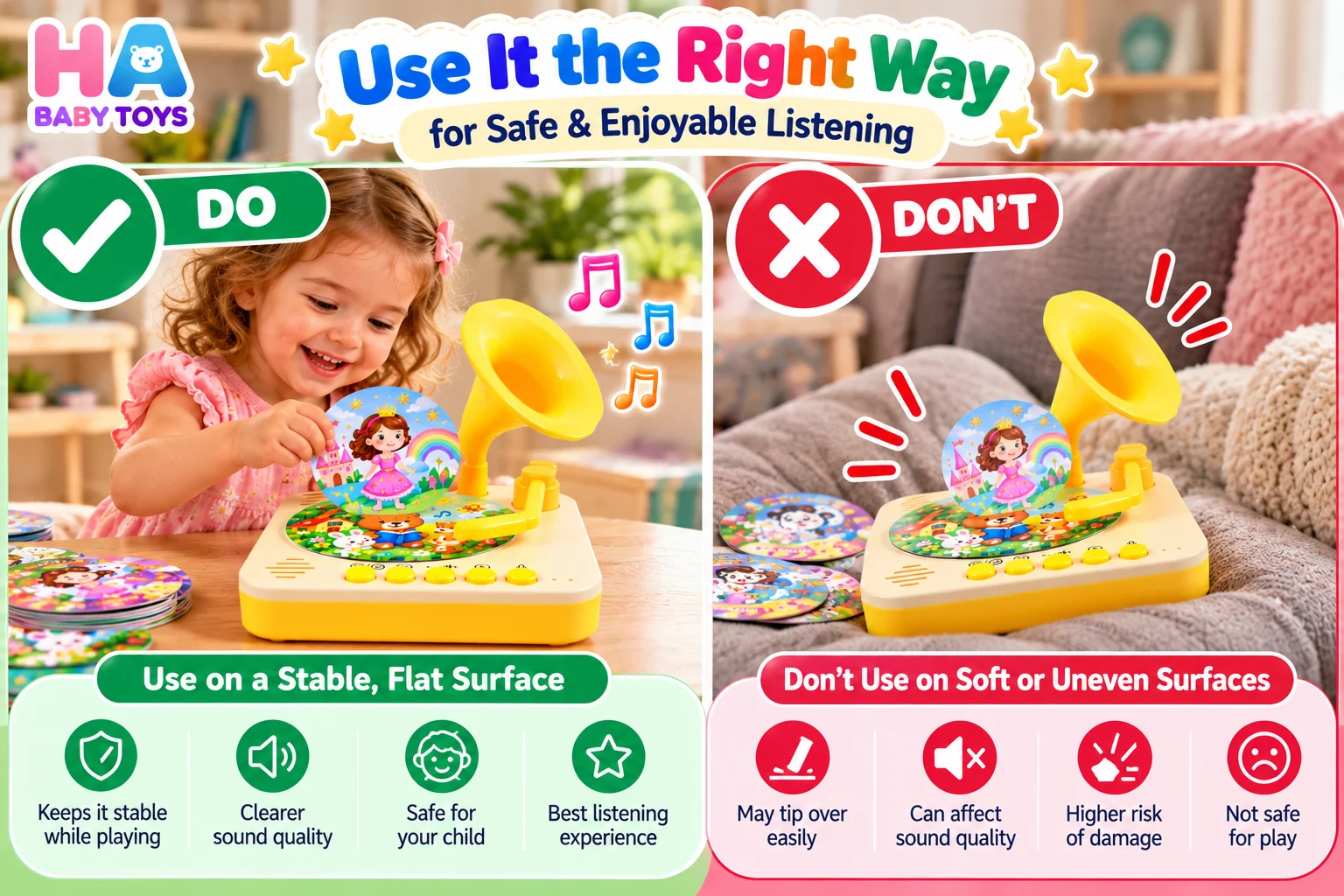
- Place the player on a stable surface
- Offer two or three cards only
- Keep the volume low
- Stay within earshot
Quiet time works best when it becomes predictable. If your child knows that quiet time means “one story on the player,” they are more likely to settle into it than if the activity changes every day.
Travel and Car-Use Ideas
The story player can work well for travel if the device and supervision setup suit the situation.
- Use it during long car journeys with a parent in the car
- Bring a small selection of cards rather than the full set
- Keep the volume low enough that traffic cues remain audible
- Choose familiar content so the child can follow along without help
- Keep the player secured so it does not slide around
Do not use the player as a substitute for supervising a child in a car. It is an activity, not a safety device. If you use headphones on older children, follow the manufacturer’s guidance on volume limits.
Travel is one of the clearest reasons parents choose a screen-free device in the first place. For the broader case, see the article on why parents may choose a screen-free story player for kids.
How to Rotate the 96 Story Cards
Having 96 cards is a strength, but only if they are organised. A simple rotation system prevents the whole set from becoming a pile.
Divide into categories
Stories, songs, animals, bedtime, and favorites is a simple starting point.
Keep only a small working set out
Two or three cards visible at a time is enough for most toddlers.
Rotate weekly
Swap the working set once a week so content stays fresh without overwhelming the child.
Keep favorites accessible
A small tray of “always available” cards reduces frustration when the child wants a specific story.
Store the rest away
Keeping the full set in a labeled box protects the cards and keeps the play area tidy.
Example categories:
How to Choose Stories Versus Songs
Songs and stories serve different purposes, and matching the content to the moment makes the player work harder.
Choose a story when…
- It is bedtime
- You want a longer focused activity
- You plan to ask questions afterward
- The child is calm and ready to listen
Choose a song when…
- The child is restless
- You want movement and participation
- The session needs to be short
- You are in the car or during active play
Mixing both across the week works well. Songs keep the device fun, while stories build the listening habit over time.
Parent-Child Listening Prompts
What you say during and after a story matters more than the story itself. Simple prompts turn passive listening into shared conversation.
“What happened?”
Ask about the story in one simple question.
“Who did you hear?”
Encourage the child to name a character.
“Can you make that sound?”
Repeat an animal or action sound together.
“What happened first?”
Introduces simple sequencing.
“Do you want to hear it again?”
Gives the child a small choice and supports repetition.
“Where is the bear?”
Connects the story to a real object in the room.
Shared reading and language-rich interaction are widely encouraged in early childhood. ZERO TO THREE and the National Association for the Education of Young Children (NAEYC) both highlight responsive caregiver interaction as a key driver of early language, and the Harvard Center on the Developing Child describes these back-and-forth exchanges as “serve and return” interactions that build brain architecture.
Independent Listening Ideas
Independent listening builds gradually. A realistic progression looks like this:
Stage 1
Parent chooses and starts the story.
Stage 2
Child chooses between two cards.
Stage 3
Child places the card with help and starts playback with a parent nearby.
Stage 4
Child selects and starts familiar content with a parent in the room.
Stage 5
Child uses the player independently during quiet time with a parent within earshot.
Not all toddlers will progress at the same speed. Follow your child’s readiness rather than a fixed timeline.
How Long a Session Should Last
There is no universal perfect session length. Younger children may prefer a few minutes, while older toddlers may stay engaged longer.
Stop when:
- The child loses interest
- The child becomes restless
- Listening turns into frustration
- The child starts switching cards constantly without listening
Short, happy sessions build a better association with the device than long, forced ones. The NHS baby development guidance and the Raising Children Network both note that children’s attention spans and play preferences vary widely at this stage.
Volume and Hearing Safety
Volume is one of the few settings that parents should manage actively rather than letting the child control.
- Start low and increase only if needed
- Keep the player physically close so high volume is unnecessary
- Avoid using the player at full volume
- Take breaks during longer sessions
- If headphones are used, follow the manufacturer’s volume limits
The World Health Organization publishes guidance on safe listening and protecting hearing from excessive sound exposure. Moving the player closer is almost always the better solution.
Storage Ideas for All 96 Cards
Once the cards are organized, they stay usable. A few practical systems work well:
- Small labeled card box with dividers
- A tray for the current week’s working set
- A separate favorites pouch
- Weekly rotation to keep content fresh
- Keep cards away from water, heat, and direct sunlight
A simple rule: if a card is not in the working set or the favorites tray, it lives in the box. That keeps the play area manageable without losing the variety that 96 cards provide.
Common Problems and Quick Fixes
| Problem | Try This |
|---|---|
| Child walks away during a story | Use shorter content or a song |
| Child keeps switching cards | Offer only two choices |
| Child ignores stories but likes songs | Lean into songs and add stories slowly |
| Child wants the same story every night | Allow repetition and ask a new question each time |
| Child gets restless during quiet time | Add movement — clapping, dancing, or acting out the story |
| Volume seems too loud | Lower it and move the player closer |
| Cards are getting lost | Return to the box-and-tray system after each session |
| Child is not interested in the player at all | Pause for a week and reintroduce during a routine moment |
Screen-Free Story Player vs Tablet
| Feature | Kids Story Player | Tablet |
|---|---|---|
| Screen required | No | Yes |
| Audio stories | Yes | Yes |
| Apps | Usually no | Yes |
| Notifications | Usually none | Possible |
| Physical story cards | Yes | No |
| Simple controls | Often | More complex |
| Visual content | No or limited | Extensive |
| Travel suitability | Usually simple to pack | Requires more setup |
Neither option is universally better. The right choice depends on what kind of story time you want to create. For family media balance guidance, Common Sense Media publishes independent recommendations, and the American Academy of Pediatrics offers general family media guidance. HealthyChildren.org also covers balanced media habits in more detail.
The 10-Minute Listening Routine
For busy parents who want a repeatable, screen-free session.
- Minute 1: Choose one card
- Minute 2: Start listening at low volume
- Minutes 3–7: Listen together or nearby
- Minute 8: Ask one simple question
- Minute 9: Replay the favorite part if requested
- Minute 10: Return the card to the tray and end positively
Parents who want more activity ideas can also browse the HA Baby Toys blog.
What Parents Should Not Expect
This is the credibility section. A story player is a useful routine tool, not a solution to every parenting challenge.
A story player does not:
- Replace parent conversation
- Guarantee language development
- Replace books
- Automatically improve sleep
- Interest every child equally
- Work the same way in every family routine
What it can do:
- Provide screen-free audio during routines
- Offer story and song variety
- Support bedtime and quiet time structure
- Create prompts for conversation
- Give children a simple activity during travel
Safety and Practical Checks
Before and during every session
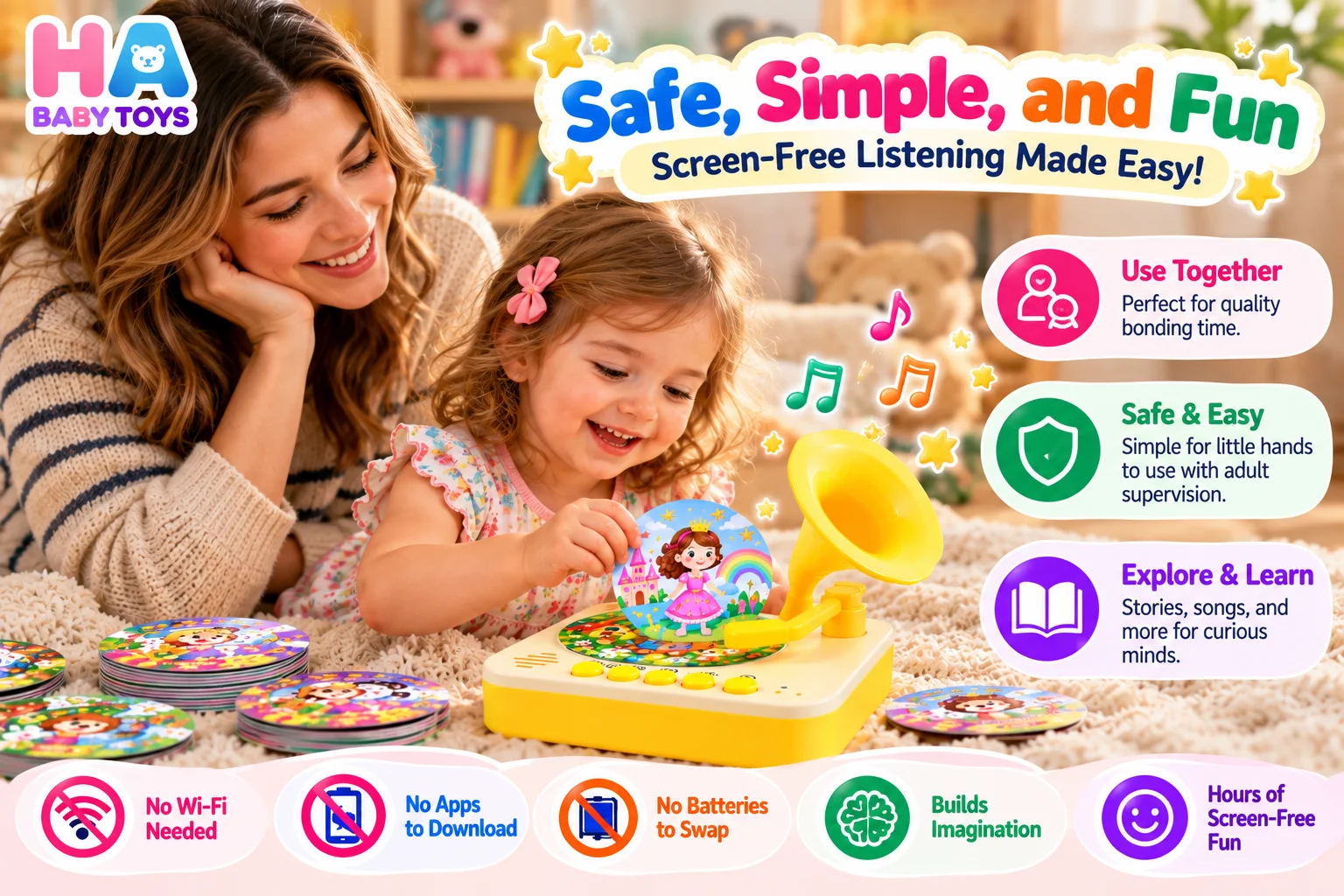
- Follow the manufacturer’s age guidance
- Keep small cards and accessories away from younger siblings
- Inspect charging cables regularly
- Keep the device dry unless it is rated otherwise
- Place the player on a stable surface
- Check the volume before handing it to the child
- Supervise younger children
- Store the player and cards away after use
For product safety guidance, the U.S. Consumer Product Safety Commission publishes information on children’s products, recalls, and hazards. HealthyChildren.org from the American Academy of Pediatrics also covers safe play practices in more detail.
How to Get the Most From the Player
Once a routine is in place, a few small habits keep the device useful rather than collecting dust:
- Keep one routine tied to the player — bedtime, quiet time, or travel
- Rotate the working set of cards weekly
- Pair stories with a related toy or object
- Ask one question after each session
- Store everything back in its place so the next session is easy to start
Parents who already know the basics but want the full setup walkthrough can revisit the guide on how to use a kids audio story player for screen-free listening. If you are still learning what the device is, start with what a kids story player is and how it works.
Ready to see the HA Baby Toys Kids Story Player with 96 story cards?
Explore the HA Baby Toys Shop →Frequently Asked Questions
How do I build a bedtime routine with a kids story player?
Dim the lights, choose one familiar card, keep the volume low, sit together, listen to one story, and then put the player away. One story, then done, keeps the routine predictable.
Can I use a kids audio story player for quiet time?
Yes. Short stories, calm narration, and familiar favorites work well for quiet time. Offer two or three cards and stay within earshot.
Is a screen-free audio player good for travel?
It can work well for car journeys and trips. Bring a small selection of cards rather than the full set, keep the volume low, and secure the player so it does not slide around.
How do I rotate 96 story cards without losing them?
Divide into categories, keep only two or three cards out at a time, rotate the working set weekly, keep favorites in a separate tray, and store the rest in a labeled box.
Should I choose stories or songs for my toddler?
Choose stories for bedtime and focused listening, and songs for restlessness, movement, and short sessions. Mixing both across the week keeps the device engaging.
How can I use story cards for toddler activities?
Use prompts like “Who did you hear?”, “Can you make that sound?”, and “What happened first?”. Story cards can also be paired with toys for matching games.
Can toddlers use a story player independently?
Independence builds gradually. Many toddlers start by choosing between two cards with a parent nearby, then progress to placing cards and starting familiar content themselves with a parent within earshot.
How long should a listening session be?
There is no universal perfect length. Younger children may prefer a few minutes, while older toddlers may stay engaged longer. Stop when interest fades or listening turns into frustration.
How loud should the story player be for a toddler?
Start low and increase only if needed. Keep the player close so high volume is unnecessary. The World Health Organization publishes guidance on safe listening and hearing protection.
What if my child keeps replaying the same story?
Repetition is a normal part of early childhood learning. Let them replay favorites, ask a new question each time, or pair the story with a toy instead of forcing a new card.
What if my child loses interest in the story player?
Try a shorter story, switch to a song, reduce distractions, offer fewer choices, or pause for a week and reintroduce the player during a routine moment.
Is a kids story player better than a tablet for story time?
Not universally better, but different. A story player offers screen-free audio with simple controls, while a tablet offers visual content and apps. The right choice depends on what kind of story time you want to create.
Where should I store the story player and cards?
Keep the player on a shelf or in a small bag when not in use, and store cards in a labeled box with the current working set in a separate tray. This keeps the play area tidy and the cards protected.
What safety checks should parents make before using a story player?
Check the age guidance, inspect charging cables, keep the device dry, place it on a stable surface, check volume, and supervise younger children. The HA Baby Toys FAQ also answers common product and ordering questions.
Where can I buy the HA Baby Toys Kids Story Player?
Browse the HA Baby Toys shop for the gramophone music toy with 96 story cards and other screen-free listening products. Retailers and larger buyers can also request a quote from HA Baby Toys.
The Short Version for Busy Parents
A kids audio story player becomes far more useful when it is tied to a routine rather than treated as a one-off activity. Pick one moment in your day — bedtime, quiet time, or travel — and build a simple, repeatable session around it.
Keep the working set of cards small. Rotate weekly. Keep the volume low and the player close. Ask one question after each story. That is the whole system, and it works without any extra planning.
For more hands-on family products and screen-free play ideas, HA Baby Toys offers toys and activity products designed around everyday family routines.