
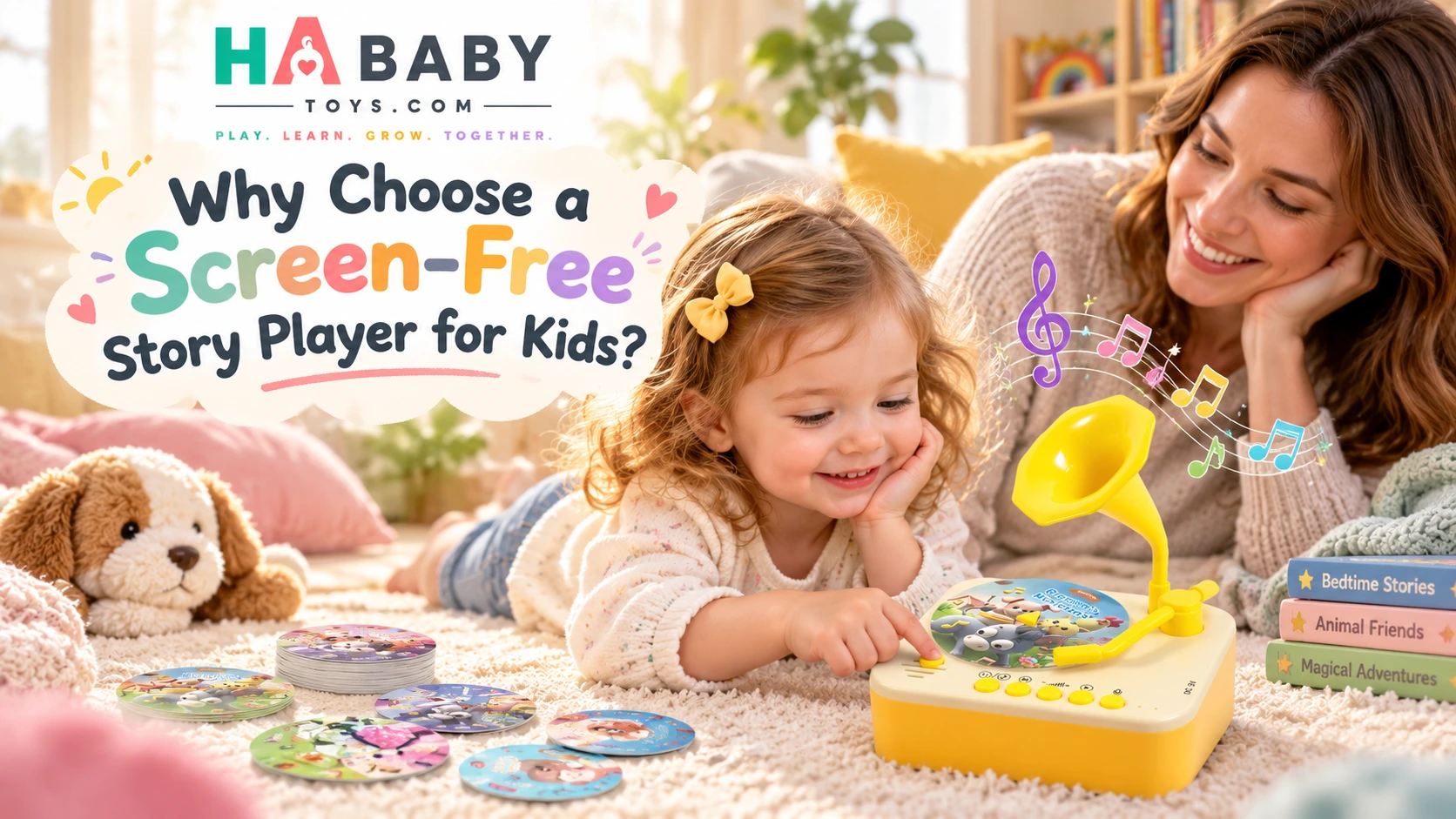
A screen-free story player gives children access to stories, songs, and audio play without requiring a phone, tablet, or video screen. For families looking for a simpler listening routine, it can provide a focused alternative to app-based entertainment.
The real question most parents are quietly asking is: “Why should I buy a dedicated story player when my child can already listen to stories on a phone, tablet, or smart speaker?” This guide answers that honestly. It covers what a dedicated audio device does well, where it does not replace other tools, and how to decide whether it fits your family. If you are still learning what this device category is, start with the guide on what a kids story player is and how it works.
Why Parents Consider One
- No video screen required
- Simple story selection
- Can support quiet-time routines
- Encourages listening and imagination
- Reduces reliance on a parent’s phone
- Can be easier for children to operate
- Works well for stories, songs, and repeated favorites
Listen Without the Screen
Six benefits behind a dedicated audio device
HA Baby Toys Kids Story Player
Gramophone music toy with 96 story cards
Choose
Child selects a story or song.
Listen
Audio becomes the main focus.
Imagine
No video telling the child what the scene looks like.
Talk
Parents can discuss characters and events.
Repeat
Children can replay favorites.
Explore
Different story cards create variety.
Choose → Listen → Imagine → Talk → Repeat → Explore
Benefit 1: Less Dependence on Phones and Tablets
A separate listening device
A dedicated player separates listening from everything else on a phone.
A dedicated story player can separate listening time from:
- Apps
- Notifications
- Video platforms
- Games
- Messaging
- Adult phone content
A screen-free story player does not make all screen use unnecessary, but it can give families another option when they want stories without opening a phone or tablet. For balanced family media habits, HealthyChildren.org from the American Academy of Pediatrics publishes practical guidance, and the American Academy of Pediatrics maintains broader family media recommendations.
Benefit 2: Encourages Listening-Focused Play
Watching vs listening
Audio-only play asks the child to follow the story without visual support.
With audio-only stories, children can focus on:
- Voices
- Sound effects
- Rhythm
- Words
- Story sequence
Audio-only play gives children an opportunity to practice listening without a competing visual stream. ZERO TO THREE and the National Association for the Education of Young Children (NAEYC) both emphasize that listening and language development grow through repeated, responsive interaction. Reading Rockets also offers practical guidance on how talking about stories supports early literacy.
Benefit 3: Leaves More Room for Imagination
Hearing instead of seeing
When a story is heard rather than watched, the child has to form their own mental picture.
Simple prompts turn audio into imaginative play:
- “What do you think the bear looks like?”
- “Where do you think they are going?”
- “What happens next?”
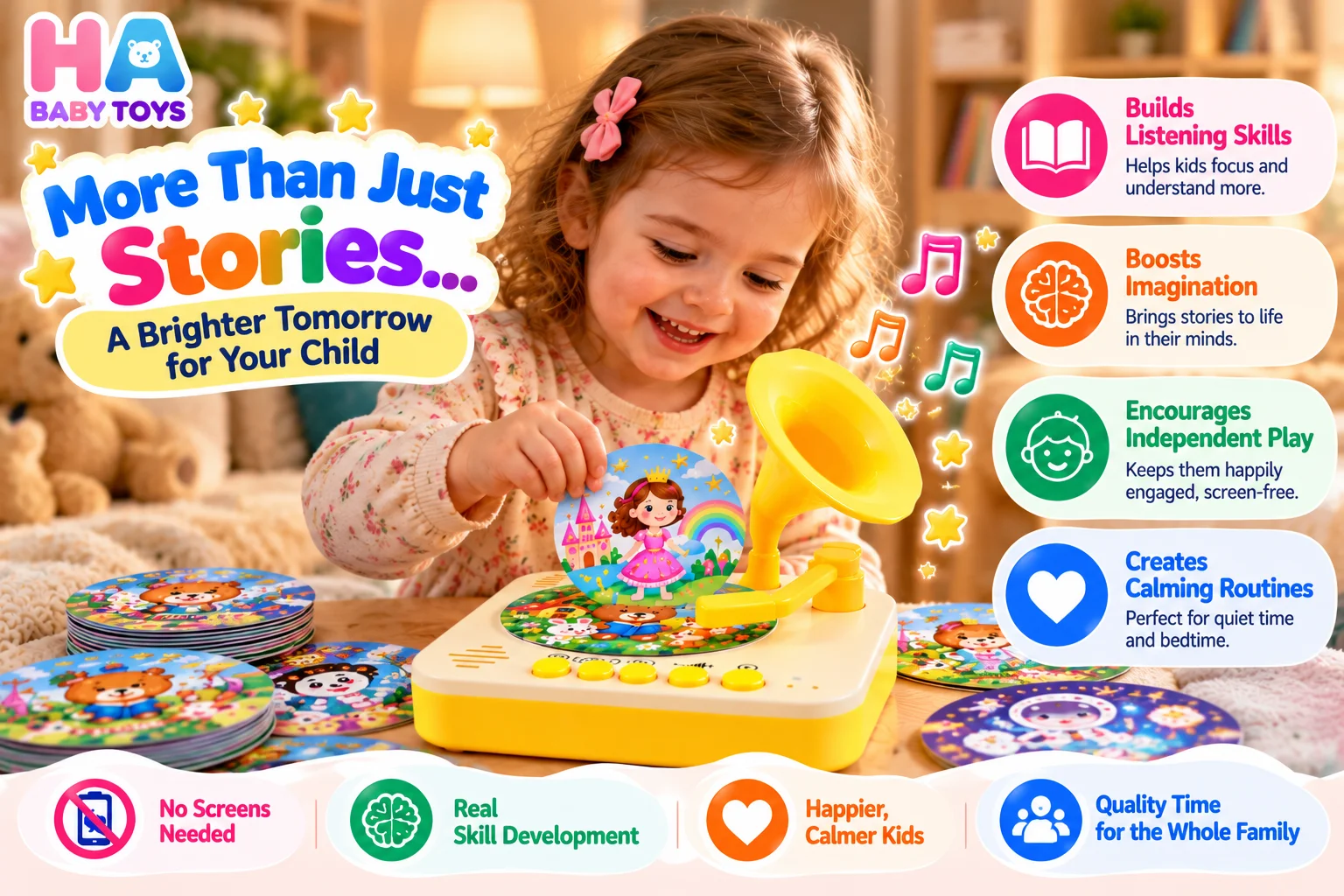
From Audio to Imagination
What happens in a child’s mind during audio play
Hear
Child listens to the story.
Picture
They imagine the scene.
Think
They follow what is happening.
Talk
They discuss it with a parent.
Create
They may draw, act, or retell the story.
Hear → Picture → Think → Talk → Create
Benefit 4: Simple Controls for Young Children
Dedicated kids devices are often easier than general-purpose tablets because they may have:
- Fewer buttons
- Simple playback controls
- Physical story cards
- Less menu navigation
The HA Baby Toys Kids Story Player Gramophone Music Toy with 96 Story Cards is built around card-based audio play, helping keep the experience focused on stories and songs rather than apps. Parents who want to understand the practical setup can also follow the step-by-step guide on how to use a kids audio story player for screen-free listening.
Benefit 5: Gives Children Manageable Choices
This is a very practical benefit. Instead of scrolling through hundreds of app options, parents can offer:
- Two story cards
- Three songs
- One bedtime favorite
Better Choice, Less Overload
Offer 2–3 cards at a time rather than every option at once.
This is one of the simplest reasons physical story cards can be more useful than a digital menu. A small choice keeps the child focused on listening rather than browsing.
Benefit 6: Works Well for Quiet Time
Parents can use the story player during:
- Afternoon quiet time
- Calm play
- Wind-down periods
- Travel breaks
- Bedtime routines
A familiar audio routine can help create structure around quieter parts of the day. It does not automatically make children calm or sleepy, but it does provide a consistent, screen-free activity that fits naturally into a routine.
Benefit 7: Can Support Bedtime Routines
A predictable bedtime sequence
- Choose one calm story
- Lower the room lights
- Keep volume comfortable
- Listen together
- Put the player away afterward
The goal is consistency, not using audio as a guaranteed sleep solution. A familiar story routine may help make bedtime feel more structured, but every child is different.
Benefit 8: Parent-Child Interaction Is Easy to Add
Parents can participate without turning the session into a lesson. Try:
“Who was in the story?”
Encourages the child to name a character.
“What happened first?”
Introduces simple sequencing.
“Did you like that song?”
Simple opinion questions build conversation.
“Can you make that animal sound?”
Links audio to physical imitation.
“What do you think happens next?”
Encourages prediction and imagination.
“Do you want to hear it again?”
Gives the child a small, manageable choice.
This is where the device supports shared interaction rather than passive background noise. The Harvard Center on the Developing Child describes these back-and-forth exchanges as “serve and return” interactions that build early brain architecture.
Benefit 9: Repetition Is Easy
Parents often worry when children repeat the same story again and again. In practice, repetition is a normal part of early childhood learning, and a story player makes it simple to support.
Instead of resisting repetition, parents can:
- Let the child replay a favorite
- Ask a different question each time
- Act out one part
- Draw a character
- Introduce a new story later
ZERO TO THREE notes that repetition in early childhood is a form of learning, not a sign of boredom.
Benefit 10: One Device Can Support Several Activities
The story player is not only for sitting and listening. Parents can use it for a range of activities throughout the day.
Story time
Listen to a full story from start to finish.
Song time
Play a favorite song and sing along.
Movement time
Clap or move with the music.
Drawing time
Draw while listening to a story.
Pretend play
Act out characters from a favorite story.
Quiet time
Use a familiar story during the afternoon lull.
Family time
Listen together during shared moments.
Travel time
Bring a small selection of cards for car journeys.
Screen-Free Story Player vs Tablet
| Feature | Screen-Free Story Player | Tablet |
|---|---|---|
| Video screen required | No | Yes |
| Stories | Yes | Yes |
| Apps | Usually limited or none | Many |
| Notifications | Usually none | Possible |
| Physical story selection | Often | No |
| Simple child controls | Often | Varies |
| Games and video distractions | Limited | Common |
| Parent setup | Usually simple | Varies |
Neither option is universally better. The right choice depends on what kind of story time you want to create. For independent media guidance, Common Sense Media publishes practical recommendations on children’s media and technology.
Story Player vs Smart Speaker
This comparison matters for parents who already have a smart speaker at home and wonder whether a dedicated device adds anything.
| Feature | Kids Story Player | Smart Speaker |
|---|---|---|
| Designed for kids | Yes | General-purpose |
| Physical story cards | Often | No |
| Voice commands required | Usually no | Often |
| Screen required | No | No |
| Account or cloud dependence | Depends | Often |
| Content control | More physical and manual | Platform-dependent |
Smart speakers are convenient for the whole family. A dedicated kids story player keeps the content choice physical and simple, which some parents prefer for younger children.
Story Player vs Traditional Books
Books and story players can work together. They are not competitors.
Use a book when:
- You want shared reading
- You want pictures and page turning
- You want print exposure
Use a story player when:
- The child wants independent listening
- A parent is busy
- You want audio during quiet time
- You want songs and stories in one device
This balanced approach is what most child development guidance recommends. UNICEF Parenting highlights shared reading and language-rich interaction as core early learning experiences, and audio stories are one more prompt for conversation when caregivers participate.
“Screen-Free” Does Not Mean “No Limits”
A screen-free player can still be overused. Parents should still think about:
- Volume
- Duration
- Variety
- Movement breaks
- Social interaction
- Independent play balance
Screen-free does not mean parent-free, and it does not mean unlimited. It simply means the primary activity is listening rather than watching. For broader guidance on balanced media habits, American Academy of Pediatrics family media guidance is a useful starting point.
Hearing and Volume Safety
Simple rules that protect hearing
- Start at low volume
- Keep the player nearby
- Avoid unnecessary high volume
- Follow device instructions
- Take breaks during longer sessions
- If headphones are used, follow the manufacturer’s volume limits
The World Health Organization publishes guidance on safe listening and protecting hearing from excessive sound exposure. Moving the player closer is almost always better than turning the volume up.
Why the 96 Story Cards Matter
96 cards is not just a number. It is what makes variety possible without app browsing or downloads.
Rotate by theme
Rotate by week
Keep only a small selection accessible. Swap the working set once a week so content stays fresh without overwhelming the child.
Create a “Today’s Choice” box
Offer 2–3 cards from the box each day. This turns the number of cards into a practical benefit rather than just a specification.
Story Card Rotation Planner
A simple weekly system for all 96 cards
Stories
Focus on story cards to start the week.
Songs
Bring in songs for movement and participation.
Animal Audio
Animal-themed cards with sounds and names.
Favorites
Replay a favorite from earlier in the week.
New Card
Introduce one card the child has not heard before.
Family Choice
Let the child pick any card from the box.
Who Is This Type of Product Best For?
Who Might Prefer Something Else?
This is worth being honest about. A screen-free story player may not be ideal if:
- You want visual educational content
- Your child strongly prefers picture books
- You want streaming services
- You want advanced interactive games
- You need a device with a large digital library
- You do not want to manage physical cards
This helps the buyer make a real decision rather than a pressured one. The device is a strong fit for focused, screen-free listening. It is not a general-purpose media hub.
Choose a Screen-Free Story Player If:
- You want stories without video
- You prefer simple controls
- Your child enjoys listening to stories or songs
- You want a dedicated device instead of using your phone
- You like physical story cards
- You want something useful for quiet time
- You are comfortable storing and rotating cards
If those priorities match your family, you can explore the HA Baby Toys Kids Story Player with 96 Story Cards.
Ready to bring screen-free listening into your routine?
Explore the HA Baby Toys Shop →How to Get the Most From a Screen-Free Story Player
Once a routine is in place, a few small habits keep the device useful rather than collecting dust.
- Keep one routine tied to the player — bedtime, quiet time, or travel
- Rotate the working set of cards weekly
- Pair stories with a related toy or object
- Ask one question after each session
- Store everything back in its place so the next session is easy to start
For additional activity ideas and routines, browse the HA Baby Toys blog, which covers story player routines, camera guides, and screen-free play ideas. If you are still deciding whether this category fits your child, the article on why parents may choose a screen-free story player for kids provides a broader view.
Frequently Asked Questions
Why choose a screen-free story player for kids?
Because it gives children access to stories and songs without a phone, tablet, or video screen. For families who want a simpler listening routine, it provides a focused, dedicated device that keeps the primary activity audio rather than visual.
Is a story player better than a tablet?
Not universally better, but different. A story player offers screen-free audio with simple controls, while a tablet offers visual content and apps. The right choice depends on what kind of story time you want to create.
Can toddlers use a story player independently?
Independence builds gradually. Many toddlers start by choosing between two cards with a parent nearby, then progress to placing cards and starting familiar content themselves with a parent within earshot.
Are audio stories good for quiet time?
Yes. Short stories, calm narration, and familiar favorites work well for quiet time. Offer two or three cards, keep the volume low, and stay within earshot.
Can I use a story player at bedtime?
Yes. Choose one calm story, lower the lights, keep the volume low, listen together, and put the player away afterward. The goal is consistency, not using audio as a guaranteed sleep solution.
How many story cards should I offer at once?
Two or three at a time works better than the full set. A small choice keeps the child focused on listening rather than browsing.
Why does my child replay the same story?
Repetition is a normal part of early childhood learning. Let them replay favorites, ask a new question each time, or pair the story with a toy instead of forcing a new card.
Can a story player replace books?
No, and it is not meant to. Books and story players work well together. Use books for shared reading and picture exploration, and use the story player for independent listening, quiet time, and audio during busy moments.
How loud should a kids audio player be?
Start low and increase only if needed. Keep the player close so high volume is unnecessary. The World Health Organization publishes guidance on safe listening and hearing protection.
Can screen-free audio support imaginative play?
Audio-only stories give children the space to picture characters, places, and actions for themselves. Parents can support this by asking questions like “What do you think the bear looks like?” or “What happens next?”
Is a story player useful for travel?
It can work well for car journeys and trips. Bring a small selection of cards rather than the full set, keep the volume low, and secure the player so it does not slide around.
How should I store 96 story cards?
Use a small labeled box with category dividers for stories, songs, animals, bedtime, and favorites. Keep only the current working set out and rotate weekly.
What age is a story player suitable for?
It varies by model. Always follow the manufacturer’s age recommendation, which is set for safety and usability reasons. Many story players are designed for toddler and preschool ages.
What should parents check before buying one?
Check the age guidance, card type and quantity, volume controls, battery or charging method, durability, and storage requirements. The HA Baby Toys FAQ also answers common product and ordering questions.
Where can I buy the HA Baby Toys story player?
Browse the HA Baby Toys shop for the gramophone music toy with 96 story cards. Retailers and larger buyers can also request a quote from HA Baby Toys.
The Buyer’s Bottom Line
A screen-free story player is not a replacement for every device in your home. It is a focused tool for one specific job: giving children stories, songs, and audio play without opening a phone or tablet.
If you want simpler controls, physical story cards, and a device that supports quiet time, bedtime, and travel routines, it can be a genuinely useful choice. If you need visual content, streaming services, or a large digital library, a tablet or smart speaker may fit better.
For more screen-free play ideas and family-friendly products, HA Baby Toys offers toys and activity products designed around everyday family routines.