
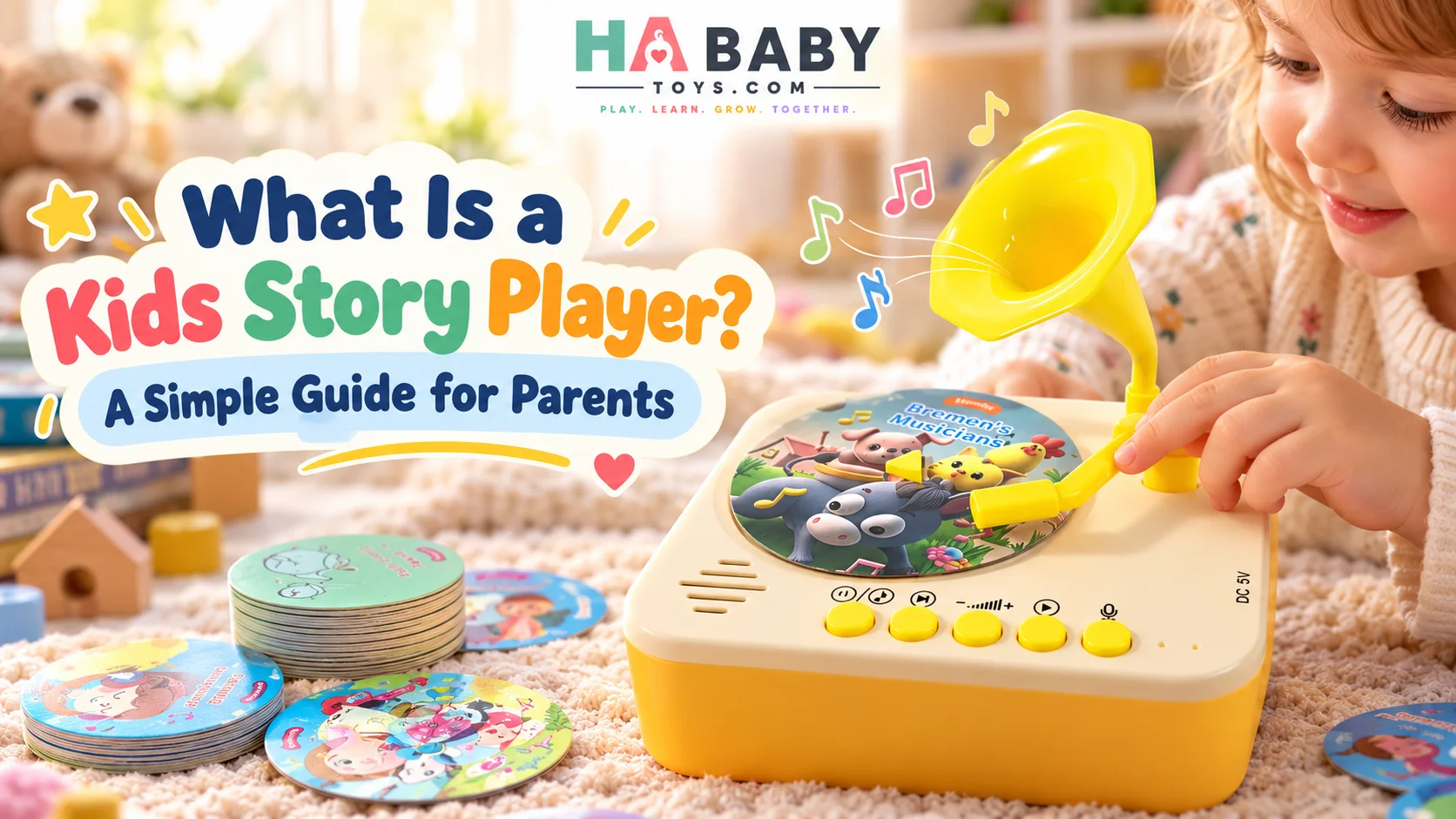
A kids story player is a child-friendly audio device designed to play stories, songs, rhymes, or other spoken content without requiring a video screen. Some models use physical story cards, giving children a simple way to choose what they want to hear.
If you have seen these devices online and are not sure what they actually do, this guide covers everything in plain language: what the device is, how story cards work, how it differs from a tablet or audiobook app, and whether it fits your child. The HA Baby Toys Kids Story Player Gramophone Music Toy with 96 Story Cards combines card-based audio play with stories, songs, and screen-free listening in one child-focused device.
Quick Answer
A kids story player is a dedicated audio device that lets children listen to:
- Stories
- Songs
- Rhymes
- Audio activities
- Repeated favorite content
without relying on a phone or tablet screen.
How a Story Player Works
Five steps from card to listening
HA Baby Toys Kids Story Player
Gramophone music toy with 96 story cards
Choose
The child picks a story or song card.
Place
The card is inserted or positioned as required.
Play
The audio begins.
Listen
The child focuses on the story or song.
Repeat
Favorites can be played again.
Choose → Place → Play → Listen → Repeat
What Exactly Is a Kids Story Player?
A kids story player is usually:
- Audio-focused
- Designed for children
- Simpler than a smartphone
- Built around stories or songs
- Often controlled through physical cards or buttons
- Designed to work without constant screen use
In practice, it is a small speaker-like device that plays stories, songs, and audio activities. What separates it from a generic audio player is the design intent: it is built for children, with content and controls matched to how toddlers and preschoolers actually use devices. Parents who want a practical walkthrough of setup can read the guide on how to use a kids audio story player for screen-free listening.
How Is It Different From a Normal Audio Player?
A standard audio player is designed for adults. A kids story player is designed around the way young children actually interact with sound.
| Feature | Kids Story Player | Standard Audio Player |
|---|---|---|
| Designed for children | Yes | Usually no |
| Story-focused content | Yes | Not necessarily |
| Physical story cards | Often | Rare |
| Simple controls | Usually | Varies |
| Screen required | No or minimal | Varies |
| Child-led selection | Often | Depends |
| Songs and stories | Yes | Depends |
How Story Cards Work
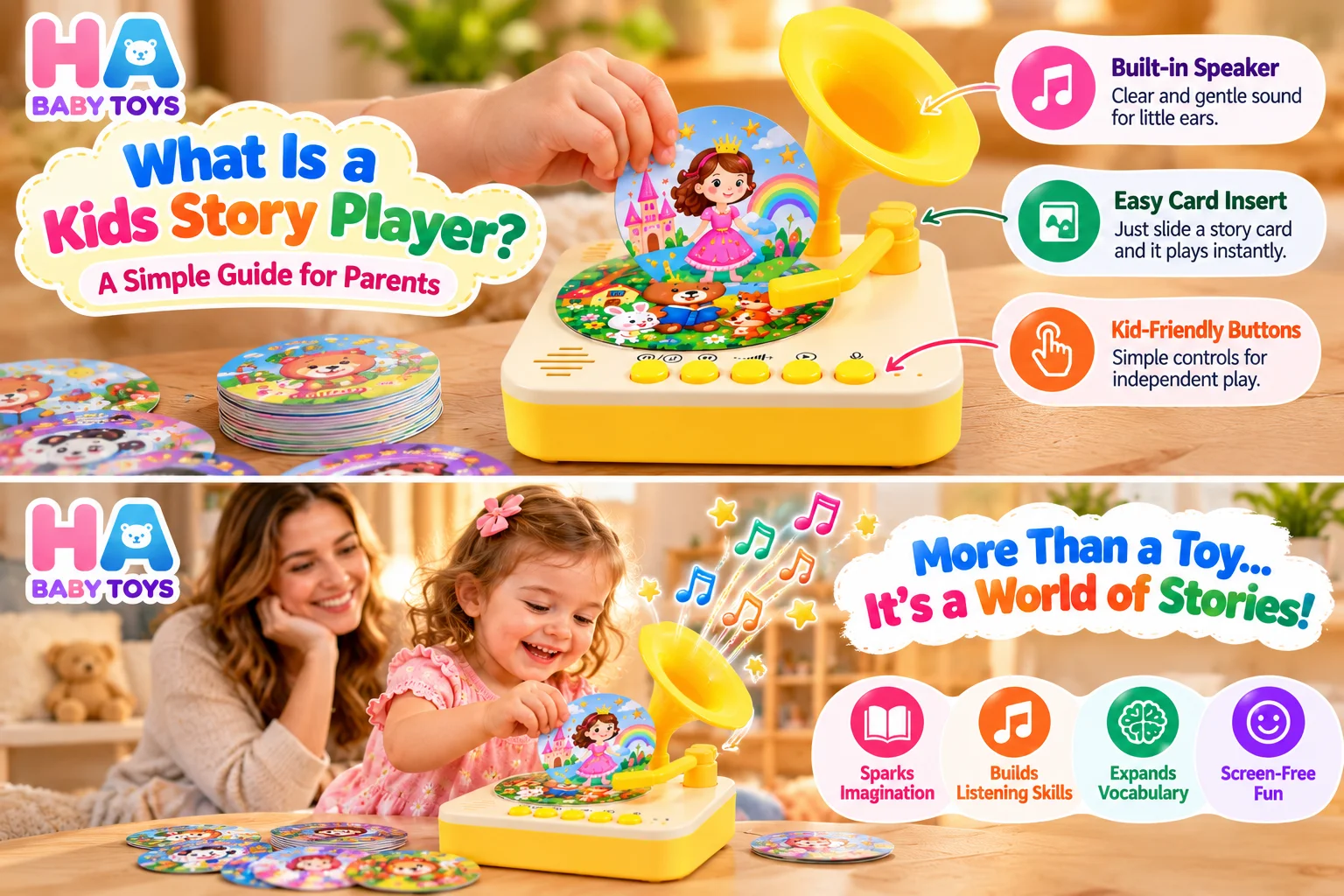
Many story players use physical cards so children can choose content without navigating apps or long menus. The card acts as a physical shortcut to a specific story or song.
Child selects a card
The child picks one card from a small set of options.
Card is placed in or on the player
Depending on the model, the card is inserted or positioned on the device.
Device identifies the content
The player matches the card to its audio.
Story or song begins
Playback starts, and the child listens.
Do not assume the same technology across brands. Some players use card slots, some use top-loaded chips, and some use other mechanisms. Check the manufacturer’s instructions for your specific device.
The HA Baby Toys Kids Story Player with 96 Story Cards gives families a large physical selection of stories and songs that can be rotated over time. Parents comparing options can also read the article on why families may choose a screen-free story player for kids.
Inside the Story Experience
From card to conversation
Card
Child makes a choice.
Sound
Audio delivers the story.
Imagination
The child pictures characters and events.
Conversation
Parents can talk about what happened.
Card → Sound → Imagination → Conversation
What Can Kids Listen To?
Content varies by product. Most kids story players focus on a few core categories.
Stories
Short narratives and character-based audio.
Songs
Music for singing, dancing, or movement.
Rhymes
Repetitive language and rhythm.
Bedtime audio
Calmer content for evening routines.
Educational audio
Depending on the product, simple vocabulary, animals, colors, or concepts.
Favorites
Content the child returns to repeatedly.
Do not assume every card in a set contains all these categories. Check the product details for what is actually included.
Is It Really Screen-Free?
A screen-free story player is designed to deliver audio without requiring children to watch videos or use a tablet interface.
- No video stream
- No scrolling through apps
- No visual entertainment needed
- Audio becomes the main activity
If a product has a small display or indicator light, “screen-free” still applies to the type of activity it enables: listening rather than watching. Use the phrase screen-free listening rather than making absolute technical claims about zero screens unless the manufacturer confirms it.
Why Parents Use Story Players
Parents mention the same reasons again and again. These are practical, not aspirational.
- A dedicated story device
- Less dependence on phones
- Simpler controls
- Quiet-time listening
- Bedtime audio
- Songs without opening streaming apps
- Independent story selection
- Travel entertainment
For a deeper buyer-focused comparison, see why families may choose a screen-free story player for kids. And for practical routines around bedtime, quiet time, and travel, the guide on the HA Baby Toys blog covers those scenarios in more detail.
What Can Children Actually Do With It?
Listening is the start, not the end. There are several simple activities around the device.
Listen to a story
The simplest use — start a card and listen from beginning to end.
Sing along
Use song cards and join in.
Repeat favorite audio
Children often enjoy familiar content repeated.
Act out characters
Turn listening into pretend play.
Draw after listening
Create a picture based on the story.
Retell the story
Ask what happened first, next, and last.
Match toys to stories
If a story mentions animals or objects, find matching toys.
Family listening
Listen together and talk afterward.
Story Player vs Tablet
| Feature | Story Player | Tablet |
|---|---|---|
| Screen required | No | Yes |
| Stories | Yes | Yes |
| Video content | Usually no | Yes |
| Apps | Usually limited or none | Many |
| Notifications | Usually none | Possible |
| Simple controls | Often | More complex |
| Physical cards | Often | No |
| Distraction level | Lower | Potentially higher |
Tablets are more versatile, while story players are more focused. That is the buying distinction, not a claim that one is better than the other.
Story Player vs Smart Speaker
| Feature | Story Player | Smart Speaker |
|---|---|---|
| Child-focused design | Yes | General-purpose |
| Physical story cards | Often | No |
| Voice commands needed | Usually no | Often |
| Screen required | No | No |
| Account dependence | Varies | Common |
| Content selection | Physical and manual | Voice or app based |
Smart speakers are useful for the whole family, but they often rely on voice commands and an account. A story player keeps content choice physical and simple, which some parents prefer for younger children.
Story Player vs Audiobook App
An audiobook app usually runs on a phone or tablet, while a kids audiobook player is a dedicated device intended to keep the listening experience separate from other apps.
Possible differences:
- Fewer distractions
- No app switching
- Physical story cards
- Child-friendly controls
- Dedicated device
For families trying to reduce continuous phone use during story time, this is often the deciding factor.
Is a Story Player Good for Toddlers?
Suitability depends on a few things:
- Manufacturer age guidance
- Child’s ability to handle cards
- Ability to use controls
- Listening interest
- Supervision needs
Many toddlers may enjoy songs, repetition, and short stories, but parents should always follow the specific product’s age recommendations. The NHS baby development guidance and the Raising Children Network both note that children develop at different rates and play preferences vary widely.
What Age Can Children Use It Independently?
Rather than a fixed age, independence builds in stages.
Early stage
Parent chooses and starts audio.
Next stage
Child chooses between two cards.
Developing independence
Child places familiar cards with help.
More independent use
Child chooses and starts favorite content with a parent within earshot.
Not all children progress at the same pace. Follow your child’s readiness rather than a fixed timeline.
How the 96 Story Cards Can Be Organized
Having 96 cards is a strength, but only if they are organized. Instead of handing over all 96 at once, group them.
Simple Choice Rule
2–3 cards at a time is often easier than 96 choices at once.
Story Card Organizer
Simple categories for all 96 cards
Stories
Short narratives and character-based audio.
Songs
Music for singing, dancing, and movement.
Bedtime
Calmer content for evening routines.
Favorites
Content the child returns to repeatedly.
New This Week
One new card introduced each week.
Animals
Cards that focus on animal sounds and names.
How Parents Can Use It for Language-Rich Play
Story audio can create opportunities for:
- Hearing words
- Repeating phrases
- Naming characters
- Talking about events
- Asking questions
- Retelling simple stories
Audio stories work best as one part of a language-rich environment, especially when caregivers talk, respond, and connect the story to everyday experiences. ZERO TO THREE and the National Association for the Education of Young Children (NAEYC) both emphasize responsive interaction as a key driver of early language, and Reading Rockets offers practical guidance on talking about stories. The Harvard Center on the Developing Child describes these back-and-forth exchanges as “serve and return” interactions that build brain architecture.
How It Can Fit Into Daily Routines
The device works best when it slots into moments that already exist in your day.
Morning
Songs and rhymes.
Quiet time
Short stories.
Afternoon
Story plus drawing.
Travel
Audio during family trips.
Bedtime
One calm story.
Weekend
Family listening and talking about what happened.
The 10-Minute Story Player Routine
For busy parents who want a simple, repeatable session.
- Minute 1: Choose one card
- Minutes 2–7: Listen
- Minute 8: Ask one question
- Minute 9: Talk about a favorite part
- Minute 10: Put the card away
More routine ideas are available on the HA Baby Toys blog.
What If My Child Only Wants Songs?
This is normal and not a problem.
- Songs still involve listening
- Movement can be added
- Rhymes can become repetitive play
- Stories can be introduced later
Do not force story content if the child prefers music. Music is often the entry point that builds the habit of listening, and stories can follow naturally over time.
What If My Child Keeps Replaying the Same Story?
Repetition is a normal part of early childhood learning. Rather than resisting it, parents can build on it.
- Let them replay it
- Ask a new question
- Add a toy character
- Draw something from the story
- Introduce one new card after the favorite
ZERO TO THREE notes that repetition is a form of learning, not a sign of boredom.
What If My Child Loses Interest?
| Problem | Try This |
|---|---|
| Walks away quickly | Choose shorter audio |
| Keeps changing cards | Offer only 2 choices |
| Prefers music | Start with songs |
| Gets restless | Add movement |
| Ignores the player | Listen together |
| Wants the same story | Allow repetition |
Safety and Volume Considerations
- Use age-appropriate supervision
- Keep volume comfortable
- Inspect charging cable
- Keep cards and accessories organized
- Follow manufacturer instructions
- Keep device dry unless rated otherwise
The World Health Organization publishes guidance on safe listening and protecting hearing from excessive sound exposure. The U.S. Consumer Product Safety Commission provides product safety guidance for children’s items, and HealthyChildren.org from the American Academy of Pediatrics covers safe play practices.
What Parents Should Not Expect
A kids story player does not:
- Replace books
- Replace conversation
- Guarantee language development
- Automatically improve sleep
- Need to replace all screen use
What it can do:
- Provide audio stories
- Reduce reliance on video for story time
- Offer simple child-friendly listening
- Create opportunities for shared conversation
- Support quiet-time routines
Who Might Like a Story Player Most?
Who Might Prefer Something Else?
A story player may not be ideal if:
- Your child strongly prefers picture books
- You want full video learning
- You want streaming apps
- You do not want to manage physical cards
- You want a general-purpose smart device
This is not a weakness of the device — it is a boundary of what it is designed to do.
Before Buying, Ask:
- Does my child enjoy stories or songs?
- Do I want audio without video?
- Would physical story cards be useful?
- Do I prefer a dedicated kids device?
- Am I comfortable organizing the cards?
- Is the product age guidance appropriate?
- Can I control volume easily?
- Does the included content match my child’s interests?
If that sounds like a good match, you can explore the HA Baby Toys Kids Story Player with 96 Story Cards.
Ready to see the HA Baby Toys Kids Story Player for yourself?
Explore the HA Baby Toys Shop →Frequently Asked Questions
What is a kids story player?
It is a child-friendly audio device that plays stories, songs, rhymes, or other spoken content. Many models use physical story cards so children can choose content without navigating apps or a phone screen.
How does a kids story player work?
The child selects a card or chooses content from the device, starts playback, and listens. Favorites can be replayed. The exact mechanism varies by model, so check the manufacturer’s instructions for your specific device.
What are story cards?
Story cards are physical cards that correspond to specific stories or songs. The child places or inserts a card, and the player identifies the content and starts the audio. They act as a physical shortcut to specific content.
Is a kids story player screen-free?
It is designed to deliver audio without requiring children to watch videos or use a tablet interface. Some models may have small display indicators, but the primary activity is listening rather than watching.
Can toddlers use a story player?
Many toddlers may enjoy songs, repetition, and short stories, but suitability depends on the manufacturer’s age guidance, the child’s ability to handle cards, and supervision needs. Always follow the specific product’s recommendations.
What is the difference between a story player and a tablet?
A tablet is more versatile — it can do video, apps, and games. A story player is more focused — it delivers audio stories and songs without app switching or notifications. The right choice depends on the kind of activity you want to prioritize.
Is a story player the same as a kids audiobook player?
They overlap. A kids audiobook player is a dedicated audio device for children. A story player often adds physical story cards and a broader content range that can include songs and rhymes alongside stories.
Can children use it independently?
Independence builds in stages. Many children start with a parent choosing and starting audio, then progress to choosing between two cards, then placing familiar cards with help, and eventually starting content with a parent within earshot.
Can I use a story player at bedtime?
Yes. A predictable routine with one calm story, lower lights, and low volume works well for many families. Audio does not automatically improve sleep, but it can make the routine feel more structured.
How many cards should I offer at once?
Two or three at a time works better than the full set. A small choice keeps the child focused on listening rather than browsing.
Why does my child repeat the same story?
Repetition is a normal part of early childhood learning. Let them replay favorites, ask a new question each time, or add a toy character to extend the activity.
Can story players replace books?
No, and they are not meant to. Books and story players work well together. Use books for shared reading and picture exploration, and use the story player for independent listening and audio during busy moments.
How loud should the audio be?
Start low and increase only if needed. Keep the player close so high volume is unnecessary. The World Health Organization publishes guidance on safe listening and hearing protection.
How should I store 96 story cards?
Use a small labeled box with category dividers for stories, songs, animals, bedtime, and favorites. Keep only the current working set out and rotate weekly. The HA Baby Toys FAQ also answers common product and ordering questions.
Where can I buy the HA Baby Toys story player?
Browse the HA Baby Toys shop for the gramophone music toy with 96 story cards. Retailers and larger buyers can also request a quote from HA Baby Toys.
The Short Version for Busy Parents
A kids story player is a dedicated audio device built around stories, songs, and screen-free listening. It is not a tablet replacement and it is not a smart speaker. It is a focused tool for one job: letting children choose and listen to audio content in a simple, child-friendly way.
If your child enjoys stories or songs, if you want less reliance on phones during story time, and if physical story cards sound appealing, it can be a strong fit. If you need visual content, streaming services, or a general-purpose device, another product will serve you better.
For more family-friendly products and screen-free play ideas, HA Baby Toys offers toys and activity products designed around everyday family routines.