
A kids badminton set is a child-friendly racket-and-shuttlecock play set designed for simple recreational games rather than formal competition. It usually includes lightweight rackets sized for smaller hands and one or more shuttlecocks, making it easier for children to practice basic hitting, passing and outdoor play. If you are standing in a store aisle or scrolling a product page wondering whether you are buying a real badminton set, a toy racket set, or a general outdoor sports kit — this guide settles it fast.
If you are new to the category, this guide explains what a kids badminton set is and how child-sized racket sets differ from adult sports equipment, before moving into what to check and how to choose.
The 20-second answer
A kids badminton set is typically:
- A child-sized racket play set
- Designed for recreational badminton-style games
- Usually supplied with rackets and shuttlecocks
- Easier to handle than adult sports equipment
- Suitable for simple outdoor or spacious indoor play, depending on the set
- Intended for fun and beginner use rather than formal competition
The beginner rally in five moves — Hold → Serve → Hit → Return → Play Again
Hold
Grip the child-sized racket comfortably.
Serve
Start with a gentle underhand hit.
Hit
Make controlled contact with the shuttlecock.
Return
The other child sends it back.
Play Again
Repeat casually, without focusing on scoring.
↻ The loop that makes beginner rallies fun
What exactly comes in a kids badminton set?
This is the first question almost every confused buyer asks, and the honest answer is: it varies. There is no standard box. Some sets are minimal, some are complete kits.
Possible components may include:
- Two child-sized rackets
- Shuttlecocks
- A carry bag
- A practice ball or soft ball
- A net
- Storage accessories
If you want a concrete example of what a complete set looks like, the HA Baby Toys Kids Badminton Set lists its included components directly on the product page. And if you are comparing this against other outdoor toys, the HA Baby Toys shop is the fastest way to see what else is available.
How is a kids badminton set different from adult badminton equipment?
This comparison resolves most buyer confusion in under a minute. The differences are not cosmetic — they change who can use the equipment and how.
| Feature | Kids badminton set | Adult badminton equipment |
|---|---|---|
| Racket size | Smaller | Full-size |
| Weight | Usually lighter | Performance-specific |
| Grip size | Child-friendly | Adult grip |
| Play style | Recreational | Recreational or competitive |
| Skill level | Beginner | Beginner to advanced |
| Focus | Fun and practice | Technique and performance |
The practical takeaway: a child using an adult racket will usually swing it late, hit the frame, and lose interest. A child-sized racket is not a “lesser” version — it is the correct tool for the grip and reach the child actually has. For age-appropriate physical play expectations rather than product claims, the American Academy of Pediatrics’ school-age guidance on HealthyChildren.org is a clear, non-commercial reference.
Kids racket anatomy: what you are actually holding
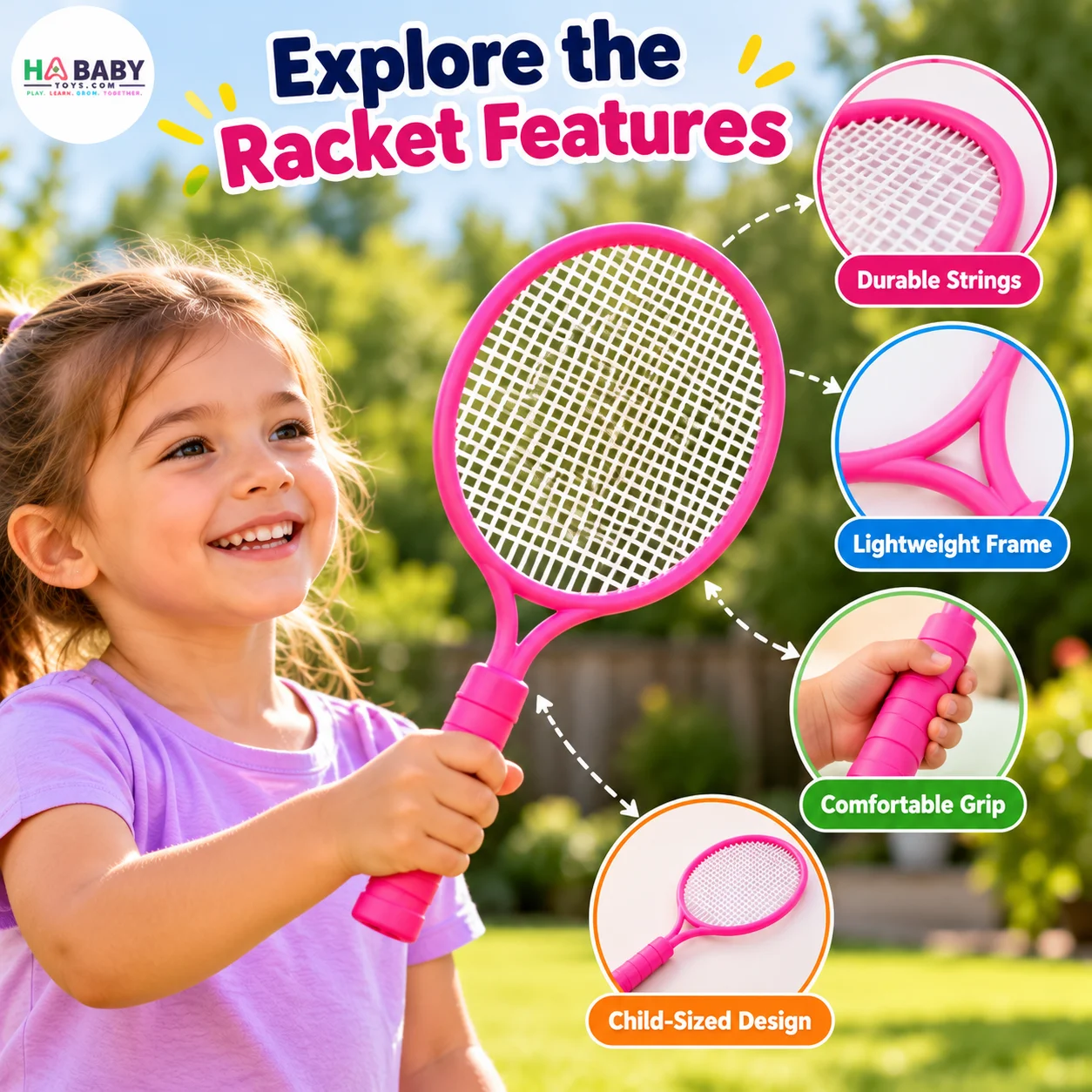
You do not need to be a coach to buy a child’s racket, but knowing the parts helps you judge a listing — especially the parts that determine whether a child can control the swing.
Exact dimensions vary by model, so treat the listing’s measurements as the source of truth rather than assuming any standard size.
Is it badminton, tennis, or both?
This matters because many children’s racket sets are marketed broadly — and buyers sometimes end up with something different from what they expected.
Some children’s racket sets are marketed broadly as badminton or tennis-style sports toys because they use lightweight rackets for simple hitting games. A true badminton game uses a shuttlecock, while tennis uses a ball and different equipment. That distinction is the whole difference in practice.
Kids badminton set vs kids tennis set
Kids badminton set
- Usually uses shuttlecocks
- Lighter contact
- Easier backyard rallies
- Less bounce-dependent
Kids tennis set
- Usually uses a ball
- Requires more ground space
- Bounce and court surface matter more
- Suits hard, flat surfaces
Neither is universally better. For a small garden or a quick backyard game, the shuttlecock is usually easier. For a hard court or driveway, a tennis-style ball may suit better.
Kids badminton set vs mini racket toy
A mini racket toy may be more basic and used mostly for casual batting games. A kids badminton set is more likely to support two-player rallies, shuttlecock play, beginner serving and simple family games. If you want something a sibling pair can actually play together with, the set is the better fit.
What is a shuttlecock, and why does it matter?
Many parents do not know, and there is no shame in that. A shuttlecock is the lightweight projectile used in badminton. Its shape helps it travel differently from a ball, which can make slower beginner rallies easier to follow.
That is the practical reason it suits children: a shuttlecock slows down and drops more predictably than a bouncy ball, so a beginner has a better chance of actually making contact. For official sport context rather than product claims, the Badminton World Federation explains the sport’s basic equipment and rules.
Where can kids use a badminton set?
Possible settings include:
- Backyard
- Garden
- Park
- Playground
- Indoor sports room
- A large open room, if the set and space allow
The safest place is an open area with enough space around the players for controlled racket swings. That single rule prevents most of the incidents covered later in this guide.
Safe play zone
Player A → clear zone → shuttle path → clear zone → Player B
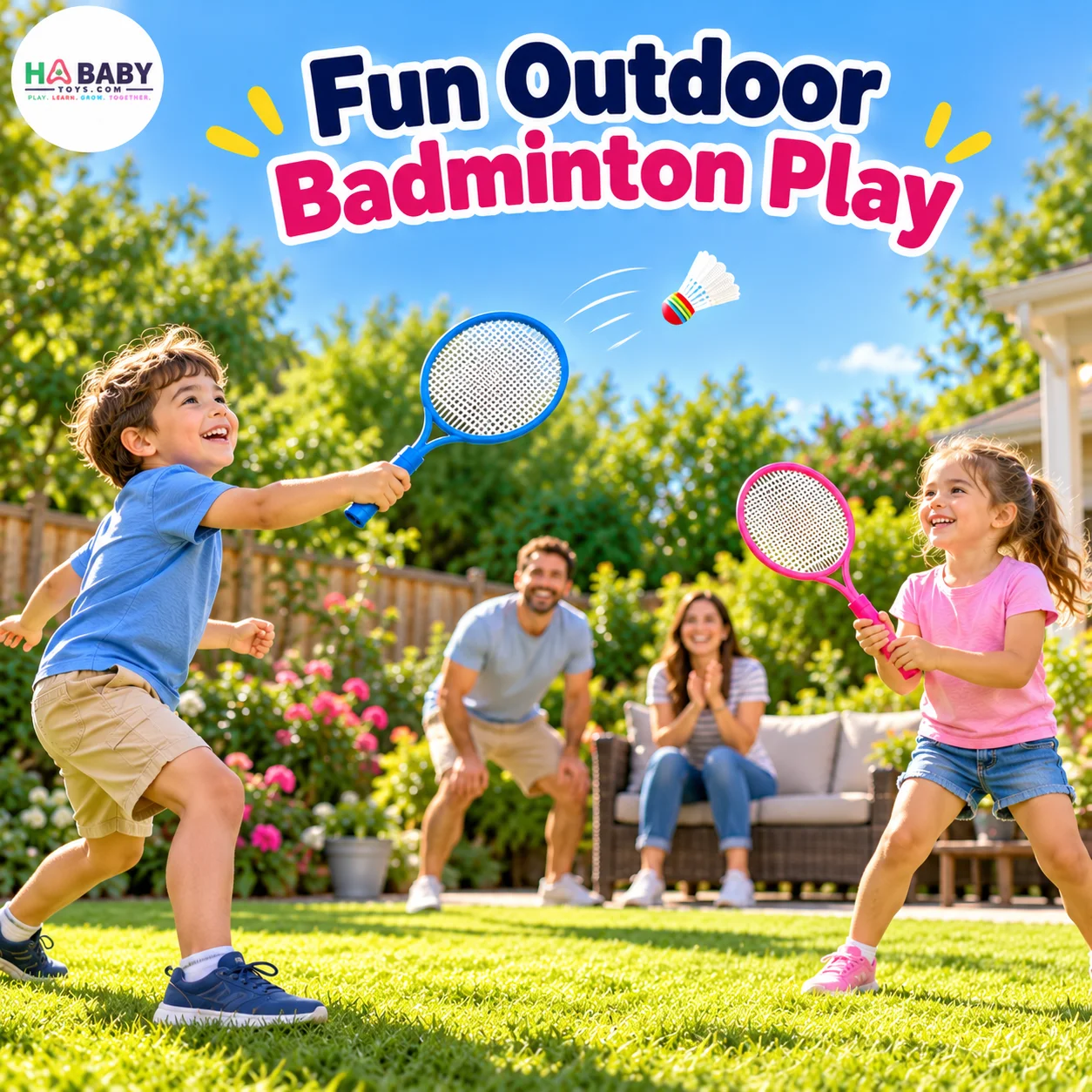
How do children actually play with it?
Keep the first sessions simple. A beginner sequence that works for most families:
- Stand several steps apart.
- Hold the racket comfortably.
- One child gently serves.
- The other tries to return.
- Keep rallies slow.
- Reset if the shuttlecock falls.
Do children need a net? A net can make the game more badminton-like, but young beginners can still enjoy simple back-and-forth hitting without one. If you are unsure how to set up a first session, how to use a kids badminton racket set covers spacing, grip and safe beginner play step by step.
Can one child use it alone?
Yes. A badminton set does not require two players to be useful. Simple solo activities include:
- Toss and tap
- Keep-it-up challenge
- Hit toward a target
- Practice serving
- Bounce-free control drills with the shuttlecock
These are genuine activities, not consolation prizes — a child practicing keep-it-up is doing exactly the kind of hand-eye work the toy is built for. For wider context on how movement play fits into child development, the CDC’s physical activity guidance for children is a clear reference.
Two-player and parent-child games
When two children are playing, the simplest games are the ones that actually get repeated:
The “serve and catch” version is worth highlighting for families new to racket sports. Catching first removes the pressure of making contact and lets a child focus on tracking the shuttlecock — which is the harder half of the skill anyway.
Can it support active play, hand-eye practice and outdoor time?
Careful wording matters here, so here is the careful version.
A kids badminton set can encourage children to stand, move, reach and follow the shuttlecock during recreational play. Tracking the shuttlecock and trying to make contact can provide opportunities to practice hand-eye coordination during play. These are descriptions of what the activity asks for, not guaranteed development outcomes.
On outdoor time: because badminton works well in gardens, yards and parks, the set can give families another simple reason to spend time playing outdoors. That is practical without overselling. For broader physical activity context, the World Health Organization’s physical activity fact sheet is a reliable reference point.
Is it good for beginners? Is it suitable for toddlers?
A beginner-friendly set may be easier because rackets are smaller, equipment is lighter, rules can be simplified, scoring is optional, and short rallies are enough. For beginners, fun and controlled contact matter more than formal badminton rules — that is the whole point of a child-sized set.
Toddlers are a different question. Suitability depends on the manufacturer’s stated age guidance, racket size, grip size, projectile size, and the child’s ability to follow simple safety instructions. Do not assume all kids badminton sets are appropriate for toddlers — a set designed for a six-year-old has different dimensions and expectations than one designed for a three-year-old. If you are browsing by age, the HA Baby Toys 3+ Years category keeps you in age-appropriate territory.
What should parents check before buying?
This is the checklist that separates a good purchase from a return. Check:
- Manufacturer age guidance
- Racket size
- Racket weight
- Grip comfort
- Shuttlecock size
- Number of rackets included
- Whether a net is included
- Storage bag, if relevant
- Smooth edges on the frame and shaft
- Overall build quality
Only state verified features as facts — if a listing does not mention a net, assume there is no net. If you are comparing outdoor toys more broadly, why choose a kids badminton set sets out the buying case in more detail.
Safety considerations
A racket is a swinging object, and a shuttlecock is a fast-moving one. Both are fine for children — with a few rules taught early.
Parents should teach:
- Do not swing near another person’s face
- Maintain space between players
- Do not throw rackets
- Do not hit people or pets
- Stop if the racket cracks
- Use controlled swings
- Supervise younger children
For authoritative toy and equipment safety guidance, the U.S. Consumer Product Safety Commission’s toy safety guidance and Safe Kids Worldwide’s toy safety tips are both worth two minutes before checkout. The Mayo Clinic’s child safety overview and Nemours KidsHealth’s toy safety page cover the same ground in plain language.
What the set is not
Trust is built by saying what a product does not do, so here is that list plainly. A kids badminton set:
- Is not professional tournament equipment
- Does not guarantee sports skill
- Does not need formal scoring
- Is not safe for rough sword-style play
- Is not appropriate in crowded spaces
- Should not be used if damaged
What it can offer: simple racket play, family activity, outdoor recreation, beginner sports practice and casual two-player games. That is a genuinely good list — it just is not a promise of athletic development.
Who is this set best for?
Who might prefer something else?
Another product may be better if:
- You need an indoor-only toy
- You want a completely quiet activity
- You want professional sports equipment
- Your child dislikes racket games
- You have very limited play space
- The manufacturer’s age guidance does not fit
Balanced guidance builds trust, and it also prevents returns. For more parent guides written in this same plain-English style, browse the HA Baby Toys blog.
60-second buyer checklist — choose a kids badminton set if…
- Your child enjoys active play
- You want a simple racket game
- You have enough clear play space
- Two-player play is important
- Outdoor use appeals to your family
- The racket size fits the child
- The manufacturer’s age guidance fits
- You understand it is recreational equipment, not professional gear
If that sounds right for your family, explore the HA Baby Toys Kids Badminton Set. To compare it with the wider range, visit the HA Baby Toys shop or learn more about HA Baby Toys.
Kids badminton set FAQ
Tap any question to expand the answer.
What is a kids badminton set?
A kids badminton set is a child-friendly racket-and-shuttlecock play set designed for simple recreational games rather than formal competition. It usually includes lightweight rackets sized for smaller hands and one or more shuttlecocks, making it easier for children to practice basic hitting, passing and outdoor play.
What usually comes in a kids badminton set?
Contents vary by model. Possible components include two child-sized rackets, shuttlecocks, a carry bag, a practice ball or soft ball, a net, and storage accessories. Always check the specific product page — not every set includes the same items.
How is a kids badminton set different from adult badminton equipment?
Kids’ rackets are smaller, usually lighter, and have child-friendly grips. The play style is recreational rather than competitive, the skill level is beginner, and the focus is fun and practice rather than technique and performance.
Is a kids badminton set the same as a kids tennis set?
No. Badminton uses a shuttlecock; tennis uses a ball. Some children’s racket sets are marketed broadly as badminton or tennis-style sports toys, but the projectile and the play surface expectations differ. Badminton generally suits smaller spaces better.
Do children need a net to play?
A net can make the game more badminton-like, but young beginners can still enjoy simple back-and-forth hitting without one. If your set does not include a net, you are not blocked from play.
Can one child use a badminton set alone?
Yes. Solo activities include toss and tap, keep-it-up challenge, hitting toward a target, practicing serves, and bounce-free control drills with the shuttlecock. These are genuine practice activities, not just filler.
Can siblings use it together?
Yes. Simple two-player games include counting returns in a rally, aiming at color targets, practicing gentle serves, and playing as a team with a parent. Short rallies are enough for beginners.
Can it be used indoors?
Possibly, in a large open room with enough space for controlled swings — but the safer default is outdoors. Indoor play requires ceiling height, clear floor space, and no nearby glass or fragile objects. Check the set’s guidance and use your own judgment about the room.
Is it suitable for toddlers?
It depends on the manufacturer’s stated age guidance, racket size, grip size, projectile size, and the child’s ability to follow simple safety instructions. Do not assume all kids badminton sets are appropriate for toddlers — a set designed for a six-year-old has different dimensions than one for a three-year-old.
What should parents check before buying one?
Manufacturer age guidance, racket size, racket weight, grip comfort, shuttlecock size, number of rackets included, whether a net is included, storage bag if relevant, smooth edges, and overall build quality. Only treat features listed on the product page as confirmed.
Are smaller rackets easier for children?
Generally yes. A racket matched to the child’s grip and reach is easier to control than an adult racket. A child using an oversized racket tends to swing late and hit the frame, which usually ends in frustration rather than play.
Can kids play badminton without keeping score?
Yes, and for beginners it is usually better. Fun and controlled contact matter more than formal rules at this stage. Rallies, target games and keep-it-up challenges all work without any scoring at all.
Is it good for outdoor play?
Yes. A kids badminton set works well in gardens, yards and parks, and it gives families another simple reason to spend time playing outdoors. The safest place is an open area with enough space around the players for controlled racket swings.
What safety rules should children follow?
Do not swing near another person’s face, maintain space between players, do not throw rackets, do not hit people or pets, stop if the racket cracks, use controlled swings, and supervise younger children. The single most important rule: never swing while someone is within arm’s reach.
Where can I buy the HA Baby Toys Kids Badminton Set?
You can buy it directly from the HA Baby Toys Kids Badminton Set product page. For more parent guides, browse the HA Baby Toys blog, and for common order and safety questions, check the HA Baby Toys FAQ. Retailers and larger-volume buyers can request a quote.
The short version
A kids badminton set is a simplified, child-sized racket-and-shuttlecock kit for recreational play — not tournament equipment, and not a guaranteed route to athletic skill. It is at its best when children have clear space, a racket that fits their hands, and a parent willing to start with slow rallies. Buy it if that sounds like your family; skip it if you need a quiet indoor toy or a real beginner sports instrument.
If you are still deciding whether the category is right, why choose a kids badminton set covers the buying case in more detail. And if you have already decided, the HA Baby Toys Kids Badminton Set is the direct next step.
About this guide: Written for parents, guardians and gift buyers choosing a first racket set for a child. Product-specific details such as included accessories, racket dimensions and recommended age vary by model — always confirm them on the individual product page and follow the manufacturer’s instructions. Safety guidance here is general in nature and does not replace manufacturer instructions or adult supervision.
2 Responses