
A kids badminton set gives children a simple way to enjoy racket-based play without needing a full sports court or advanced technique. With child-sized rackets and a lightweight shuttlecock, it can be easier to set up, easier to understand, and more flexible for casual garden, park or family play. If you are weighing it against another outdoor toy, a tennis set, or a more complicated sports game, this guide makes the decision straightforward.
If you are still comparing racket toys, start with what a kids badminton set is and come back here for the buying case.
Why parents may choose a kids badminton set
- Simple to set up
- Easy to understand
- Good for two-player play
- Can be used in gardens, parks and open spaces
- Child-sized rackets are easier to handle
- No complicated equipment needed
- Can be played casually without strict rules
- Useful for family play and beginner racket practice
Best for: families who want a simple outdoor activity that combines movement, racket play and easy parent-child or sibling interaction.
The play loop in five moves — Grab → Serve → Move → Rally → Repeat
Grab
Pick up the child-sized racket.
Serve
Start with a gentle hit.
Move
Track the shuttlecock and reposition.
Rally
Try to return it.
Repeat
Play again without complicated setup.
↻ Five moves, no court, no rulebook
Benefit 1: It is easier to start than many sports
This is the clearest reason to choose one over a larger sports toy. A kids badminton set usually requires less setup than football goals, basketball hoops, full tennis courts or large sports equipment.
A simple beginner session may need only:
- Two rackets
- One shuttlecock
- Some open space
You do not need formal scoring, a full court or advanced technique to start playing. That low barrier is exactly what a family with twenty minutes before dinner actually needs. For broader physical activity context rather than product claims, the CDC’s physical activity guidance for children and the World Health Organization’s physical activity fact sheet are both reliable references.
Benefit 2: Child-sized rackets can be easier to handle
Smaller equipment may feel more manageable for children. A child-sized racket can make beginner handling more comfortable than using full-size adult equipment, for a few simple practical reasons:
- Shorter reach matches a shorter arm
- Easier grip for a small hand
- Lighter handling
- Less awkward than an adult racket
We are not claiming precise weight advantages — those vary by model. The point is simpler: a racket that fits the child’s body produces cleaner swings and fewer misses, and fewer misses means the toy actually gets used. For age-appropriate physical play expectations, the American Academy of Pediatrics’ school-age guidance on HealthyChildren.org is a clear, non-commercial reference.
Kids badminton set vs adult badminton gear
This table resolves most of the confusion buyers arrive with. The differences are not cosmetic — they change who can use the equipment and how.
| Feature | Kids badminton set | Adult badminton gear |
|---|---|---|
| Racket size | Smaller | Full-size |
| Handling | Beginner-friendly | More performance-focused |
| Setup | Simple | Can be more formal |
| Rules | Flexible | Often regulation-based |
| Play style | Casual | Casual or competitive |
| Best use | Family and beginner play | Sport and training |
Benefit 3: It is good for two-player play
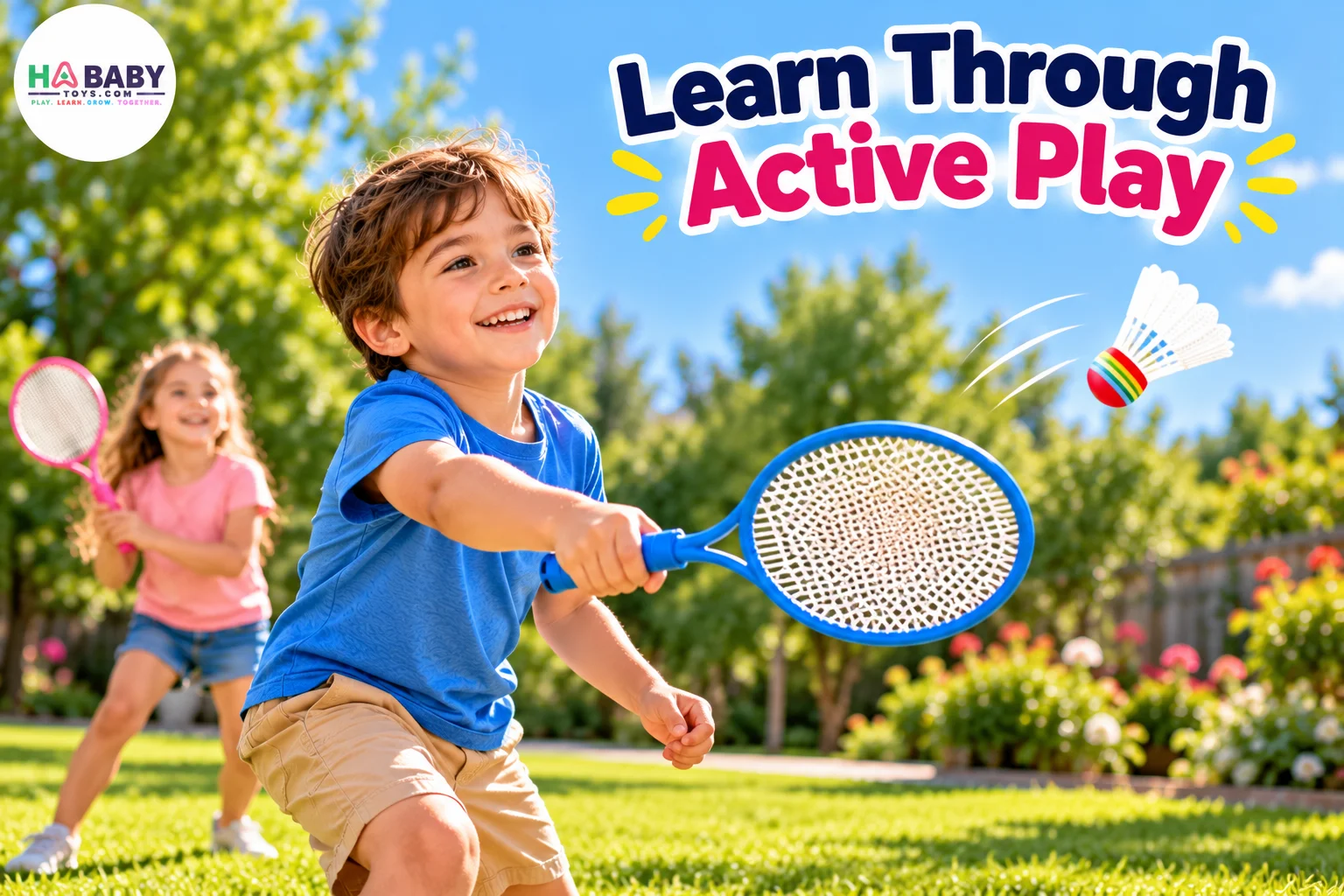
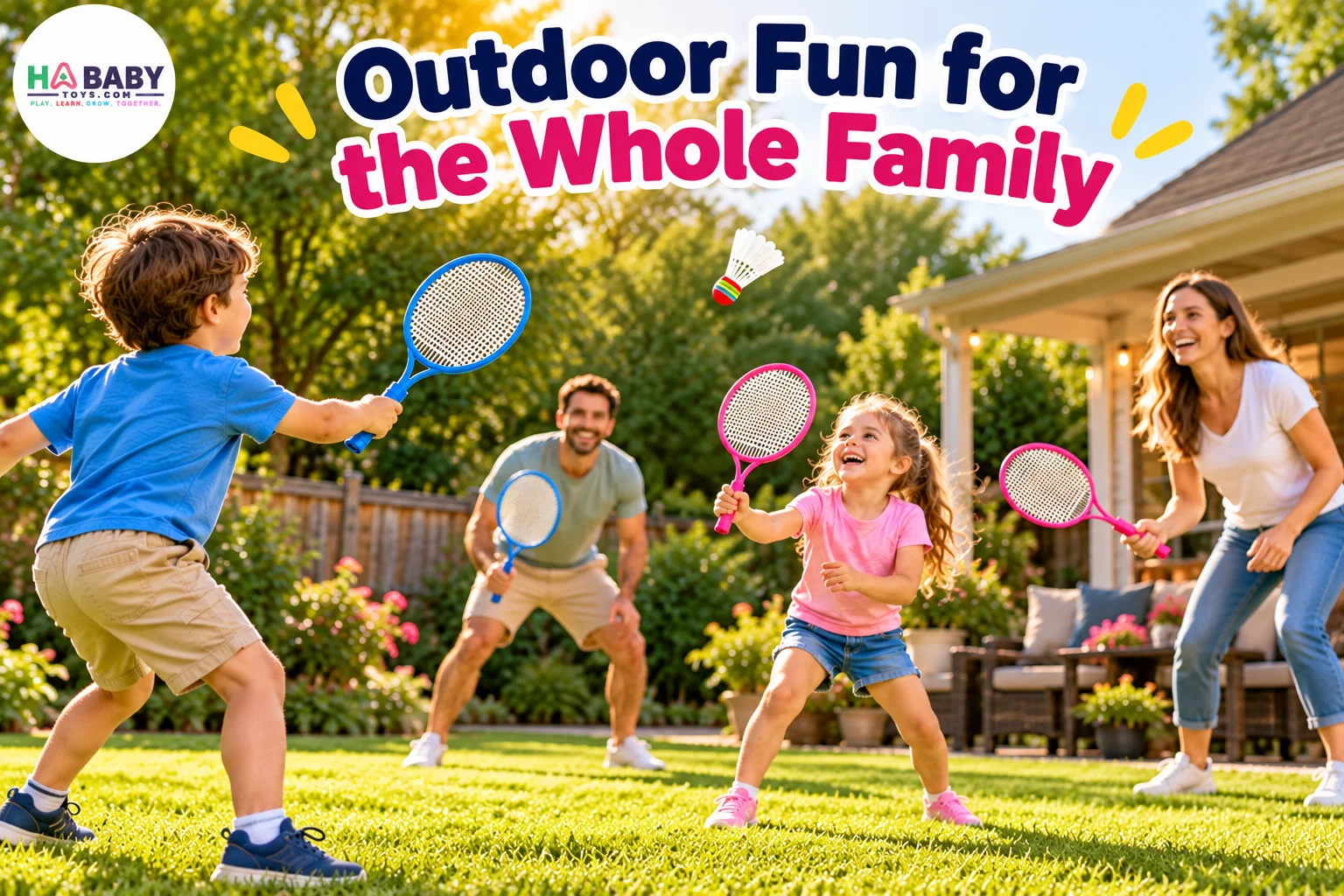
This is one of the strongest family benefits, and it is the reason many parents choose a badminton set over a solo toy. Children can play with a sibling, play with a parent, play with a friend, take turns serving, and count simple rallies.
The set can create opportunities for turn-taking and cooperative play without requiring a complex team setup. A football match needs a group; badminton needs one other person and a few square metres.
Who can play
Every combination works, with the right spacing
Benefit 4: It works well for outdoor play
Possible settings include a backyard, garden, park, playground or picnic area. Badminton is flexible because children can play casually in many open spaces without needing a permanent court.
One honest caveat: wind can affect the shuttlecock, so calmer outdoor conditions may be easier for beginners. A breezy day is not unsafe — it just makes consistent contact harder, and beginners read that as their own failure.
Benefits 5 and 6: Movement-based play and hand-eye practice
Careful wording matters here, so here is the careful version.
Children may naturally step, reach, turn and move while following the shuttlecock during play. Trying to track and hit a moving shuttlecock can provide opportunities to practice hand-eye coordination during play. These are descriptions of what the activity asks for — not guarantees of fitness or developmental gains.
For beginner sport context and youth movement resources, USA Badminton and SHAPE America are both useful references. For the sport’s actual equipment and rules, the Badminton World Federation is authoritative if you ever want to look them up.
Benefit 7: It is easy to simplify for beginners
This is a major advantage over formal sports. Parents can remove strict scoring, net requirements, service rules and court boundaries — and focus only on a gentle hit, a return, and a repeat.
That makes the game less frustrating. A child who is allowed to catch the shuttlecock and then serve it is still practising tracking and contact; the rules can come later, once the fun is established. For a full step-by-step setup, how to use a kids badminton racket set covers grip, spacing, serving and safe beginner play.
Beginner mode
Strip it back to five things that actually work
Every one of these can be dropped back to the previous step if a child loses confidence. That flexibility is the point of a beginner set.
Benefit 8: It can grow with the child’s interest
Without making strong developmental claims, the play can become more complex over time — and that is where the replay value sits.
Start with:
- Toss and hit
- Catch and return
- One-hit rallies
Later add:
- A net
- Longer rallies
- Target zones
- Simple scoring
A set that a four-year-old uses for tap-ups and a seven-year-old uses for rallies is a set that earns its shelf space twice over.
Benefits 9 and 10: Parent-child and sibling play
The easiest parent-child activities are the ones that need no explanation:
- Serve to me — parent serves slowly to child
- Five-hit challenge — try to make five combined hits
- Target zone — aim toward a marked area
- Copy my swing — parent demonstrates a gentle movement
For siblings, keep competition light: one serves and one returns, switch every five attempts, count combined rallies, or cooperate to keep the shuttlecock in play. Cooperative formats tend to last longer than competitive ones at this age.
Kids badminton set vs kids tennis set
Kids badminton set
- Uses a shuttlecock
- No bounce required
- Works well in smaller open spaces
- Lightweight play
Kids tennis set
- Uses a ball
- Usually needs a bounce-friendly surface
- Often needs more horizontal space
- Suits hard, flat courts
Badminton may be easier for families who want a simple rally game without relying on ball bounce. Neither is universally better — the right choice depends on your surface and space.
Kids badminton set vs football
Badminton
- Smaller play area
- Racket-based
- Good for pairs
Football
- More running
- Usually more open space
- Can suit larger groups
Neither is universally better. Badminton suits pairs in a small garden; football suits groups in a larger field.
Kids badminton set vs indoor electronic toy
Badminton set
- Outdoor or spacious-area play
- Physical movement
- Social interaction
Electronic toy
- Often indoor
- More stationary
- May include sound and light feedback
These are different play styles rather than competitors. If you want movement and a second player, badminton wins; if you want a quiet indoor activity, it does not.
Is it portable? Is it a good gift?
If the set is compact enough, it may be portable — useful for a family picnic, a park trip, garden play or a holiday activity. A lightweight racket set can be convenient for car trips or holidays if the rackets fit easily into your luggage or vehicle. We are not making product-specific portability claims here, because storage features vary by model — check the product page for what is actually included.
As a gift, it suits several occasions: birthdays, holidays, summer gifts, outdoor-play gifts and sibling activity gifts. It may suit children who already enjoy active games, racket play or outdoor family activities. If you are shopping by age, the HA Baby Toys 3+ Years category is the fastest route to appropriate options.
Who is this product best for?
Who might prefer something else?
Another product may be better if:
- You have no safe open space
- Your child dislikes racket games
- You need a quiet indoor toy
- You want professional sports equipment
- Wind is a constant issue in your play area
- The manufacturer’s age guidance does not fit
Balanced guidance builds trust, and it also prevents returns. For more parent guides written in this same plain-English style, browse the HA Baby Toys blog.
Safety is part of the value
A set that is not safe is not a bargain. Before the first game, parents should check the racket condition, grip security, shuttlecock condition, play-space clearance, spacing between players, and nearby people and pets.
For the wider standards behind those checks, the U.S. Consumer Product Safety Commission’s toy safety guidance and Safe Kids Worldwide’s toy safety tips are both authoritative. The Mayo Clinic’s child safety overview and Nemours KidsHealth’s toy safety page cover the same ground in plain language, and the NHS exercise guidance is useful for general activity context.
What the set cannot do
A kids badminton set:
- Does not guarantee sports skill
- Does not replace formal coaching
- Does not need to follow regulation rules
- Is not professional tournament equipment
- Should not be used for rough sword-style play
- Should not be used if damaged
What it can offer:
- Simple racket fun
- Family interaction
- Outdoor recreation
- Beginner sports play
- Easy two-player activity
Common buyer expectations vs reality
Tap each expectation to see the honest version.
Expectation: “My child will instantly play proper badminton.”
Reality: Most beginners start with simple tapping, serving and short rallies. Proper play comes later, if at all — and for a recreational set, it does not need to.
Expectation: “We need a net.”
Reality: Beginners can enjoy back-and-forth hitting without one. A net is a useful addition once contact is consistent, not a requirement to start.
Expectation: “Kids badminton and tennis are the same.”
Reality: They are different sports using different equipment and play patterns. Badminton uses a shuttlecock; tennis uses a ball and relies on bounce.
Expectation: “It will automatically improve coordination.”
Reality: It can provide opportunities for hand-eye practice, but outcomes vary. The set creates the opportunity; it does not guarantee the result.
Expectation: “We need a big court.”
Reality: Casual play can work in many open spaces if there is enough safe swing room. A garden or a quiet corner of a park is usually sufficient.
60-second buyer checklist — choose a kids badminton set if…
- Your child enjoys active play
- You want a simple two-player activity
- You have safe open space
- Child-sized equipment matters
- You prefer low-setup outdoor toys
- Parent-child play is important
- The manufacturer’s age guidance fits
- You understand it is recreational, not professional gear
If that matches your needs, explore the HA Baby Toys Kids Badminton Set. To compare it with the wider range, visit the HA Baby Toys shop or learn more about HA Baby Toys.
Kids badminton set FAQ
Tap any question to expand the answer.
Why choose a kids badminton set?
Because it gives children a simple way to enjoy racket-based play without needing a full sports court or advanced technique. Child-sized rackets and a lightweight shuttlecock make it easier to set up, easier to understand and more flexible for casual garden, park or family play.
Is a kids badminton set good for beginners?
Yes. Rackets are smaller, equipment is lighter, rules can be simplified, scoring is optional, and short rallies are enough. For beginners, fun and controlled contact matter more than formal badminton rules.
Do children need a net to play?
No. Young beginners can enjoy simple back-and-forth hitting without one. A net becomes useful once the child is making consistent contact and is ready to aim upward over a height.
Is badminton easier than tennis for kids?
It can be, for a few practical reasons: the shuttlecock slows down more predictably than a bouncing ball, and badminton does not depend on the play surface. Tennis may suit better if you have a hard court or driveway available.
Can siblings use the set together?
Yes. Simple formats include one serves and one returns, switching every five attempts, counting combined rallies, or cooperating to keep the shuttlecock in play. Keep competition light, and stop the rally if both players move toward the same shuttlecock.
Can one child play alone?
Yes. Solo activities include a tap-up challenge, hitting toward a target, serve practice, and parent-toss returns. These are genuine practice activities and often the fastest route to a decent first rally.
Can it be used indoors?
Possibly, in a large open room with enough ceiling height and no nearby breakables — but a small room is usually a poor choice because of swing clearance. Outdoors is the safer default for beginners.
Is it good for outdoor play?
Yes. It works well in gardens, parks and playgrounds, and it does not need a permanent court. Wind can affect the shuttlecock, so calmer conditions are easier for beginners.
Does it help with hand-eye coordination?
Trying to track and hit a moving shuttlecock can provide opportunities to practice hand-eye coordination during play. It does not guarantee improvement — outcomes vary, and the toy creates the opportunity rather than the result.
What should parents check before buying one?
Manufacturer age guidance, racket size, racket weight, grip comfort, shuttlecock size, number of rackets included, whether a net is included, smooth edges and overall build quality. Before the first game, follow how to use a kids badminton racket set for grip, spacing, serving and safe beginner play.
How much space do children need?
Enough room for each child to swing a racket in every direction without reaching the other player, and enough clear space around the pair for the shuttlecock to land safely. A garden or a quiet corner of a park is usually sufficient for casual play.
Is a kids badminton set good for travel?
A lightweight racket set can be convenient for car trips or holidays if the rackets fit easily into your luggage or vehicle. Check the product page for what is actually included, since storage features vary by model.
Is it a good gift?
It suits birthdays, holidays, summer gifts, outdoor-play gifts and sibling activity gifts. It may suit children who already enjoy active games, racket play or outdoor family activities. If unsure, the 3+ Years category keeps you in age-appropriate territory.
What safety rules should children follow?
Never swing near another person’s face, maintain space between players, do not throw rackets, do not hit people or pets, stop if the racket cracks, use controlled swings, and supervise younger children. The single most important rule: stop the rally if both players move toward the same shuttlecock.
Where can I buy the HA Baby Toys Kids Badminton Set?
You can buy it directly from the HA Baby Toys Kids Badminton Set product page. For more parent guides, browse the HA Baby Toys blog, and for common order and safety questions, check the HA Baby Toys FAQ. Retailers and larger-volume buyers can request a quote.
The short version for buyers
Choose a kids badminton set if you want an active, two-player outdoor toy that is quick to set up, easy for a child to handle, and flexible enough to work in a garden, park or playground. Skip it if you have no safe open space, need a quiet indoor activity, or want professional sports equipment. It is not tournament gear and it will not guarantee athletic skill — but as a simple, social, low-setup outdoor activity, it earns its place.
If you are still weighing the category itself, the detail on what a kids badminton set is pairs well with this guide, and how to use a kids badminton racket set takes you from purchase to first rally. If you have already decided, the HA Baby Toys Kids Badminton Set is the direct next step.
About this guide: Written for parents, guardians and gift buyers comparing outdoor and racket-based toys for children. Product-specific details such as included accessories, racket dimensions and recommended age vary by model — always confirm them on the individual product page and follow the manufacturer’s instructions. Safety guidance here is general in nature and does not replace manufacturer instructions or adult supervision.