
A kids badminton racket set is easiest to use when parents start with space, a simple grip, gentle swings and short rallies rather than formal rules. Clear the play area, show the child where to hold the racket, begin with an underhand serve, and focus on controlled contact instead of power. This guide walks through that sequence step by step, in the order you will actually need it.
If you are still figuring out what the set should contain, start with what a kids badminton set is and come back here when you are ready to play.
The 60-second beginner setup
- Check the rackets and shuttlecock.
- Choose a clear play area.
- Stand players far enough apart.
- Show the correct grip.
- Start with a gentle underhand serve.
- Use short, controlled swings.
- Keep rallies slow.
- Stop if players move too close together.
The beginner workflow in five moves — Check → Space → Grip → Serve → Rally
Check
Inspect racket, strings, handle and shuttlecock.
Space
Create a safe area around each player.
Grip
Hold the racket comfortably, not tightly.
Serve
Use a gentle underhand start.
Rally
Try slow back-and-forth hits.
↻ Five steps that make the first session work
Step 1: Inspect the set before play
Two minutes of inspection prevents most of the frustration that ends a first session early. A racket that is cracked, or a shuttlecock missing its skirt, will produce misses the child cannot understand and cannot fix.
Parents should check:
- Cracked racket frame
- Loose handle
- Frayed or broken strings
- Sharp edges on the frame or shaft
- Damaged shuttlecock
- Loose detachable pieces
For the wider safety standards behind these checks, the U.S. Consumer Product Safety Commission’s toy safety guidance and Safe Kids Worldwide’s toy safety tips both explain what a well-made set should and should not have. For the wider buying context, why choose a kids badminton set covers what to look for before you even open the box.
Step 2: Choose the right play area
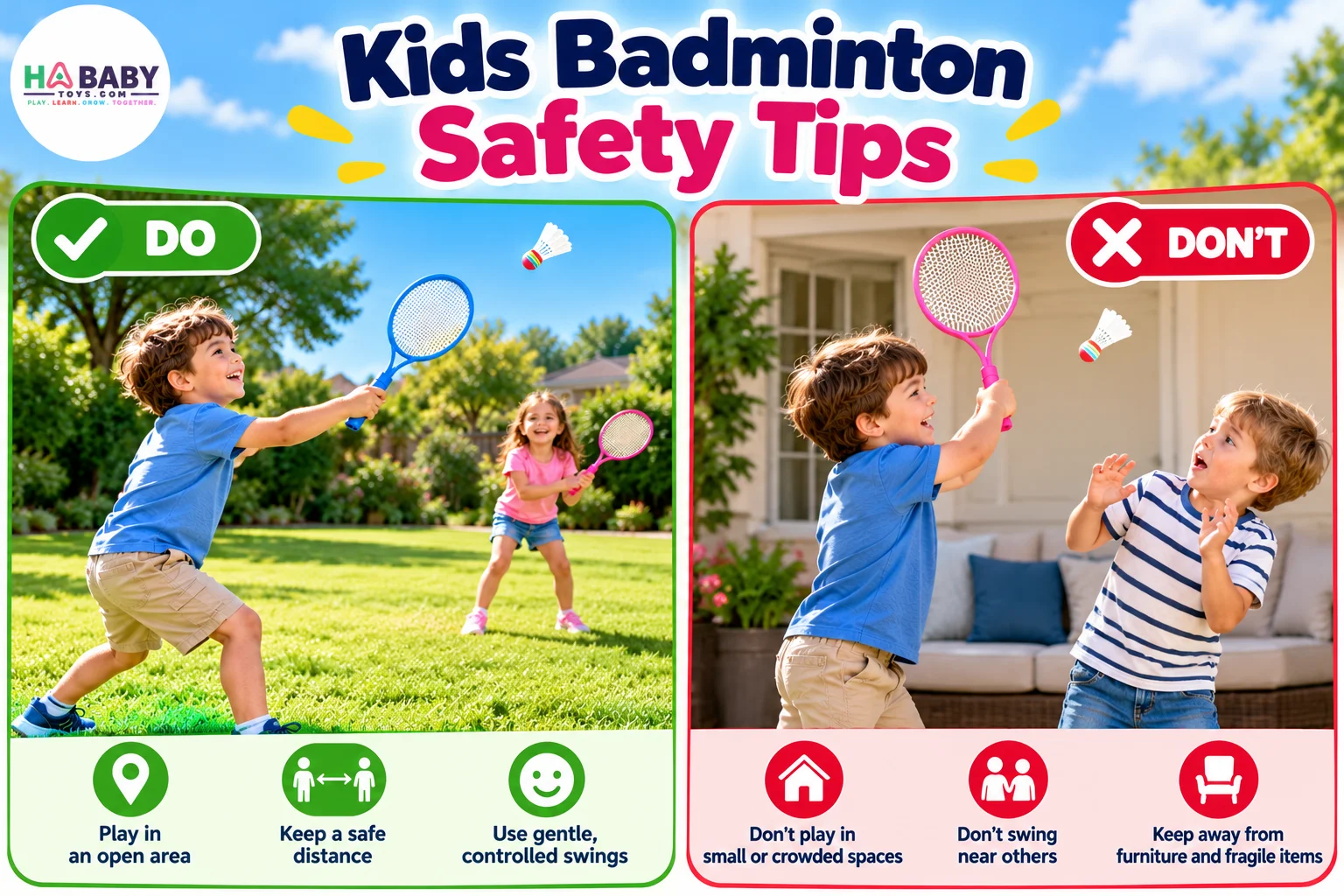
This is the single most useful thing a parent can control, and it takes about thirty seconds. A badminton swing travels further than most adults expect — roughly the length of the racket plus the child’s arm, in every direction.
Good options may include:
- Garden
- Backyard
- Open park
- Playground
- Large sports room
Avoid:
- Glass nearby
- Tight hallways
- Low ceiling fans
- Busy walkways
- Crowded furniture
- Pets crossing the play zone
Safe play zone
Player A → clear swing zone → shuttle path → clear swing zone → Player B
Step 3: Show a simple grip
Children do not need a competition-style grip to begin. The goal is to hold the handle securely but comfortably without squeezing too tightly. That is the whole instruction — resist the urge to teach advanced technique in week one.
When you demonstrate, show:
- Hold near the grip center
- Keep the wrist relaxed
- Keep the racket in front of the body
- Avoid gripping at the very top of the frame
The “top of the frame” mistake is common with children who have watched adults swing hard. It turns the racket into a club. A relaxed grip near the handle gives far more control, and control is what beginners actually need. For age-appropriate physical play context rather than product claims, the American Academy of Pediatrics’ school-age guidance on HealthyChildren.org is a clear, non-commercial reference.
Step 4: Start without a net
Young players do not need a net for the first few sessions. Simple back-and-forth hitting can be easier and less frustrating, because the net adds a height target the child has not yet learned to judge.
Start with:
- Toss and hit
- Parent gently throws the shuttlecock
- Child taps it back
- Catch and reset
This is the fast-solution version of badminton: no rules, no net, no scoring, just contact. Once the child is making consistent contact, the net becomes a natural next step rather than an obstacle.
Step 5: Teach a gentle underhand serve
The serve is where most beginners try to hit too hard. Keep the instruction simple:
- Hold the shuttlecock low.
- Keep the racket below waist level.
- Swing gently forward.
- Aim upward rather than hard.
- Let the other player return it.
Focus on control, not speed. A serve that lands gently in front of the other player is a better serve than one that flies over the fence — for beginners, the point is to keep the rally alive, not to win the point.
Beginner serve path
Ready → Drop → Gentle swing → Contact → Follow through
The follow-through matters more than it looks — a child who stops the racket dead at contact tends to lose control of the shuttlecock.
Step 6: Keep the first rallies short
One or two successful returns can be enough for a beginner. This is not a compromise — it is the correct goal for the first session.
Use goals such as:
- 1 return
- 3 returns
- 5 returns
Avoid making children focus on winning too early. A child who is counting their own successful returns is learning; a child who is worrying about losing is usually just getting frustrated. For wider context on how movement play fits into childhood, the CDC’s physical activity guidance for children is a clear reference.
Step 7: Use controlled swings
This is the main safety section of the guide, and it is worth reading twice.
Teach children:
- Swing only when the area is clear
- Keep movements moderate
- Avoid overhead power swings at first
- Stop if someone steps too close
- Never swing toward another person
Do not use the racket like a sword — don’t do this
- No hitting people
- No poking
- No sword fighting
- No swinging indoors near faces
- No throwing rackets
This is especially important with younger children, who copy action-movie swings without judging distance.
Step 8: Add a net later
Once basic hitting is comfortable, the net becomes a natural addition rather than a barrier. At that point:
- Place the net at a suitable height if one is included
- Stand on opposite sides
- Keep serves gentle
- Focus on clearing the net
Do not worry about regulation height — official badminton dimensions are designed for adult competition, not for a six-year-old in a garden. For the sport’s actual rules and equipment standards, the Badminton World Federation is the authoritative source if you want to look them up later.
Can one child practice alone?
Yes. A racket set does not need two players to be useful, and solo practice is often the fastest route to a decent first rally.
Useful solo activities:
- Tap-up challenge — try to tap the shuttlecock upward repeatedly
- Target hit — aim at a safe floor marker
- Serve practice — serve toward an open target zone
- Parent toss — parent throws, child returns
These are useful before two-player rallies. The “parent toss” version in particular removes the pressure of a serve and lets a child focus entirely on making contact.
Can two children play together?
Yes, but set the rules first. Most collisions at this age come from both children chasing the same shuttlecock, not from the rackets themselves.
Set these rules before the first rally:
- One racket per child
- Maintain distance
- No running through the other player’s swing zone
- Stop play when the shuttle falls between them
That last rule is the one that matters most. Stopping the rally when the shuttle lands between the two players removes the single most common collision scenario.
Parent-child beginner games
These make the guide useful in practice, not just in theory. All of them can be played without a net, without scoring, and in a small garden.
If you want a complete set to play with, the HA Baby Toys Kids Badminton Set lists its included components on the product page. For age-appropriate options, the HA Baby Toys 3+ Years category is the fastest route.
How to make the game easier
If the first session is not working, the fix is almost never the child — it is the difficulty. Simplify before you correct.
- Stand closer
- Use slower, gentle hits
- Allow catching
- Remove scoring
- Use larger target zones
One clarification worth making: standard badminton does not use bouncing. But casual play rules can be simplified if needed — a child who is allowed to catch the shuttlecock and then serve it is still practicing the same tracking and contact skills. Simplifying the game is often better than insisting on formal badminton rules.
How to make it more challenging
Once children are comfortable, add difficulty gradually — one change at a time, not all at once.
- Increase distance slightly
- Add a net
- Count rallies
- Use target zones
- Alternate forehand and backhand
- Add simple scoring
The progression should feel like a small step, not a test. If the child’s success rate drops sharply after a change, go back one step. For beginner sport context rather than product claims, USA Badminton and the SHAPE America resources on youth movement are both useful references.
Outdoor vs indoor use
| Setting | Advantage | What to check |
|---|---|---|
| Backyard | Easy access | Space, pets, obstacles |
| Park | More room | Other people, wind |
| Indoor sports room | No wind | Ceiling height, breakables |
| Small room | Usually a poor choice | Swing clearance |
What about wind?
Shuttlecocks are light, so wind can make outdoor play unpredictable. This is not a reason to avoid the garden — it is a reason to pick the right day and the right spot.
For beginners:
- Choose calmer weather
- Shorten the distance
- Play in a sheltered area
Wind also explains a lot of “my child keeps missing” frustration. On a breezy day, even a well-struck shuttlecock drifts, and a child will read that as their own failure. For broader physical activity context, the World Health Organization’s physical activity fact sheet is a reliable reference, and the NHS exercise guidance covers general activity levels in plain language.
What if something goes wrong? Quick fixes
What if the child keeps missing?
Normalize it. Try a shorter distance, a slower toss, a larger swing target, the catch-and-hit method, or feeding the shuttle gently as a parent. Missing is normal at the beginning — the goal is to make contact easier, not to correct every swing.
What if the shuttlecock goes too far?
Reduce swing force, stand closer, aim upward gently, and use a larger target zone. Avoid encouraging harder hits — the fix for overshooting is always less power, not more.
What if children move too close together?
Use a stop rule: if both players move toward the same shuttlecock, stop the rally and reset. This is worth repeating out loud at the start of every session, and it belongs in the safety rules box on the next screen.
Supervision and session length
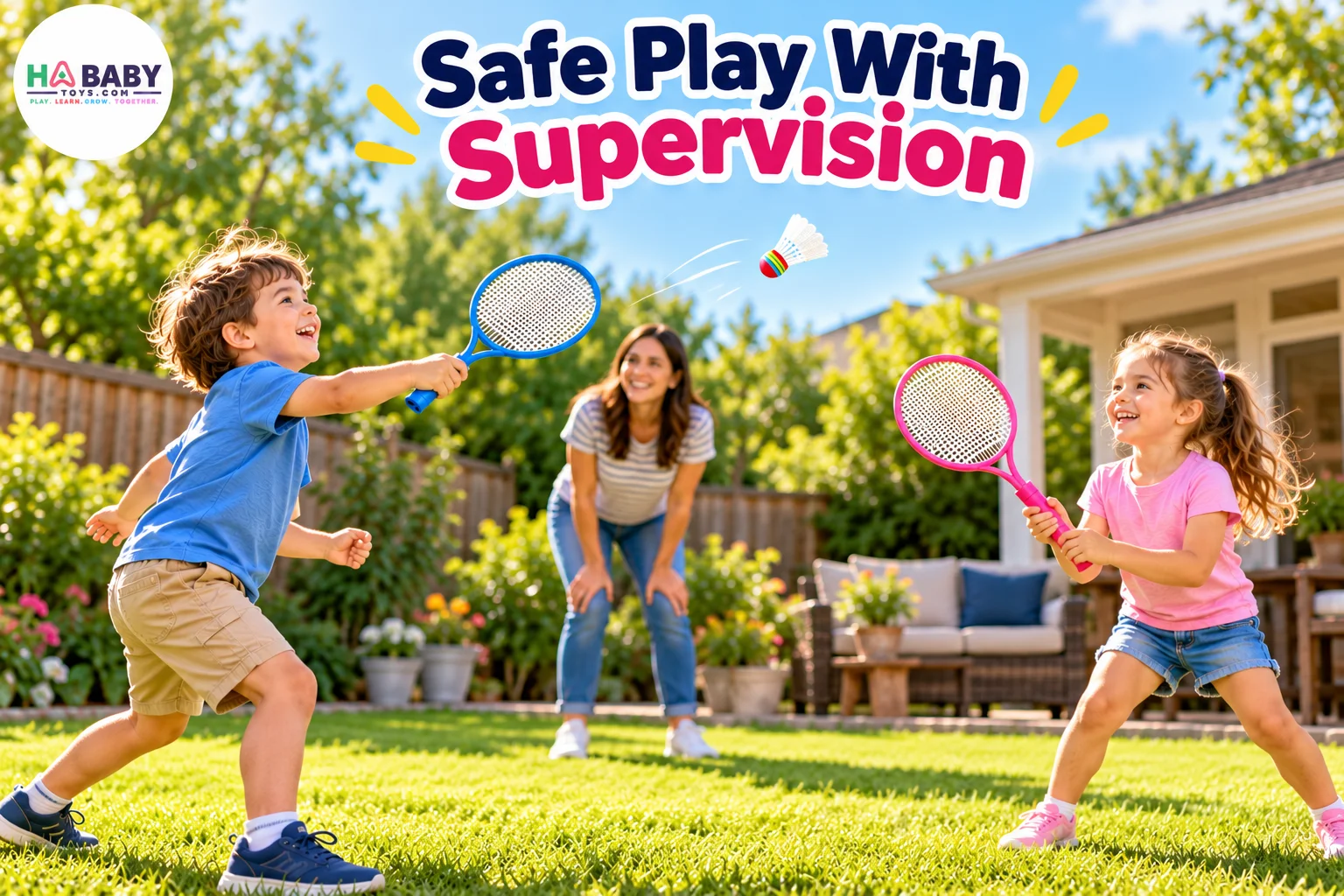
For younger children, an adult should set spacing, demonstrate swings, stop rough play, watch for broken equipment, and keep other children out of the swing zones. That is not a long list, and it covers almost every realistic risk.
How long should a session be? There is no universal number. End the session when the child loses interest, becomes frustrated, starts swinging carelessly, or gets tired. Short, positive sessions are often better for beginners — a five-minute rally that ends well is more likely to be repeated than a twenty-minute one that ends in tears.
For general injury-prevention guidance around children’s play, Safe Kids Worldwide and the Nemours KidsHealth toy safety page are both worth a skim, alongside the Mayo Clinic’s child safety overview.
Cleaning and storage
After play, a simple routine keeps the set usable for years:
- Wipe racket grips if dirty
- Dry equipment before storage
- Keep rackets flat or safely supported
- Avoid heavy objects on the strings
- Store shuttlecocks in a dry place
Do not invent material-specific cleaning methods — if the manufacturer has not specified a cleaning product, a slightly damp cloth is the safe default. A racket stored under a heavy box is a racket with a warped head.
60-second safe-use checklist — before every game
- Rackets are undamaged
- Shuttlecock is in good condition
- Play area is clear
- Players have enough spacing
- Grip is comfortable
- Start with gentle underhand serves
- No hitting people or pets
- Stop if players move too close
- Keep swings controlled
- Store equipment safely afterward
Ready to put this into practice? Explore the HA Baby Toys Kids Badminton Set, or compare the wider range in the HA Baby Toys shop.
Kids badminton racket set FAQ
Tap any question to expand the answer.
How do you use a kids badminton racket set?
Inspect the set, choose a clear play area, stand players far enough apart, show a comfortable grip, start with a gentle underhand serve, and keep rallies short and slow. Add a net and scoring later, once contact is consistent. The five-step version is: check, space, grip, serve, rally.
Do children need a net to start playing?
No. Young players do not need a net for the first few sessions. Simple back-and-forth hitting can be easier and less frustrating. A net becomes useful once the child is making consistent contact and is ready to aim upward over a height.
How should a child hold the racket?
Hold near the grip center, keep the wrist relaxed, keep the racket in front of the body, and avoid gripping at the very top of the frame. The goal is a secure but comfortable hold — not a white-knuckle squeeze.
What is the easiest way to serve?
Hold the shuttlecock low, keep the racket below waist level, swing gently forward, and aim upward rather than hard. Focus on control, not speed — a gentle serve that the other player can reach is better than a fast one that ends the rally.
How far apart should children stand?
Far enough that each child can swing a racket in any direction without reaching the other. There is no fixed number, because racket length and child height vary — the test is whether a full swing in every direction is clear of the other player.
Can one child practice alone?
Yes. Solo activities include a tap-up challenge, hitting toward a target, serve practice, and parent-toss returns. These are genuine practice activities and often the fastest route to a decent first rally.
Can two children play together safely?
Yes, with rules set first: one racket per child, maintain distance, no running through the other player’s swing zone, and stop play when the shuttle falls between them. That last rule prevents the most common collision.
Can the set be used indoors?
Possibly, in a large room with no wind and enough ceiling height — but a small room is usually a poor choice because of swing clearance and breakables. Outdoors is the safer default for beginners.
What should I do if the child keeps missing the shuttlecock?
Make contact easier rather than correcting every swing. Try a shorter distance, a slower toss, a larger swing target, the catch-and-hit method, or gently feeding the shuttle as a parent. Missing is normal at the beginning.
What if it is windy outside?
Shuttlecocks are light, so wind makes outdoor play unpredictable. Choose calmer weather, shorten the distance, and play in a sheltered area. A breezy day is not unsafe — it just makes consistent contact harder.
Should children use overhead smashes?
Not at first. Avoid overhead power swings in early sessions and focus on controlled, moderate swings. Once the child has consistent contact and safe spacing, overhead play can be introduced gradually.
What should parents check before each game?
Cracked racket frame, loose handle, frayed or broken strings, sharp edges, damaged shuttlecock, and loose detachable pieces. If a racket is cracked or the handle feels loose, stop using it until it is replaced or checked.
How do I store kids badminton rackets?
Wipe the grips if dirty, dry the equipment before storage, keep rackets flat or safely supported, avoid heavy objects on the strings, and store shuttlecocks in a dry place.
What safety rules are most important?
Never swing near another person’s face, maintain space between players, do not throw rackets, do not hit people or pets, stop if the racket cracks, use controlled swings, and supervise younger children. The single most important rule: stop the rally if both players move toward the same shuttlecock.
Where can I buy the HA Baby Toys Kids Badminton Set?
You can buy it directly from the HA Baby Toys Kids Badminton Set product page. For more parent guides, browse the HA Baby Toys blog, and for common order and safety questions, check the HA Baby Toys FAQ. Retailers and larger-volume buyers can request a quote.
The short version
Using a kids badminton racket set safely comes down to four habits: inspect before play, give both players clear space, teach a comfortable grip with gentle underhand serves, and keep swings controlled. Add a net and scoring later — beginners need contact, not competition.
If you are still deciding whether the set is right for your family, why choose a kids badminton set covers the buying case in more detail. To see the full range, visit HA Baby Toys or browse the HA Baby Toys blog for more parent guides written in this same plain-English style.
About this guide: Written for parents, guardians and gift buyers helping a child start recreational badminton. Product-specific details such as included accessories, racket dimensions and recommended age vary by model — always confirm them on the individual product page and follow the manufacturer’s instructions. Safety guidance here is general in nature and does not replace manufacturer instructions or adult supervision.
One Response