
6-in-1 Montessori Busy Board: Skills & Activities
Your child is curious, constantly touching, turning, and exploring. But you are overwhelmed by the options and unsure which activity toy actually delivers real value. Discover how a 6-in-1 Montessori busy board turns everyday curiosity into meaningful hands-on practice.
Expertly reviewed by the HA’BABY Child Development Team. We combine pediatric play insights with rigorous product safety standards to help you make informed decisions.
Table of Contents
- 1. Introduction: Why Parents Consider Montessori Busy Boards
- 2. What Is a 6-in-1 Montessori Busy Board?
- 3. Skills Children Can Practise with a Busy Board
- 4. 6-in-1 Montessori Busy Board Activities to Try at Home
- 5. How to Introduce Busy Board Activities Step by Step
- 6. How Busy Boards Support Hands-On Learning
- 7. Choosing the Right Montessori Busy Board
- 8. Common Busy Board Mistakes Parents Should Avoid
- 9. Who May Enjoy a Montessori Busy Board?
- 10. Discover the HA’BABY Sensory Busy Board Drawer Cube
- 11. Frequently Asked Questions
- 12. Conclusion and Next Steps
A 6-in-1 Montessori busy board is a hands-on activity toy that brings different interactive tasks together in one play experience. Depending on its design, children may explore activities involving turning, fastening, matching, moving, and problem-solving. With age-appropriate supervision, parents can use these activities to encourage exploration, coordination, and independent practice.
Introduction: Why Parents Consider Montessori Busy Boards
If you are a parent, you know the scene: your toddler is fascinated by the door latch, the light switch, the cabinet handle. They want to touch, turn, open, and close everything. You want to encourage this natural curiosity, but you are also wary of passive screen time and toys that do little more than flash lights and play repetitive sounds. You are not alone in this search for meaningful, hands-on play.
This is where the 6-in-1 Montessori Busy Board enters the conversation. A busy board is a hands-on activity toy that brings several tasks together in one compact play experience. Instead of scattering a dozen single-purpose toys across the floor, a multi-activity board offers different challenges in one place. You can explore HA’BABY educational toys to see how these boards fit into a broader approach to learning.
This guide will explain exactly what a 6-in-1 busy board is, the skills children can practise, six activities to try at home, how to introduce the board step by step, and what to check before buying. If you are looking for more hands-on play ideas for children, this article will give you a clear, practical starting point.
What Is a 6-in-1 Montessori Busy Board?
A busy board is a collection of interactive tasks mounted on a single board or cube. The term “6-in-1” in a product title usually means the toy combines multiple activities or functions in one design. Rather than a child simply watching a screen, they are actively manipulating physical components: turning a knob, opening a latch, moving a slider, or matching a shape.
Children often enjoy repeating simple actions because repetition is how they learn. A busy board can be used during short, supervised play sessions, and the variety of activities keeps the experience engaging without requiring a completely different toy for every task.
Understanding the Montessori-Inspired Approach
The Montessori-inspired approach generally emphasizes hands-on exploration, practical activities, repetition, and allowing children to try tasks at their own pace. A busy board aligns with this philosophy because it invites active participation rather than passive consumption. However, it is important to note that a product should not be described as Montessori-certified unless documentation supports that claim.
Why Multiple Activities in One Toy Can Be Convenient
A multi-activity toy provides variety without requiring parents to introduce a completely different toy for every task. It is compact, easy to store, and offers a range of challenges that can grow with the child. To see how these activities fit into a broader learning approach, you can read about hands-on learning with Montessori busy boards.
Skills Children Can Practise with a Busy Board
This is the most important informational section for parents who want to understand the value of the toy. Each skill is explained through a real activity example.
Fine Motor Coordination
Using fingers and hands to manipulate controls, fasteners, or movable pieces provides opportunities to practise small-muscle movements. For example, a child repeatedly turns a knob or moves a slider while exploring how it works. The NAEYC’s fine motor skill activities guidance supports the value of these repeated hand movements.
Hand-Eye Coordination
Children look at an object and guide their hands to interact with it. Moving a piece toward a target or positioning a component correctly requires coordination between visual information and physical action.
Problem-Solving and Exploration
Children can experiment with an activity, notice what happens, and try another approach. Exploring how a latch opens and closes is a simple but effective problem-solving exercise.
Concentration and Repetition
Children may choose to repeat an action because they want to understand how it works. While a busy board does not guarantee longer attention spans, it provides a structured opportunity for focused, self-directed play.
Early Practical-Life Experiences
Suitable activities can introduce actions that resemble everyday tasks, such as fastening, turning, and opening. These early experiences build familiarity with the mechanisms children encounter in daily life.
Independence and Confidence
Allowing children to attempt manageable activities independently gives them opportunities to practise and experience success. Encouragement matters more than expecting children to complete every activity without help.
6-in-1 Montessori Busy Board Activities to Try at Home
Make this the most practical part of your child’s play routine. Each activity includes what the child interacts with, how a parent can demonstrate it, what the child can try independently, the skill practised, and one simple variation.
Activity 1: Turn and Explore
What the child interacts with: A rotating control or knob.
How to demonstrate: Invite the child to turn it slowly and observe how it moves.
Independent practice: Let the child try turning it in both directions.
Skill practised: Fine motor coordination and hand-eye coordination.
Variation: Ask the child to turn it “fast” and then “slow.”
Activity 2: Open and Close
What the child interacts with: A fastening mechanism or latch.
How to demonstrate: Show the child how to open and close it with guidance.
Independent practice: Let the child explore opening and closing it on their own.
Skill practised: Problem-solving and early practical-life experience.
Variation: Count how many times the child can open and close it.
Activity 3: Move and Match
What the child interacts with: Movable pieces or a slider.
How to demonstrate: Show how to move the piece from one position to another.
Independent practice: Encourage the child to move the pieces between positions.
Skill practised: Hand-eye coordination and concentration.
Variation: Ask the child to move the piece to a specific color or position.
Activity 4: Find the Match
What the child interacts with: Matching shapes or components.
How to demonstrate: Ask the child to identify the matching shapes.
Independent practice: Let the child try to match the pieces independently.
Skill practised: Problem-solving and visual discrimination.
Variation: Time the matching activity or mix up the pieces for a new challenge.
Activity 5: Fastening Practice
What the child interacts with: A buckle, zipper, or similar fastening feature.
How to demonstrate: Demonstrate the action slowly and let the child try.
Independent practice: Encourage the child to fasten and unfasten it.
Skill practised: Fine motor coordination and independence.
Variation: Practice with different fastening types if the board includes them.
Activity 6: Explore and Discover
What the child interacts with: The final verified activity on the board.
How to demonstrate: Create a short exploration game based on the actual feature.
Independent practice: Let the child explore the activity freely.
Skill practised: Curiosity, exploration, and confidence.
Variation: Introduce a simple story or scenario to make the activity more engaging.
For more ideas on sensory play, explore sensory activity cube play ideas.
How to Introduce Busy Board Activities Step by Step
Parents sometimes buy an educational toy but are unsure how to introduce it. This step-by-step guide removes the confusion.
Step 1: Choose a Calm Play Area
Choose a stable, comfortable space where the child can explore without distractions. Follow the product’s instructions for positioning and use.
Step 2: Introduce One Activity at a Time
Avoid demonstrating every feature at once. Start with one activity and give the child time to explore it.
Step 3: Demonstrate Slowly
Show the action once or twice. Use simple language, such as “turn it,” “move it,” or “open it.”
Step 4: Let the Child Try
Allow the child to experiment without immediately correcting every attempt. Offer help when needed.
Step 5: Repeat and Introduce Variety
When the child becomes familiar with one activity, introduce another suitable feature.
Step 6: Finish and Store Safely
Check the board for loose or damaged components and store it according to the manufacturer’s instructions. The CDC’s child-led play guidance supports allowing children to lead play while adults describe, imitate, and encourage their exploration.
How Busy Boards Support Hands-On Learning
Active participation matters because children learn by touching and manipulating objects. Understanding simple cause-and-effect relationships, exploring actions through repetition, and developing familiarity with everyday mechanisms are all part of the learning process.
Consider a real-life example: A parent demonstrates how a suitable fastener works. The child watches, tries the action, makes an attempt, and repeats it. The important part is not how quickly the child completes the task; it is the opportunity to explore and practise. The CDC’s positive parenting tips for toddlers and the NAEYC’s guidance on toys for young children both emphasize the value of interactive, hands-on play.
Choosing the Right Montessori Busy Board
This section targets parents comparing products who want a straightforward buying checklist. The American Academy of Pediatrics’ toy-buying guidance is a useful reference.
- Age suitability: Check the manufacturer’s age recommendation and warnings.
- Activity variety: Look at the actual tasks rather than relying only on a “6-in-1” label.
- Construction: Check for sturdy components, smooth edges, and secure fittings.
- Small parts: Make sure detachable parts do not create a choking risk for the intended age group.
- Ease of use: Consider whether the child can reach and interact with the activities comfortably.
- Storage: Check whether the product is easy to store and keep organized.
- Cleaning: Review the manufacturer’s cleaning instructions.
- Product information: Look for clear photographs, dimensions, materials, and safety details.
To compare options, you can explore the HA’BABY toy collection.
Common Busy Board Mistakes Parents Should Avoid
This section addresses common concerns and helps parents use the toy sensibly.
Expecting Every Activity to Be Immediately Easy
Children have different interests and abilities. Let them explore at their own pace.
Demonstrating Too Many Features at Once
Introducing one activity at a time can make exploration less overwhelming.
Forcing the Child to Complete a Task
Avoid turning play into a test. Let children stop, repeat, or change activities.
Leaving the Child Unsupervised
Supervision is important, especially when a product has moving, detachable, or small components.
Ignoring Wear and Tear
Inspect the board regularly for loose parts, damaged fasteners, sharp edges, or other hazards.
Buying Based Only on the Number of Activities
A product with six advertised activities is not automatically better than one with fewer well-designed activities. Consider suitability, construction, and actual usefulness.
A particularly important point for this category is small-part safety. The CPSC has issued busy-board warnings and recalls involving detachable components that could create choking hazards. Parents should check the CPSC’s toy safety information and review the specific busy-board safety warning.
Who May Enjoy a Montessori Busy Board?
Explain the types of children and play situations for which a busy board may be appealing.
- Children who enjoy exploring switches, fasteners, and moving objects.
- Children who like hands-on activities.
- Families looking for a compact activity toy.
- Parents who want an alternative to passive screen entertainment.
- Gift buyers considering practical, interactive toys.
Avoid promising that a busy board is suitable for every child or every developmental stage. The manufacturer’s age guidance should always take priority. For more age-appropriate play guidance, see Seattle Children’s toys and play resource.
Discover the HA’BABY Sensory Busy Board Drawer Cube
If you are looking for a hands-on activity toy that offers different ways to explore, the sensory busy board drawer cube from HA’BABY is the primary recommendation for readers interested in multi-activity sensory and practical-play toys.
This product combines a multi-activity concept with a compact drawer cube design. Each feature is designed to connect to a practical play example, such as turning, opening, matching, or fastening. Parents can introduce the activities gradually, following the step-by-step guide above.
What to check before ordering: Review the verified dimensions, materials, age recommendations, and included components on the product listing. You can also visit the common questions about HA’BABY products page for more information.
Note: Always verify the actual product features and safety details on the live listing before purchasing.
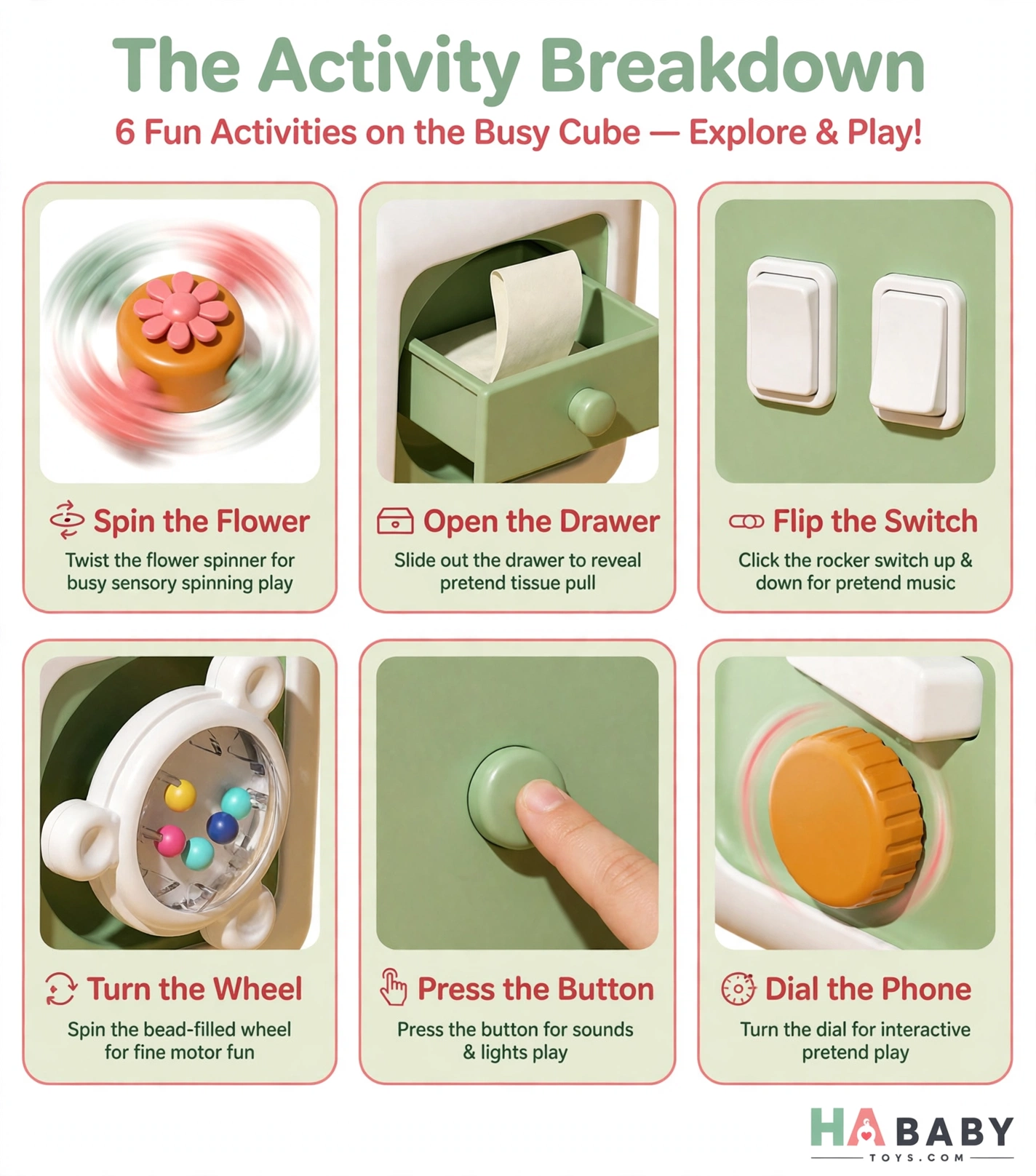
Explore the HA’BABY Sensory Busy Board Drawer Cube6 Activities, Multiple Ways to Explore
Turn and Explore
Practise fine motor coordination by turning a knob or rotating control.
Open and Close
Build problem-solving skills by exploring how a latch or fastening works.
Move and Match
Develop hand-eye coordination by moving pieces between positions.
Find the Match
Encourage visual discrimination and concentration by matching shapes.
Fastening Practice
Build independence and fine motor control by practising buckles or zippers.
Explore and Discover
Foster curiosity and confidence through open-ended exploration.
Frequently Asked Questions
What is a 6-in-1 Montessori busy board?
A 6-in-1 Montessori busy board is a hands-on activity toy that combines multiple interactive tasks into one play experience. Depending on the design, it may include activities involving turning, fastening, matching, moving, and problem-solving, allowing children to explore different practical actions in a single compact toy.
What skills can children practise with a Montessori busy board?
Children can practise fine motor coordination, hand-eye coordination, exploration, problem-solving, concentration, and practical life actions such as fastening or opening. Outcomes vary between children, and the board is a tool for practice rather than a guaranteed developmental intervention.
At what age can a child start using a busy board?
Suitability depends on the actual product, its age grading, the child’s abilities, and its safety features. Parents should always follow the manufacturer’s age recommendation and instructions rather than assuming every busy board suits every toddler.
How long should children play with a busy board?
There is no universal required duration. Short, enjoyable sessions based on the child’s interest and attention are recommended, with breaks whenever needed. Forced or extended play is not necessary for the toy to be beneficial.
Can a busy board help develop fine motor skills?
Manipulating appropriate activities gives children opportunities to practise hand and finger movements, which supports fine motor development. However, parents should avoid expecting guaranteed developmental improvements, as each child develops at their own pace.
How can parents make busy board activities more interesting?
Parents can demonstrate one activity at a time, use simple instructions, allow independent exploration, and introduce variations when the child is ready. Rotating attention between activities and playing alongside the child can also keep the experience engaging.
What should parents check before buying a Montessori busy board?
Parents should check age guidance, detachable components, secure construction, material information, dimensions, product photographs, and manufacturer safety instructions. Reviewing CPSC safety warnings and recalls is also strongly recommended, especially for busy boards with small parts. You can also review the CPSC Product Recalls page.
Conclusion and Next Steps
The 6-in-1 Montessori busy board is a practical, hands-on tool that offers multiple ways for children to explore, practise, and repeat. By understanding the skills involved, introducing activities gradually, and checking safety details, you can make a confident decision that supports your child’s natural curiosity.
Ready to explore further? Explore the HA’BABY toy collection to compare options, or ask about product details if you have specific questions. For more hands-on play inspiration, visit the HA’BABY blog.
View the Sensory Busy Board Drawer Cube
One Response