
Montessori Busy Board for Toddlers: Hands-On Learning
Toddlers rarely want to watch someone else do everything. They want to touch, try, move, and discover things themselves. Discover how a Montessori busy board for toddlers transforms everyday curiosity into practical, hands-on learning.
Expertly reviewed by the HA’BABY Child Development Team. We combine pediatric play insights with rigorous product safety standards to help you make informed decisions.
Table of Contents
- 1. Introduction: Toddlers Learn by Doing
- 2. What Is a Montessori Busy Board for Toddlers?
- 3. Practical Skills Toddlers Can Explore Through a Busy Board
- 4. Everyday Busy Board Activities Toddlers May Enjoy
- 5. How Parents Can Teach Through Busy Board Play
- 6. Busy Board vs. Ordinary Toys — What Is the Difference?
- 7. How to Choose the Right Montessori Busy Board for a Toddler
- 8. At-Home Busy Board Play Ideas
- 9. Common Busy Board Mistakes Parents Should Avoid
- 10. HA’BABY Product Spotlight — Sensory Busy Board Drawer Cube
- 11. Frequently Asked Questions
- 12. Conclusion and Next Steps
A Montessori busy board for toddlers is an interactive activity board featuring hands-on elements that children can explore through touching, moving, fastening, turning, and other simple actions. Depending on its design, it can provide opportunities to practise coordination, explore cause and effect, and become familiar with everyday movements through supervised play.
Introduction: Toddlers Learn by Doing
If you have a toddler, you know the phrase “I do it myself” all too well. They want to open the door, turn the handle, fasten the strap, and explore every mechanism in the house. This is not just stubbornness; it is their natural drive to learn through hands-on participation. Passive entertainment, like watching a screen, simply does not satisfy this deep desire to touch, try, and discover.
This is why the Montessori Busy Board for Toddlers has become such a popular choice for parents. It offers a safe, supervised way for children to explore practical movements that mimic everyday tasks. When you explore HA’BABY educational toys, you will find options designed to support this active, hands-on approach to learning.
This guide will explain what a busy board is, the practical skills toddlers can practise, specific activity examples, how parents can teach through play, and what to check before buying. To see how this concept scales across different age groups, you can read about the 6-in-1 Montessori busy board activities. If you are looking for more hands-on play ideas for children, you are in the right place.
What Is a Montessori Busy Board for Toddlers?
A busy board is an interactive activity board featuring hands-on elements that children can explore. It typically includes a variety of components mounted on a single board, such as zippers, buckles, latches, knobs, or sliding pieces. What makes it interactive is that the child is not just looking at it; they are physically manipulating the parts to see what happens.
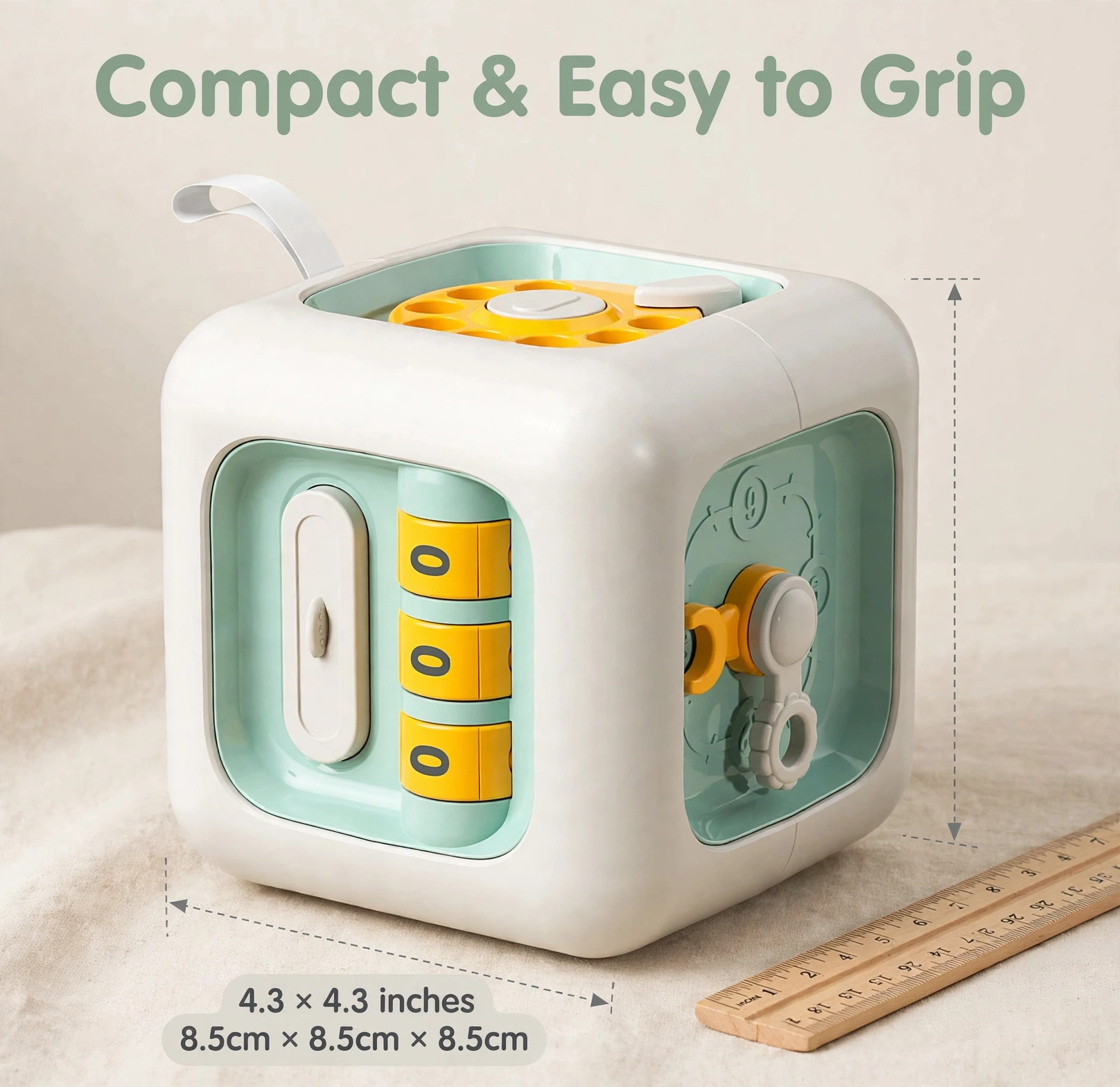
What does “Montessori-inspired” mean in this context? It refers to the general philosophy of hands-on exploration, practical activities, repetition, and allowing children to try tasks at their own pace. It is important to note that not every commercial busy board follows a complete Montessori educational method. It is more accurate to describe these toys as Montessori-inspired unless the manufacturer provides specific evidence of an educational design.
When choosing a busy board, activity quality matters more than the number of features. A board with three well-designed, age-appropriate activities is often more valuable than one with ten features that are too difficult for a toddler to use. For a broader look at how sensory and busy boards compare, you can read about the baby sensory activity cube.
Practical Skills Toddlers Can Explore Through a Busy Board
This is the main educational section. It is important to describe these as opportunities to practise skills, not guaranteed outcomes. Here is what toddlers can explore.
Fine Motor Movements
Toddlers may practise small hand and finger movements through suitable activities. Grasping a zipper pull, turning a knob, or manipulating a latch requires precise control. The NAEYC’s guidance on fine motor skills highlights the importance of these repeated hand movements for later development.
Hand-Eye Coordination
Looking at a component and moving it together involves visual attention and hand movements. For example, a child sees a latch and must guide their hand to open it. This coordination is essential for everyday tasks.
Everyday Practical Movements
Busy boards can introduce examples such as opening, closing, fastening, turning, and sliding. These are the same movements children see adults perform daily, which makes the play feel meaningful and relevant.
Problem-Solving Through Trial and Error
Children can try different approaches when interacting with an activity. If one way does not work, they may try another. This experimentation is the foundation of problem-solving.
Patience and Repetition
Toddlers may repeat the same movement many times. This is not a sign of failure; it is how they build mastery and understanding. Repetition is a natural and valuable part of learning.
Independence and Confidence
Giving children time to attempt simple actions can encourage participation and a sense of accomplishment. When a toddler successfully opens a latch on their own, the pride they feel is a powerful motivator. For more age-appropriate play guidance, refer to the CDC’s positive parenting tips for toddlers.
Everyday Busy Board Activities Toddlers May Enjoy
Use these practical examples to help you picture how a busy board can be used. Remember to verify which activities are actually included in the product you are considering.
Zipping and Unzipping
What the toddler does: Pulls a zipper up and down.
How to demonstrate: Show the movement slowly.
What makes it interesting: The physical feedback and the visual change.
Safety: Ensure the zipper is securely attached and not a choking hazard.
Buckles and Fastening
What the toddler does: Explores how two parts connect and separate.
How to demonstrate: Show how to open and close the buckle.
What makes it interesting: The challenge of manipulating the mechanism.
Safety: Check that the buckle does not have small detachable parts.
Turning and Rotating
What the toddler does: Investigates movable components, such as knobs.
How to demonstrate: Turn the knob slowly and show the result.
What makes it interesting: The cause-and-effect relationship.
Safety: Ensure the knob is firmly attached and cannot be pulled off.
Opening and Closing
What the toddler does: Practises simple movements where suitable, such as opening a small door.
How to demonstrate: Open and close the door, then let the child try.
What makes it interesting: The element of discovery.
Safety: Check for sharp edges or pinch points.
Sliding Components
What the toddler does: Follows an object along a path.
How to demonstrate: Slide the piece from one end to the other.
What makes it interesting: The smooth movement and visual tracking.
Safety: Ensure the track is secure and the piece cannot detach.
Matching and Discovery
What the toddler does: Explores matching elements if the board includes them.
How to demonstrate: Show how to match the pieces.
What makes it interesting: The satisfaction of finding the correct match.
Safety: Verify that matching pieces are appropriately sized and securely attached.
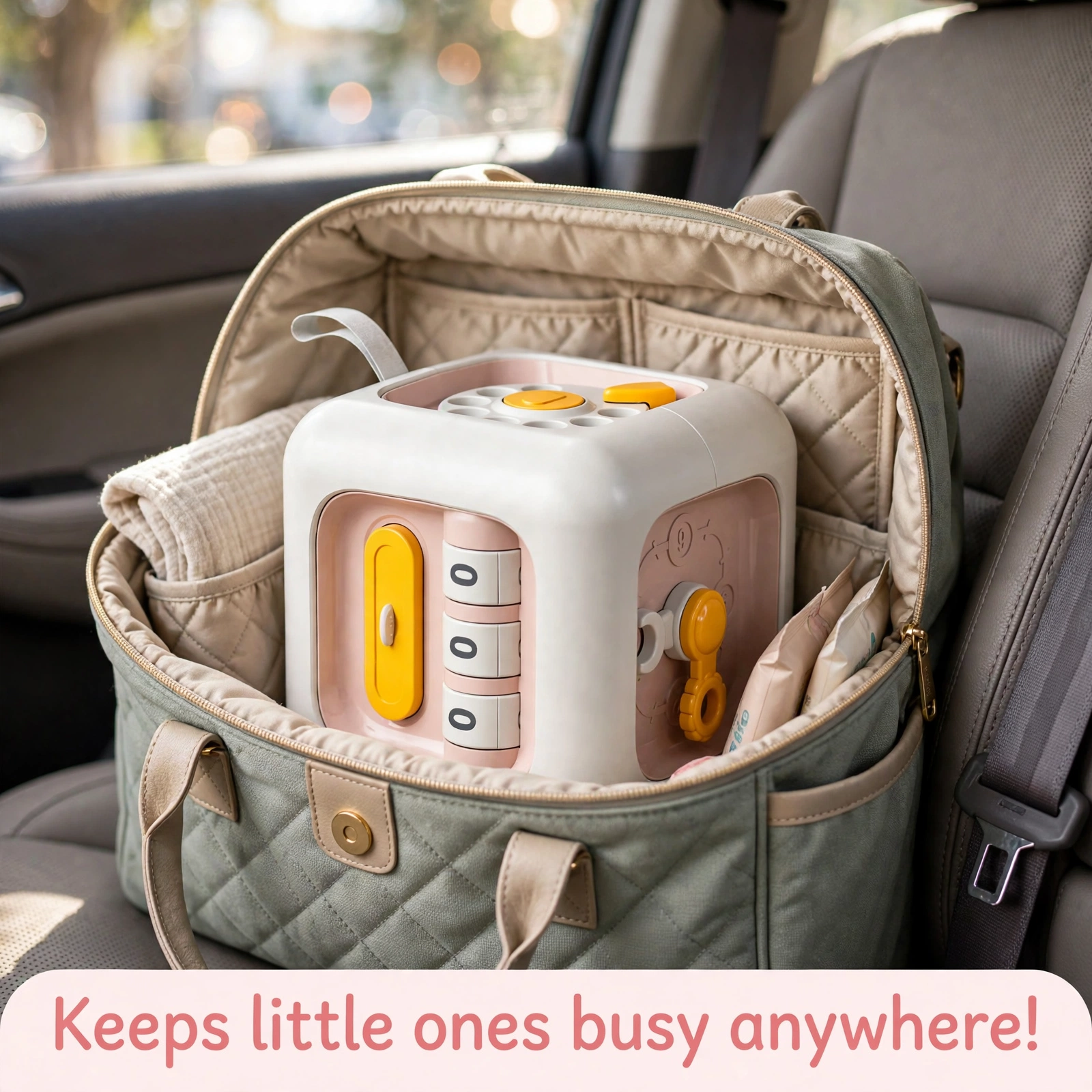
How Parents Can Teach Through Busy Board Play
You do not need to be a teacher to support your child’s learning. Follow this practical approach:
- Start with one activity: Avoid introducing every feature at once.
- Demonstrate slowly: Show the movement without taking over.
- Let the toddler try: Allow time for experimentation.
- Use everyday language: Say words like open, close, turn, pull, and push.
- Encourage rather than correct constantly: Allow safe attempts and exploration.
- Repeat familiar activities: Children may enjoy practising the same movement.
- Introduce variety gradually: Explore another feature when the toddler is ready.
Consider a short, supervised play session. You might sit with your child, demonstrate how a zipper works, and then let them try. The CDC’s child-led play guidance supports allowing children to lead while adults describe, imitate, and encourage. There is no required duration; five minutes of focused play is just as valuable as a longer session if the child is engaged.
Busy Board vs. Ordinary Toys — What Is the Difference?
It is helpful to understand how a busy board compares to other toys. This is not about claiming one is universally better; it is about recognizing different types of play.
| Busy board | Other traditional toys |
|---|---|
| Often focuses on manipulating attached components | May focus on building, sorting, or imaginative play |
| Can introduce practical movements | Can introduce different types of play |
| Offers several activities in one board | Often has a more specific purpose |
| Encourages repeated interaction with its features | Offers other forms of exploration and creativity |
A busy board can complement blocks, puzzles, books, pretend play, and outdoor activities. It does not need to replace them. A balanced play routine includes a variety of experiences.
How to Choose the Right Montessori Busy Board for a Toddler
This section helps parents comparing products make a confident decision. The American Academy of Pediatrics’ toy-buying guidance is a useful reference.
- Age recommendation: Check the manufacturer’s age label.
- Activity suitability: Choose movements appropriate for the toddler’s abilities.
- Construction quality: Look for sturdy construction and securely attached components.
- Choking hazards: Check small detachable parts carefully.
- Surface quality: Look for smooth surfaces and no accessible sharp edges.
- Activity variety: Prefer useful, understandable activities over an inflated feature count.
- Ease of handling: Consider the child’s ability to reach and manipulate the features.
- Cleaning: Follow the manufacturer’s cleaning instructions.
- Storage: Consider how the board will fit into the home.
Buyer checklist: Before ordering, confirm the age recommendation, inspect the product photographs for detachable parts, and review the material and safety information. To compare options, you can explore the HA’BABY toy collection.
At-Home Busy Board Play Ideas
These informal play ideas can help you introduce activities into everyday routines. They are not tests or performance targets.
- Action-naming game: Say the name of each movement as the toddler explores.
- Show-and-try: Demonstrate one action and let the toddler repeat it.
- Find the activity: Invite the toddler to locate a familiar feature.
- Slow exploration: Give the toddler time to investigate without rushing.
- Parent-child turn-taking: Take turns demonstrating simple movements.
- Free exploration: Let the child choose which activity to explore.
Common Busy Board Mistakes Parents Should Avoid
This section helps parents use the toy sensibly and safely.
- Expecting toddlers to master every activity immediately.
- Forcing a child to complete an activity.
- Giving too many instructions.
- Buying a board only because it advertises many activities.
- Ignoring the recommended age.
- Leaving toddlers unattended.
- Overlooking loose, broken, or damaged components.
- Assuming that Montessori branding guarantees safety or educational quality.
For safety guidance, review the CPSC Toy Safety Guide and check the CPSC Recalls page for any relevant product notices. The CDC choking hazards information is also useful for understanding small-part risks.
HA’BABY Product Spotlight — Sensory Busy Board Drawer Cube
If you are looking for a practical, hands-on activity toy for your toddler, the HA’BABY Sensory Busy Board Drawer Cube is a natural recommendation. This product is designed as a drawer-style busy board cube, offering interactive components that encourage toddlers to explore, move, and discover.
The multi-activity design aligns with the principles discussed in this guide: it provides different ways for toddlers to practise practical movements in one compact toy, allowing parents to introduce activities gradually during supervised play. Each feature is intended to support exploration and coordination, not to guarantee specific developmental outcomes.
What to check before ordering: Review the confirmed product specifications, dimensions, materials, and age recommendations on the listing. If you have questions, visit the HA’BABY FAQ page for more information.
Note: Always verify the actual product features and safety details on the live listing before purchasing.
Explore the HA’BABY Sensory Busy Board Drawer CubeLittle Hands, Everyday Discoveries
Open and Close
Practise simple movements like opening a small door or lifting a latch.
Turn and Move
Investigate rotating components and sliding elements.
Fasten and Explore
Explore how two parts connect and separate.
Look and Discover
Observe visual changes and cause-and-effect relationships.
Try and Repeat
Build mastery through repetition and practice.
Learn Through Play
Every interaction is an opportunity for hands-on learning.
Frequently Asked Questions
What is a Montessori busy board for toddlers?
A Montessori busy board for toddlers is an interactive activity board featuring hands-on elements that children can explore through touching, moving, fastening, turning, and other simple actions. It is designed to encourage practical skill practice and independent exploration during supervised play.
What skills can toddlers practise with a busy board?
Toddlers can practise fine motor movements, hand-eye coordination, everyday practical actions such as opening and fastening, problem-solving through trial and error, patience through repetition, and independence by attempting manageable tasks on their own.
At what age can toddlers start using a busy board?
Suitability depends on the specific product’s age recommendation, warnings, and the child’s individual abilities. Parents should always follow the manufacturer’s age guidance and check for small-part choking hazards before introducing a busy board to a toddler.
Are Montessori busy boards safe for toddlers?
Safety depends on secure construction, the absence of detachable small parts, smooth surfaces, and adult supervision. Parents should regularly inspect the board for loose or damaged components and review CPSC toy safety guidance.
How long should a toddler play with a busy board?
There is no required duration. Follow the child’s interest and allow them to stop when they become tired or frustrated. Short, focused sessions with breaks are more beneficial than forced extended play.
Do busy boards help toddlers become more independent?
Busy boards provide opportunities for children to attempt manageable actions on their own, which can build confidence and a sense of accomplishment. However, independence develops gradually, and encouragement matters more than expecting mastery.
Is a Montessori busy board a good educational gift?
It can be a thoughtful educational gift if it matches the child’s age, interests, and abilities. Parents should verify the product’s safety details, construction quality, and actual features before purchasing as a gift. You can also visit the HA’BABY FAQ page for more information.
Conclusion and Next Steps
A Montessori busy board for toddlers is a practical, engaging toy that offers multiple opportunities for hands-on learning. By understanding the skills involved, introducing activities gradually, and checking safety details, you can support your child’s natural drive to explore and do things independently.
Ready to explore further? Explore the HA’BABY toy collection to compare options, or ask about product details if you have specific questions. For more hands-on play inspiration, visit the HA’BABY blog.
View the Sensory Busy Board Drawer Cube
2 Responses