
Baby Sensory Activity Cube: Learn Through Play
Your baby is naturally curious, reaching for everything and exploring the world through touch. But you want a toy that truly engages their senses without overwhelming them. Discover how a baby sensory activity cube turns everyday curiosity into meaningful learning through play.
Expertly reviewed by the HA’BABY Child Development Team. We combine pediatric play insights with rigorous product safety standards to help you make informed decisions.
Table of Contents
- 1. Introduction: Why Babies Learn Through Play
- 2. What Is a Baby Sensory Activity Cube?
- 3. How a Sensory Activity Cube Encourages Learning Through Play
- 4. Different Types of Activities Found on Sensory Cubes
- 5. How Parents Can Introduce a Baby Sensory Activity Cube
- 6. Age-Appropriate Play: Choosing Activities for Different Stages
- 7. What to Look for Before Buying a Sensory Activity Cube
- 8. Simple Ways to Make Play More Interesting
- 9. Common Mistakes Parents Should Avoid
- 10. HA’BABY Product Spotlight
- 11. Frequently Asked Questions
- 12. Conclusion and Next Steps
A baby sensory activity cube is a multi-sided toy designed to provide different hands-on activities in one compact structure. Depending on the model, its sides may include moving components, matching activities, shape-related tasks, spinning elements, or other interactive features. These activities encourage exploration, coordination, and discovery through play.
Introduction: Why Babies Learn Through Play
If you have ever watched a baby carefully examine a spoon, turn it over, tap it on the table, and then try to put it in their mouth, you have witnessed the essence of early learning. Babies are natural explorers. They investigate the world through touching, looking, listening, and moving objects. Your job as a parent is not to teach them with flashcards or screens; it is to provide safe, engaging opportunities for them to discover on their own.
This is where the Baby Sensory Activity Cube becomes a valuable addition to your play routine. A multi-activity toy can offer variety without requiring several separate toys, making it convenient for parents and engaging for babies. When you explore HA’BABY educational toys, you will find options designed to support this natural curiosity.
A toy does not need complicated technology to make play interesting. Sometimes, a simple activity that invites a baby to touch, turn, move, and discover can hold their attention far longer than a flashing screen. This guide will explain what a sensory activity cube is, what activities to look for, how to introduce it, and what to check before buying. If you are looking for more hands-on play ideas for children, you are in the right place.
What Is a Baby Sensory Activity Cube?
A baby sensory activity cube is a multi-sided toy designed to provide different hands-on activities in one compact structure. Depending on the model, its sides may include moving components, matching activities, shape-related tasks, spinning elements, or other interactive features. Unlike a single-purpose toy that only does one thing, a cube offers different play opportunities on each face, keeping the experience varied and engaging.
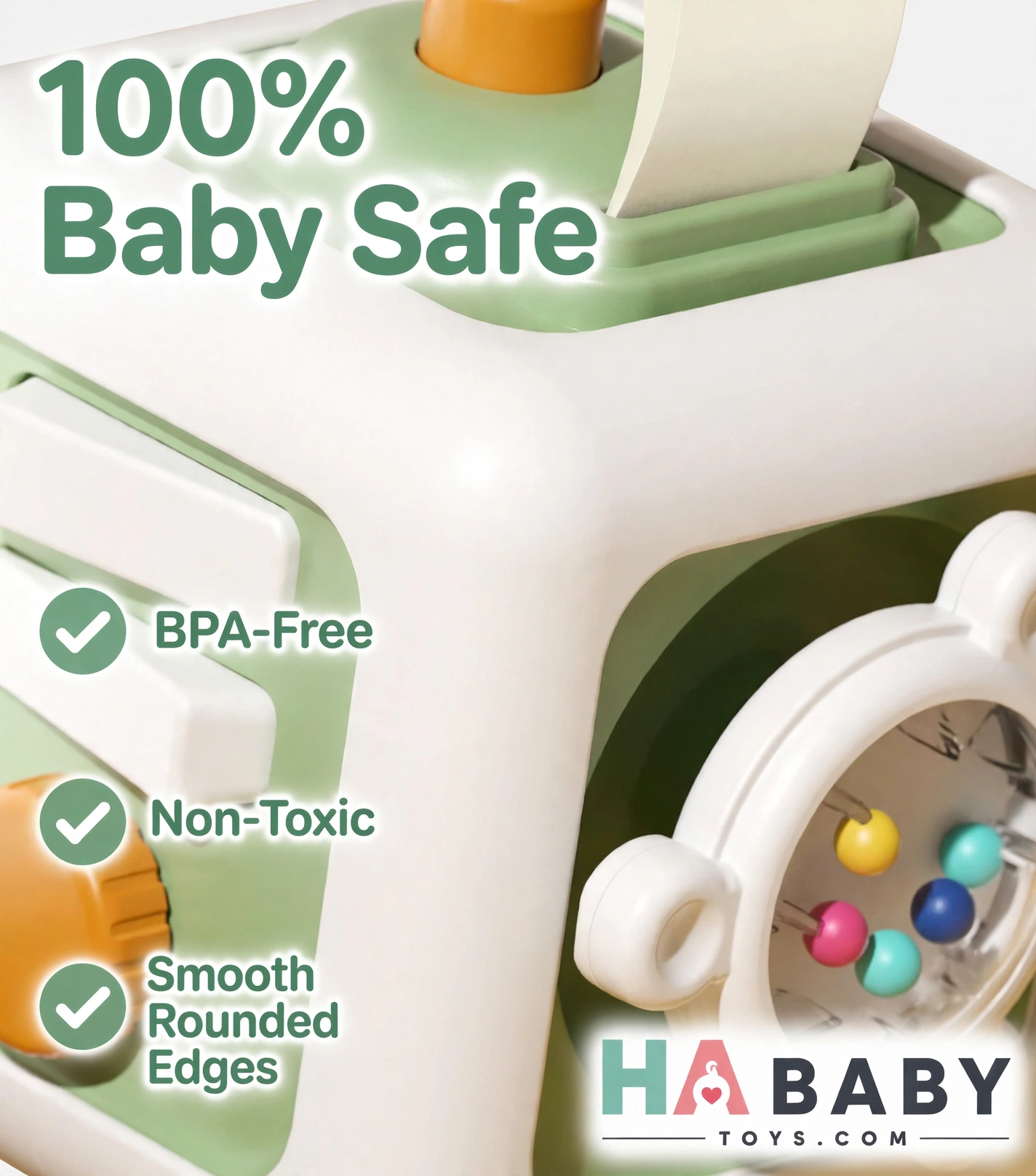
What makes a cube different from a single-purpose toy is the element of choice. A baby can explore one side, then move to another, then return to a favorite activity. This variety is useful for parents because it reduces the need to buy multiple toys and keeps the play area less cluttered. However, it is important to remember that the actual features matter more than the number of activities advertised. A cube with fewer well-designed activities may be more valuable than one with many features that are poorly constructed or difficult for a baby to use.
To see how these concepts apply to older toddlers, you can read about the Montessori busy board for toddlers, which follows a similar hands-on philosophy.
How a Sensory Activity Cube Encourages Learning Through Play
This is the main educational section. It is important to understand that a toy does not guarantee developmental outcomes. Instead, it provides opportunities for practice and exploration. Here is how a sensory activity cube supports early learning.
Learning Through Touch and Exploration
Babies investigate objects by touching, holding, pressing, turning, and moving them. A sensory cube offers multiple textures and interactive components that invite this type of tactile exploration. The NAEYC’s guidance on fine motor skills emphasizes that these early hand movements are foundational for later development.
Understanding Cause and Effect
A child may notice that an action produces a result. For example, moving a component changes its position, or turning a knob causes something to spin. This simple cause-and-effect discovery is a building block of early cognitive development.
Hand-Eye Coordination
Looking at an object while reaching for and manipulating it brings visual attention and hand movements together. This coordination is essential for everyday tasks and is practised naturally during play.
Early Problem-Solving
A child may experiment with different ways to move or interact with an activity. If one approach does not work, they may try another. This experimentation is the foundation of problem-solving.
Curiosity and Concentration
A baby may return to a familiar activity, repeat an action, or explore a different side of the cube. This self-directed exploration supports the development of concentration and curiosity, without the pressure of a structured lesson. The CDC’s child-led play guidance encourages parents to allow children to lead their own exploration.
Independent Exploration
Children can be given time to explore at their own pace while an adult remains nearby. This independence builds confidence and allows the child to discover things on their own terms. Avoid statements such as “improves intelligence” or “guarantees faster development.” The value of the toy lies in the opportunity for practice, not in a promised outcome.
Different Types of Activities Found on Sensory Cubes
While every sensory cube is different, here are some common activity types. Remember that these are general examples, not confirmed features of any specific product. To see how a multi-activity design works in practice, explore the 6-in-1 Montessori busy board activities.
Moving and Sliding Elements
Children explore how components move along a path. This activity invites repeated movement and observation. A parent can demonstrate the action slowly, and the child can try it independently.
Spinning Activities
Rotating parts invite repeated movement and observation. Children enjoy the visual feedback of a spinning component, and the action supports fine motor coordination.
Shape and Matching Activities
Some cubes introduce simple matching or recognition tasks. Children may try to fit a shape into a corresponding slot or match colors. This activity supports visual discrimination and early problem-solving.
Bead or Track Activities
These can involve guiding a movable piece along a track. The child practices hand-eye coordination while moving the piece from one end to the other.
Opening and Closing Features
Certain designs introduce simple practical movements, such as opening a small door or flipping a latch. These activities build familiarity with everyday mechanisms.
Visual and Tactile Details
Different shapes, colors, and textures can invite observation and touch. Even simple visual details can capture a baby’s attention and encourage exploration.
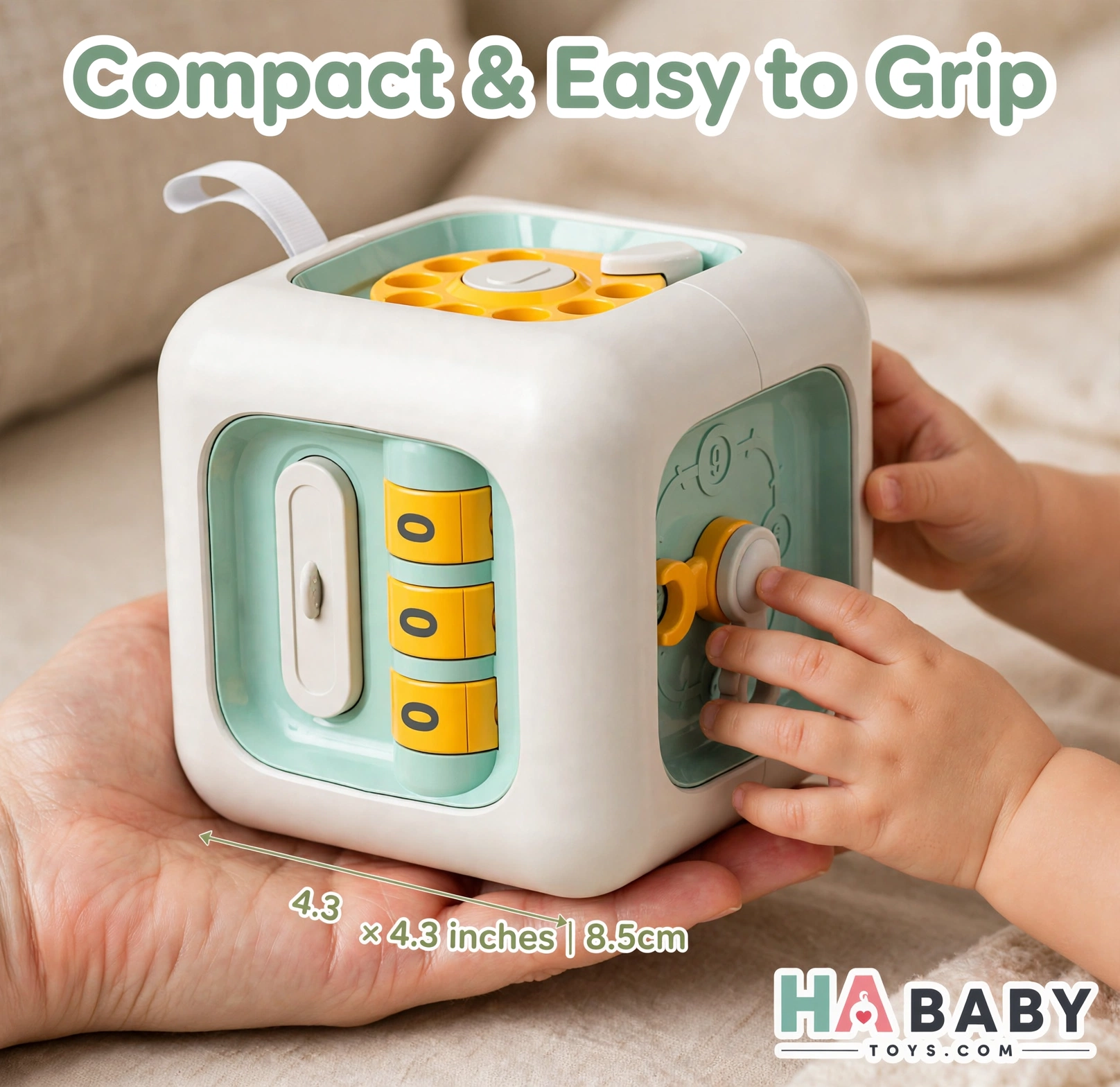
For each activity, consider what the child can do, what makes it interesting, how a parent can demonstrate it, and what to check for in terms of age suitability and safety. Always verify the specific features of the product you are considering.
How Parents Can Introduce a Baby Sensory Activity Cube
Introducing the toy in a calm, structured way helps your baby get the most out of the experience. Follow this practical routine:
- Choose a suitable play space: Use a stable, uncluttered surface and keep the child within reach.
- Introduce one activity: Avoid presenting every side at once.
- Demonstrate slowly: Show one simple action without expecting the child to copy immediately.
- Allow exploration: Give the child time to touch and investigate.
- Use simple words: Describe what is happening, such as “turn,” “move,” “open,” or “stop.”
- Follow the child’s interest: Change activities when the child loses interest.
- Finish and inspect: Put the toy away and check for loose or damaged parts.
Babies develop at different rates. Play should remain relaxed rather than becoming a test. If your child is not interested in a particular activity, that is perfectly normal.
Age-Appropriate Play: Choosing Activities for Different Stages
This section provides general guidance on how play may vary as babies develop. The manufacturer’s age label and the child’s individual abilities always take priority.
- Younger babies: Focus on looking, reaching, and adult-supported exploration. Only use toys specifically labeled as suitable for the child’s age.
- Babies beginning to sit and reach: Offer supervised opportunities to explore accessible features.
- Older babies: Let them investigate simple movement-based activities if suitable for their abilities.
- Toddlers: Encourage exploration of more challenging features where the product is age-appropriate.
For more age-specific guidance, refer to the Seattle Children’s toys and play resource.
What to Look for Before Buying a Sensory Activity Cube
This section helps confused buyers make a sensible decision. The American Academy of Pediatrics’ toy-buying guidance is a useful reference.
- Age suitability: Check the manufacturer’s recommended age and warnings.
- Activity quality: Consider whether the activities are genuinely usable and appropriate.
- Construction: Look for sturdy construction and components that remain securely attached.
- Small-part risks: Check whether any component could detach and become a choking hazard.
- Edges and surfaces: Look for smooth, finished surfaces and the absence of accessible sharp edges.
- Size and stability: Consider where the toy will be used and stored.
- Cleaning: Check the manufacturer’s cleaning instructions.
- Play value: Consider whether the activities offer meaningful variety rather than simply a high advertised activity count.
Buyer tip: A cube with fewer well-designed, age-appropriate activities may be a better choice than one advertising many activities that are difficult to use or poorly explained. To compare options, you can explore the HA’BABY toy collection.
Simple Ways to Make Play More Interesting
You do not need extra equipment to make play more engaging. Try these simple ideas:
- Describe actions: Use simple words while the child explores.
- Take turns: Demonstrate an action and give the child an opportunity to try.
- Explore one side at a time: Keep the experience manageable.
- Ask simple questions: “Where did it go?” or “Can you move it?”
- Repeat favourite activities: Repetition is a normal part of learning through play.
- Let the child lead: Do not insist that every activity must be completed.
These are play suggestions, not a structured lesson plan. The goal is enjoyment and exploration.
Common Mistakes Parents Should Avoid
This section builds trust by acknowledging that a sensory cube is a play option, not a substitute for adult interaction or a guarantee of developmental progress.
- Buying a toy based only on its advertised number of activities.
- Ignoring the manufacturer’s age recommendation.
- Giving a child too many instructions.
- Expecting a baby to understand every feature immediately.
- Leaving a baby unattended with a toy.
- Continuing to use a cube with loose, broken, or damaged components.
- Ignoring cleaning and maintenance instructions.
- Assuming that an educational label automatically means a toy is safe.
For safety guidance, review the CPSC Toy Safety Guide and check the CPSC Toy Recalls page for any relevant product notices. The CDC choking hazards information is also useful for understanding small-part risks.
HA’BABY Product Spotlight: Baby Sensory Activity Cube
If you are looking for a sensory activity toy that supports hands-on exploration, the HA’BABY Sensory Busy Board Drawer Cube is a practical option. This product is designed as a drawer-style busy board cube, offering interactive activities that encourage babies and toddlers to explore, move, and discover.
The multi-activity design aligns with the principles discussed in this guide: it provides different ways to explore in one compact toy, allowing parents to introduce activities gradually during supervised play. Each feature is intended to support exploration and coordination, not to guarantee specific developmental outcomes.
What to check before ordering: Review the confirmed product specifications, dimensions, materials, and age recommendations on the listing. If you have questions, visit the HA’BABY FAQ page for more information.
Note: Always verify the actual product features and safety details on the live listing before purchasing.
Explore the HA’BABY Sensory Activity CubeOne Cube, Many Ways to Explore
Touch and Explore
Different textures and surfaces invite babies to investigate through touch.
Move and Discover
Moving components help children understand how actions create results.
Look and Observe
Colorful elements and visual details capture attention and encourage focus.
Try and Repeat
Repetition is a natural part of learning and builds familiarity.
Explore Cause and Effect
Simple actions teach children that their movements have an impact.
Learn Through Play
Every interaction is an opportunity for discovery and growth.
Frequently Asked Questions
What is a baby sensory activity cube?
A baby sensory activity cube is a multi-sided toy designed to provide different hands-on activities in one compact structure. Depending on the model, its sides may include moving components, matching activities, shape-related tasks, spinning elements, or other interactive features.
What does a sensory activity cube teach babies?
A sensory activity cube provides opportunities for babies to practise exploration, movement, observation, and simple problem-solving. Through hands-on interaction, they can discover cause-and-effect relationships and develop fine motor coordination, though results vary between children.
At what age can a baby use a sensory activity cube?
Age suitability depends on the specific product, its warnings, and the child’s individual abilities. Parents should always follow the manufacturer’s recommended age and safety instructions rather than assuming every cube suits every baby.
Are sensory activity cubes safe for babies?
Safety depends on the product’s age label, securely attached components, and absence of choking hazards. Always check for smooth edges, inspect the toy for loose parts, and supervise your baby during play. Reviewing CPSC toy safety guidance is strongly recommended.
How long should a baby play with an activity cube?
There is no universal session length. Follow the child’s interest and stop when they become tired or frustrated. Short, relaxed play sessions based on the baby’s attention span are more beneficial than forced or extended play.
Can a sensory activity cube replace other toys?
A sensory activity cube can provide variety, but it should not replace other forms of play, movement, books, or adult interaction. A balanced play routine includes a range of experiences that support different aspects of development.
Is a baby sensory activity cube a good gift?
It can be a thoughtful gift if you consider the child’s age, interests, available space, and the quality of the activities. Always verify the product’s age recommendation and safety details before purchasing as a gift. You can also visit the HA’BABY FAQ page for more information.
Conclusion and Next Steps
A baby sensory activity cube is a practical, engaging toy that offers multiple ways for babies to explore, practise, and discover. By understanding the learning opportunities, introducing activities gradually, and checking safety details, you can make a confident decision that supports your child’s natural curiosity.
Ready to explore further? Explore the HA’BABY toy collection to compare options, or ask about product details if you have specific questions. For more hands-on play inspiration, visit the HA’BABY blog.
View the Sensory Activity Cube