
Baby Tissue Box Toy Guide: How Montessori Tissue Pulling Toys Support Early Learning and Development
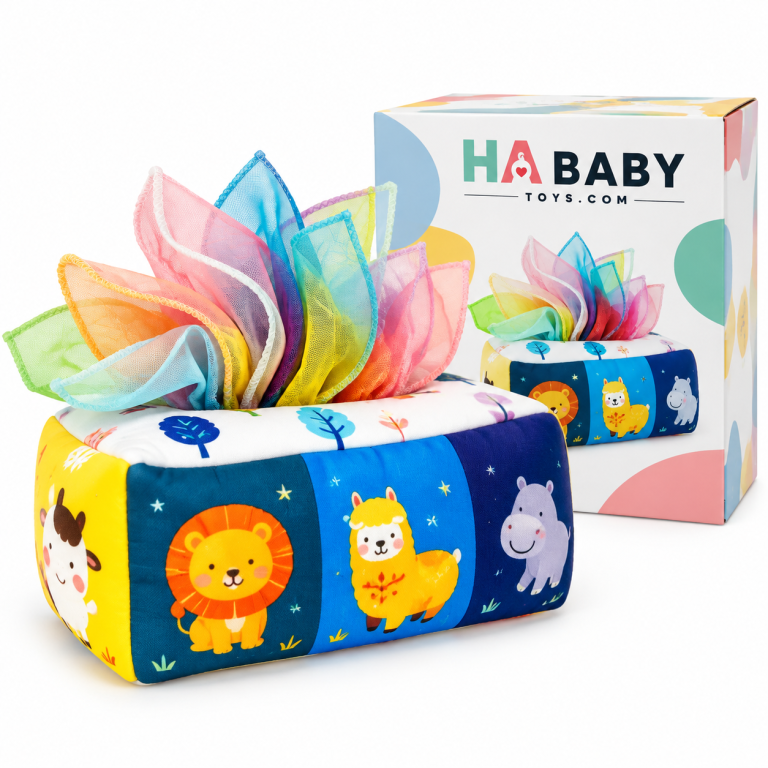
Why a simple baby tissue box toy can become a powerful learning tool. Babies learn about the world through touching, grabbing, pulling, and exploring — every movement is a learning opportunity. Many parents search for toys that are affordable, safe, educational, and engaging. The HA BABY Tissue Box Toy transforms a familiar activity into a sensory learning experience. A baby pulling colorful tissues from a soft toy box is not just entertainment — it encourages hand movement, curiosity, problem-solving, and sensory exploration.
Parents looking for more educational toys can explore the complete collection at HA BABY Toys.
What This Guide Covers
- What Is a Baby Tissue Box Toy?
- How Montessori Tissue Pulling Toys Support Learning
- Sensory Development Through Touch
- Fine Motor Skill Development
- Why Babies Love Repetitive Activities
- vs Traditional Toys Comparison
- Age Guide for Babies
- Screen-Free Learning Benefits
- HA BABY Tissue Box Toy
- Educational Gift for Babies
- Interactive FAQ
What Is a Baby Tissue Box Toy?
A baby tissue box toy is a sensory activity toy designed around the natural curiosity babies have toward pulling objects. Instead of using real tissues that are wasted, babies can repeatedly pull colorful fabric tissues from a reusable toy box. It’s an elegant solution to a very common parent problem — “my baby is obsessed with pulling tissues!”
Here are the three main components that make it work.
🧸 Soft Tissue Box
Provides easy gripping, comfortable handling, and baby-friendly play.
🌈 Colorful Fabric Tissues
Encourage visual attention, touch exploration, and repeated activity.
✋ Interactive Pulling Action
Supports hand movement, coordination, and cause-and-effect understanding.
Parents can learn more about sensory learning through our guide: Baby Sensory Toys Explained: How a Tissue Box Toy Helps Babies Learn Through Play.
How Montessori Tissue Pulling Toys Support Early Learning
Montessori-inspired toys encourage children to learn through hands-on activities, independent exploration, repetition, and self-discovery. A tissue pulling activity follows this idea because babies control the action themselves — no adult input is required for the basic activity to work.
The learning cycle is simple and powerful: Pulls → Observes → Repeats → Learns.
🌟 Independence
Baby explores without needing constant instructions from a parent.
⭐ Confidence
Successful actions create achievement — “I did that!”
🎯 Focus
Repeated activity improves attention and concentration.
Montessori approaches commonly emphasize purposeful, hands-on learning experiences and independence — the American Montessori Society provides detailed resources for parents exploring this philosophy. For a deeper look, see Montessori Toys for Babies: Why Tissue Pulling Toys Encourage Independent Learning.
Sensory Development: How Babies Learn Through Touch and Colors
Babies understand the world through touch, sight, movement, and sound. A tissue pulling toy provides all four — often without the parent realizing just how much is happening.
👀 Visual Stimulation
Bright colors attract attention and help babies learn to focus.
✋ Tactile Experience
Different fabric textures create rich sensory exploration.
🔄 Movement Learning
Pulling teaches cause and effect through direct action.
Multisensory play combines different types of input — a key principle behind many educational toy designs and one confirmed by ongoing research in early education (see the Frontiers in Education journal for peer-reviewed studies). For a deeper look, see Why Montessori Tissue Pulling Toys Are Perfect for Baby Sensory Development and Fine Motor Skills.
How Tissue Pulling Toys Develop Fine Motor Skills
Fine motor skills involve small hand movements — and they are one of the most important developmental milestones in the first two years. A baby tissue pulling toy helps babies practice four key motions.
Grasping
Baby learns how to hold objects — the foundation of all later hand skills.
Pulling
Strengthens hand movement and grip through resistance and repetition.
Coordination
Improves hand-eye connection — seeing and reaching at the same time.
Control
Develops precise, intentional movements instead of random grabbing.
Learn more in our guide: How a Baby Tissue Pulling Toy Builds Hand-Eye Coordination, Focus, and Curiosity. The CDC’s child development milestones provide useful reference points for what babies can do at different ages.
Why Babies Love Repetitive Activities
Parents often wonder: “Why does my baby repeat the same action again and again?” The answer is simple — repetition is how babies learn.
Repetition helps babies understand cause and effect, movement, results, and control. When a baby pulls a tissue, they learn: “I pull → something appears.” That connection is genuinely exciting for a developing brain.
The Zero to Three organization explains that repetition and predictable routines help babies build confidence and understanding of the world.
Baby Tissue Box Toy vs Traditional Toys
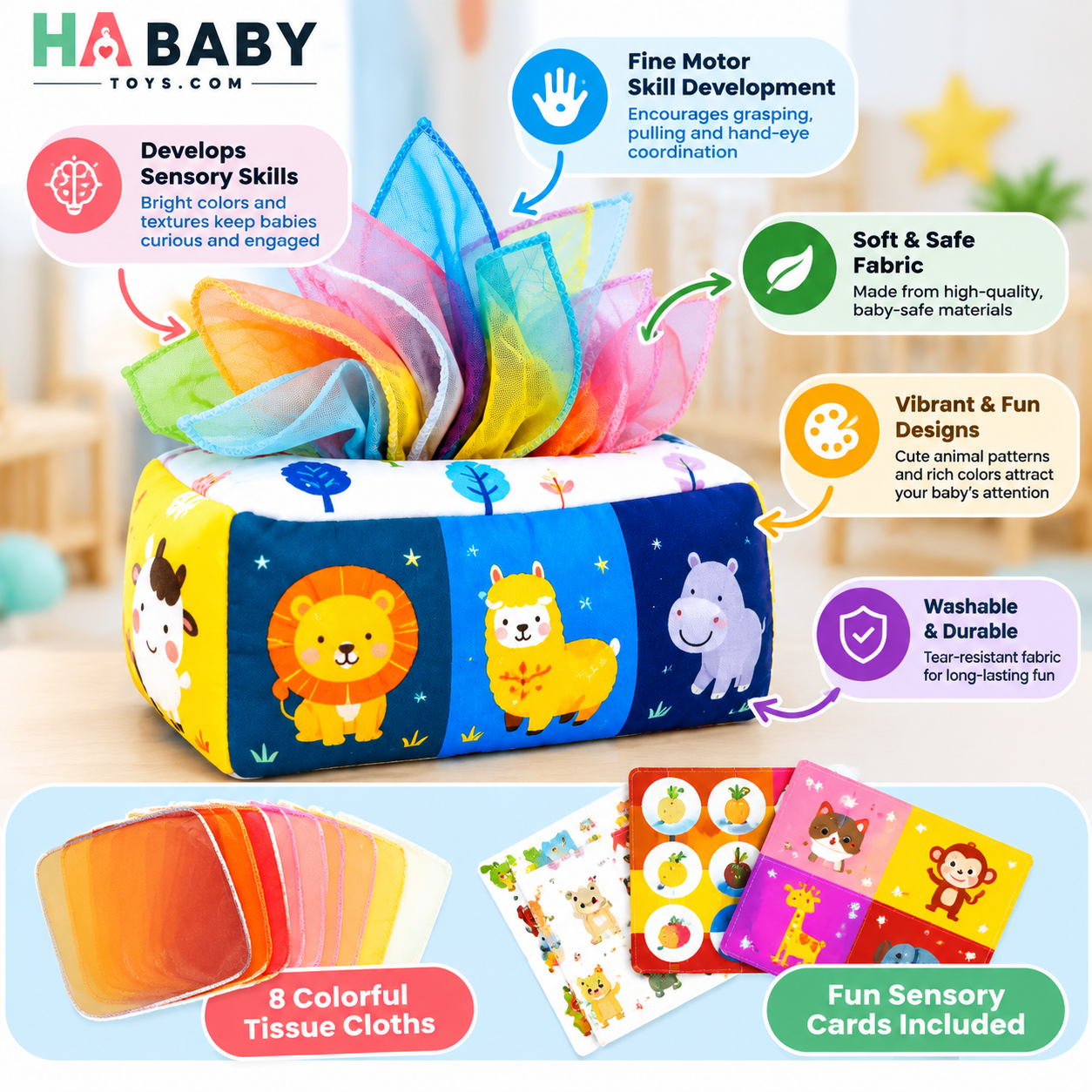
Traditional toys can be valuable, but sensory toys add developmental opportunities that ordinary toys don’t. Here’s how the two compare.
| Traditional Toys | Tissue Pulling Toy |
|---|---|
| Often passive play | Active interaction |
| Limited actions | Repeated exploration |
| Entertainment focused | Skill development focused |
| Less sensory engagement | Multi-sensory activity |
| Short-lived interest | Grows with development |
For a deeper comparison, see Baby Tissue Box Toy vs Traditional Toys: Why Sensory Toys Create Better Learning Experiences.
How Baby Tissue Box Toy Supports Development
Tap each stage to follow the developmental pathway
Colors
Visual attention
Baby + Tissue Box
Interactive play
Hand Movement
Fine motor practice
Sensory Learning
Brain development
Development
Skills growth
Stage 1 — Colors
Bright, high-contrast colors capture a baby’s visual attention. Even before babies can reach and grab, they’re learning to focus their eyes and track movement — the beginning of visual development.
Baby Tissue Box Toy Age Guide: When Can Babies Use It?
The right age depends on your baby’s developmental stage. Here’s a simple breakdown.
6–12 Months
Learning: grabbing, pulling, exploring textures — the core tissue pulling phase.
12–18 Months
Learning: coordination, independent play, intentional pulling.
18+ Months
Learning: creative activities, storytelling, more complex play.
For a full breakdown, see Baby Tissue Box Toy Age Guide: What Babies Learn From Sensory Pulling Activities.
Screen-Free Learning: Why Parents Choose Sensory Toys
Modern parents want alternatives to screens — especially in the first two years when screen exposure should be minimal. A tissue pulling toy encourages physical activity, exploration, parent interaction, and independent play.
The American Academy of Pediatrics recommends limited screen time and prioritizes hands-on play for babies and toddlers. For more ideas, see Screen-Free Activities for Babies: How Tissue Pulling Toys Make Learning Fun at Home.
HA BABY Tissue Box Toy: A Simple Toy With Big Learning Benefits
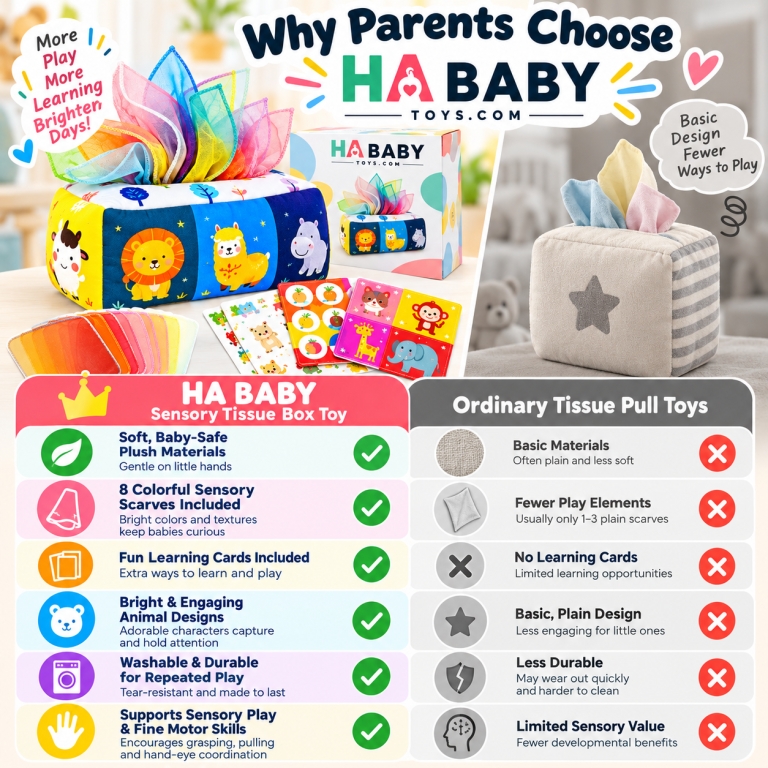
The HA BABY Tissue Box Toy helps babies explore through touching, pulling, and discovering — combining Montessori-inspired design with real developmental value.
HA BABY Tissue Box Toy
- Montessori-inspired sensory activity
- Soft, reusable fabric tissues
- Fine motor skill practice built in
- Color learning and visual stimulation
- Interactive play for babies
- Baby-safe, comfortable materials
- Complete set — no extra tissues needed
For readers who want to compare the wider range of sensory products, the full shop is a useful next step. The HA Baby Toys blog also covers every aspect of early learning and sensory development.
Why Parents Choose Baby Tissue Box Toys as Educational Gifts
A tissue box toy is perfect for baby showers, first birthdays, new parents, and learning toy collections. A useful gift should provide fun, learning, and long-term engagement — and this one delivers all three.
For more on this, see Why a Baby Tissue Box Toy Is the Perfect Educational Gift for Infants and Toddlers. The UNICEF Early Childhood Development resources also emphasize the importance of early sensory engagement.
Frequently Asked Questions
A baby tissue box toy is a sensory pulling toy designed around the natural curiosity babies have toward pulling objects. Instead of real tissues that get wasted, babies pull colorful fabric tissues from a soft, reusable toy box. It’s Montessori-inspired, safe, and reusable — giving babies unlimited sensory play without the mess.
A tissue pulling toy develops fine motor skills (grasping, pulling, releasing), hand-eye coordination, sensory awareness, cause-and-effect understanding, focus and attention, and independence. These skills form the foundation for later learning, including handwriting and problem-solving. The CDC’s child development milestones highlight fine motor practice as foundational in the first two years.
Yes. Montessori-inspired activities emphasize hands-on exploration, independence, repetition, and purposeful activities — all of which a tissue pulling toy naturally supports. Babies control the action themselves, which builds confidence and curiosity. The American Montessori Society provides detailed resources on Montessori principles for parents.
With supervision, a baby tissue box toy is suitable from around 6 months — when babies can sit with support and reach for objects. Babies 6–12 months will explore textures and pulling. Ages 12–18 months develop coordination and independent play. Ages 18+ months enjoy more creative play. For a full breakdown, see the Baby Tissue Box Toy Age Guide.
Babies love pulling tissues because it satisfies their natural curiosity and their drive to understand cause and effect. When a baby pulls a tissue and something appears, their brain forms a connection: “I did that.” That discovery is deeply rewarding — which is why babies repeat the action again and again. Repetition is how babies build understanding. The Zero to Three organization explains that repetition is a core part of infant learning.
They serve different purposes. Ordinary toys provide entertainment; sensory toys provide entertainment plus development. A tissue pulling toy offers active interaction, repeated exploration, multi-sensory engagement, and skill development. For a detailed comparison, see Baby Tissue Box Toy vs Traditional Toys.
Yes — a tissue pulling toy is a genuine screen-free alternative. It encourages active play, physical movement, and independent exploration rather than passive consumption. The American Academy of Pediatrics recommends limited screen time for babies and prioritizes hands-on play — exactly what a tissue pulling toy delivers.
Give Your Baby More Than a Toy
Give them an opportunity to explore, learn, and develop through simple sensory play. Pull → Observe → Repeat → Learn
The Bottom Line: Simple Toy, Powerful Learning
A baby tissue box toy is proof that the best learning toys don’t have to be complicated or expensive. It turns a familiar activity into a genuine developmental tool that supports fine motor skills, sensory awareness, hand-eye coordination, and independence.
Whether you’re a new parent looking for a screen-free activity, a grandparent searching for a meaningful gift, or a family focused on early learning, a Montessori tissue pulling toy delivers real value. It turns curiosity into discovery — and discovery into a lifelong love of learning.
For parents ready to explore one, the HA BABY Tissue Box Toy product page is the natural next step. For deeper guidance on sensory learning and early development, explore the full HA Baby Toys blog library.
2 Responses