
A dumpling squishy toy is easiest to use by holding it in one or both hands, squeezing gently, releasing the pressure, and repeating the motion. It can also be used as a casual fidget or tactile toy — but it should not be bitten, punctured, pulled aggressively, or stretched beyond what the product is designed to handle. This guide walks through that routine step by step, including what to do when something goes wrong.
If you are new to this type of toy, start with what a glitter dumpling squishy is and come back here when you are ready to squeeze.
The 60-second quick start
- Inspect the toy first.
- Hold it comfortably.
- Squeeze gently.
- Release and let it return toward shape.
- Repeat at a comfortable pace.
- Avoid sharp objects.
- Do not bite or chew it.
- Stop using it if it tears or leaks.
- Wipe and store it after play.
The safe-use workflow in five moves — Check → Hold → Squeeze → Release → Store
Check
Look for tears, punctures or exposed filling.
Hold
Rest it naturally in the palm.
Squeeze
Compress gently rather than crushing or twisting.
Release
Let the material return toward its normal form.
Store
Keep it away from sharp objects and excess heat.
↻ Five steps that keep a squishy usable for months
Step 1: Inspect the squishy before use
This takes ten seconds and prevents most of the disappointment that ruins a good squishy. A small tear becomes a large leak very quickly once a child starts squeezing.
Parents and users should check for:
- Tears
- Small punctures
- Loose seams
- Sticky residue
- Exposed filling
- Surface damage
- Unusual deformation
For the wider standards behind these checks, the U.S. Consumer Product Safety Commission’s toy safety guidance and Safe Kids Worldwide’s toy safety tips both explain what a well-made toy should and should not have.
Step 2: Hold it correctly
There is no complex technique, but the way the toy is held does affect how long it lasts.
- Use one hand for a light squeeze
- Use two hands for a broader, gentle compression
- Keep fingernails away from vulnerable seams
- Avoid pinching one tiny area repeatedly
Broad, gentle pressure is usually safer than squeezing one small spot as hard as possible. A nail pressed repeatedly into the same point is the most common way a squishy develops a puncture.
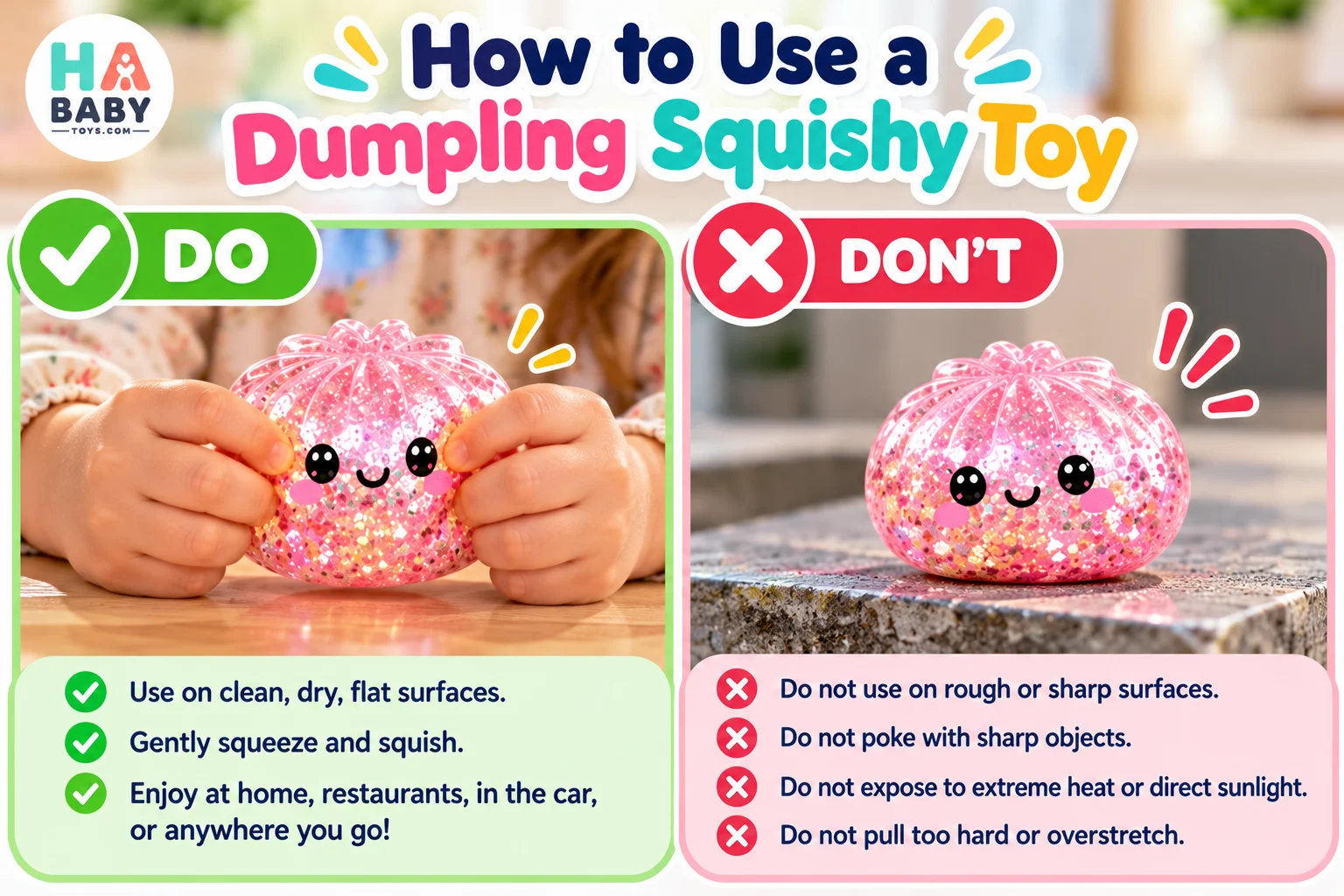
Step 3: Use a gentle squeeze-and-release motion
The basic sequence is simple:
Hold → Compress → Pause → Release → Repeat
The goal is tactile movement, not maximum force. There is no benefit to testing how far the squishy can deform — and a fair amount of risk, since the seams are the part that fails first.
Safe squeeze zones
Where to press, and where to leave alone
These zones are general handling guidance, not product-engineered specifications. They describe how a squishy typically behaves under pressure.
How hard should you squeeze it?
Only use enough pressure to compress the toy comfortably. If the shell feels overstretched, creases sharply, or starts to split, stop.
That is a practical test rather than an invented pressure limit. A squishy that is being squeezed correctly feels springy and returns quickly; one that is being squeezed too hard feels tight and slow to recover.
Can you stretch a dumpling squishy?
Some squishy toys tolerate light stretching, while others are designed mainly for compression. Unless the product specifically states that stretching is intended, squeezing is safer than pulling.
Avoid the following:
- Aggressive stretching
- Twisting
- Pulling from opposite sides
- Testing maximum stretch
If stretch tolerance matters to you, check the product page. If you are comparing options more broadly, why choose a glitter dumpling squishy covers what to look for in a novelty squeeze toy.
Do not twist it like a rope
Twisting is the most common way a squishy fails early, and it is the one people do without thinking. It puts extra stress on:
- Seams
- Thin outer areas
- Decorative features
Better: squeeze and release instead of wringing or twisting. If you catch a child twisting the toy, redirect them to a two-hand press — it delivers the same satisfying resistance without the seam stress.
Do not bite or chew the toy
This is especially important because the toy looks food-shaped.
- It is not food
- It is not a teether
- It is not a chew toy
- Children should not bite through the shell
Because the dumpling shape looks playful and food-inspired, adults should make the “toy, not food” rule clear to younger users. If a child does bite into a squishy and the filling is unknown, contact Poison Control for guidance rather than guessing. The AAP’s choking prevention guidance on HealthyChildren.org is also a sensible reference for small-part risks.
Keep it away from sharp objects
Common risks include:
- Scissors
- Pens
- Keys
- Pins
- Long fingernails
- Pet claws
- Rough-edged furniture
This is one of the most practical damage-prevention sections in the guide. A bag with keys in it is the single most common way these toys die — a small pouch solves the problem entirely.
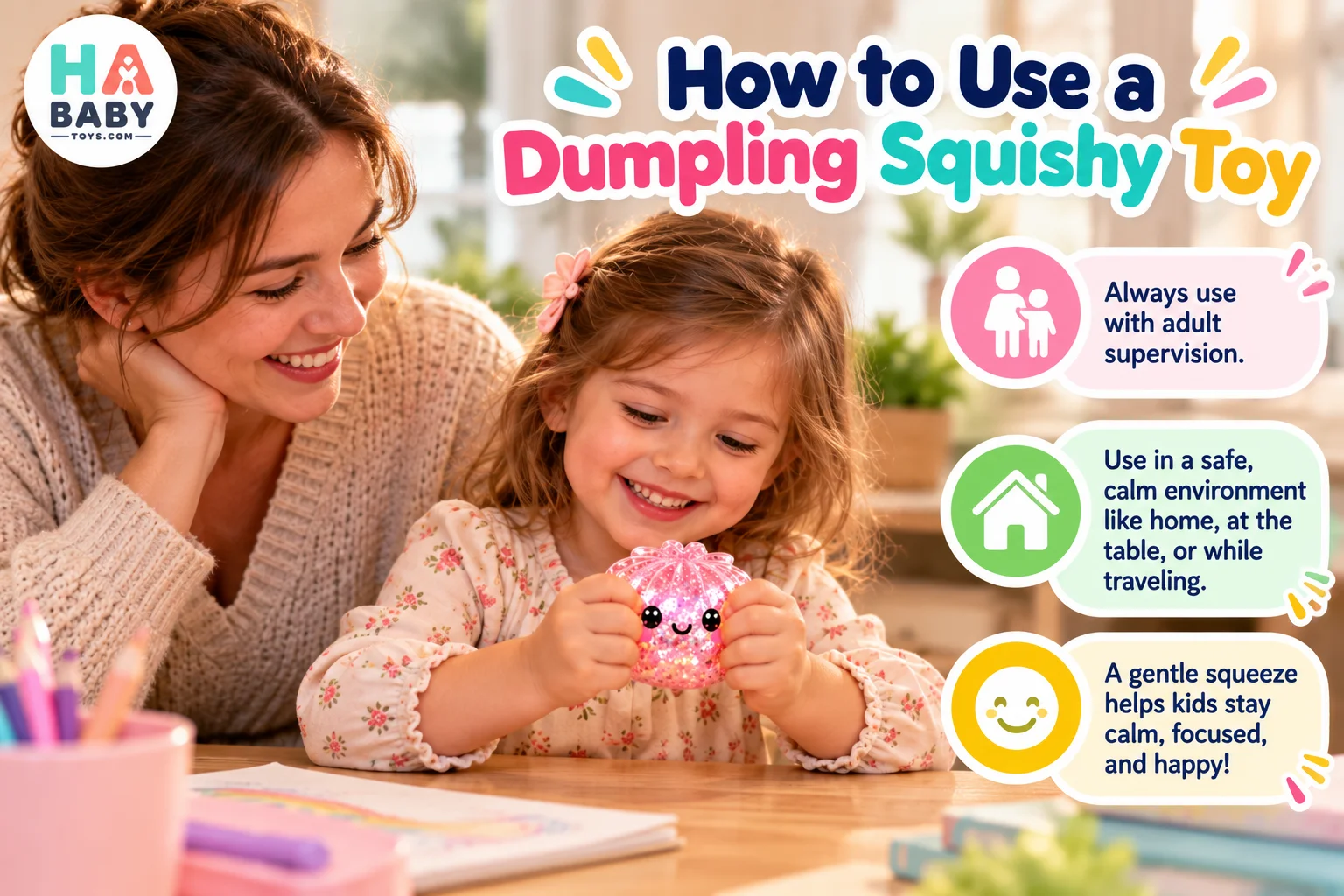
Step 4: Use it as a casual fidget toy
Possible uses are practical and modest:
- Desk fidgeting
- Waiting-time activity
- Short tactile breaks
- Car or travel toy
- Quiet hand activity
It may feel satisfying or calming for some people, but that is a personal experience rather than a medical effect. For general mental health context rather than product claims, the NHS mental health information is a reliable starting point.
Step 5: Try simple squeeze patterns
None of these add force — they just give the hands something varied to do.
Desk use, travel and sharing
Can it be used at a desk?
Yes, if allowed. Possible uses include short breaks, non-writing moments, a quiet hand fidget, and waiting time. In classrooms or workplaces, use depends on local rules and whether the toy becomes distracting.
Can it be used during travel?
Potentially useful because it is compact, simple, screen-free and needs no setup. Recommendations: store it in a small pouch, keep it away from keys, do not leave it loose under luggage, and keep it away from heat.
Can children share it?
Yes, but clean it between users if needed, avoid pulling from opposite sides, take turns instead of tugging, and stop if rough play starts. A two-child tug-of-war is the fastest way to tear a squishy.
Parent-child use ideas
These work with no equipment and no setup:
- Copy my squeeze — parent demonstrates, child copies
- Left hand / right hand — switch hands
- Slow and fast — use different squeeze speeds without adding force
- Count and release — count each squeeze
- Describe the texture — use words like soft, smooth or squishy, but only if they match the actual product
If you want the buying case rather than the care case, why choose a glitter dumpling squishy sets out what makes the toy appealing in the first place.
What if something goes wrong? Troubleshooting
Tap any problem to see the safe response.
What if the toy feels sticky?
Stop and inspect it. Wipe gently if appropriate, check for surface breakdown or residue, and do not apply random powders, oils or solvents. If stickiness comes from material damage rather than surface dirt, replace it.
What if the toy loses its shape?
Stop squeezing for a while and let it rest. Inspect for shell damage. Do not force or aggressively reshape it. If it does not recover, follow the manufacturer’s guidance or replace it.
What if the squishy tears?
Stop using it immediately. Keep exposed filling away from mouth and eyes. Keep the damaged toy away from children and pets. Do not patch it for continued child use unless the manufacturer explicitly permits repair. Dispose of it according to the product or material guidance.
What if filling leaks out?
Treat any unknown toy filling cautiously. Avoid skin, eye or mouth contact, clean the area, and follow the manufacturer’s safety information. If you are unsure what the filling is or a child may have ingested it, contact Poison Control rather than speculating.
Can it be washed under water?
Do not assume it is washable or waterproof. Use a soft damp cloth, avoid soaking, avoid harsh cleaners, dry completely, and keep water away from any seams or openings.
Is it okay to leave it in a hot car?
Better to discourage it. Extreme heat can affect some soft toy materials, so storing a squishy in a hot car or beside a heater is generally best avoided unless the manufacturer says otherwise.
Cleaning and storing the squishy
Cleaning
- Use a soft damp cloth
- Avoid soaking
- Avoid harsh cleaners
- Dry completely
- Keep water away from any seams or openings
Storage
- Keep in a clean, dry place
- Store away from sharp objects
- Avoid direct heat
- Avoid heavy objects pressing on it
- Do not leave under long-term compression
A small pouch or separate toy bin can help protect the surface from keys, pens or rough-edged items. A squishy stored loose in a school bag will not last the term. The Nemours KidsHealth toy safety page and the Mayo Clinic’s child safety overview are both worth a skim alongside these habits.
When should you stop using it?
A retirement checklist is more useful than a vague warning. Stop using it if:
- The shell tears
- Filling leaks
- A seam opens
- The material becomes sticky or degraded
- Sharp damage appears
- A piece breaks off
- The toy becomes impossible to clean
Common mistakes to avoid — don’t do this
- Biting
- Chewing
- Puncturing
- Overstretching
- Twisting
- Pulling between two people
- Leaving near pets
- Storing with keys or scissors
- Continuing after a tear
- Assuming “stress relief” means medical treatment
60-second safe-use checklist — before every squeeze
- Toy has no tears
- Surface is intact
- Hands are clean
- Squeeze gently
- Do not twist
- Do not over-stretch
- Keep away from sharp objects
- Do not bite or chew
- Stop if filling is exposed
- Clean and store after use
Ready to put this into practice? Explore the HA Baby Toys Glitter Dumpling Squishy, or compare the wider range in the HA Baby Toys shop.
How to use it without overusing it
There is no need to squeeze continuously for long periods. Use it casually and stop if the hand becomes tired, sore or uncomfortable. That is a simple self-check rather than a medical instruction — the toy is meant to be a small break, not a workout.
Dumpling squishy use and care FAQ
Tap any question to expand the answer.
How do you use a dumpling squishy toy?
Inspect it first, hold it comfortably in one or both hands, squeeze gently, release the pressure, and let it return toward its shape. Repeat at a comfortable pace. Avoid biting, puncturing, twisting or over-stretching, and stop using it if it tears.
How hard should I squeeze it?
Only use enough pressure to compress the toy comfortably. If the shell feels overstretched, creases sharply or starts to split, stop. Broad, gentle pressure is safer than pinching one small spot hard.
Can you stretch a dumpling squishy?
Some squishy toys tolerate light stretching, while others are designed mainly for compression. Unless the product specifically states that stretching is intended, squeezing is safer than pulling. Avoid aggressive stretching, twisting and testing maximum stretch.
Can you twist it?
No. Twisting puts extra stress on seams, thin outer areas and decorative features, and it is one of the most common ways a squishy fails early. Squeeze and release instead of wringing or twisting.
Can children bite or chew it?
No. It is not food, not a teether and not a chew toy. This matters especially because the toy looks food-shaped. If a child bites into a squishy and the filling is unknown, contact Poison Control for guidance.
Is it safe to use as a fidget toy?
Yes, casually. It may feel satisfying or calming for some people, but that is a personal experience rather than a medical effect. It is not a treatment for anxiety, ADHD, autism or any other condition.
What should I do if the squishy tears?
Stop using it immediately. Keep exposed filling away from mouth and eyes, keep the damaged toy away from children and pets, do not patch it for continued child use unless the manufacturer explicitly permits repair, and dispose of it according to the product or material guidance.
What should I do if filling leaks out?
Treat any unknown toy filling cautiously. Avoid skin, eye or mouth contact, clean the area, and follow the manufacturer’s safety information. If ingestion is possible, contact Poison Control.
How do I clean a dumpling squishy?
Use a soft damp cloth, avoid soaking, avoid harsh cleaners, dry completely, and keep water away from any seams or openings. Do not assume it is washable or waterproof unless the manufacturer says so.
Can I wash it under water?
Do not assume it is washable or waterproof. A wipe-down with a soft damp cloth is the safe default. Soaking can force water into seams and damage the toy from the inside.
Can children share one squishy toy?
Yes, but clean it between users if needed, avoid pulling from opposite sides, take turns instead of tugging, and stop if rough play starts. A two-child tug-of-war is the fastest way to tear a squishy.
Is it good for travel?
Potentially — it is compact, simple, screen-free and needs no setup. Store it in a small pouch, keep it away from keys, do not leave it loose under luggage, and keep it away from heat.
How should I store it?
Keep it in a clean, dry place, away from sharp objects, direct heat and heavy objects pressing on it. Do not leave it under long-term compression. A small pouch or separate toy bin protects the surface from keys, pens or rough-edged items.
When should I replace it?
Stop using it if the shell tears, filling leaks, a seam opens, the material becomes sticky or degraded, sharp damage appears, a piece breaks off, or the toy becomes impossible to clean. Those are the signals to replace rather than repair.
Where can I buy the HA Baby Toys Glitter Dumpling Squishy?
You can buy it directly from the HA Baby Toys Glitter Dumpling Squishy product page. For more care and buying guides, browse the HA Baby Toys blog, and for common order and safety questions, check the HA Baby Toys FAQ. Business buyers can request a quote.
The short version
Using a dumpling squishy toy safely comes down to four habits: inspect it before use, squeeze broadly and gently instead of pinching or twisting, keep it away from sharp objects and mouths, and stop using it the moment the shell tears or filling is exposed. Everything else in this guide is detail on those four habits.
If you are still deciding whether the toy is right for you in the first place, what a glitter dumpling squishy is covers the category and why choose a glitter dumpling squishy covers the buying case. To see the full range, visit HA Baby Toys or browse the HA Baby Toys 3+ Years category.
About this guide: Written for parents, gift buyers and general users of novelty squeeze toys. Product-specific details such as filling material, stretch tolerance, glitter placement and recommended age vary by model — always confirm them on the individual product page and follow the manufacturer’s instructions. Safety guidance here is general in nature and does not replace manufacturer instructions or adult supervision.
One Response