
A kids archery set should always be treated as a supervised target-play toy. Before the first shot, parents should create a clear shooting direction, keep everyone behind the shooter, inspect the bow and arrows, and teach one simple rule: aim only at the target.
If you are new to toy archery, start with the guide explaining what a kids bow and arrow set is. This article assumes you already have the set — or are about to — and want a clear, practical safety routine that works the very first time.
Before Play
- Inspect the bow and arrows.
- Choose one safe shooting direction.
- Place the target securely.
- Keep people and pets behind the shooter.
- Use only the included or approved toy arrows.
- Allow one shooter at a time.
- Stop immediately if the equipment is damaged.
Check → Aim → Clear → Shoot → Retrieve
The five-step safety workflow behind every session
Target
Check, aim, clear, shoot, retrieve
Check
Inspect the bow, string, arrows, and target.
Aim
Point only at the designated target.
Clear
Make sure nobody is in front of or behind the target.
Shoot
One child shoots at a time.
Retrieve
Collect arrows only after everyone has stopped.
Check → Aim → Clear → Shoot → Retrieve
Step 1: Inspect the Archery Set Before Every Session
Inspection takes less than a minute and prevents most accidents. Check for:
- Cracked bow body
- Loose string
- Bent arrows
- Damaged arrow tips
- Loose suction cups, if applicable
- Broken target pieces
- Sharp edges
- Missing parts
If a toy arrow, bow, or string looks damaged, stop using that part rather than trying to repair it during play. Replace only with compatible toy parts from the same manufacturer.
For product safety guidance on children’s items, the U.S. Consumer Product Safety Commission publishes information on recalls, hazards, and age suitability.
Step 2: Choose One Safe Shooting Direction
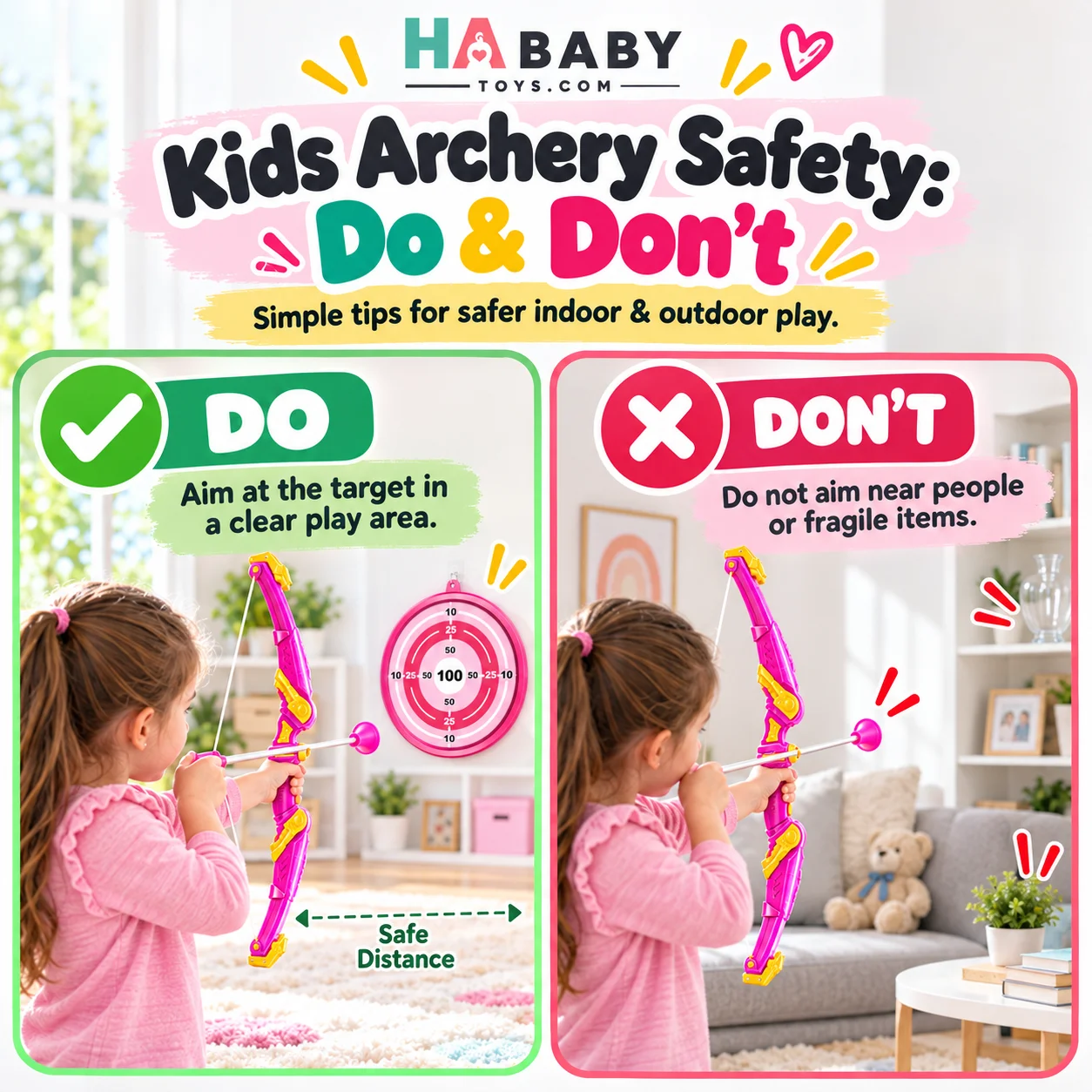
The child should always shoot toward one designated target. Avoid aiming toward:
- Doors
- Windows
- Roads
- Pets
- People
- Glass
- TVs
- Other children
A kids archery set becomes much easier to supervise when every shot goes in one direction. That single rule prevents most of the confusion that leads to accidents.
Safe-Zone Layout
A simple top-down view of safe archery play
Waiting Zone
Everyone else stands behind the shooter, well clear of the lane.
↓
Shooter Line
The child stands here with the bow, facing the target.
↓
Clear Lane + Target
No people, pets, or obstacles between the shooter and the target.
↓
No-Entry Zone Behind the Target
Nobody stands behind the target while arrows are being shot.
Step 3: Secure the Target
The target should be:
- Stable
- Visible
- Large enough for the play distance
- Positioned away from breakable objects
- Not balanced where it can fall over easily
If the set includes a target stand, follow the manufacturer’s setup instructions. Avoid inventing specific distances unless the product manual confirms them.
Step 4: Teach the “Target Only” Rule
Teach children a single, clear rule:
“The arrow points only at the target.”
No aiming at:
- People
- Pets
- Siblings
- Toys held by another person
- Faces
- Moving objects
Even if the arrows are soft, suction-cup, or foam-tipped, target-only rules still matter.
Step 5: Keep Everyone Behind the Shooter
Safe Position
- Shooter: at the line
- Other players: behind the shooter
- Target: ahead
- Nobody: beside or behind the target
This prevents children from walking into the shooting lane. When everyone knows where to stand, the whole activity becomes easier to supervise.
Step 6: One Shooter at a Time
For siblings or parties:
- One child shoots
- Others wait
- Everyone stops before retrieving arrows
- Next child takes a turn
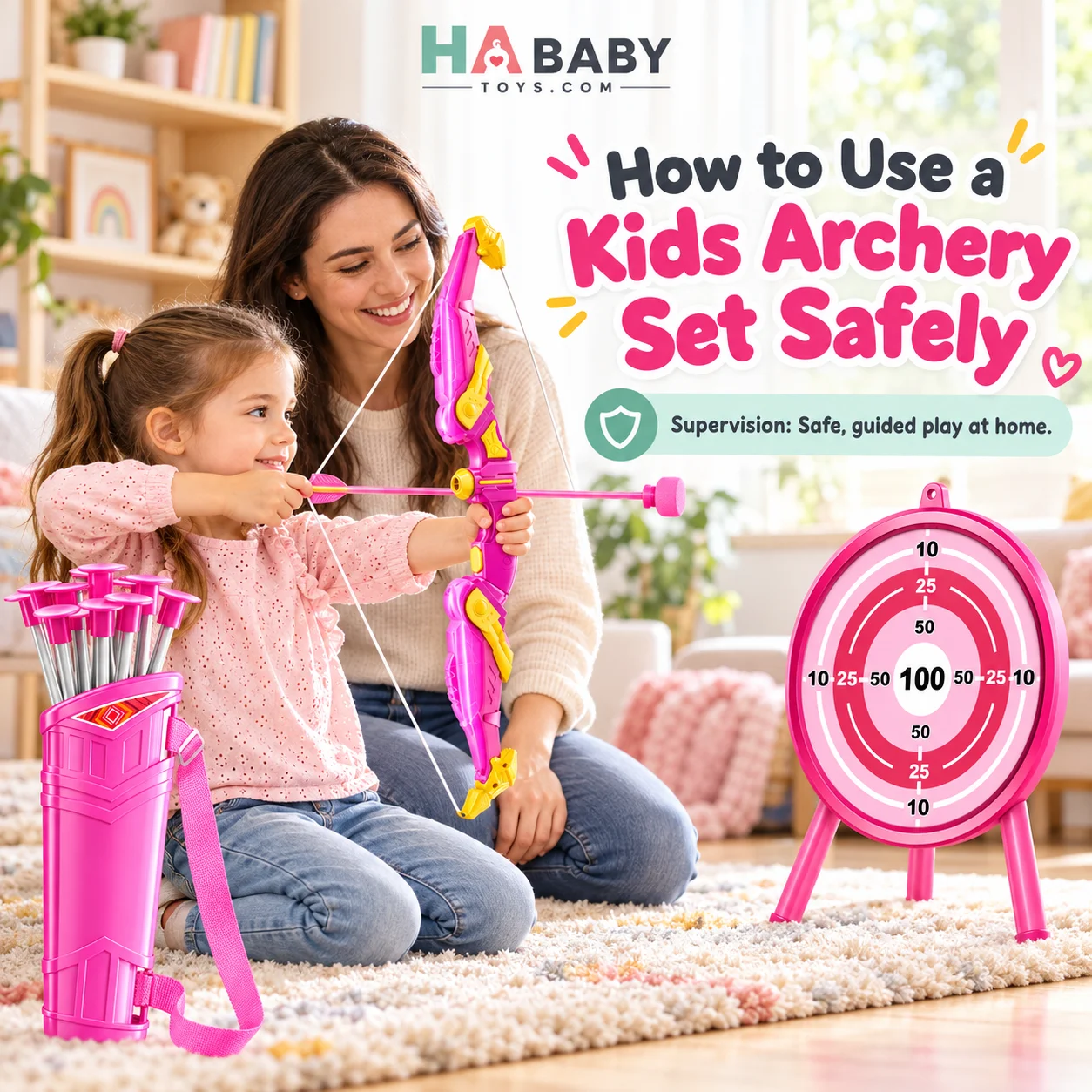
This makes supervision much easier and creates natural turn-taking. The National Association for the Education of Young Children (NAEYC) highlights structured turn-taking as a normal part of early group play, and a supervised archery line is a good example of that in practice.
Step 7: Retrieve Arrows Only After the Round Ends
Do not allow children to run toward the target while someone is still holding or drawing the bow.
Use a simple routine:
Shoot → Put bow down → Parent says clear → Retrieve arrows
That sequence can become a memorable habit that parents and children use the same way every time.
Shoot & Retrieve Cycle
Six stages repeated safely for every turn
Load
Place the toy arrow as instructed.
Aim
Point the bow toward the target.
Shoot
Release toward the target only.
Stop
Put the bow down.
Clear
Parent confirms the lane is clear.
Retrieve
Collect the arrows carefully.
Load → Aim → Shoot → Stop → Clear → Retrieve
How to Hold a Toy Bow Safely
Teach children to:
- Hold the grip firmly but comfortably
- Keep fingers away from moving string areas
- Point the bow down or toward the target when not shooting
- Never swing the bow around
- Never dry-fire unless the manufacturer explicitly allows it
This is a toy safety article, not real archery training. Do not attempt to modify the bow, increase the draw, or replicate sport archery techniques with a toy set.
How to Load Toy Arrows
Point the bow toward the target area
Never toward a person, animal, or unapproved direction.
Place the toy arrow as instructed
Follow the product manual for the correct loading method.
Make sure the arrow is seated correctly
An improperly seated arrow can fall or misfire.
Keep fingers clear of the release path
Both hands should be positioned safely before drawing.
Draw only as intended for the toy
Do not over-draw beyond what the toy is designed to allow.
Release toward the target
Not toward a person, pet, or moving object.
Do not give guidance for increasing power, modifying the bow, or changing arrow types. These modifications can turn a toy into something much less safe.
Indoor Safety Setup
Good indoor conditions
- Large clear room
- Soft surroundings
- No glass nearby
- Target against a safe background
- No pets moving through the area
Avoid indoors
- Hallways
- Kitchens
- Rooms with TVs or mirrors
- Busy shared spaces
- Stairs
Outdoor Safety Setup
Possible safe environments include:
- Backyard
- Garden
- Open supervised play area
- Suitable park area where allowed
Before shooting, check:
- Roads nearby
- People walking behind the target
- Pets
- Wind
- Uneven ground
- Other activities nearby
Outdoor space is bigger, but the safety rules stay the same. In fact, larger spaces sometimes encourage more running and more enthusiasm — so supervision matters just as much outdoors as indoors. The American Academy of Pediatrics’ HealthyChildren.org covers safe outdoor play practices in more detail.
Indoor vs Outdoor Comparison
| Factor | Indoor | Outdoor |
|---|---|---|
| Space | Limited | Usually larger |
| Wind | None | Possible |
| Breakable objects | More likely | Fewer |
| Target placement | Needs careful setup | More flexible |
| Supervision | Required | Required |
| Weather | Not relevant | Important |
What If a Child Aims at Someone?
Stop the activity immediately.
Then:
- Take the bow
- Restate the target-only rule
- Resume only if the child can follow it
Avoid treating unsafe aiming as a joke. Even if the arrow is soft or foam-tipped, allowing the behavior once makes it harder to enforce the rule next time.
What If the Child Gets Overexcited?
Signs to watch for:
- Running into the shooting lane
- Firing too quickly
- Ignoring turn-taking
- Swinging the bow
- Aiming away from the target
Quick fixes:
- Pause the game
- Shorten the session
- Use one arrow at a time
- Return to one-player practice
What If Younger Siblings Are Nearby?
- Keep them out of the play zone
- Put them behind a physical boundary
- Pause shooting if they enter
- Store arrows when play is finished
This is especially important when multiple children are present. Younger children may not understand the shooting-lane rule and can wander into it unexpectedly.
Safe Group Games
Score challenge
Each child gets a fixed number of turns.
Color target
Aim for a color named by the parent.
Parent-child match
Parent and child take alternating turns.
Three-shot round
Each player takes three safe target shots.
Team score
Add points together as a group.
Distance practice
Only if the toy is designed for it and the space is safe.
All games should keep one shooter at a time. Turn-taking is not just polite — it is the safety system.
What Parents Should Avoid
- Do not aim at people
- Do not modify arrows
- Do not sharpen tips
- Do not increase bow tension
- Do not shoot objects not designed as targets
- Do not allow running in front of the target
- Do not use damaged equipment
- Do not allow unsupervised play if supervision is required
For broader injury-prevention guidance that applies to projectile toys, Safe Kids Worldwide publishes practical resources for parents and caregivers.
How to Introduce the Set to a Beginner
Minute 1–2: Explain the rules
Target only, one shooter at a time, arrows retrieved on command.
Minute 3–4: Show the target direction
Walk the child to the shooting line and point toward the target.
Minute 5–6: Demonstrate one safe shot
Show how to hold the bow, aim, and release toward the target.
Minute 7–8: Let the child try
Stay close and watch for safety before accuracy.
Minute 9: Retrieve arrows together
Practice the retrieval routine.
Minute 10: End on a positive note
Stop while rules are still being followed, not after they break down.
How Long Should a Play Session Last?
Session length should depend on the child’s age, attention, environment, and ability to follow safety rules.
Stop the session if:
- Child becomes tired
- Rules are ignored
- Equipment becomes damaged
- Play area becomes crowded
- Weather conditions worsen
Short, focused sessions build better habits than long, exhausting ones.
Can a Kids Archery Set Be Used at Parties?
Yes, but group control becomes more important. Recommendations:
- One shooting lane
- One child at a time
- Adult supervising the line
- Waiting zone behind shooter
- Clear arrow collection routine
For public-space use, the National Recreation and Park Association provides general guidance on shared outdoor spaces.
How to Store the Set Safely
- Put bow and arrows away after use
- Store arrows together
- Keep out of reach of children who cannot follow the rules
- Keep equipment dry
- Inspect again before next session
A storage hook or container can reduce lost parts. Families who want more hands-on activity products can also explore the Educational Learning Toys category.
What If an Arrow Breaks?
Stop using it.
Do not tape or improvise a damaged projectile unless the manufacturer specifically provides a repair method. Replace only with compatible toy arrows.
This is an important safety point. A broken arrow can splinter, misfire, or behave unpredictably — and repairing it at home can create a projectile that is not designed to be used that way.
Safety Checklist Before Every Session
- Bow inspected
- Arrows inspected
- Target stable
- Shooting direction clear
- No people behind the target
- No pets in the lane
- One shooter at a time
- Adult supervision in place
- Retrieval rule explained
- Damaged parts removed
Families comparing options before buying can read why parents may choose a bow and arrow toy for kids, or explore the HA Baby Toys Kids Bow and Arrow Set directly.
Ready for a supervised archery set built for target play?
Explore the HA Baby Toys Shop →Frequently Asked Questions
How do you use a kids archery set safely?
Inspect the bow and arrows, choose one safe shooting direction, secure the target, keep everyone behind the shooter, teach the target-only rule, allow one shooter at a time, and retrieve arrows only after the round ends. The full step-by-step process is covered above.
Should children use a bow and arrow toy with adult supervision?
Yes. Toy archery involves projectiles, and even soft-tip arrows can cause injury if aimed improperly. Adult supervision is essential at all ages. Safe Kids Worldwide and the U.S. Consumer Product Safety Commission both emphasize supervision for projectile toys.
Can kids archery sets be used indoors?
Yes, in a large clear room with soft surroundings and a safe target background. Avoid hallways, kitchens, rooms with TVs or mirrors, busy shared spaces, and stairs.
Can children use them outdoors?
Yes. Outdoor use is often easier for space and setup. Always choose a flat area with no roads nearby, no people or animals behind the target, and stable target placement.
What should I check before each session?
Inspect the bow, string, arrows, arrow tips, and target. Look for cracks, loose parts, bent shafts, and damaged tips. If anything looks damaged, stop using that part and replace it with a compatible toy part.
How should the target area be arranged?
One designated shooting direction, one target, a clear lane between the shooter and the target, and nobody behind the target. The shooter stands at a marked line, and everyone else waits behind the shooter.
Can kids aim at toys or objects?
No. Even soft-tip arrows should only be aimed at the designated target. Aiming at toys held by another person, pets, or objects around the house increases the risk of injury and weakens the target-only rule.
What should I do if my child aims at someone?
Stop the activity immediately, take the bow, restate the target-only rule, and resume only if the child can follow it. Do not treat unsafe aiming as a joke.
How many children can play at once?
One shooter at a time. Other children can wait behind the shooter and take turns. This keeps the shooting lane clear and makes supervision much easier.
When should arrows be retrieved?
Only after the round has ended and the bow has been put down. Use a routine: shoot, put the bow down, parent says clear, then retrieve arrows. Nobody should run toward the target while someone is still holding the bow.
Can broken toy arrows still be used?
No. Damaged arrows should be removed from the set and replaced with compatible toy arrows. Do not tape or modify a broken arrow unless the manufacturer provides a specific repair method.
How should I store a kids archery set?
Put the bow and arrows away after use, keep arrows together, store equipment dry, and keep everything out of reach of children who cannot yet follow the safety rules. Inspect the set again before the next session.
What is the safest way to introduce the toy?
Use a short first session: explain the rules, show the target direction, demonstrate one safe shot, let the child try, retrieve arrows together, and end while the rules are still being followed.
Are toy archery sets the same as real archery equipment?
No. Toy archery sets use lower-power bows and toy arrows designed for recreational play. Real archery equipment is designed for sport and requires much stricter handling. For context on how the real sport approaches safety, see USA Archery or Archery GB.
Where can I buy the HA Baby Toys kids archery set?
Visit the HA Baby Toys shop to see the kids archery set and other active play products. The HA Baby Toys FAQ also answers common product and ordering questions, and retailers can request a quote from HA Baby Toys.
The Short Version for Busy Parents
Using a kids archery set safely is not complicated once you follow the five-step workflow: check, aim, clear, shoot, retrieve. The rest is consistency.
Inspect the set before every session. Choose one shooting direction and stick to it. Keep everyone behind the shooter. Teach the target-only rule and enforce it every time. Retrieve arrows only after the round ends. Store the set safely when play is done.
If your child follows the rules and you can supervise consistently, a kids archery set can be a genuinely enjoyable target activity. If the rules are not being followed — even occasionally — it is safer to pause the activity and try again another day.
For more hands-on family products and active play ideas, HA Baby Toys offers toys and activity products designed around everyday family play. You can also browse the HA Baby Toys blog for more guides on safe active play and screen-free activities.
One Response