
A retractable sword toy should be used as a supervised pretend-play prop, not as a contact weapon. The safest approach is to inspect it first, extend it carefully, use slow controlled movements, keep a clear no-contact play zone, and retract it before storage.
If you are still learning how the mechanism works, start with what a telescopic sword toy is. This article assumes you already have the toy — or are about to — and want a clear, practical safety routine that works the very first time.
How to Use It Safely
- Inspect the toy.
- Clear the play area.
- Extend it gently.
- Keep it away from faces and heads.
- Use slow, controlled movements.
- Keep play non-contact.
- Retract it before storage.
- Stop immediately if the toy cracks or jams.
Check → Clear → Extend → Play → Retract
The five-step safety workflow behind every session
Retractable Sword Toy
Pretend play, not contact play
Check
Inspect the toy for cracks or loose sections.
Clear
Create enough open space.
Extend
Open the telescopic sections carefully.
Play
Use controlled, non-contact pretend movements.
Retract
Collapse the toy before putting it away.
Check → Clear → Extend → Play → Retract
Step 1: Inspect the Toy Before Every Play Session
Parents should look for:
- Cracks
- Loose telescopic sections
- Sharp broken edges
- Damaged handle
- Battery compartment damage
- Loose decorative parts
- Sections that do not retract properly
If the toy is cracked, jammed, or partially broken, stop using it. Damaged toys can cause injuries and are not safe to repair at home.
For broader toy safety guidance, the U.S. Consumer Product Safety Commission publishes information on age labeling, recalls, and hazards.
Step 2: Choose a Safe Play Area
Choose a space with:
- Clear floor
- No glass nearby
- No stairs
- No ceiling fans
- No lamps within reach
- No pets moving through the area
- Enough distance from other children
This helps prevent accidental collisions. An extended telescopic sword has more reach than children often expect, so clearing more space than seems necessary is usually the right call.
Safe-Play-Zone Layout
A simple top-down view of safe pretend sword play
Green Zone — Player Movement
One child with clear space around them. Slow, controlled movement only.
↓
Yellow Zone — Slow Down
Approaching furniture or a low-ceiling area. Reduce movement speed.
↓
Red Zone — Off Limits
Faces, pets, breakables, stairs, ceiling fans, and other people.
This layout applies to indoor and outdoor use. The specific distances depend on the toy and the space, but the principle is the same.
Step 3: Extend the Sword Gently
Hold the handle securely
Use a firm grip on the main handle, not the extending sections.
Follow the product’s intended extension method
Check the manual for the correct way to extend your specific model.
Avoid sudden jerking
A firm, smooth motion is safer than a sharp flick.
Do not force stuck sections
If a section resists, stop and inspect it.
Stop if the mechanism resists abnormally
Unusual resistance usually means something is misaligned or damaged.
Do not give advice on making the sword extend faster or with more force. Forcing the mechanism can break it and create sharp edges.
What If the Sword Does Not Extend?
Possible causes:
- Section misalignment
- Dirt or debris
- Damage
- Locked mechanism
- Toy not assembled properly
The safest response is a simple sequence:
Stop → inspect → follow manufacturer instructions → do not force
If the toy still will not extend after following the manual, retire it from play until you can inspect it more thoroughly or contact the manufacturer.
Step 4: Use Slow, Controlled Movements
Teach children to focus on:
- Posing
- Pointing downward
- Slow sweeping motions
- Pretend character movements
- Holding still for cosplay
Avoid:
- Fast spinning
- Hard swinging
- Lunging at people
- Overhead striking
- Running with the toy
No Contact With People or Pets
The toy should not be used to:
- Hit siblings
- Tap heads
- Poke faces
- Strike pets
- Duel physically
- Chase someone while swinging it
Pretend sword play should be about acting, posing, and storytelling — not impact.
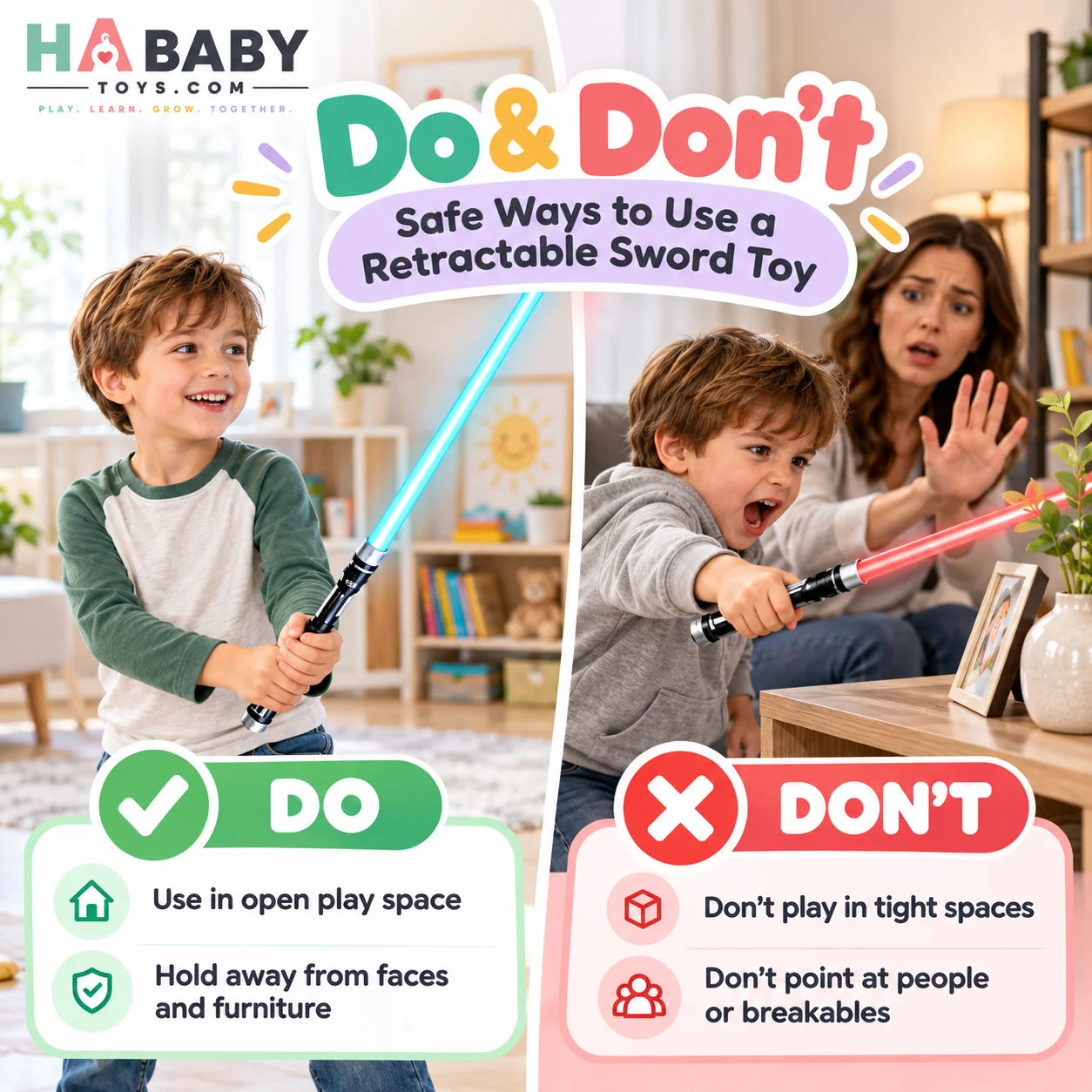
Keep the Sword Away From:
- Eyes
- Face
- Head
- Neck
- Hands of nearby players
Even soft or plastic toy swords can cause injury if used near the face or head. This is the single most important rule to reinforce.
Step 5: Teach a Safe Carry Position
Recommended:
- Hold by handle
- Keep blade pointed down
- Walk, do not run
- Keep it retracted when moving between rooms
A simple rule to remember: move with it closed whenever possible.
Indoor Use
Good indoor play:
- Pose
- Role-play
- Costume play
- Slow choreography
- Story scenes
Avoid:
- Running through hallways
- Swinging in small rooms
- Playing near TVs
- Playing near windows
Outdoor Use
Outdoor use may offer more space, but the rules still matter. Use only in:
- Clear backyard areas
- Suitable open spaces
- Supervised play zones
Avoid:
- Roads
- Crowded parks
- Pets
- Uneven ground
- Night play without visibility
For broader outdoor play safety, HealthyChildren.org from the American Academy of Pediatrics publishes safe play practices, and Safe Kids Worldwide covers injury prevention for children’s activities.
Indoor vs Outdoor Safety Comparison
| Consideration | Indoors | Outdoors |
|---|---|---|
| Space | Limited | Usually larger |
| Breakables | More common | Fewer |
| Visibility | Usually controlled | Varies |
| Ground hazards | Lower | Can be higher |
| Supervision | Important | Important |
| Best activity | Posing and role-play | Role-play with more space |
How to Use It for Pretend Play
Hero pose game
Children create dramatic poses.
Character walk
Walk slowly while staying in character.
Story scene
Act out a non-contact adventure.
Freeze pose
Move, then freeze when music stops.
Costume show
Use the sword as a prop.
Photo moment
Pose for photos with the glowing effect.
These keep the toy fun without encouraging impact.
Safe Cosplay Use
For cosplay:
- Keep it retracted in crowded areas
- Do not point it at strangers
- Follow event rules
- Use it mainly for posing
- Avoid swinging in lines or crowds
For cosplay-specific safety expectations, many fan conventions publish public rules and conduct policies that cover prop size, usage, and behaviour. Check the venue’s guidance in advance of the event.
Safe Pretend Play Wheel
Eight non-contact activities that work with the toy
Pose
Dramatic hero poses with the sword pointed down.
Story
Acting out a non-contact character adventure.
Walk
Slow character walk with controlled movement.
Freeze
Move, then freeze when music stops.
Costume
Using the sword as a costume accessory.
Light Show
Simple glow displays in a dim room.
Photo Prop
Posing for photos at home or an event.
Character Game
Invented role-play without physical contact.
How to Use the Light Feature Safely
If the toy glows:
- Use enough room lighting to see obstacles
- Avoid shining bright light directly into eyes
- Check the battery compartment
- Turn off after use
Do not assume brightness levels. Even bright toy LEDs can be uncomfortable if aimed at someone’s eyes at close range.
How to Use Music or Sound Features
If included:
- Use in short play sessions
- Keep volume reasonable where adjustable
- Avoid using sound to encourage rough play
If the model has no volume control, keep instructions general and rely on frequent short sessions rather than long loud ones.
How to Play With Two Children Safely
Do not recommend sword fighting. Instead suggest:
Mirror game
One child makes slow motions; the other copies from a safe distance.
Pose contest
Take turns making character poses.
Story scene
Each child plays a character without physical contact.
Light show
Move slowly in separate zones.
This preserves social play without impact.
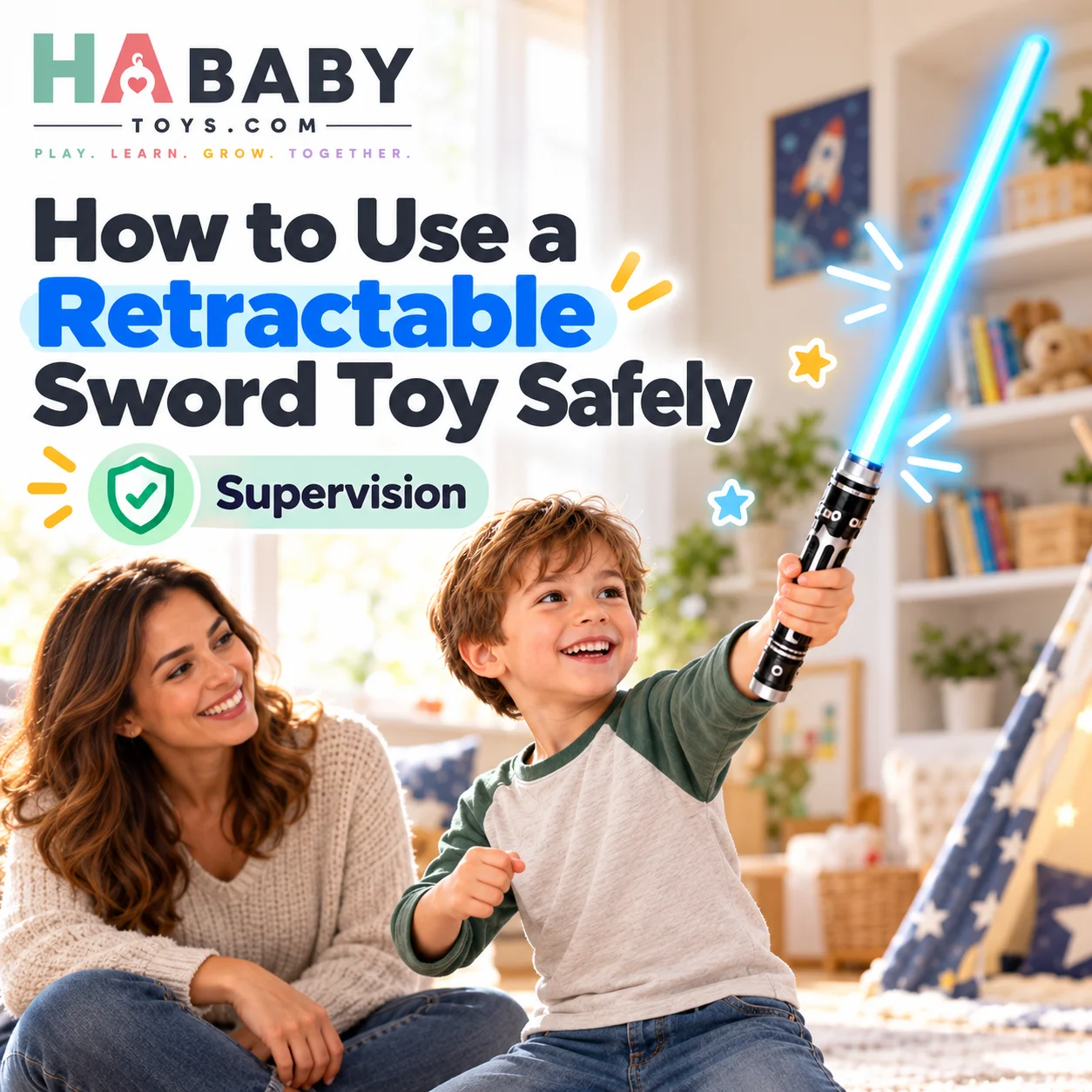
The No-Contact Rule
The sword may point toward an open area or the floor, but it should not touch another person.
No hitting → No poking → No chasing → No face aiming
This is the single rule that prevents most injuries in pretend sword play. Reinforce it every session.
What to Do If a Child Starts Swinging Too Hard
Stop play
Call a clear, calm pause.
Retract the toy
Put it back into its shortened form.
Restate the no-contact rule
Simple, direct, and repeated each time.
Clear more space
Increase distance from furniture and other people.
Resume only with controlled movement
If the rules are followed, play can continue.
What to Do If Children Start “Duelling”
Redirect to:
- Pose contest
- Mirror movements
- Story role-play
- Target-free choreography
- Character walk
Do not give striking techniques or duel instructions. Real or simulated contact is not part of this toy’s intended use.
How to Retract the Toy Safely
- Stop movement first
- Hold securely
- Collapse sections carefully
- Keep fingers away from pinch points
- Do not slam sections closed
- Check that it is fully retracted before storage
Do not invent a specific locking procedure unless the product manual confirms it. Follow the manufacturer’s instructions for your exact model.
What If It Jams While Retracting?
A safe response:
- Stop
- Do not twist aggressively
- Do not force it
- Inspect for misalignment
- Follow manufacturer guidance
If the toy is damaged, retire it from play rather than attempting a home repair.
Pinch-Point Awareness
Tell parents and children:
- Keep fingers clear of sliding joints
- Retract slowly
- Do not let younger children force sections together
- Watch narrow telescoping areas
This is one of the most overlooked safety details with telescopic toys. Sliding joints can pinch skin, and children sometimes try to speed up the process by forcing the sections.
Battery Safety
If the toy includes lights or music:
- Use the specified battery type
- Secure the battery cover
- Keep batteries away from small children
- Remove leaking batteries
- Follow manufacturer instructions
Do not invent battery specifications. Check the product listing or manual for the correct battery type and replacement guidance.
Cleaning the Toy
Recommended:
- Turn it off
- Wipe outer surfaces
- Avoid soaking electronic areas
- Keep telescopic joints dry unless instructions say otherwise
- Let it dry fully
No harsh chemicals unless the manufacturer approves them.
Storage
Good storage practices:
- Retract fully
- Turn off
- Store dry
- Keep away from heat
- Do not leave it extended under pressure
- Keep it out of walkways
Storage Rule
Store it closed, not ready for action. A retracted sword takes up less space, is less likely to be knocked over, and is less tempting for younger siblings to grab.
Common Problems and Quick Fixes
Won’t extend
Do not force it. Inspect for misalignment.
Won’t retract
Stop and inspect. Do not twist aggressively.
Light does not work
Check power and battery compartment.
Section feels loose
Stop use if structural damage is suspected.
Toy cracks
Remove from play immediately.
Music stops
Check power and controls.
60-Second Safe-Use Checklist
- Toy is not cracked
- Telescopic sections move normally
- Play area is clear
- Faces and heads are off-limits
- No hitting people or pets
- Movements stay slow
- No running with the toy
- Retract before carrying or storing
- Stop if the toy jams or breaks
If you want to compare options before buying, see why choose an extendable sword toy for kids, or explore the HA Baby Toys Telescopic Sword Toy directly.
Ready for a supervised retractable sword built for pretend play?
Explore the HA Baby Toys Shop →Frequently Asked Questions
How do you use a retractable sword toy safely?
Inspect the toy, clear the play area, extend it gently, keep it away from faces and heads, use slow controlled movements, keep play strictly non-contact, and retract it before storage. The full process is covered above.
Can kids hit each other with a telescopic sword toy?
No. Keep play strictly non-contact. Even soft or plastic toy swords can cause injury if used with force. Pretend sword play should focus on posing, movement, and storytelling.
How should the sword be extended?
Hold the handle securely and follow the product’s intended extension method. Use a firm, smooth motion rather than a sharp flick. Do not force stuck sections. If the mechanism resists abnormally, stop and inspect it.
What should I do if it gets stuck?
Stop using the toy, inspect it for misalignment or debris, and follow the manufacturer’s instructions. Do not twist aggressively or force the mechanism. If the toy is damaged, retire it from play.
Can kids swing it indoors?
Indoor play works best as posing, role-play, and slow choreography. Avoid swinging in small rooms, near TVs, near windows, or in hallways. Clear furniture edges and fragile objects before play.
How much space is needed?
Enough room for the extended blade and slow movement, with no fragile objects within swing range. A good rule: if you would not comfortably swing a broom in the space, it is probably too tight.
Can two children play with these together?
Yes, but not as duels. Try a mirror game, pose contest, story scene, or separate light show. Keep physical contact out of play entirely.
How do I keep it away from faces?
Teach the no-contact rule from the first session: the sword points toward an open area or the floor, never at a face or head. Reinforce the rule every time. If a child aims at a face, stop play, retract the toy, and restate the rule.
Can it be used for cosplay?
Yes. Keep it retracted in crowded areas, do not point it at strangers, follow event rules, and use it mainly for posing. Check the venue’s prop policies before attending a convention or event.
Can it be used outdoors?
Yes. A clear backyard or supervised open space works well. Avoid roads, crowded parks, uneven ground, and night play without visibility. HealthyChildren.org from the American Academy of Pediatrics covers safe outdoor play practices.
How do I retract it safely?
Stop movement, hold the toy securely, collapse the sections carefully, and keep fingers away from pinch points. Do not slam sections closed. Confirm the toy is fully retracted before storing it.
What if the toy cracks?
Stop using it immediately. Damaged toys can cause injuries and create sharp edges. Do not attempt home repairs. Replace the toy rather than continuing to use a cracked one.
How should it be cleaned?
Turn the toy off first. Wipe the outer surfaces with a soft, slightly damp cloth. Avoid soaking electronic areas, and keep telescopic joints dry unless the manufacturer’s instructions say otherwise. Let the toy dry fully before storing it.
How should it be stored?
Retract fully, turn off, store dry, keep away from heat, and do not leave it extended under pressure. Keep it out of walkways and away from younger siblings. The HA Baby Toys FAQ also answers common product and ordering questions.
Where can I buy the HA Baby Toys telescopic sword?
Visit the HA Baby Toys shop to see the telescopic sword and other pretend-play toys. Families can also browse the 3+ Years category for related products. Retailers and larger buyers can request a quote from HA Baby Toys.
The Short Version for Busy Parents
Using a retractable sword toy safely is not complicated once you follow the five-step workflow: check, clear, extend, play, retract. The rest is consistency and repetition.
Inspect the toy before every session. Clear a safe play area. Extend it gently, without forcing. Keep movements slow and controlled. Reinforce the no-contact rule every time. Retract the toy before storing it. And if the toy cracks, jams, or stops working correctly, retire it from play rather than trying to repair it.
If your child enjoys pretend play, role-play, or cosplay, and can follow the no-contact rules, this toy can be genuinely fun and safe. If the rules are ignored — even occasionally — pausing the activity and trying again another day is the safest response.
For more family-friendly toys and parent guides, HA Baby Toys offers products designed around everyday play. You can also browse the HA Baby Toys blog for more ideas on safe pretend play and screen-free activities.
One Response