
10 Amazing Benefits of Baby Tissue Box Toys for Sensory Development and Motor Skills
Why baby tissue box toys are more than just fun. During the first years of life, babies learn through interaction — every touch, movement, and repeated action helps them understand the world around them. A baby tissue box toy transforms a simple pulling activity into a sensory learning experience. When babies pull colorful fabric tissues from a toy box, they practice grabbing, pulling, observing, repeating actions, and understanding results — all while staying entertained.
Parents looking for more educational baby products can explore the complete collection at HA BABY Toys.
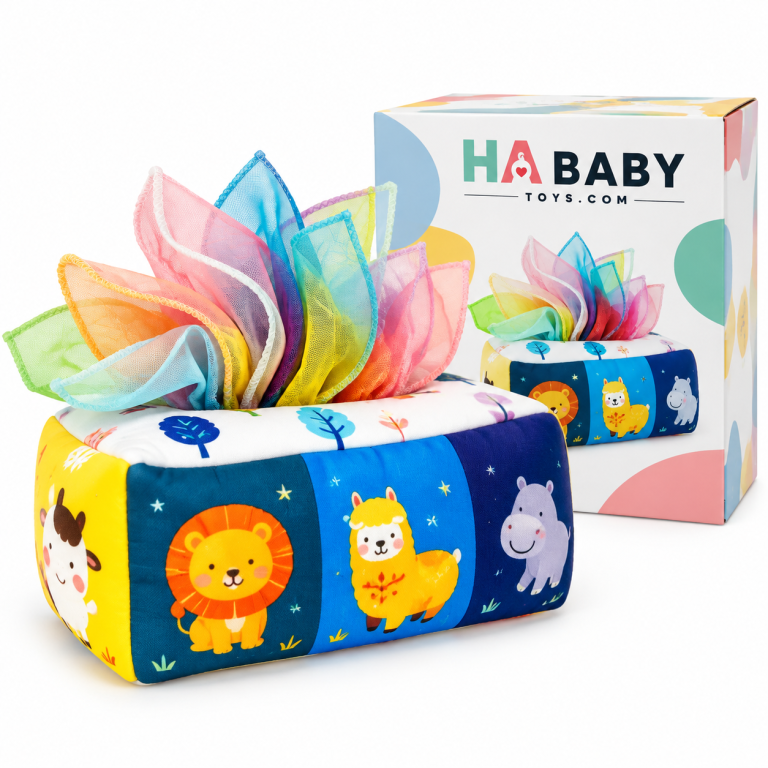
Table of Contents
- What Is a Baby Tissue Box Toy?
- Why Sensory Toys Matter
- 1. Improves Sensory Development
- 2. Builds Fine Motor Skills
- 3. Improves Hand-Eye Coordination
- 4. Encourages Curiosity
- 5. Teaches Cause and Effect
- 6. Improves Focus
- 7. Supports Independent Learning
- 8. Encourages Creativity
- 9. Provides Screen-Free Play
- 10. Supports Cognitive Development
- vs Traditional Baby Toys
- HA BABY Tissue Box Toy
- Frequently Asked Questions
What Is a Baby Tissue Box Toy?
A baby tissue box toy is a reusable sensory toy designed around babies’ natural curiosity about pulling objects. Unlike real tissues, this toy uses colorful fabric pieces that babies can pull repeatedly — no waste, no mess.
🧸 Soft Toy Box
Supports easy gripping, comfortable handling, and safe exploration.
🌈 Colorful Fabric Tissues
Encourage visual attention, texture discovery, and sensory stimulation.
✋ Pulling Activity
Supports hand movement, coordination, and learning through repetition.
Learn more about how these toys support early development in: Baby Tissue Box Toy Guide: How Montessori Tissue Pulling Toys Support Early Learning and Development.
Why Sensory Toys Matter During Early Development
Babies learn through their senses — seeing, touching, moving, and listening. Sensory toys help babies understand their environment, develop awareness, and practice new skills.
The NAEYC emphasizes that responsive and interactive experiences during the early years build the foundation for all future learning. The Harvard Center on the Developing Child also explains how sensory experiences shape brain architecture.
Benefit 1: Improves Sensory Development
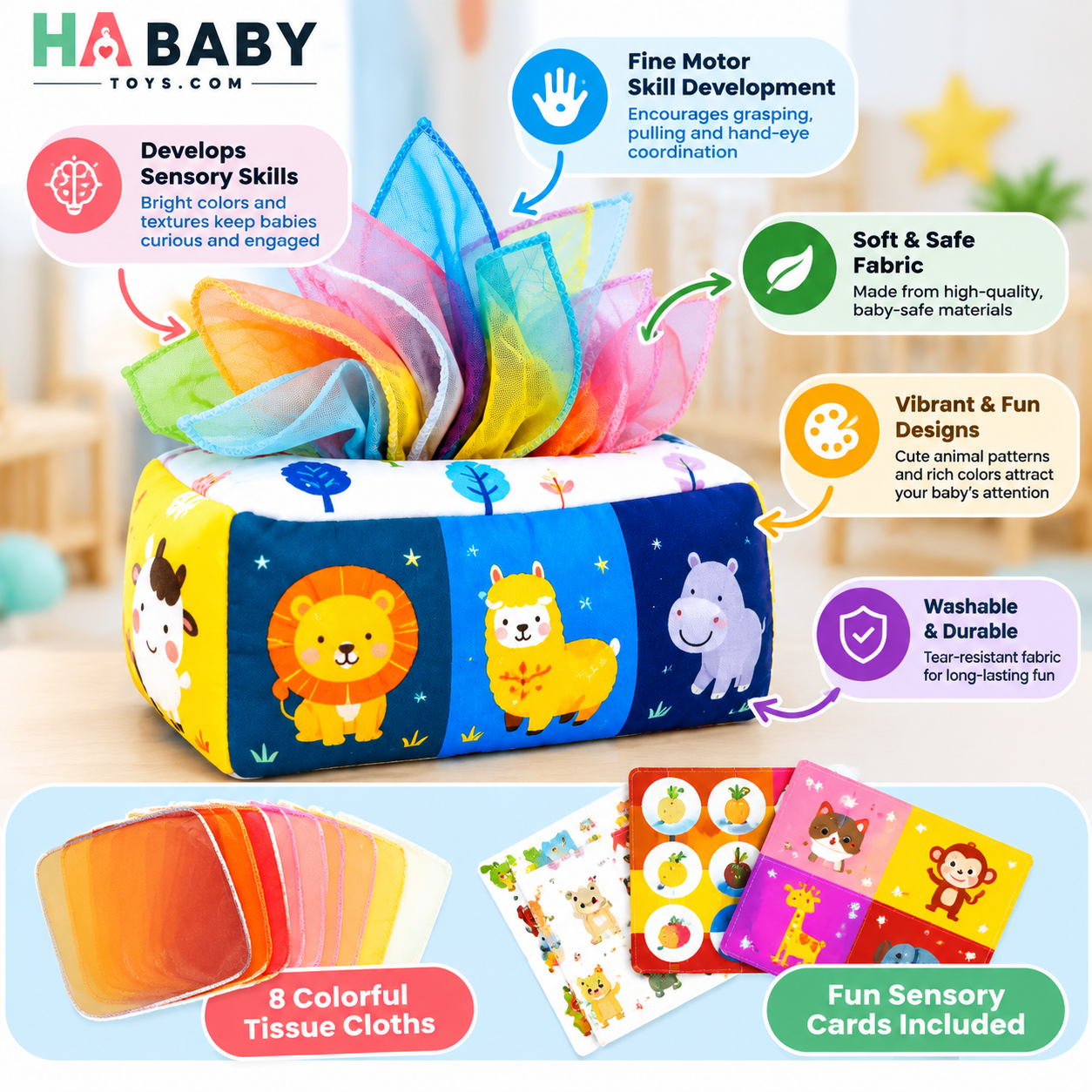
A tissue box toy provides multiple sensory experiences at once — visual development through bright colors, touch development through different fabrics, and movement awareness through pulling.
Learn more in our guide: Baby Sensory Toys Explained: How a Tissue Box Toy Helps Babies Learn Through Play.
Benefit 2: Builds Fine Motor Skills
Fine motor skills involve small hand and finger movements. Tissue pulling helps babies practice grasping, holding, pulling, and releasing — skills that later support writing, eating, dressing, and daily activities.
Learn more in our guide: How a Baby Tissue Pulling Toy Builds Hand-Eye Coordination, Focus, and Curiosity. The CDC’s child development milestones provide useful reference points.
Benefit 3: Improves Hand-Eye Coordination
Babies learn to connect eyes → brain → hands. During play: baby sees tissue → reaches toward it → grabs and pulls → learns movement control. This coordination improves through repeated practice.
Benefit 4: Encourages Curiosity and Exploration
Babies naturally want to understand: “What happens if I pull this?” “Where does it go?” “What color comes next?” Curiosity is the foundation of all learning.
Learn more in our guide: From Curiosity to Discovery: How Baby Tissue Box Toys Support Early Childhood Development.
Benefit 5: Teaches Cause and Effect
Babies learn simple relationships: action → result. Example: pull tissue → another tissue appears. This builds early problem-solving skills — and the connection is deeply rewarding for a developing brain.
Benefit 6: Improves Focus and Concentration
Repeated activities help babies develop attention. Benefits include longer engagement, patience, and observation skills — the ability to focus on one activity for extended periods.
Benefit 7: Supports Independent Learning
Montessori-inspired toys encourage babies to explore independently. Benefits include confidence, self-discovery, and decision making — the foundations of self-directed learning.
Learn more in our guide: Montessori Toys for Babies: Why Tissue Pulling Toys Encourage Independent Learning. The American Montessori Society provides detailed resources on Montessori principles.
Benefit 8: Encourages Creativity Through Play
Creative learning begins with exploration. Babies create their own play patterns — pulling different colors, exploring textures, repeating activities, inventing new ways to interact with the toy.
Benefit 9: Provides Screen-Free Entertainment
Parents increasingly look for alternatives to digital entertainment. Sensory toys encourage physical activity, real interaction, and hands-on learning. The American Academy of Pediatrics recommends limited screen time and prioritizes hands-on play.
Learn more in our guide: Screen-Free Activities for Babies: How Tissue Pulling Toys Make Learning Fun at Home.
Benefit 10: Supports Early Cognitive Development
Baby tissue box toys support memory, attention, understanding patterns, and problem-solving. Simple activities create important early learning experiences — and they compound over time.
The UNICEF Early Childhood Development resources emphasize that the first years of life shape lifelong learning patterns.
10 Development Benefits of Baby Tissue Box Toy
Tap each benefit card to see what it develops
Sensory Development
Fine Motor Skills
Coordination
Curiosity
Problem Solving
Focus
Creativity
Independence
Screen-Free Play
Cognitive Growth
Sensory Development
A tissue box toy provides multiple sensory experiences at once — visual development through bright colors, touch development through different fabrics, and movement awareness through pulling. Each pull is a multi-sensory learning moment.
Baby Tissue Box Toy vs Traditional Baby Toys
| Traditional Toys | Baby Tissue Box Toy |
|---|---|
| Entertainment focused | Development focused |
| Limited interaction | Active exploration |
| Less sensory variety | Multi-sensory play |
| Fixed activities | Repeated discovery |
For a deeper comparison, see Baby Tissue Box Toy vs Traditional Toys: Why Sensory Toys Create Better Learning Experiences.
HA BABY Tissue Box Toy: Designed for Sensory Learning
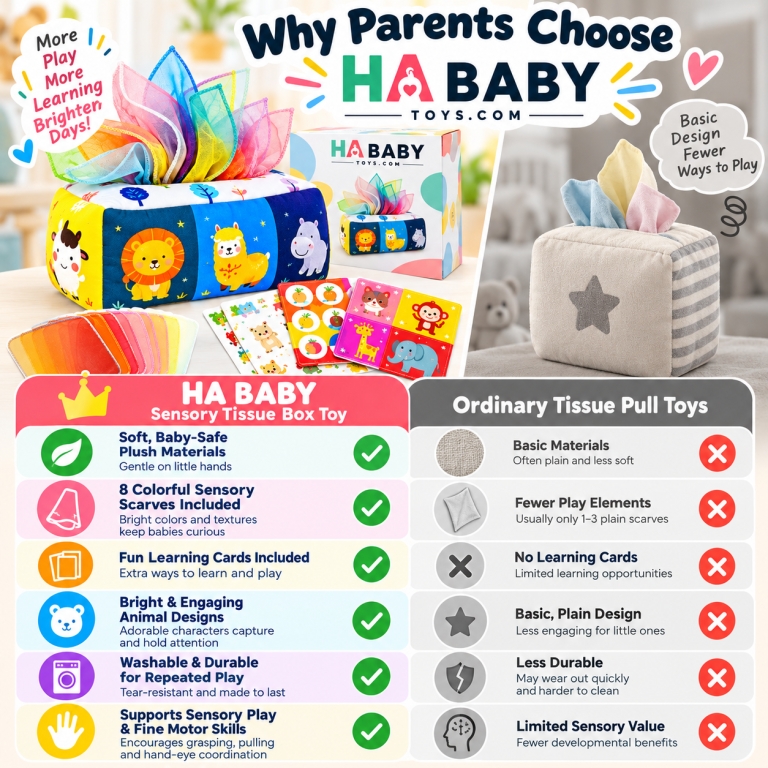
The HA BABY Tissue Box Toy helps babies learn naturally through touching, pulling, and discovering — combining Montessori-inspired design with real developmental value.
HA BABY Tissue Box Toy
- Montessori-inspired play design
- Sensory exploration built into every pull
- Fine motor practice with grasping and pulling
- Color recognition through varied tissues
- Independent learning encouraged by design
- Screen-free activity for daily use
- Baby-safe, comfortable materials
For readers who want to compare the wider range of sensory products, the full shop is a useful next step. The HA Baby Toys blog also covers every aspect of early learning and sensory development.
Frequently Asked Questions
Baby tissue box toys deliver 10 major benefits: sensory development, fine motor skills, hand-eye coordination, curiosity, cause-and-effect understanding, focus, independent learning, creativity, screen-free entertainment, and early cognitive development. Each benefit compounds over time — and they all come from a simple pulling activity.
A tissue pulling toy develops fine motor skills (grasping, pulling, releasing), hand-eye coordination, sensory awareness, cause-and-effect understanding, focus, and independence. These skills form the foundation for handwriting, self-feeding, and countless everyday activities later on. The CDC’s child development milestones highlight fine motor practice as foundational in the first two years.
With supervision, baby tissue box toys are suitable from around 6 months — when babies can sit with support and reach for objects. Babies 6–12 months explore textures and pulling. Ages 12–18 months develop coordination and independent play. Ages 18+ months enjoy creative play. For a full breakdown, see the Baby Tissue Box Toy Age Guide.
They serve different purposes. Normal toys provide entertainment; sensory toys provide entertainment plus development. A tissue box toy adds multiple sensory experiences, active exploration, and repeated discovery — developmental value that ordinary toys don’t match. For a detailed comparison, see Baby Tissue Box Toy vs Traditional Toys.
Babies enjoy pulling activities because they satisfy natural curiosity and their drive to understand cause and effect. Each pull teaches a connection: “I pull → something appears.” That discovery is genuinely rewarding for a developing brain — which is why babies naturally repeat the action. The Zero to Three organization explains that repetition is a core part of infant learning.
Yes — a tissue box toy provides a genuine screen-free alternative. It encourages active play, physical movement, and real interaction rather than passive consumption. The American Academy of Pediatrics recommends limited screen time for babies and prioritizes hands-on play.
Yes — the HA BABY Tissue Box Toy is designed specifically for babies. It features a soft, baby-safe tissue box, colorful fabric tissues, and a simple pulling activity that supports all 10 developmental benefits in this guide. It’s Montessori-inspired, safe for babies 6 months and up with supervision, and provides genuine developmental value.
Small Hands Learn Through Big Discoveries
A baby tissue box toy turns everyday play into meaningful sensory learning and early development. Pull → Observe → Repeat → Learn
The Bottom Line: Simple Toy, Multiple Benefits
A baby tissue box toy delivers far more than entertainment. It supports sensory development, fine motor skills, hand-eye coordination, curiosity, cause-and-effect understanding, focus, independent learning, creativity, screen-free play, and early cognitive development — all through a simple activity that babies genuinely enjoy.
Whether you’re a new parent looking for a screen-free activity, a grandparent searching for a meaningful gift, or a family focused on Montessori learning, a baby tissue box toy delivers genuine developmental value. It turns curiosity into discovery — and discovery into a lifelong love of learning.
For parents ready to explore one, the HA BABY Tissue Box Toy product page is the natural next step. For deeper guidance on sensory learning and early development, explore the full HA Baby Toys blog library.