
10 Amazing Benefits of Using a Microscope for Kids During Early Science Education
Why early science education starts with exploration. Children are naturally curious — they observe insects, plants, objects, and small details around them, and constantly ask questions about how things work. But many children spend more time consuming information than exploring and discovering. A microscope for kids provides an exciting way to introduce science through hands-on learning — helping children observe the hidden world, ask scientific questions, develop patience, build curiosity, and learn through discovery.
Parents searching for more educational learning products can explore the complete collection at HA BABY Toys.
What This Guide Covers
- 1. Builds Curiosity
- 2. Develops Observation Skills
- 3. Encourages STEM Learning
- 4. Improves Focus and Patience
- 5. Encourages Creativity
- 6. Builds Critical Thinking
- 7. Makes Learning Fun
- 8. Reduces Screen Time
- 9. Builds Confidence
- 10. Future Science Interest
- What Kids Can Explore
- HA BABY Kids Microscope Kit
- Interactive FAQ
Benefit 1: Builds Curiosity About the World Around Them
Curiosity is the beginning of every scientific discovery. A microscope allows children to explore things they normally cannot see — leaf patterns, flower textures, fabric fibers, and small objects from around the house.
Children start asking: “Why does this look different?” “What is inside this object?” “How does nature work?” These questions aren’t side effects of using a microscope — they’re the whole point. Learn more in our guide: How a Kids Microscope Kit Builds Curiosity, Creativity, and Scientific Thinking.
Benefit 2: Develops Observation Skills
Science begins with careful observation. A microscope teaches children to look carefully, notice differences, compare objects, and identify patterns. A normal leaf looks simple — but under magnification, children discover details they never imagined.
Observation skills help in school learning, problem solving, and research thinking. The NAEYC emphasizes that careful observation is one of the foundational skills young children develop through hands-on exploration.
Benefit 3: Encourages STEM Learning From an Early Age
STEM learning naturally integrates all four subjects. Here’s how a microscope covers each one:
🔬 Science
Understanding nature and materials through direct observation.
💻 Technology
Using scientific tools and understanding how equipment extends our senses.
⚙️ Engineering
Testing and experimenting — designing what to observe and how.
📐 Mathematics
Comparing sizes and patterns — practical math in action.
Early exposure creates confidence with science concepts. The U.S. Department of Education STEM resources emphasize early STEM exposure as foundational for future learning. For a deeper look, see STEM Toys for Kids: How Microscope Science Kits Encourage Future Scientists.
Benefit 4: Improves Focus and Patience
Using a microscope requires children to adjust focus, observe carefully, and wait for clear results. In a world of fast digital entertainment, microscope activities encourage slower, deeper learning.
The result is better concentration, attention control, and persistence — skills that transfer to every area of learning. The CDC child development resources highlight sustained attention as a key developmental milestone in early childhood.
Benefit 5: Encourages Creativity Through Science Exploration
Science and creativity work together. Children can create science journals, discovery projects, observation drawings, and mini experiments. A child observing a leaf can create a complete nature project — with drawings, notes, and their own observations.
Microscopes encourage children to think differently. The National Geographic Kids resources offer endless inspiration for turning observations into creative projects.
Benefit 6: Builds Critical Thinking and Problem-Solving Skills
Scientific thinking follows a simple, repeatable process — and a microscope makes that process concrete for children.
1. Observation
“What do I see?” — careful, patient looking.
2. Question
“Why does this happen?” — asking is where science starts.
3. Testing
“How can I learn more?” — experimenting and comparing.
4. Conclusion
“What did I discover?” — reflecting on the results.
These skills are useful beyond science — in school, in life, and in every future problem a child encounters. For a deeper look, see Kids Microscope Kit Guide: How a 1200X Children’s Microscope Helps Young Explorers Discover Science.
Benefit 7: Makes Learning Fun and Interactive
Children learn better when they participate. Traditional learning often means reading only. Microscope learning means seeing + touching + exploring — the full sensory experience.
Interactive learning creates stronger memories because the brain has more pathways to connect the information. The Smithsonian Science Education Center emphasizes that inquiry-based, hands-on learning is one of the most effective approaches for young children.
Benefit 8: Reduces Screen Time Through Hands-On Discovery
Many parents want alternatives to tablets, phones, and video games. A microscope provides active play, real-world exploration, and educational entertainment — a genuine screen-free activity that children actually enjoy.
For more on this, see Microscope Science Toy for Kids: A Complete Guide to Hands-On STEM Learning. The NASA Kids’ Club also offers free screen-free science resources for extending exploration.
Benefit 9: Builds Confidence and Independent Learning
When children discover something themselves, they develop confidence. “I found something new.” “I discovered a pattern.” “I solved this problem.” These small declarations are the building blocks of self-belief.
Microscope activities encourage independent thinking — the child chooses what to observe, decides how to investigate, and interprets what they find. That independence is what makes learning stick.
Benefit 10: Creates Interest in Future Science Learning
Early experiences can influence future interests. A microscope introduces children to biology, nature science, research, and investigation. A simple science toy today can create lifelong curiosity.
For more on this, see From Curiosity to Discovery: How Kids Microscope Kits Make Science Fun. The UNESCO Education resources also emphasize the importance of early science engagement.
10 Benefits of a Microscope for Kids
Tap any benefit card to see the detail
Curiosity Growth
Observation Skills
STEM Learning
Focus Building
Creativity
Problem Solving
Scientific Thinking
Screen-Free Play
Confidence
Future Learning
Curiosity Growth
Curiosity is the beginning of every scientific discovery. A microscope lets children explore things they normally cannot see — leaf patterns, flower textures, fabric fibers, and small objects from around the house.
What Can Children Explore With a Kids Microscope?
Here’s what children can observe with a microscope — the range is surprisingly wide.
Nature
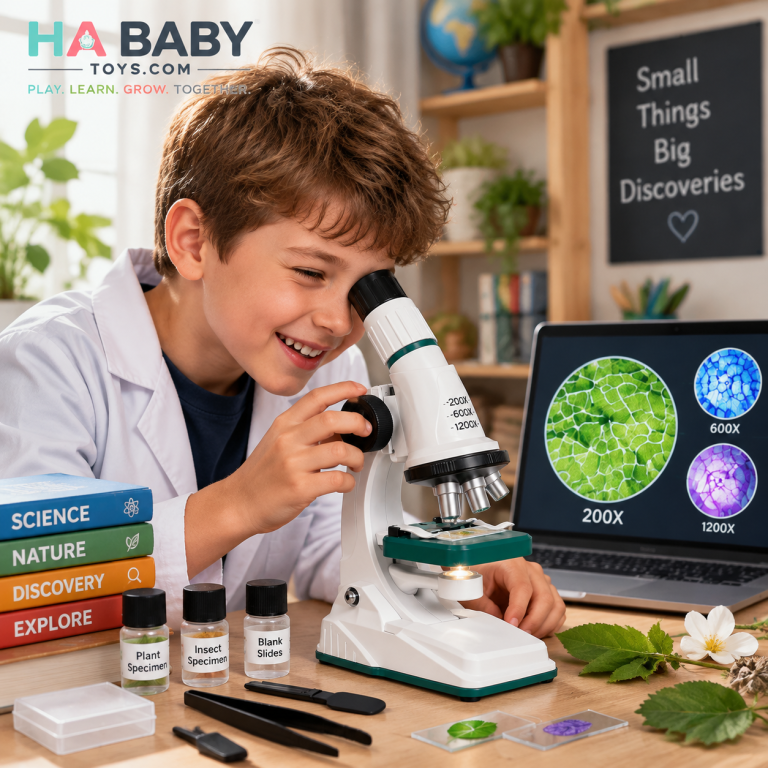
Leaves, flowers, and seeds all reveal hidden structures under magnification. A leaf becomes a study in patterns. A flower becomes a lesson in symmetry. A seed becomes a mystery worth investigating.
Household Objects
Fabric, paper, and salt crystals are available in every home. Children learn that everyday objects have fascinating microscopic structures — and that science isn’t confined to a laboratory.
Science Activities
Comparing materials, creating observation notes, and recording discoveries turn microscope use into a genuine scientific practice. For more hands-on ideas, see Fun Science Experiments Kids Can Try With a Microscope Kit at Home.
Why HA BABY Kids Microscope Kit Is a Great Learning Choice
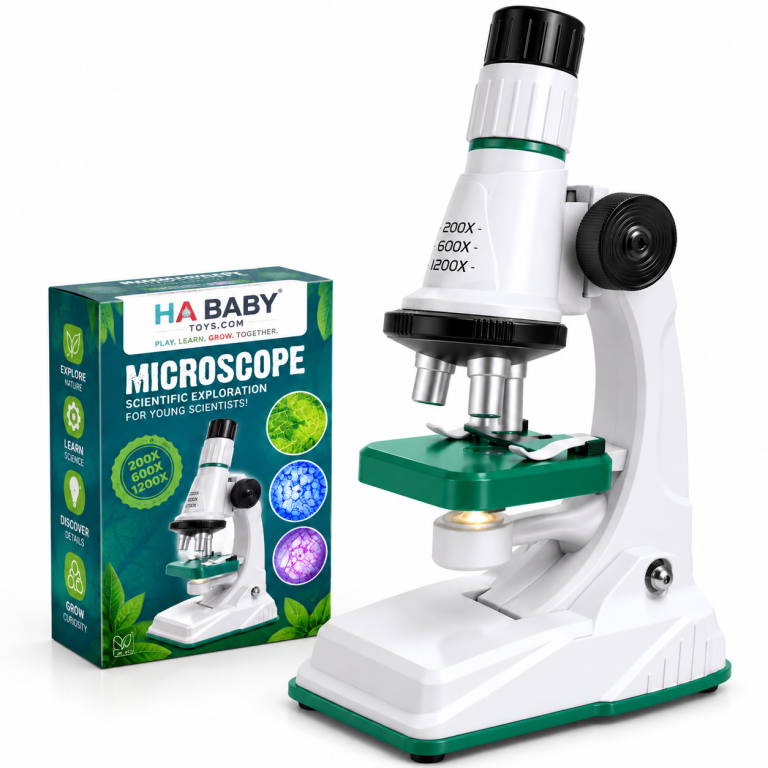
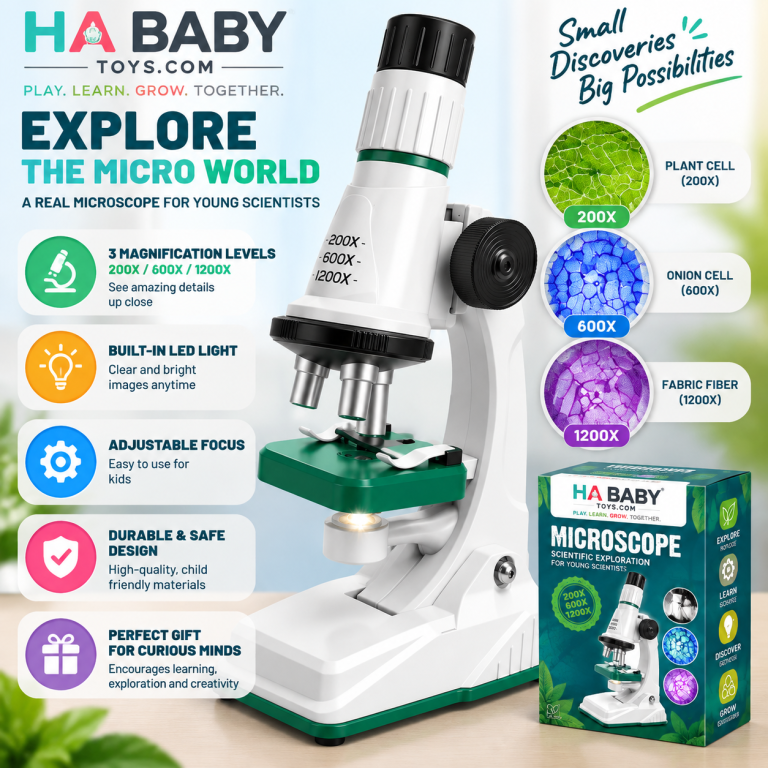
The HA BABY Kids Microscope Kit is designed for beginner-friendly science exploration and hands-on learning. Explore the product and introduce children to exciting scientific discovery.
HA BABY Kids Microscope Kit
- Beginner-friendly science exploration
- 1200X magnification for detailed observation
- Hands-on learning experience
- STEM education support across all four subjects
- Educational entertainment — not just a toy
- Safe, durable construction for young explorers
- Complete kit with slides and accessories
For readers who want to compare the wider range of educational products, the full shop is a useful next step. The HA Baby Toys blog also covers every aspect of science learning and early education.
Frequently Asked Questions
A microscope for kids delivers 10 major benefits: builds curiosity, develops observation skills, encourages STEM learning, improves focus and patience, encourages creativity, builds critical thinking, makes learning fun and interactive, reduces screen time, builds confidence, and creates interest in future science learning. It’s not just a toy — it’s a learning tool that shapes how children approach every future challenge.
With supervision, kids microscopes are suitable from around age 5. Ages 5–7 do best with basic observation and simple magnification. Ages 8–10 can handle simple experiments and recording findings. Ages 10+ can use higher magnification for detailed exploration and science projects. The CDC child development resources provide useful reference points for what children can understand at different ages.
Yes. A microscope naturally integrates all four STEM subjects: science (observing nature and materials), technology (using scientific tools), engineering (testing and designing experiments), and mathematics (comparing size, shape, and patterns). The U.S. Department of Education STEM resources emphasize early STEM exposure as foundational for future learning.
No — a kids microscope is a learning tool disguised as a toy. It entertains, but it also builds real skills: curiosity, observation, focus, critical thinking, and confidence. That’s why parents and educators consider it an educational investment, not just a birthday present.
Children can observe leaf veins, fabric fibers, paper texture, salt crystals, plant cells, insect wings, and prepared biology slides. What they can see depends on the magnification level and the sample. The National Geographic Kids resources offer endless inspiration for what to explore.
A microscope improves creativity by giving children new material to work with. They create science journals, discovery projects, observation drawings, and mini experiments. Because the microscope reveals things they’ve never seen before, it naturally sparks new ideas. The National Geographic Kids resources offer endless inspiration for turning observations into creative projects.
Science toys are important for early education because they build foundational thinking skills — curiosity, observation, problem solving, and persistence — that shape every future learning experience. The NAEYC emphasizes that children learn best through hands-on exploration that invites questions. A microscope is one of the simplest and most effective ways to deliver that experience.
Science Starts With Curiosity
A microscope for kids gives young explorers the opportunity to observe, question, and discover the world around them. Observe → Question → Discover → Learn → Grow
The Bottom Line: A Learning Tool That Lasts
A microscope for kids delivers 10 genuine benefits — curiosity, observation, STEM learning, focus, creativity, critical thinking, interactive learning, screen-free play, confidence, and future science interest. It’s not just entertainment — it’s a foundation for lifelong learning.
Whether you’re looking for an educational gift, a homeschool resource, or a way to reduce screen time while building real skills, a kids microscope kit is one of the smartest choices available. It turns curiosity into discovery — and discovery into a lifelong love of science.
For parents ready to explore one, the HA BABY Kids Microscope Kit product page is the natural next step. For deeper guidance on science learning and early education, explore the full HA Baby Toys blog library.