
Fun Science Experiments Kids Can Try With a Microscope Kit at Home
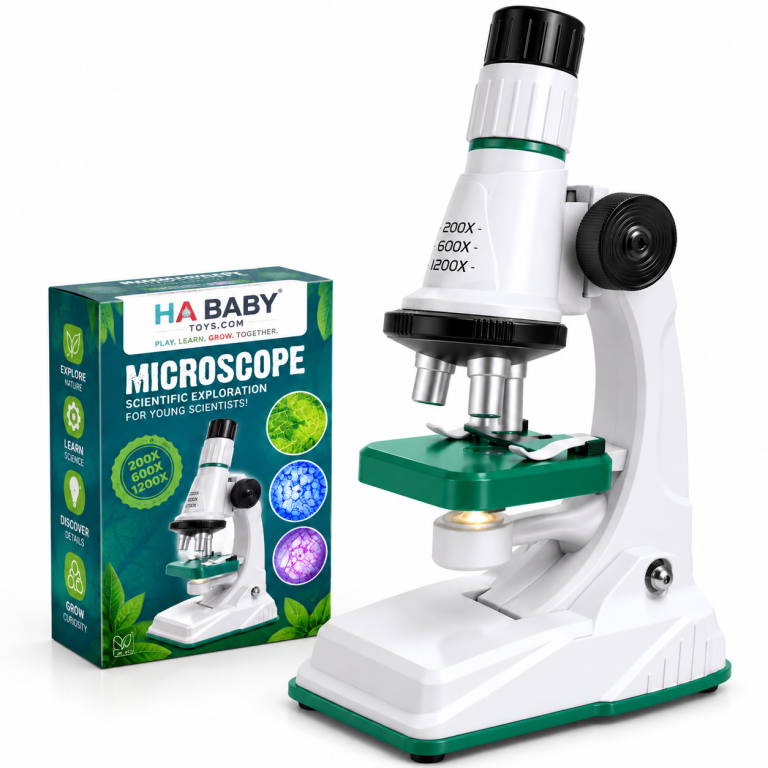
Turn your home into a mini science laboratory. Many children are naturally curious — they collect leaves, look at insects, and ask questions about the world around them. But parents often wonder: “How can I turn this curiosity into meaningful learning?” A kids microscope kit provides the perfect solution by transforming everyday objects into exciting scientific discoveries. A simple leaf, flower, piece of fabric, or crystal can become an interesting experiment.
Parents can discover more educational learning products from HA BABY Toys.
What This Guide Covers
- Why Microscope Experiments Are Great
- Experiment 1: Leaf Discovery
- Experiment 2: Flower Structure
- Experiment 3: Fabric Fiber Investigation
- Experiment 4: Salt Crystal Science
- Experiment 5: Paper Texture Investigation
- Experiment 6: Backyard Nature Exploration
- Experiment 7: Science Discovery Journal
- How These Build STEM Skills
- How Parents Can Make Learning Fun
- HA BABY Kids Microscope Kit
- Safety Tips
- Interactive FAQ
Why Microscope Experiments Are Great for Kids
Children learn best when they actively participate. A microscope experiment allows children to observe (look closely at objects), ask questions (think about differences), test ideas (compare samples), and discover (learn through experience).
This follows the scientific method: Observation → Question → Experiment → Discovery. Hands-on exploration plays an important role in early science learning, as emphasized by the NAEYC. Microscope experiments help children develop observation skills, scientific thinking, creativity, patience, and problem-solving abilities.
7 Days of Microscope Science Discovery
Tap each day to see the experiment
Leaf Investigation
Flower Discovery
Fabric Exploration
Crystal Observation
Paper Science
Nature Collection
Science Journal
Day 1 — Leaf Investigation
Start the week with the simplest and most rewarding experiment. Children compare different leaves and discover plant structures, surface patterns, and textures they never imagined existed.
Experiment 1: Leaf Discovery Under a Microscope
🍃 Leaf Discovery
Goal: Explore plant structures
- Different leaves from the yard or a walk
- Kids microscope kit
- Blank slide or clear tape
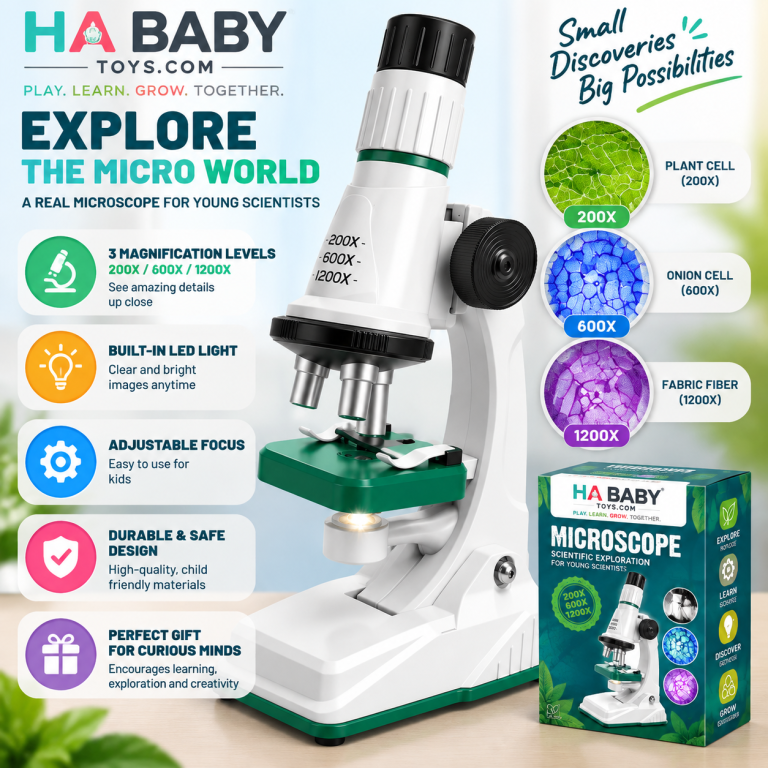
Activity: Children compare different leaves under the microscope. Observe surface patterns, textures, and small structures that aren’t visible to the naked eye.
Children learn that plants have complex structures — and that nature contains hidden details everywhere. This builds the foundation for understanding biology.
Learn more in our guide: How Children’s Microscope Toys Introduce Kids to Biology and the Hidden World.
Experiment 2: Flower Structure Exploration
🌸 Flower Structure Exploration
Goal: Discover the hidden details of flowers
- Flower petals (any flower works — from the garden or a store)
- Small flower samples
- Kids microscope kit
Activity: Children observe petal textures, surface patterns, and different structures. The variety across flower types is genuinely surprising.
- “What differences can you see?”
- “Why do flowers have different designs?”
- “Which flower has the most interesting texture?”
Introduction to plant biology — children discover that flowers have structure and purpose beyond their beauty.
Experiment 3: Fabric Fiber Investigation
🧵 Fabric Fiber Investigation
Goal: Explore materials around the home
- Cotton fabric
- Wool
- Different cloth pieces (silk, denim, polyester)
- Kids microscope kit
Activity: Children compare fiber patterns, texture differences, and material structure across different fabrics. The difference between natural and synthetic fibers becomes visible.
Introduction to material science — children learn that materials have structure, and that structure determines properties.
Experiment 4: Salt Crystal Science Experiment
🧂 Salt Crystal Science
Goal: Explore crystal structures
- Table salt (or sugar)
- Blank slide
- Kids microscope kit
Activity: Children observe crystal shapes and patterns. Salt crystals have a distinctive cubic structure that’s visible under magnification.
A simple kitchen ingredient becomes a science discovery. Children learn that even ordinary substances have fascinating structures at the microscopic level.
Experiment 5: Paper Texture Investigation
📄 Paper Texture Investigation
Goal: Understand everyday materials
- Newspaper
- Notebook paper
- Tissue paper
- Kids microscope kit
Activity: Children compare surface texture and fiber patterns across different paper types. The difference in fiber density and arrangement becomes visible.
Different materials have different structures — and those structures determine how the materials behave.
Experiment 6: Backyard Nature Exploration
🌿 Backyard Nature Exploration
Goal: Turn the outdoors into a science classroom
- Leaves
- Small natural objects (safe to handle)
- Flower pieces
- Kids microscope kit
Activity: Children collect safe natural samples from the backyard, then observe patterns, textures, and differences. Every object becomes a potential discovery.
Nature becomes a science classroom. Children learn to look at the outdoors with scientific eyes — noticing details they used to walk past.
The National Geographic Kids resources offer endless inspiration for nature exploration.
Experiment 7: Create a Science Discovery Journal
📖 Science Discovery Journal
Goal: Turn observations into lasting learning
- Blank notebook or journal
- Pencils and colored pencils
- Kids microscope kit
Activity: After each microscope session, children record their findings in a science journal. Three simple sections make the journal effective.
Observation: What did I see?
Drawing: What did it look like?
Questions: What do I want to learn?
A microscope journal makes learning more memorable. Benefits include improved writing, research habits, and communication skills.
How These Experiments Build STEM Skills
Every experiment in this guide builds STEM skills — often without the child realizing they’re “learning.”
🔬 Science
Understanding nature and materials through direct observation.
💻 Technology
Using scientific equipment — understanding how tools extend the senses.
⚙️ Engineering
Testing ideas and adjusting approach based on results.
📐 Mathematics
Comparing sizes, patterns, and differences.
The STEM education resources from the U.S. Department of Education emphasize early STEM exposure as foundational for future learning. For a deeper look, see STEM Toys for Kids: How Microscope Science Kits Encourage Future Scientists.
How Parents Can Make Microscope Learning More Fun
Three simple habits transform microscope experiments into genuine family science practices.
Weekly Science Challenges
“Find three objects and compare them.”
Ask Open Questions
Instead of explaining, ask: “What do you notice?” “What is different?”
Explore Together
Parent involvement increases engagement — curiosity is contagious.
The CDC Child Development resources highlight hands-on, guided discovery as central to healthy early development. The NASA Kids’ Club also offers free resources for extending science exploration.
HA BABY Kids Microscope Kit: Your Child’s Home Science Explorer
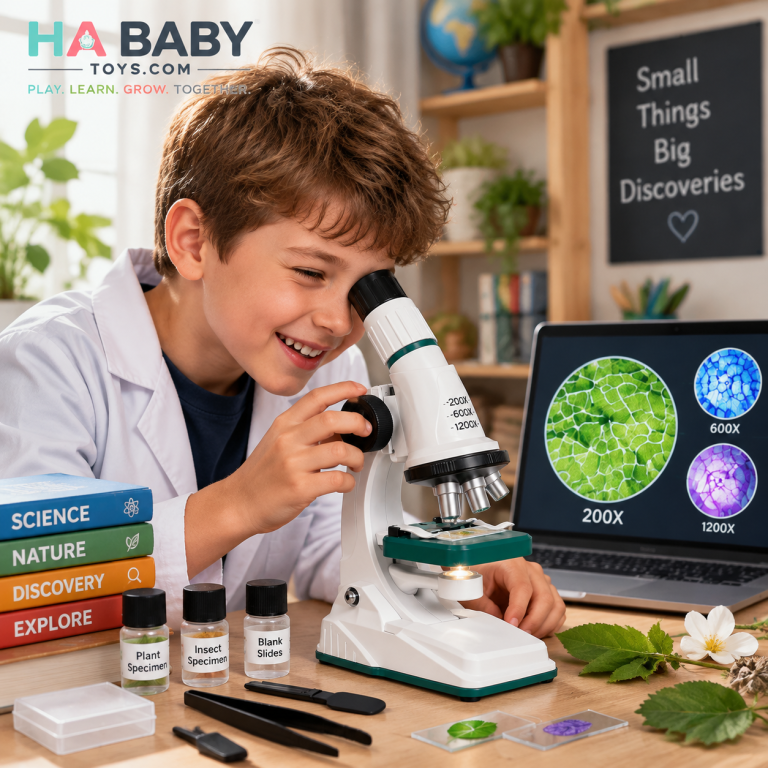
The HA BABY Kids Microscope Kit gives children the opportunity to explore science from home — combining beginner-friendly design with real scientific capability for every experiment in this guide.
HA BABY Kids Microscope Kit
- 1200X magnification for detailed exploration
- Beginner-friendly design with simple controls
- Perfect for all 7 experiments in this guide
- Supports nature exploration and STEM learning
- Hands-on experiments built into every session
- Safe, durable construction for young explorers
- Complete kit with slides and accessories
For readers who want to compare the wider range of educational products, the full shop is a useful next step. The HA Baby Toys blog also covers every aspect of science learning and early education.
Safety Tips for Kids Microscope Experiments
Science should be exciting and safe. Here are five simple guidelines for parents.
Supervise Young Children
Stay nearby during experiments — especially for children under 6.
Use Safe Samples
Only use safe, non-toxic samples from nature or the home.
Avoid Unknown Materials
Don’t use unknown chemicals, sharp objects, or questionable substances.
Handle Slides Carefully
Glass slides should be handled by parents or older children.
Keep Equipment Clean
Wipe lenses and slides after each session to keep the microscope in good shape.
Frequently Asked Questions
Kids can do many simple experiments with a microscope: leaf investigations, flower structure exploration, fabric fiber comparison, salt crystal observation, paper texture study, backyard nature exploration, and science journaling. All of these use safe, everyday objects and require only a beginner microscope kit. This guide covers all seven in detail.
Children can observe leaves, flowers, fabrics, crystals, paper, and other safe samples. What they can see depends on the magnification level and the sample. The National Geographic Kids resources offer endless inspiration for what to explore next.
Yes, with supervision and safe materials. Always supervise young children (especially under 6), use only safe non-toxic samples, avoid unknown chemicals or sharp objects, handle glass slides carefully, and keep equipment clean. Follow the five safety tips in this guide for worry-free experiments.
With supervision, children can start microscope activities from around age 5. Ages 5–7 do best with simple observation and parent-guided experiments. Ages 8–10 can handle more structured experiments and recording findings. Ages 10+ can explore independently. The CDC Child Development resources provide useful reference points.
A microscope naturally integrates all four STEM subjects: science (understanding nature and materials), technology (using scientific equipment), engineering (testing ideas), and mathematics (comparing sizes and patterns). The STEM education resources emphasize early STEM exposure as foundational for future learning.
No. All the experiments in this guide use ordinary household items and nature samples — leaves, flowers, fabric, salt, paper. The only specialized equipment needed is a beginner-friendly microscope kit. Science doesn’t require expensive tools — it requires curiosity and the right beginner equipment.
A kids microscope kit is a good educational toy because it delivers continuous discovery instead of one-time entertainment. It builds eight transferable skills (observation, critical thinking, problem-solving, research, patience, creativity, communication, confidence), supports STEM learning, and works with unlimited everyday samples. For a deeper look, see 10 Amazing Benefits of Using a Microscope for Kids.
Science Does Not Only Happen in Laboratories
With a kids microscope kit, your home can become a place where curiosity turns into discovery. Observe → Question → Experiment → Discover
The Bottom Line: Curiosity Turns Into Discovery
The seven experiments in this guide show that a kids microscope kit is not just a toy — it’s a tool that turns everyday objects into scientific discoveries. A leaf, a flower, a piece of fabric, a pinch of salt — all become opportunities for real learning.
Whether you’re a parent looking for home science activities, a homeschool family building a science curriculum, or a gift buyer wanting something meaningful, a kids microscope kit delivers genuine educational value. It turns curiosity into discovery — and discovery into a lifelong love of science.
For parents ready to explore one, the HA BABY Kids Microscope Kit product page is the natural next step. For deeper guidance on science learning and early education, explore the full HA Baby Toys blog library.