
Baby Tissue Box Toy vs Traditional Toys: Why Sensory Toys Create Better Learning Experiences
Choosing the right baby toy: entertainment or learning? Every parent wants their baby to enjoy playtime, but many also wonder: “Is this toy helping my baby learn?” The baby toy market offers thousands of options — musical toys, plush toys, interactive toys, learning toys, sensory toys. This makes choosing the right toy confusing. Traditional toys have always been valuable because they encourage imagination and enjoyment. However, sensory toys introduce another level of learning by allowing babies to actively explore through touch, movement, and discovery.
Parents looking for more educational baby products can explore the complete collection at HA BABY Toys.
Table of Contents
- What Are Traditional Baby Toys?
- What Are Sensory Toys for Babies?
- Why Babies Learn Through Active Play
- Key Differences Compared
- How Sensory Toys Support Development
- 10 Development Benefits
- Montessori Independent Learning
- Why Babies Repeat Sensory Activities
- Choosing Between Toy Types
- HA BABY Tissue Box Toy
- Making Playtime More Educational
- Frequently Asked Questions
What Are Traditional Baby Toys?
Traditional baby toys include stuffed animals, rattles, musical toys, plastic activity toys, and building toys. They’ve been part of childhood for generations — and for good reason.
🎨 Imagination
Children create their own play stories and scenarios.
👨👩👧 Social Interaction
Parents and children play together — building connection.
🎉 Entertainment
They provide enjoyable experiences that keep babies engaged.
Traditional toys are important, but many focus mainly on watching, listening, or basic interaction. That’s not a flaw — it’s just a different design goal.
What Are Sensory Toys for Babies?
Sensory toys are designed to stimulate a baby’s senses — touch, sight, movement, and sound. Examples include textured toys, activity cubes, tissue pulling toys, and Montessori toys.
Sensory toys encourage babies to participate actively instead of only observing. Learn more in our guide: Baby Sensory Toys Explained: How a Tissue Box Toy Helps Babies Learn Through Play.
Why Babies Learn Through Active Play
Babies learn through experiences — not through observation alone. A sensory toy encourages touch learning (feeling different textures), visual learning (recognizing colors), movement learning (practicing hand control), and cognitive learning (understanding actions and results).
A tissue box toy combines multiple learning experiences in one activity. The NAEYC emphasizes that active, hands-on exploration is the most effective way young children learn.
Baby Tissue Box Toy vs Traditional Toys: Main Differences
Here’s a direct, balanced comparison of the features that matter most for development.
| Feature | Traditional Toys | Baby Tissue Box Toy |
|---|---|---|
| Play Style | Mostly entertainment | Active exploration |
| Baby Role | Observer / player | Explorer |
| Learning Method | Watching and interaction | Touch and discovery |
| Skills Developed | General play skills | Sensory + motor skills |
| Repetition | Limited | Encourages repeated practice |
Learn more about how tissue pulling toys support early development in: Baby Tissue Box Toy Guide: How Montessori Tissue Pulling Toys Support Early Learning and Development.
How Sensory Toys Create Better Learning Experiences
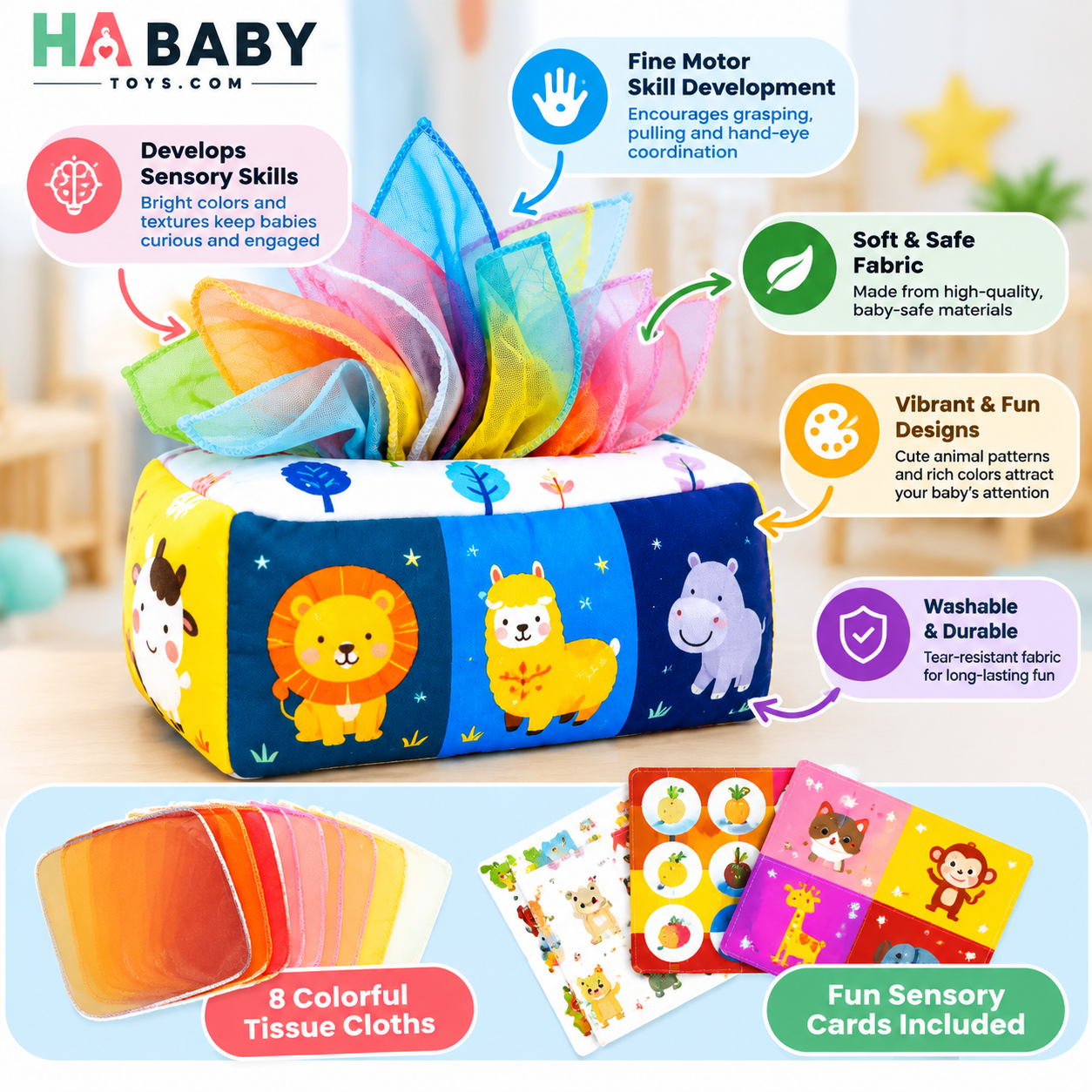
Sensory toys create opportunities for babies to actively interact with their environment through four learning pathways.
✋ Touch Learning
Feeling different textures builds tactile awareness.
👀 Visual Learning
Recognizing colors strengthens visual development.
🏃 Movement Learning
Practicing hand control builds fine motor skills.
🧠 Cognitive Learning
Understanding actions and results builds problem-solving.
10 Development Benefits of Baby Tissue Box Toys
1. Sensory Development
Babies explore textures and colors.
2. Fine Motor Skills
Pulling strengthens hand movements.
3. Hand-Eye Coordination
Connects vision and movement.
4. Curiosity
Creates discovery moments.
5. Cause and Effect
Actions create results.
6. Focus
Encourages concentration.
7. Independence
Allows self-guided play.
8. Creativity
Creates exploration opportunities.
9. Screen-Free Play
Encourages active learning.
10. Cognitive Growth
Builds thinking skills.
For a deeper look, see 10 Amazing Benefits of Baby Tissue Box Toys for Sensory Development and Motor Skills.
Why Montessori Tissue Pulling Toys Encourage Independent Learning
Montessori principles emphasize independence, repetition, hands-on learning, and self-discovery. A tissue pulling toy allows babies to control when they play, how they explore, and how often they repeat — which is exactly what the philosophy recommends.
Learn more in our guide: Montessori Toys for Babies: Why Tissue Pulling Toys Encourage Independent Learning. The American Montessori Society provides detailed resources on Montessori principles.
Why Babies Love Repeating Sensory Activities
Parents often notice babies repeat the same action again and again. This repetition helps babies understand control, movement, and results. When a baby pulls a tissue, they learn: “I did something and something happened.”
The Zero to Three organization explains that repetition is a core part of infant learning.
Choosing Between Traditional Toys and Sensory Toys
Parents do not need to choose only one category. A balanced toy collection can include both — and often works best that way.
🎲 Traditional Toys For
- ✓ Imagination
- ✓ Creativity
- ✓ Social play
🧸 Sensory Toys For
- ✓ Exploration
- ✓ Development
- ✓ Skill building
The right choice depends on the child’s needs and learning stage. For a full breakdown, see Baby Tissue Box Toy Age Guide.
Traditional Toy vs Sensory Learning Journey
Play + Learning = Better Development
🎲 Traditional Toy
- Fun
- Imagination
- Entertainment
- Social Play
🧸 Tissue Box Sensory Toy
- Touch Learning
- Motor Skills
- Curiosity
- Independence
- Discovery
“Play + Learning = Better Development”
HA BABY Tissue Box Toy: A Sensory Alternative for Early Learning
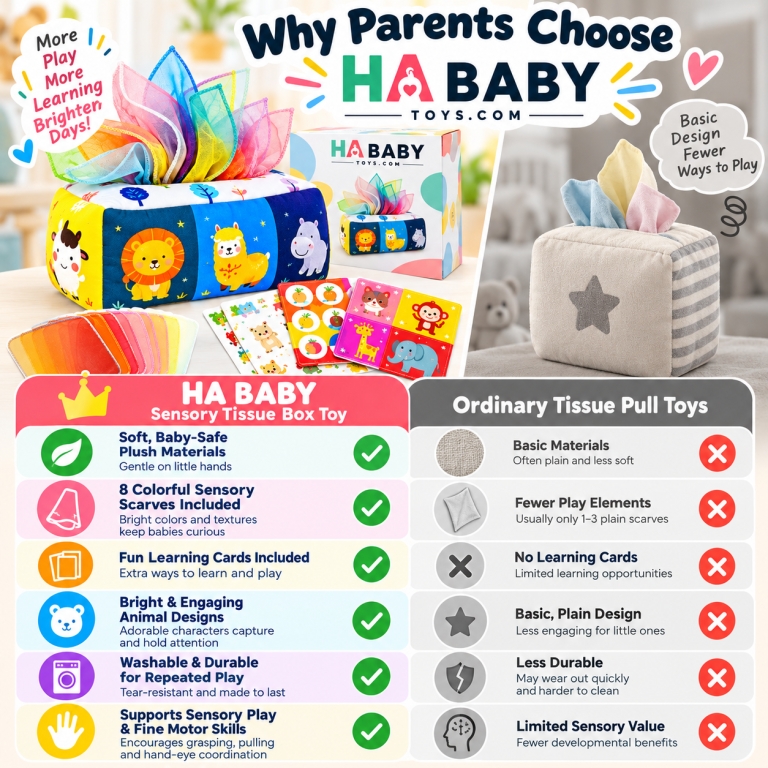
The HA BABY Tissue Box Toy combines fun and developmental learning in one simple activity — pairing Montessori-inspired design with real developmental value.
HA BABY Tissue Box Toy
- Montessori-inspired activity design
- Sensory exploration through touch, sight, and movement
- Fine motor practice with every pull
- Color learning built into every tissue
- Independent play encouraged by design
- Screen-free entertainment for daily use
- Baby-safe, comfortable materials
For readers who want to compare the wider range of sensory products, the full shop is a useful next step. The HA Baby Toys blog also covers every aspect of early learning and sensory development.
How Parents Can Make Playtime More Educational
Ask Questions
“What color did you find?”
Encourage Exploration
Let babies discover — don’t rush them.
Create Safe Play Areas
Allow movement without constant correction.
Repeat Activities
Repetition builds skills — allow it freely.
The UNICEF Early Childhood Development resources emphasize the importance of caregiver involvement in early learning.
Frequently Asked Questions
Not universally — they serve different purposes. Traditional toys excel at imagination, social play, and entertainment. Sensory toys excel at active exploration, sensory development, and fine motor practice. Many families use both. The right choice depends on what type of development you want to support at a given time.
A baby tissue box toy is educational because it combines multiple sensory experiences (sight, touch, movement) with fine motor practice (grasping, pulling, releasing) and cognitive learning (cause-and-effect understanding). It also builds focus, independence, and creativity — all through a simple activity babies genuinely enjoy.
Tissue pulling toys develop fine motor skills (grasping, pulling, releasing), hand-eye coordination, sensory awareness, cause-and-effect understanding, focus, and independence. These skills form the foundation for handwriting, self-feeding, and countless everyday activities later on. The CDC’s child development milestones highlight fine motor practice as foundational in the first two years.
With supervision, sensory toys are suitable from around 6 months — when babies can sit with support and reach for objects. Babies 6–12 months explore textures and pulling. Ages 12–18 months develop coordination and independent play. Ages 18+ months enjoy more creative play. For a full breakdown, see the Baby Tissue Box Toy Age Guide.
Yes — Montessori tissue pulling toys are worth buying because they encourage independent learning, repetition, hands-on exploration, and self-discovery. Babies control the activity themselves, which builds confidence and curiosity. The American Montessori Society provides detailed resources on Montessori principles.
Yes — sensory toys provide a genuine screen-free alternative. They encourage active play, physical movement, and real interaction rather than passive consumption. The American Academy of Pediatrics recommends limited screen time for babies and prioritizes hands-on play.
Babies enjoy tissue pulling activities because they satisfy natural curiosity and their drive to understand cause and effect. Each pull teaches a connection: “I pull → something appears.” That discovery is genuinely rewarding for a developing brain. The Zero to Three organization explains that repetition is a core part of infant learning.
Choosing the Right Baby Toy Is About More Than Keeping Babies Busy
It’s about creating opportunities for learning, exploration, and development. A baby tissue box toy turns simple play into meaningful growth. Play + Learning = Development
The Bottom Line: Both Have Value — But Sensory Toys Add Learning
Traditional toys and sensory toys aren’t competitors — they’re complements. Traditional toys build imagination, social play, and general entertainment. Sensory toys add exploration, discovery, and developmental value.
That said, when a parent wants a toy that combines entertainment with real skill-building, a baby tissue box toy stands out. It offers longer engagement, deeper learning, and a path from curiosity to scientific thinking — all through play.
For parents ready to explore one, the HA BABY Tissue Box Toy product page is the natural next step. For deeper guidance on sensory learning and early development, explore the full HA Baby Toys blog library.