
Play Food Set: Benefits & Gift Ideas — The Complete 2026 Guide
Updated for 2026 — A play food set is one of the most versatile toys you can give a child. It works as a standalone activity, pairs naturally with a play kitchen, and supports hours of imaginative play without screens or batteries. If you are a parent looking for an engaging toy, a relative searching for a birthday present, or a gift buyer unsure what to choose, this guide will help you understand what pretend food toys offer and how to pick the right one. We cover the benefits, fun activities, different set types, buying considerations, and gift ideas for every occasion.
Creativity
Invent imaginary recipes & menus
Role-Play
Become a chef, customer, or shopkeeper
Communication
Describe dishes & take imaginary orders
Sorting
Group food by colour, type & category
Social Play
Share restaurant games with family
Featured snippet: A play food set is a collection of pretend food items that children use in imaginative activities such as cooking, serving meals, running a restaurant, and playing grocery shop. These toys can encourage creativity, role-playing, communication, and social interaction while giving children opportunities to recreate familiar everyday experiences through play.
What’s inside this guide
- Why Children Enjoy Pretend Food Toys
- What Is a Play Food Set?
- Benefits of Play Food Sets
- Fun Activities with Toy Food
- Different Types of Sets
- How to Choose the Right Set
- Gift Ideas for Every Occasion
- Making Pretend Food Play Interesting
- Pairing Play Food with Kitchen Toys
- HA’BABY Product Spotlight
- FAQ (interactive)
Why Children Enjoy Pretend Food Toys
Children love copying what adults do. They watch you prepare meals, set the table, and shop for groceries, and they want to try it themselves. A play food set gives them a safe, child-sized way to recreate those familiar activities. Instead of just watching, they can chop, stir, serve, and organize — all on their own terms.
This is why pretend food toys hold attention so well. They are immediately recognizable, easy to use, and endlessly adaptable. A single play carrot can become part of a soup, a grocery order, a restaurant dish, or a sorting game. The same piece supports multiple play scenarios, which means the toy stays interesting long after the first day.
Parents and gift buyers often choose pretend food toys because they are open-ended. There is no “correct” way to play with a play food set, so children can follow their own imagination. This guide will help you understand what these toys offer, how to choose a good set, and how to use pretend food play to keep children engaged. For families exploring HA’BABY toys, this guide also shows how pretend food fits alongside other kitchen play products.

What Is a Play Food Set?
A play food set is a collection of pretend food items designed for imaginative play. These toys look like real food — fruits, vegetables, meals, or grocery items — but are made from child-safe materials such as plastic, wood, or fabric. Children use them to cook, serve, shop, and organize, either on their own or alongside a play kitchen.
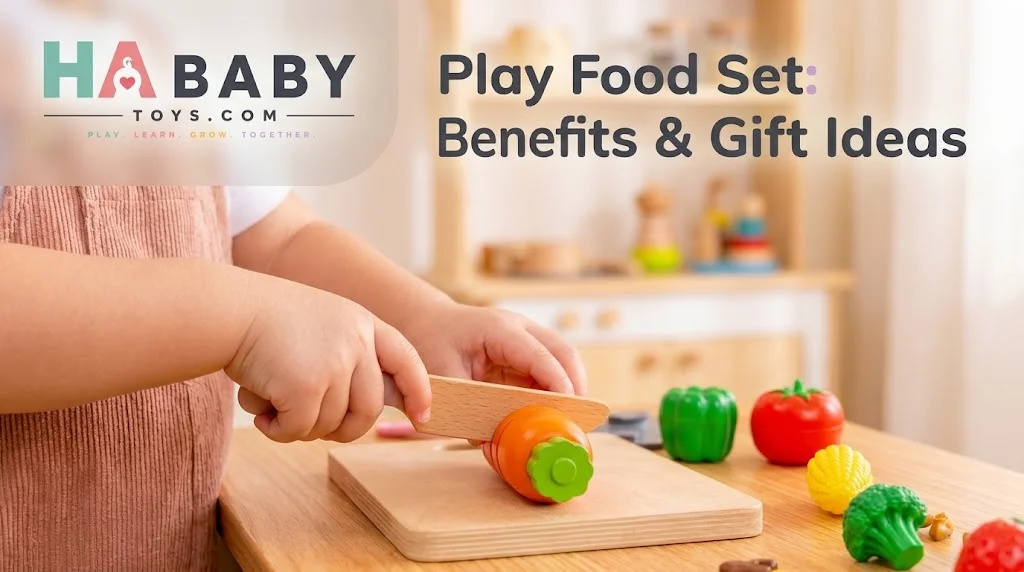
Play food differs from real food in obvious ways, but the distinction matters for safety and durability. Toy food is designed to withstand repeated handling, dropping, and pretend chopping. Many sets include Velcro-connected pieces that can be “sliced” with a toy knife, which adds a satisfying cause-and-effect element to play.
Common categories include pretend fruits and vegetables, fast-food items like burgers and pizza, meal sets with multiple courses, and grocery collections with mixed items. Children combine these pieces with kitchen accessories — pots, pans, utensils, plates — to create complete pretend-play scenarios. A play food set can be a standalone collection or part of a larger pretend-play system. The contents vary from one product to another, so it is always worth checking the listing before buying.
Benefits of Play Food Sets for Children
Play food toys are often described as educational, but the real benefits are practical and easy to observe. Below are six ways pretend food play supports children’s development through everyday activity.
Encourages Imagination and Creativity
Children can invent recipes, prepare imaginary meals, and create their own restaurant stories. A child might decide to open a small café and choose what meals to serve. Another might invent a “rainbow soup” with every colour of vegetable in the set. There is no right or wrong way to play, which gives children the freedom to experiment.
Supports Role-Playing Activities
Pretend food naturally invites role-play. Children can act as chefs, customers, restaurant owners, or grocery shopkeepers. Each role requires a different perspective and a different set of language skills. A chef explains what they are cooking. A customer places an order. A shopkeeper counts items and makes change. These roles give children practice in social situations they will encounter in real life.
Creates Opportunities for Social Interaction
Siblings, friends, and parents can all participate in shared pretend-play activities. A restaurant game requires at least two people. A grocery shop game works best with a shopkeeper and a customer. These activities teach turn-taking, negotiation, and cooperation. They also give children a shared focus, which reduces conflict and keeps play going longer.
Introduces Everyday Food Familiarity
Pretend food can give children opportunities to recognize and talk about familiar food categories, colours, and names. A child who plays with a toy carrot may be more willing to talk about real carrots at dinner. This familiarity is not a guarantee of better eating habits, but it does create natural conversation opportunities.
Encourages Communication and Vocabulary
Children can describe imaginary dishes, ask customers what they want, and explain how they are preparing meals. This kind of play supports vocabulary growth in a low-pressure context. A child who is shy in other settings may become surprisingly talkative when playing the role of a restaurant chef.
Introduces Simple Sorting and Counting Games
Parents can create activities involving grouping pretend food, counting items, and sorting by colour or type. These games are a natural extension of play. A child who is already engaged with the food set is more willing to participate in a sorting challenge than a child who is handed a stack of flashcards.
Fun Activities Children Can Enjoy with Toy Food
The activities below are designed to be used immediately with any play food set. Each one includes the items needed, simple instructions, and suggestions for parent participation.
Mini Grocery Shop
What is needed: A selection of pretend food, a small basket or tray, and a flat surface for the shop counter.
How to start: Arrange the food into groups and let children take turns being the shopkeeper and customer.
Parent participation: Be the first customer. Ask for specific items and pay with pretend coins or a high-five.
Little Chef Game
What is needed: Play food, a pot or pan, and a spoon or spatula.
How to start: Ask your child to create an imaginary dish and describe their pretend recipe.
Parent participation: Act as a food critic. Ask questions about the ingredients and presentation.
Restaurant Role-Play
What is needed: Play food, plates, cups, and a pretend menu.
How to start: One child becomes the chef while another places an imaginary order.
Parent participation: Be a customer. Order something specific and compliment the chef on the meal.
Food Sorting Challenge
What is needed: A mixed collection of play food and a few containers or plates.
How to start: Sort pretend food into groups such as fruits, vegetables, and other foods.
Parent participation: Time the sorting or make it a race. Celebrate the finished groups.
Family Dinner Game
What is needed: Play food, plates, cups, and utensils.
How to start: Children arrange imaginary meals and serve them to family members.
Parent participation: Sit at the pretend table and thank your child for the meal.
For more setup ideas that pair well with these activities, see our creative play kitchen setup ideas guide.
Different Types of Play Food Sets
Not all play food sets are the same. The category you choose depends on your child’s interests and the type of play you want to support.
Pretend Fruit and Vegetable Sets
These sets include toy fruits and vegetables, often with Velcro pieces that can be sliced. Children use them in shopping, sorting, and cooking games. They are a good starting point for younger children because the items are familiar and easy to recognize.
Fast-Food and Meal Sets
These sets include imaginary burgers, sandwiches, pizzas, and similar pretend meals. They work well for restaurant role-play and appeal to children who enjoy assembling multi-part items.
Grocery Shopping Sets
These are mixed food collections designed for pretend shopping and shopkeeper games. They often include a basket or storage container. They work well for children who enjoy sorting and organizing.
Kitchen and Cooking Sets with Food Accessories
Some sets combine pretend food with kitchen-related accessories such as pots, pans, and utensils. These are a good option if you are starting from scratch and want everything in one package. For a detailed look at what these sets include, see our kitchen toy set pieces and features guide.
Individual Toy Food Collections
Smaller collections can be added to an existing play kitchen. These are useful if your child already has a kitchen setup and you want to expand the food options without buying a complete new set.
How to Choose the Right Play Food Set
If you are unsure which set to buy, these eight factors will help you make a confident choice.
1. Age Recommendations
Check the manufacturer’s recommended age and warnings. Small parts pose a choking hazard for children under three. The American Academy of Pediatrics’ HealthyChildren.org offers guidance on age-appropriate toys.
2. Piece Variety
Consider whether the food categories support different play activities. A set with fruits, vegetables, and prepared meals supports more scenarios than a set with only one type of food.
3. Size of Individual Pieces
Avoid products with small parts that pose choking hazards for young children. Larger pieces are easier for toddlers to grip and safer for mixed-age play.
4. Material Information
Look for clear material descriptions and appropriate product documentation. Non-toxic, BPA-free plastics and responsibly sourced wood are the standard for quality play food. If the listing does not specify materials, contact the seller or choose a different product.
5. Ease of Cleaning
Check the manufacturer’s care instructions. Most plastic play food can be wiped clean with a damp cloth. Fabric items may require different care. Sets that are easy to clean are more likely to stay in rotation.
6. Storage
Consider whether the set can be organized easily. A storage basket or container makes cleanup faster and keeps pieces from getting lost. Sets that come with their own storage solution are especially convenient.
7. Play Compatibility
Think about whether the food accessories work with the child’s existing kitchen toys. If your child already owns a play kitchen, check that the scale and style of the new food pieces will fit alongside the existing accessories.
8. Overall Value
Compare usefulness and variety, not just the advertised piece count. A smaller set with thoughtfully varied foods is often a better investment than a larger set with many duplicates.
Quick Buying Checklist
- Does the age recommendation match my child?
- Does the set include a variety of food categories?
- Are the pieces large enough to be safe?
- Are the materials specified and non-toxic?
- Is the set easy to clean?
- Do I have a practical storage solution?
- Will the pieces fit with my child’s existing kitchen toys?
- Is the variety worth the price, regardless of piece count?
Play Food Set Gift Ideas for Different Occasions
Play food sets make thoughtful gifts because they are open-ended, durable, and easy to build on. Below are gift ideas for different occasions and recipients.
Birthday Gift
A pretend food collection is an interesting option for children who enjoy kitchen role-play. Choose a set that matches the child’s age and interests. A mixed grocery set works well for a first play food gift.
Holiday Gift
A play food set is a playful gift for a holiday celebration. It works as a standalone gift or as a companion to a play kitchen. Consider a themed set — like fast food or baked goods — for a more festive feel.
Gift for a Little Food-Shop Enthusiast
A grocery-themed pretend-play collection can inspire shopkeeper games. Look for sets with a basket or storage container to complete the shop experience.
Gift for Siblings
A shared pretend-play toy can create opportunities for taking turns and playing together. A larger set with varied food categories works well for multiple children.
Gift for a Pretend-Kitchen Setup
Combine compatible kitchen toys and pretend food accessories for a more complete play experience. If the child already has a play kitchen, add a food set that complements the existing accessories.
Before choosing a gift, consider the child’s interests, age guidance, available storage, and existing toys. A play food set that fits into an existing play routine is more likely to be used regularly than one that requires a whole new setup.
How to Make Pretend Food Play More Interesting
You do not need to buy more toys to keep pretend food play fresh. A few small changes can renew engagement without adding to the collection.
Invent a New Restaurant Theme Every Week
One week the restaurant serves Italian food. The next week it serves breakfast. A new theme gives children a reason to reorganize the food and invent new dishes.
Let Children Create Their Own Imaginary Menus
Write down the menu together. A child who has designed the menu is more invested in playing the restaurant game.
Introduce Food Sorting Games
Sorting games are quick to set up and easy to repeat. Sort by colour, type, or size. These games add a structured element to play without feeling like a lesson.
Rotate the Pretend Food Available During Play
Keep some food pieces stored away and rotate them in every few weeks. A piece that has been out of rotation feels new again.
Invite Siblings or Parents to Participate
Shared play is more engaging than solo play. Invite a sibling to be the customer or a parent to be the food critic. Social play extends the length of play sessions.
Encourage Children to Make Up Their Own Stories
Ask questions like “What is the special today?” or “Where did you learn to cook this?” These questions invite children to invent stories and explain their thinking.
Sample Imaginary Restaurant Menu
- Starters: Rainbow carrot soup, crunchy lettuce rolls
- Mains: Velcro-sliced pizza, tomato tower burger, pretend pasta
- Desserts: Toy fruit salad, imaginary chocolate cake
- Drinks: Pretend orange juice, imaginary milk tea
Pairing Play Food with Kitchen Toys
Play food works best when it has a place to go. Pairing food accessories with kitchen toys creates a more complete play experience and gives children a natural flow from preparation to serving.
Food Accessories for Imaginary Cooking
The food itself is the starting point. Chopping, sorting, and arranging the food pieces builds the foundation of pretend cooking.
Utensils for Pretend Preparation
Spoons, spatulas, and toy knives give children the tools to act out the cooking process. These small accessories make the food feel more purposeful.
Plates and Cups for Serving Games
Serving items turn a solo cooking activity into a social one. A child who has plates and cups can serve a meal to a parent, sibling, or stuffed animal.
Toy Cookware for Restaurant Activities
Pots and pans give the food somewhere to go. They also support restaurant role-play, where the chef needs cookware to prepare the meal.
Storage Solutions for Keeping Everything Organized
A storage bin or basket makes cleanup faster and keeps the set ready for the next play session. For a full breakdown of what a kitchen toy set includes, see our kitchen toy set pieces and features guide, and for setup ideas, see our creative play kitchen setup ideas.
Discover the HA’BABY Kids Kitchen Toys Set
If you are looking for a kitchen-themed gift that encourages imaginative play, the HA’BABY Kids Kitchen Toys Set is designed to complement pretend food activities. It includes cookware, utensils, plates, cups, and serving items — the accessories that turn a simple play food collection into a complete pretend-cooking experience.
The set works well alongside the activities in this guide. The pots and pans support the Little Chef Game. The plates and cups make the Family Dinner Game feel more realistic. The utensils give children the tools they need to prepare imaginary meals. When paired with a play food set, the kitchen toys create a complete play system that supports cooking, serving, and restaurant role-play.
Before ordering, review the product page to confirm the included pieces and check the manufacturer’s age guidance. If you have questions about shipping, materials, or care instructions, the common questions about HA’BABY page addresses them. And if you want to compare this set with other options, you can explore the HA’BABY collection to see the full range.
Looking for a kitchen-themed gift that encourages imaginative play?
Explore the HA’BABY Kids Kitchen Toys Set and review its product details to see whether it matches the child’s interests.
Explore the Kids Kitchen Toys SetFrequently Asked Questions
A play food set is a collection of pretend food items designed for imaginative play. It may include toy fruits, vegetables, prepared meals, or grocery items made from child-safe materials. Children use these toys to cook, serve, shop, and organize, either on their own or alongside a play kitchen. The contents vary from one product to another, so check the listing before buying.
Pretend food toys support imagination, role-play, communication, sorting, and social interaction. Children can invent recipes, act as chefs or customers, describe imaginary dishes, and play restaurant games with family members. These activities build language skills and social confidence in a low-pressure context. The benefits come from the play itself, not from any guaranteed developmental outcome.
Children can play grocery shop, pretend to be a chef, run a restaurant, sort food into groups, and serve imaginary meals to family members. These activities can be done solo or with siblings and parents. For more ideas, see the activities section above or our creative play kitchen setup ideas guide.
Yes, a play food set can be a thoughtful birthday gift because it is open-ended, durable, and easy to build on. Choose a set that matches the child’s age and interests. A mixed grocery set or a themed set — like fast food or baked goods — works well as a first play food gift. Consider the child’s existing toys and storage space before choosing.
Check the manufacturer’s age recommendation and warnings. Avoid sets with small parts that pose choking hazards for children under three. Look for clear material descriptions and non-toxic finishes. Check for recalls on the U.S. Consumer Product Safety Commission website. Inspect the set for sharp edges or damaged pieces before giving it to your child.
Yes, pretend food toys pair naturally with a play kitchen. The food gives children something to cook and serve, while the kitchen provides a place to prepare it. Together they support cooking, serving, and restaurant role-play. If you are choosing a kitchen set to pair with play food, see our kitchen toy set pieces and features guide.
Most plastic play food can be wiped clean with a damp cloth and mild soap. Check the manufacturer’s care instructions for specific guidance. Store the set in a basket or bin so pieces stay together and cleanup is quick. Avoid soaking items that contain electronic components. Inspect the set regularly for cracks or loose parts. For more on organizing a play kitchen, see our play kitchen setup guide.
Conclusion: A Gift That Grows With Your Child
A play food set is more than a toy. It is a flexible play system that supports imagination, communication, and social interaction. It works as a standalone gift, pairs naturally with a play kitchen, and stays interesting as children grow. For parents, relatives, and gift buyers, it is a safe, practical choice that offers real play value.
If you are ready to build a complete pretend-kitchen experience, the HA’BABY Kids Kitchen Toys Set provides the cookware, utensils, and serving items that pair with play food. Review the product details, check the age guidance, and consider how the set fits into your child’s existing play routine. And if you want to explore the broader range of HA’BABY toys, the full collection is available to browse.