
Kids Kitchen Toys Set: Pieces & Features — The Complete 2026 Buyer’s Guide
Updated for 2026 — If you are comparing play kitchen options for your child, you already know the market is crowded. The confusion is real: dozens of sets claim to be “the best,” but few explain what is actually inside the box or how each piece supports pretend cooking. This product-focused guide cuts through the noise. We break down the HA’BABY Kids Kitchen Toys Set piece by piece, explain the features that matter, and help you decide whether it fits your child’s playtime needs. No vague promises — just practical buying clarity.
Cookware
Pots & pans with liftable lids
Utensils
Spatulas, ladles, spoons
Play Food
Choppable vegetables & fruit
Serving
Plates, cups & dining items
Featured snippet: A kids kitchen toys set is a pretend-play collection designed to let children explore everyday kitchen activities through imaginative play. Depending on the set, it may include toy cooking utensils, play food, cookware, and other kitchen accessories. Understanding its pieces, features, and play possibilities can help parents choose a suitable set.
What’s inside this guide
What Is a Kids Kitchen Toys Set?
A kids kitchen toys set is more than a collection of plastic items — it is a complete pretend-play system. It gives children a structured way to imitate familiar household activities: preparing food, stirring pots, serving meals, and organizing kitchen accessories. Unlike individual kitchen-themed toys (a single play pan or a lone toy vegetable), a set provides a coherent play narrative. Children recognize the familiar shapes and immediately know what to do with them.
This familiarity is precisely why play kitchens hold attention so well. A child who has watched you cook dinner will naturally gravitate toward a toy stove and a play carrot. They are rehearsing adult behavior in a safe, low-stakes environment. For parents, this means the set becomes a reliable activity — something you can pull out when you need a calm, screen-free 20 minutes.
There is an important distinction, however, between a basic accessory set and a larger play kitchen. A basic set might include a few utensils and some play food, designed to supplement an existing play kitchen. A larger set — like the one we will examine later — typically includes cookware, utensils, food pieces, and serving items all in one package. Before purchasing, parents should understand what type of set they are buying. If you already own a play kitchen structure, an accessory set may be all you need. If you are starting from scratch, a comprehensive set saves you from buying items piecemeal.
For a deeper look at how a full play kitchen fits into daily routines, our play kitchen setup ideas article walks through practical arrangements. But first, let’s examine exactly what pieces you can expect to find.
What Pieces Can You Find in a Kids Kitchen Toys Set?
This is the heart of the guide. If you are comparing sets, the piece list is your most important reference. Below we break down the common accessory categories. Note: always verify the actual contents on the product listing before ordering. The categories below represent what you may find in a comprehensive kitchen set.
Toy Cooking Utensils
Pretend spoons, spatulas, ladles, and whisks are the backbone of cooking play. They are the tools a child uses to interact with the other pieces. A good utensil is sized for small hands, with a rounded handle that is easy to grip. When a child stirs a pot with a toy spatula, they are practicing wrist rotation and hand-eye coordination. They are also narrating — “I’m making soup!” — which builds language skills. For parents, utensils are the easiest entry point into play. You can hand a child a spoon and a pot and the game begins immediately.
Pots and Pans
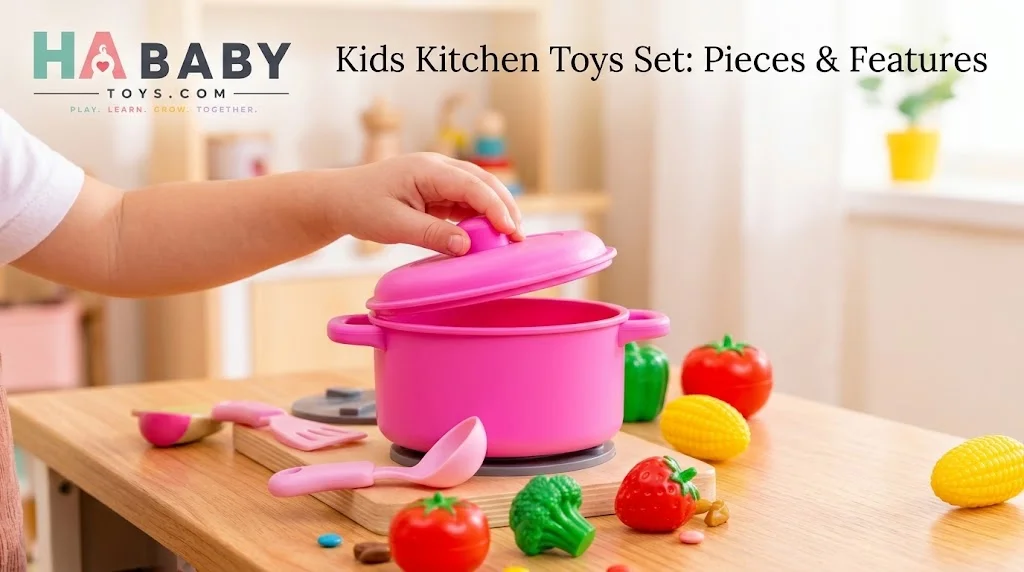
Toy cookware helps children recreate the most familiar kitchen routines: stirring, flipping, and serving. A pot with a lid is particularly engaging because the lid introduces a simple cause-and-effect mechanic. Lift the lid, peek inside, put it back. This repetitive action is soothing for toddlers and builds fine motor control. Pans with handles allow for pretend flipping, which requires more advanced coordination. The image above shows exactly this: a hand lifting a pot lid, demonstrating the kind of detail that separates a quality set from a flimsy one. When comparing sets, check whether the lids fit securely and whether the handles feel sturdy.
Play Food Accessories
Toy vegetables, fruits, and other pretend food items are what children use to “prepare” meals. Many sets include choppable food — pieces held together with Velcro that can be sliced with a toy knife. This is a powerful feature because it mimics real food preparation while being completely safe. A child chopping a play carrot is practicing bilateral coordination (one hand holds, the other cuts). Play food also opens the door to sorting and categorization games. For a deeper exploration of this topic, see our benefits of pretend play food article.
Plates, Cups, and Serving Items
Pretend dining items transform a solo cooking activity into a social one. A child can “serve” a meal to a parent, a sibling, or a stuffed animal. This is where restaurant role-play begins. Plates and cups also introduce table-setting routines, which build sequencing skills: first the plate, then the cup, then the food. If you have multiple children, serving items are essential for cooperative play. They create natural turn-taking opportunities.
Additional Kitchen Accessories
Some sets include extra items like pretend condiments, a toy knife, or a cutting board. These expand the number of possible play scenarios. A cutting board, for example, gives the chopping activity a defined workspace. Condiment bottles add variety to pretend cooking. When evaluating a set, look for accessories that serve a clear purpose rather than novelty items that will be ignored after the first day.
Understanding the Main Features of a Play Kitchen Set
Piece count alone is a poor measure of quality. A set with 40 identical plastic spoons is less useful than a set with 12 thoughtfully varied accessories. Here are the features that actually matter.
Variety of Accessories
A combination of different accessory types — cookware, utensils, food, and serving items — creates more play possibilities than several identical items. A child with one pot, one spoon, and three different play foods can cook, serve, and organize. A child with ten identical spoons can only line them up. Variety is what sustains engagement over weeks and months.
Child-Friendly Design
Easy-to-handle shapes and practical sizing are non-negotiable. Utensils should have rounded edges. Pots should be lightweight enough for a toddler to lift. Handles should be thick enough to grip but not so bulky that they are awkward. Before purchasing, check the manufacturer’s age guidance. A set designed for a 3-year-old will have different proportions than one designed for a 6-year-old.
Colours and Visual Appeal
Attractive colours and recognizable kitchen designs make pretend play more engaging. A pot that looks like a real pot is more likely to be picked up than a generic plastic cylinder. Colour coding can also support learning — for example, if vegetables are grouped by colour, children can sort them naturally during play.
Ease of Handling and Organization
Can your child pick up the pieces easily? Can they arrange them without frustration? Can you store them without needing a dedicated bin? These are practical questions that parents often overlook. A set that is difficult to organize will end up scattered across the floor, which creates mess and stress. Look for sets with a storage container or a clear organizational scheme.
Durability and Material Information
Always check material details, construction quality, and manufacturer information before purchasing. Look for non-toxic finishes and sturdy construction. A set that cracks within a month is not a bargain. If the product listing does not specify materials, that is a red flag. For broader safety guidance, refer to the U.S. Consumer Product Safety Commission toy safety resources.
How Different Kitchen Accessories Are Used During Pretend Play
Understanding the pieces is only half the story. The real value emerges when you see how children actually use them. Below are practical scenarios that parents can try at home.
Pretend Cooking
The child picks up a play carrot, places it on a cutting board, and uses a toy knife to chop it. They then transfer the pieces to a pot, stir with a spatula, and announce that dinner is ready. This sequence involves fine motor skills, sequencing, and language. It is the most natural entry point into play.
Restaurant Game
One child becomes the chef; another acts as the customer. The chef takes an order (“I would like soup and bread”), prepares it using the set, and serves it on a plate. This game builds social skills, turn-taking, and perspective-taking. It is especially effective with siblings or during playdates.
Family Kitchen
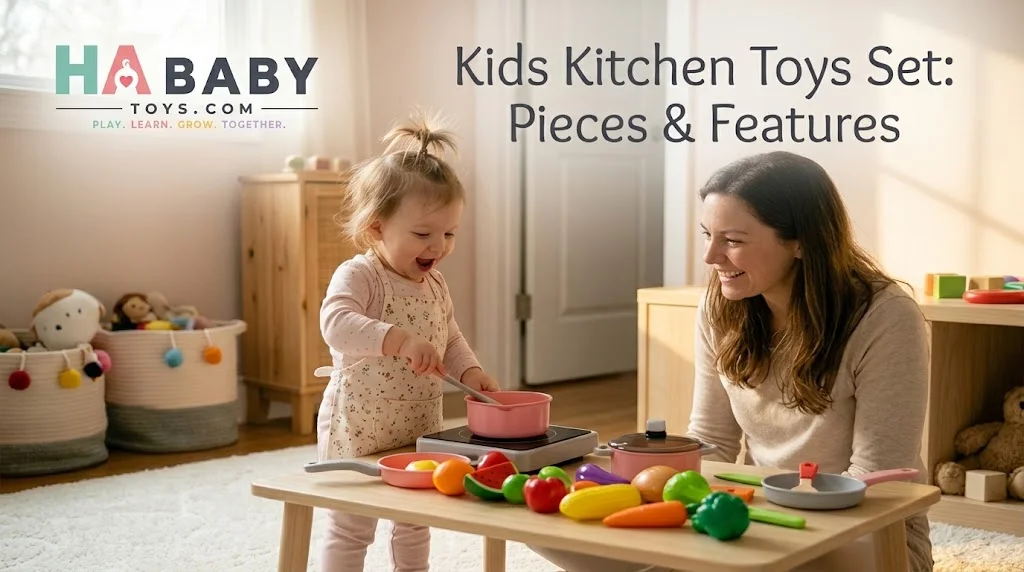
The child pretends to prepare a meal for family members. This can be a solo activity or a cooperative one. A parent can sit nearby and “receive” the meal, which reinforces the child’s sense of competence and contribution.
Food-Serving Activity
Children arrange pretend food on toy plates and serve them to stuffed animals or dolls. This is a quieter, more focused activity that appeals to children who prefer order and repetition. It builds categorization skills as children decide which food goes on which plate.
Kitchen Organization
Children sort and arrange their play accessories. They might group all the vegetables together, line up the utensils, or stack the plates. This is not “cleaning up” — it is a play activity in itself. It builds classification skills and gives children a sense of control over their environment.
What Makes a Kids Kitchen Toys Set Interesting for Children?
You might wonder why some toy sets are played with daily while others are ignored after a week. The answer comes down to a few key factors.
Different accessories create varied play scenarios. A set with pots, utensils, food, and plates can support cooking, serving, organizing, and restaurant games. A set with only one type of item becomes repetitive quickly.
Familiar kitchen objects are easy for children to recognize. A child does not need to be taught what a pot is. They have seen one in the kitchen. This immediate recognition lowers the barrier to play.
Role-playing gives children opportunities to create their own stories. The set is a prop, not a script. Children invent their own narratives, which is deeply engaging and supports creativity.
Playing with parents or siblings adds a social element. Kitchen play is naturally collaborative. It invites conversation, negotiation, and shared imagination.
Repeated pretend-play activities can encourage creativity and imagination. The more a child plays, the more elaborate their scenarios become. A simple pot of soup evolves into a full restaurant with a menu and a waiter.
For more on how to set up a play kitchen environment that supports this kind of engagement, read our play kitchen setup guide.
How to Choose the Right Kitchen Toy Set
If you are unsure what to purchase, these six considerations will guide you.
1. Check the Included Pieces
Make sure the product contents match the listing. Read the product description carefully and, if possible, look at customer reviews for confirmation. Do not assume that a set includes a specific item unless it is explicitly stated.
2. Consider the Child’s Interests
Some children prefer cooking games; others enjoy serving and restaurant role-play. If your child gravitates toward organizing and sorting, prioritize a set with varied accessories. If they prefer social play, prioritize serving items.
3. Check Recommended Age Guidance
Follow the manufacturer’s age recommendation and warnings. A set designed for a 6-year-old may contain small parts that are unsafe for a 2-year-old. For general age-appropriate play guidance, the American Academy of Pediatrics’ HealthyChildren.org is a reliable resource.
4. Review Material Details
Look for clear material and product information. If the listing does not specify what the set is made of, contact the seller or choose a different product. Non-toxic, BPA-free plastics are the standard for quality kitchen toys. For additional safety verification, the UNICEF early childhood development resources are also worth reviewing when selecting toys for young children.
5. Consider Storage
Think about where the accessories will be kept after playtime. If you do not have a dedicated playroom, a set that fits into a small bin or basket is more practical. Oversized sets often end up scattered because there is no clear storage solution. Before ordering, measure your available space and confirm the set’s dimensions.
6. Compare the Overall Value
Consider the variety and usefulness of the included pieces rather than judging a set by its piece count alone. A 30-piece set with 20 identical items offers less play value than a 12-piece set with thoughtfully varied accessories. Value is about how many distinct play scenarios the set can support, not how many pieces are in the box.
Parent Checklist Before Buying
- Are the included pieces clearly listed in the product description?
- Does the set match my child’s current interests and play style?
- Does the manufacturer’s age recommendation fit my child?
- Are the materials specified and non-toxic?
- Do I have a practical place to store the set after play?
- Is the variety of accessories balanced, or are there many duplicates?
- Have I checked customer reviews for real-world durability feedback?
Kids Kitchen Toys Set for Different Play Activities
Once you have chosen a set, the next step is putting it to use. Below are five practical play activities that parents can try at home. Each one uses the accessories in a slightly different way, which keeps the set fresh and engaging over time.
| Play Activity | How Children Can Use the Set |
|---|---|
| Little Chef | Pretend to prepare an imaginary meal using pots, utensils, and play food. |
| Restaurant Role-Play | Take turns as chef and customer, using plates and serving items to deliver orders. |
| Family Dinner | Arrange and serve pretend food to family members or stuffed animals. |
| Kitchen Organization | Sort accessories into groups by type, colour, or size. |
| Food Shop Game | Pretend to select and serve different foods from a make-believe shop counter. |
These activities are not rigid scripts. They are starting points. The most valuable play emerges when children take an activity and make it their own. For additional setup inspiration, see our play kitchen setup ideas guide.
Introducing the HA’BABY Kids Kitchen Toys Set
If you have read this far, you likely have a clear picture of what a quality kitchen set should include. The HA’BABY Kids Kitchen Toys Set was designed with those exact criteria in mind. It brings together cookware, utensils, play food, and serving items in a single package, giving children a complete pretend-play experience from the first day.
The cookware features liftable lids that add realism to play, as shown in the close-up image above. The utensils are sized for small hands, with rounded edges and easy-grip handles. The play food pieces support chopping and preparation activities, while the plates and cups open the door to serving and restaurant games. Each component serves a clear purpose, which is what keeps the set engaging over time.
What sets this product apart is not an inflated piece count. It is the balance of variety and practicality. The accessories are easy to handle, easy to organize, and easy to store. Parents do not need to buy supplemental items to make the set feel complete. It works as a standalone play system.
Before ordering, review the product listing carefully to confirm the included pieces and check the manufacturer’s age guidance. If you have specific questions, the common questions about HA’BABY products page addresses shipping, materials, and care instructions. And if you are exploring the full range of play options, you can explore the HA’BABY toy collection to see how this set fits alongside other products.
Ready to see the full piece list?
Explore the HA’BABY Kids Kitchen Toys Set and review its included pieces and product details before making your choice.
View the Kids Kitchen Toys SetCare, Storage, and Toy Safety Considerations
Once the set arrives, a few simple habits will extend its lifespan and keep play safe.
Cleaning and Maintenance
Most plastic play kitchen accessories can be wiped clean with a damp cloth and mild soap. Avoid soaking pieces that contain sound modules or electronic components. Check the product care instructions for specific guidance. Inspect the set periodically for cracks or loose parts, especially if it is used daily.
Storage and Organization
A set that is easy to store is a set that gets used. Keep the accessories in a single bin or basket so that setup and cleanup are quick. If space allows, a low shelf or a dedicated play corner helps children access the set independently. This also reinforces tidy habits from an early age.
Safety Checks
Always follow the manufacturer’s age recommendation. Small parts pose a choking hazard for children under three. Check for sharp edges, loose pieces, or damaged components regularly. For toy safety recalls and general safety guidance, the U.S. Consumer Product Safety Commission maintains an up-to-date database. Additionally, the World Health Organization provides general child health guidance that is useful for parents evaluating play products.
Frequently Asked Questions
Contents vary by product. A typical set may include toy cookware such as pots and pans, utensils like spoons and spatulas, play food pieces, and serving items such as plates and cups. Always check the individual product listing to confirm exactly what is included before purchasing. The HA’BABY set page lists all confirmed contents.
The most common pieces are pots, pans, spoons, spatulas, play vegetables and fruits, plates, and cups. Some sets also include a toy knife, a cutting board, or pretend condiments. Variety matters more than quantity — a set with a balanced mix of accessory types supports more play scenarios than one with many duplicates.
Children can cook pretend meals, run a restaurant game with siblings or parents, serve food to stuffed animals, sort and organize accessories, and invent their own kitchen stories. These activities support fine motor skills, language development, sequencing, and social play. For more ideas, see our play kitchen setup guide.
Start by checking the included pieces against your child’s interests. Consider the manufacturer’s age guidance, review the material details, and think about where the set will be stored. Compare sets by the variety of accessories rather than the total piece count. Our common questions about HA’BABY products page covers additional buying considerations.
Many kitchen toy sets are designed for toddlers, but suitability depends on the specific product. Always follow the manufacturer’s age recommendation and warnings. Sets containing small parts may not be safe for children under three. Check for rounded edges, non-toxic materials, and sturdy construction before giving the set to a toddler.
Keep accessories in a single bin, basket, or low shelf so that cleanup is quick and children can access the set independently. Group similar items together — utensils in one container, play food in another — to make organization intuitive. A consistent storage spot also helps children learn tidy habits and reduces the chance of pieces getting lost.
Confirm the included pieces on the product listing, check the age recommendation, review material details, and consider storage space. Read customer reviews for real-world feedback on durability. Look for non-toxic finishes and sturdy construction. For additional guidance on HA’BABY products, visit the FAQ page or explore the HA’BABY toy collection.
For more detailed buyer guidance and to compare options, you can also review the full kids kitchen toys set pieces and features breakdown on our main site.
Conclusion: Making a Confident Buying Decision
Choosing a kids kitchen toys set does not have to be overwhelming. The key is to focus on what matters: the variety of pieces, the quality of construction, and how well the set matches your child’s play style. A well-designed set becomes more than a toy — it becomes a reliable activity that supports development and gives parents a calm, screen-free option in the middle of a busy day.
The HA’BABY Kids Kitchen Toys Set brings together the essential pieces — cookware, utensils, play food, and serving items — in a package that is practical to store and easy to use. If you are ready to see the full details, view the Kids Kitchen Toys Set and review the included pieces before making your choice. For broader options across our range, explore the HA’BABY toy collection.