
Play Kitchen Toys: Setup & Play Tips — The Complete 2026 Guide
Updated for 2026 — Play kitchen toys work best when they have a dedicated space, a simple organization system, and a few go-to games that keep children curious. If you have ever watched your child lose interest in a toy kitchen after the first week, the issue is rarely the toy itself. It is almost always the setup. This practical guide shows you how to create a little cooking corner at home, organize accessories so they are easy to use, and introduce pretend cooking games that grow with your child. Everything here is designed for real homes — not showrooms.
Cooking Zone
Stove, pots & pretend cooking tools
Prep Zone
Cutting board & play food prep
Serving Zone
Plates, cups & serving items
Storage Zone
Bins, baskets & organized accessories
Dining Zone
Pretend family meals & restaurant games
Featured snippet: Play kitchen toys create an imaginative space where children can pretend to cook, serve meals, and explore everyday kitchen activities. Parents can make this play area more enjoyable by arranging accessories within easy reach, creating simple cooking stations, introducing pretend-play games, and encouraging children to invent their own kitchen stories.
What’s inside this guide
Making Playtime More Exciting with Play Kitchen Toys
Play kitchen toys have a familiar problem. Children love them at first, then gradually drift away. The pot stays on the shelf. The play food sits in a bin. The pretend stove becomes furniture. This is not a sign that your child has outgrown pretend cooking. It is a sign that the play area needs a refresh — a better setup, clearer organization, and a few new game ideas.
The good news is that you do not need to buy a new toy kitchen to make this happen. Most of the time, the same accessories can be rearranged and reintroduced in ways that feel new. A well-organized play area makes accessories easier to find and easier to use. A simple cooking game gives children a starting point when they are unsure what to do next. And a dedicated corner helps children associate that space with a specific kind of play.
This guide walks you through exactly that process. You will learn how to choose a location, arrange accessories by purpose, create five different setup styles, and introduce six pretend cooking games. Everything is designed to be practical, low-cost, and easy to adjust as your child grows. For families exploring HA’BABY toys for the first time, this guide also shows how a well-designed kitchen set fits into daily play.
How to Set Up a Play Kitchen at Home
Setting up a play kitchen does not require a dedicated playroom or expensive furniture. It requires a clear plan. The five steps below can be completed in a single afternoon.
Choose a Suitable Location
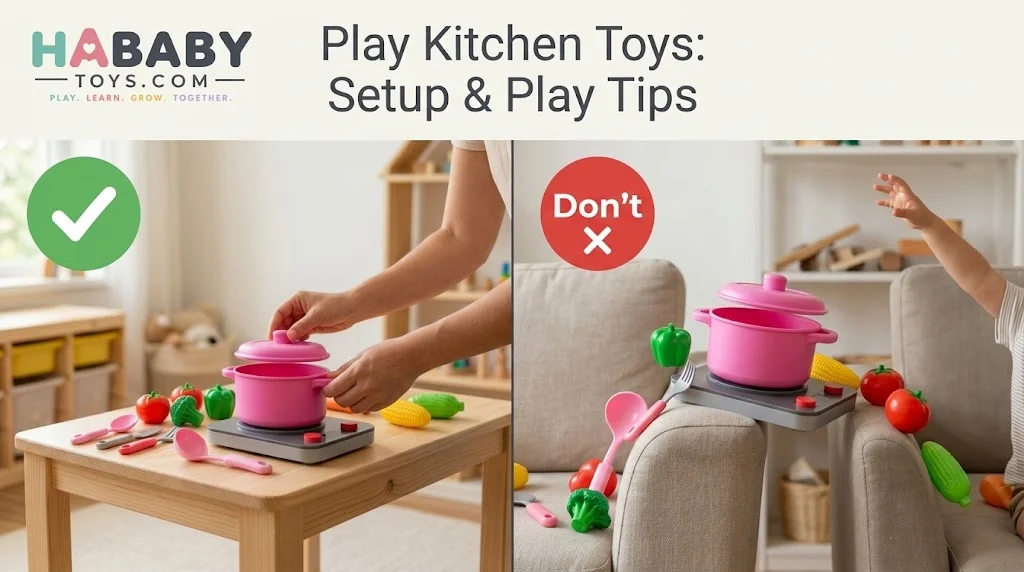
Pick a clean, comfortable corner with enough room for your child to move around. The location should allow you to supervise play easily. Keep the area away from real cooking appliances, sharp edges, and other household hazards. A corner of the living room or a section of a bedroom often works well. Avoid high-traffic walkways where the set will be knocked over.
Create a Small Kitchen Corner
You do not need a full play kitchen unit. A small shelf, a low toy table, or a designated patch of floor can serve as the foundation. For homes with limited space, a compact setup is entirely possible. Use a single low shelf to hold the accessories and a small mat to define the play area. The goal is to create a visual boundary that tells your child, “This is the kitchen.”
Arrange the Main Accessories
Group pretend utensils, cookware, play food, and serving items according to their purpose. Place the most-used items at the front and the less-used items toward the back. If your child has a favorite pot or spoon, keep it within easy reach. Only arrange the accessories your child actually has — there is no need to buy extra items just to fill space.
Make the Setup Visually Interesting
A few simple touches make the area feel special. Use clear storage containers so children can see what is inside. Add a small pretend menu or a handwritten kitchen sign. Coordinate colors where possible — for example, group all the play vegetables in one container and all the serving items in another. A small chef-themed play area with a hook for an apron adds a sense of occasion.
Keep Safety and Accessibility in Mind
Toys should be suitable for your child’s age, kept in good condition, and arranged within comfortable reach. Avoid sharp, breakable, or choking-hazard household items. Do not mix real kitchen equipment with toys — this confuses children and creates safety risks. Check the manufacturer’s age guidance and inspect accessories regularly for damage. For additional toy safety guidance, the U.S. Consumer Product Safety Commission maintains an up-to-date recalls database.
Organizing Play Kitchen Toys and Accessories
A tidy pretend kitchen is easier to use, easier to clean up, and more inviting for children. The organization system does not need to be elaborate. It needs to be consistent.
| Category | Organization Idea |
|---|---|
| Cooking utensils | Keep together in a small toy container or cup |
| Pots and pans | Arrange in a separate section, stacked if possible |
| Play food | Group by type — vegetables, fruits, and other items |
| Plates and cups | Store together in a dedicated bin |
| Extra accessories | Keep in a labelled storage box |
Encourage children to put accessories back after each activity. Make cleanup part of the game: “Let’s put the vegetables to bed.” A consistent routine reduces mess and helps children develop organizational habits. If you are still deciding which accessories to include in your setup, our guide to kitchen toy set pieces and features explains what each type of accessory is used for.
Creative Play Kitchen Setup Ideas
Once the basics are in place, you can adjust the setup to match your child’s interests. The five styles below range from simple to more elaborate. All of them use the same core accessories.
1. The Mini Home Kitchen
A simple corner with pretend cookware, toy utensils, and a small serving space. Best for children who enjoy solo play and familiar routines. Required space: about one square meter.
2. The Little Restaurant
Create a pretend restaurant with a menu, a customer area, and a chef station. Best for social play with siblings or parents. Required space: a little more room for the customer side.
3. The Mini Food Shop
Arrange pretend food into groups and let children play shopkeeper. Best for children who enjoy sorting and categorizing. Required space: a small shelf or table.
4. The Family Dining Corner
Create a small pretend dining area for serving imaginary meals. Best for quiet, focused play. Required space: a small table and two cushions.
5. The Small-Space Kitchen
Use compact storage and a limited number of accessories to create an organized play area. Best for apartments and shared rooms. Required space: a single shelf or basket.
Each setup can be adjusted to fit your home. The key is to match the style to your child’s play personality. A child who loves organizing will thrive in the mini food shop. A child who loves role-play will enjoy the little restaurant. For more on how pretend food supports this kind of play, see our guide to the benefits of pretend play food.
Fun Pretend Cooking Games for Children
Games give children a starting point. They also give parents a way to join in without taking over. Below are six games that work well with a basic play kitchen setup.
Little Chef Challenge
What is needed: A pot, a spoon, and at least one play food item.
How to start: Ask your child to prepare a meal using only the items in front of them. Let them narrate what they are cooking.
Parent participation: Act as a customer and ask questions about the dish. “What is in the soup?” “Is it spicy?”
Restaurant Owner Game
What is needed: Plates, cups, play food, and a pretend menu.
<How to start: One child becomes the restaurant owner while another acts as the customer. The owner takes the order and prepares it.
Parent participation: Be the customer. Order something specific, then compliment the chef on the imaginary meal.
Family Dinner Game
What is needed: Plates, cups, utensils, and play food.
How to start: Your child prepares and serves a pretend meal for family members. Everyone at the table plays along.
Parent participation: Sit at the pretend table and ask your child to serve each person. Thank them for the meal.
Mini Food Shop
What is needed: Play food grouped into categories, and a small basket or tray as the shop counter.
How to start: Arrange the food into groups and let children take turns playing shopkeeper and customer.
Parent participation: Be the first customer. Ask for specific items and pay with pretend coins or a high-five.
Guess the Kitchen Accessory
What is needed: A collection of kitchen accessories and a cloth or bag to hide them.
How to start: Describe a pretend kitchen item (“I am round with a handle, and I hold soup”) and ask your child to identify the matching toy.
Parent participation: Take turns. Let your child describe an item for you to guess.
What’s on Today’s Menu?
What is needed: Play food, plates, and a piece of paper for the menu.
How to start: Ask your child to create an imaginary menu and decide which pretend foods to serve.
Parent participation: Order from the menu and ask what the specials are. Write down the menu together.
These games are starting points, not scripts. The best play happens when children take an idea and change it. If your child wants to turn the restaurant into a spaceship café, let them. The point is engagement, not accuracy.
How Parents Can Make Kitchen Play More Engaging
Adults play an important role in keeping pretend play alive, but the goal is to support, not control. Here are simple ways to encourage imaginative play without taking over.
Ask Questions Instead of Giving Instructions
Instead of saying “Now stir the pot,” try asking “What are you cooking?” Open-ended questions invite children to explain their thinking. They also give you a window into what your child is imagining.
Let Children Invent Their Own Recipes
Resist the urge to correct their pretend cooking. If your child announces they are making “chocolate soup with carrots,” accept it. Imagination does not need to follow a recipe. Children who feel free to invent are more likely to stay engaged.
Take Turns Being the Chef and Customer
Alternate roles. Being the customer gives you a chance to model polite requests and gratitude. Being the chef gives your child a sense of authority. Both roles build language and social skills.
Introduce New Pretend-Play Situations
When interest starts to fade, introduce a new scenario. “Today, let’s pretend we are cooking for a birthday party.” A small shift in context can renew engagement without requiring new toys.
Encourage Children to Explain Their Imaginary Meals
Ask your child to describe what they made. “What is in this soup? How did you cook it?” This reinforces vocabulary and gives children a chance to practice sequencing.
Allow Independent Play When Appropriate
Not every play session needs a parent. Once your child is engaged, step back. Independent play builds confidence and gives you a much-needed break. If you are looking for a full kitchen set to support this kind of play, the HA’BABY Kids Kitchen Toys Set is designed with the accessories that make these games possible.
Play Kitchen Activities for Different Situations
Some days call for a full setup. Other days call for a quick activity. The table below matches play kitchen activities to common situations.
| Situation | Activity |
|---|---|
| Rainy day | Indoor restaurant game with a pretend menu |
| Family time | Pretend family dinner with everyone at the table |
| Playdate | Chef and customer role-play with turn-taking |
| Quiet time | Organizing pretend kitchen accessories by type |
| Weekend play | Create a mini food shop with a pretend counter |
This section is for parents who want a quick idea rather than a complete setup guide. Pick the activity that fits the moment. There is no need to prepare in advance.
Common Play Kitchen Setup Mistakes to Avoid
Most play kitchen problems can be traced back to a few common mistakes. The fixes are straightforward.
1. Putting too many accessories in one small area
Clutter overwhelms children and makes cleanup stressful.
Fix: Rotate accessories. Keep only the most-used items out at a time.2. Choosing a location with insufficient space
Children need room to move and set up their play.
Fix: Measure the space first. A compact shelf setup may work better than a full unit.3. Mixing toy accessories with real kitchen equipment
This confuses children and creates safety risks.
Fix: Keep real kitchen items out of the play area entirely.4. Ignoring the manufacturer’s age recommendations
Some accessories contain small parts unsuitable for younger children.
Fix: Check the age guidance before play. Review the American Academy of Pediatrics toy safety guidance.5. Making the setup too complicated
Elaborate setups can be hard to maintain and intimidating for children.
Fix: Start simple. Add elements only if your child uses them.6. Not providing a storage solution
Without a storage plan, accessories end up scattered across the floor.
Fix: Use one bin or basket per accessory category.7. Repeating the same pretend-play game every time
Repetition without variation leads to boredom.
Fix: Rotate games. Introduce a new scenario every week or two.Choosing the Right Play Kitchen Toys
If you are building a play kitchen setup from scratch, the accessories you choose matter more than the total piece count. Here is what to look for.
Variety of Accessories
Look for a set that includes cookware, utensils, play food, and serving items. A balanced mix supports more play scenarios than many duplicates of the same item.
Ease of Handling
Accessories should be sized for small hands. Rounded edges, easy-grip handles, and lightweight construction make a set more accessible for younger children.
Material and Construction Details
Check the material specifications on the product listing. Look for non-toxic finishes and sturdy construction. If the listing does not specify materials, that is a red flag.
Age Recommendations
Follow the manufacturer’s age guidance. A set designed for older children may contain small parts that are unsafe for toddlers.
Storage Requirements
Consider where the accessories will be stored. A set that comes with a storage solution or that fits easily into a bin is more practical for everyday use.
Product Information and Included Pieces
Read the product listing carefully to confirm what is included. Do not assume that a set includes a specific item unless it is explicitly stated. For a full breakdown of what to check, see our kitchen toy set pieces and features guide.
Value Based on Usefulness
Judge a set by how many distinct play scenarios it supports, not by how many pieces it contains. A smaller set with thoughtful variety is a better investment than a large set with many duplicates.
Quick Buying Checklist
- Does the set include a balanced variety of accessories?
- Are the pieces sized for my child’s hands?
- Are the materials specified and non-toxic?
- Does the age recommendation match my child?
- Do I have a practical storage solution?
- Does the product listing clearly describe the included pieces?
- Have I checked customer reviews for durability feedback?
Discover the HA’BABY Kids Kitchen Toys Set
If you are ready to build a play kitchen corner that actually gets used, the HA’BABY Kids Kitchen Toys Set is designed to support the kind of setup described in this guide. It includes a balanced mix of cookware, utensils, play food, and serving items, so you have everything you need to create a cooking zone, a preparation area, and a serving station without buying accessories piecemeal.
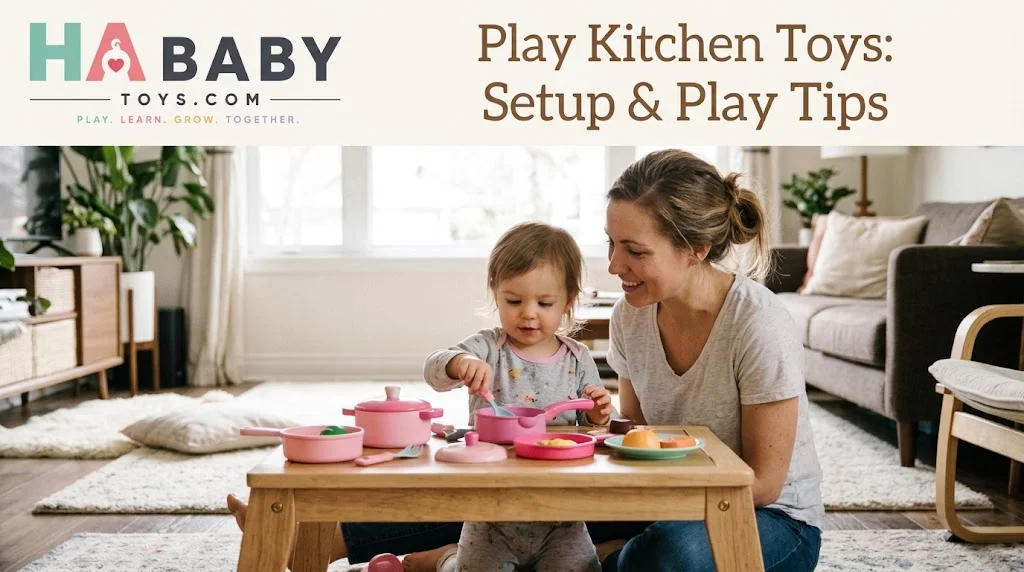
The set works well with the five setup styles above. A compact shelf becomes the cooking zone. A small basket holds the play food in the preparation zone. The plates and cups create a serving zone. And because the accessories are easy to handle and easy to organize, cleanup becomes part of the routine rather than a chore. The images throughout this guide show real examples of safe placement and guided playtime using a set like this one.
Before ordering, review the product page to confirm the included pieces and check the manufacturer’s age guidance. If you have questions about shipping, materials, or care instructions, the common questions about HA’BABY page addresses them. And if you want to compare this set with other options, you can explore the HA’BABY collection to see the full range.
Ready to create a little pretend kitchen at home?
Explore the HA’BABY Kids Kitchen Toys Set and discover whether its accessories and features match your child’s play interests.
Explore the Kids Kitchen Toys SetFrequently Asked Questions
Choose a clean, supervised corner with enough room for your child to move. Create a small kitchen area using a low shelf, toy table, or designated floor space. Arrange cookware, utensils, play food, and serving items by purpose. Add simple visual touches like a pretend menu or clear storage containers. Keep the setup simple and adjust it as your child’s play evolves.
Useful accessories include pots, pans, spoons, spatulas, play food, plates, and cups. A balanced variety supports more play scenarios than many duplicates of the same item. If you are building a set from scratch, prioritize cookware, utensils, and play food first, then add serving items. For a detailed breakdown, see our kitchen toy set pieces and features guide.
Introduce new pretend-play scenarios, rotate accessories, and try different games. A small change in context — like turning the kitchen into a restaurant or a food shop — can renew engagement without requiring new toys. Ask open-ended questions and let your child invent their own recipes. For more game ideas, see the pretend cooking games section above.
Popular games include the Little Chef Challenge, Restaurant Owner Game, Family Dinner Game, Mini Food Shop, Guess the Kitchen Accessory, and What’s on Today’s Menu. Each game uses the same core accessories but introduces a different role or scenario. These games build language, social skills, and sequencing while keeping play fresh.
Group accessories by category: utensils in one container, pots and pans in another, play food grouped by type, and plates and cups stored together. Use clear bins or a low shelf so children can access items independently. A consistent storage routine helps children learn to tidy up after play and reduces the chance of pieces getting lost.
Yes. A play kitchen does not require a dedicated room. A single low shelf, a small toy table, or a designated patch of floor can serve as the foundation. Keep the accessory count manageable and use compact storage. The Small-Space Kitchen setup idea above is designed specifically for apartments and shared rooms.
Consider the variety of accessories, ease of handling, material details, age recommendations, and storage requirements. Read the product listing carefully to confirm the included pieces. Judge value by how many play scenarios the set supports rather than the total piece count. For additional guidance, visit the HA’BABY FAQ page or explore the HA’BABY collection.
Conclusion: A Small Setup That Makes a Big Difference
A play kitchen does not need to be elaborate to be engaging. A clean corner, a simple organization system, and a few go-to games are often enough to turn a neglected toy into a daily favorite. The setup ideas in this guide are designed to be adjusted, not followed rigidly. Start with one idea, see how your child responds, and build from there.
If you are looking for a set that supports this kind of play out of the box, the HA’BABY Kids Kitchen Toys Set brings together cookware, utensils, play food, and serving items in one package. Review the product details, check the age guidance, and consider how the set fits into your home. And if you want to explore the broader range of HA’BABY toys, the full collection is available to browse.
2 Responses