
Baby Play Gym Mat: Tummy Time & Early Development
Your baby spends most of the day lying down. You want to encourage active play, but you are unsure how to start tummy time or which play mat to buy. Discover how a Baby Play Gym Mat can give your little one a better space to explore, move, and grow.
Expertly reviewed by the HA’BABY Child Development Team. We combine pediatric play insights with practical product guidance to help you make informed decisions.
Table of Contents
- 1. Quick Answer: What Is a Baby Play Gym Mat?
- 2. What Is a Baby Play Gym Mat and How Does It Work?
- 3. Why Is Tummy Time Important for Babies?
- 4. How Can a Baby Play Gym Mat Support Early Development?
- 5. 10 Baby Play Gym Mat Activities Parents Can Try
- 6. Baby Tummy Time Timeline: What Progress Can Parents Expect?
- 7. What If Your Baby Does Not Like Tummy Time?
- 8. Baby Play Gym Mat vs. Ordinary Play Mat
- 9. How to Use a Baby Play Gym Mat Step by Step
- 10. Common Baby Play Gym Mat Mistakes Parents Should Avoid
- 11. Who Should Consider Buying a Baby Play Gym Mat?
- 12. Doctor-Informed Guidance: Safe Tummy Time and Infant Play
- 13. How to Choose the Best Baby Play Gym Mat: Complete Buyer Guide
- 14. HA’BABY Baby Play Gym Mat — Product Guide and Recommendation
- 15. Bundle Strategy: Build a Practical Baby Play Environment
- 16. Quick Tips for Better Baby Playtime
- 17. Frequently Asked Questions
- 18. Conclusion — Make Everyday Playtime Count
A baby play gym mat is a padded play surface, often paired with an overhead frame and hanging toys, that gives infants a dedicated area for supervised play. Depending on its design, it can encourage visual exploration, reaching, kicking, and age-appropriate tummy-time activities while providing parents with an organized play space.
What Is a Baby Play Gym Mat and How Does It Work?
A baby play gym mat is a padded play surface designed to give infants a dedicated area for supervised play. It typically consists of a floor mat and may include an overhead frame with hanging toys, visual patterns, and sensory accessories. Some designs also feature removable or adjustable components.
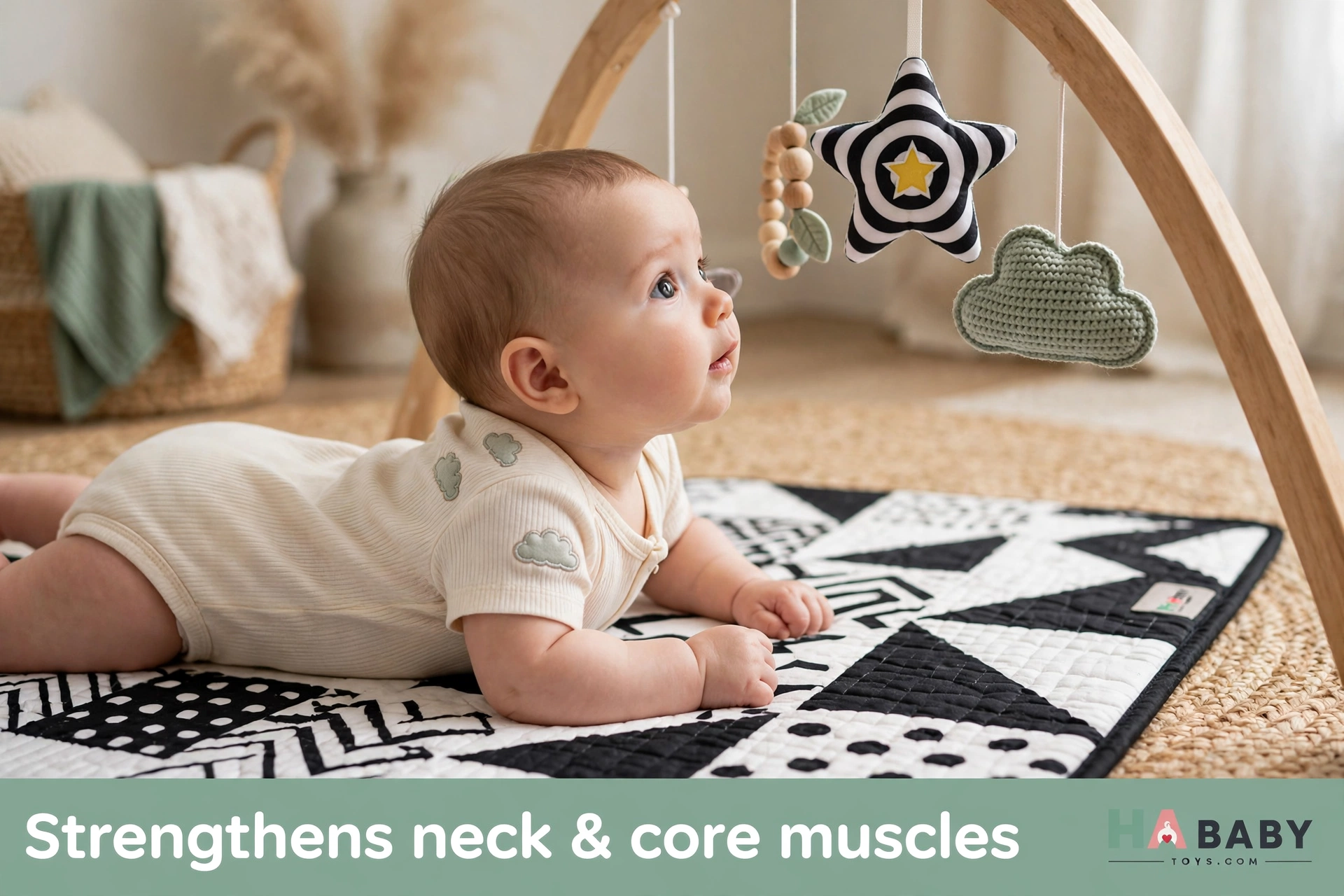
How does it work? Parents position the baby on the mat for supervised play. The hanging toys and visual patterns provide something interesting to look at, which can encourage the baby to move their arms, reach, and kick. The mat itself provides a comfortable, designated space for floor play and tummy time.
Buyer insight: A larger number of hanging toys does not automatically make a gym better. Stability, safe construction, age suitability, easy cleaning, and practical design matter more than accessory count. For more information on how these mats support development, you can read about the baby play gym mat tummy-time guide.
Why Is Tummy Time Important for Babies?
Tummy time means supervised time on the stomach while the baby is awake. It is not a sleeping position. The AAP’s guidance on Back to Sleep, Tummy to Play explains the difference between back-to-sleep and tummy-to-play.
Why do babies need tummy time? It provides opportunities to practise lifting and turning the head. Babies use their shoulders, arms, back, and neck during this position. Changing body position gives babies different views of their surroundings. Short, manageable sessions can be a useful starting point.
The CDC’s 2-month milestones highlight early developmental skills, and the AAP’s tummy time activities provide practical suggestions. Tummy time supports early movement skills, but it does not promise that a baby will crawl or walk by a particular date.
How Can a Baby Play Gym Mat Support Early Development?
A baby play gym mat can support early development in several ways.
Visual Exploration
Babies look at colours, patterns, faces, and nearby objects. Hanging toys may provide something interesting to look at when positioned appropriately.
Reaching and Hand Movement
An appropriately positioned toy can invite a baby to move an arm or reach toward an object when developmentally ready. The CDC’s 4-month milestones describe developmental progression in this area.
Kicking and Body Movement
Babies can move their legs and explore their bodies during supervised play. This free movement is important for physical development.
Listening and Interaction
Parents can speak, sing, or gently move an appropriate toy to invite attention and interaction. The NAEYC’s resources on play emphasize the importance of parent-child interaction.
Tummy-Time Practice
The mat can provide a designated play area for supervised tummy time, provided its surface and setup are suitable.
Parent-Baby Bonding
Eye contact, talking, smiling, and responding to the baby’s cues make play meaningful. This bonding is the most valuable part of the experience.
Avoid claims such as “boosts brain power” or “guarantees faster crawling.” The mat provides opportunities to practise and explore; it does not guarantee specific outcomes.
10 Baby Play Gym Mat Activities Parents Can Try
Here are ten practical activities to try with your baby.
1. Face-to-Face Tummy Time
Setup: Get down at the baby’s eye level.
Instructions: Talk gently and make eye contact.
Parent tip: Stop if the baby becomes distressed.
2. Toy-at-Eye-Level Activity
Setup: Position an appropriate toy where the baby can comfortably see it.
Instructions: Let the baby look at the toy.
Parent tip: Change the toy if the baby loses interest.
3. Gentle Visual Tracking
Setup: Hold an interesting object within the baby’s comfortable field of view.
Instructions: Slowly move the object from side to side.
Parent tip: Follow the baby’s gaze; do not force tracking.
4. Reach and Explore
Setup: When the baby is ready, place an appropriate toy within easy reach.
Instructions: Encourage the baby to reach for the toy.
Parent tip: Celebrate any attempt, not just success.
5. Back-Lying Kick Time
Setup: Place the baby on their back on the mat.
Instructions: Allow the baby to move their legs freely while awake and supervised.
Parent tip: This is a good alternative if the baby dislikes tummy time.
6. Mirror Exploration
Setup: Use a securely designed baby-safe mirror if the play gym includes one.
Instructions: Let the baby look at their reflection.
Parent tip: Talk about what the baby sees.
7. Sound and Attention Game
Setup: Sit near the baby.
Instructions: Talk or sing softly and observe the baby’s response.
Parent tip: Pause and give the baby time to respond.
8. Texture Discovery
Setup: Let the baby explore safe, attached textures where the product is designed for that purpose.
Instructions: Gently guide the baby’s hand to the texture.
Parent tip: Only use textures that are securely attached.
9. Parent-and-Baby Play
Setup: Sit close to the baby.
Instructions: Use facial expressions, smiles, and gentle conversation.
Parent tip: This is the most important activity of all.
10. Short Tummy-Time Sessions
Setup: Place the baby on their tummy on the mat.
Instructions: Offer several manageable opportunities rather than insisting on one long session.
Parent tip: Stop when the baby becomes tired or distressed.
For more activity ideas, you can read about the newborn activity gym activities.
Baby Tummy Time Timeline: What Progress Can Parents Expect?
A baby’s development is not a recovery process, and there is no universal week-by-week timetable for every infant. Here is a flexible developmental guide.
| Stage | What parents can focus on |
|---|---|
| Newborn period | Brief, supervised tummy-time opportunities and face-to-face interaction |
| Around 1–2 months | Comfortable positioning, looking around, and practising head lifting |
| Around 3–4 months | More opportunities for reaching, head control, and upper-body movement |
| Around 5–6 months | Interactive floor play and exploring movement as the baby develops |
These are broad examples, not deadlines or promises. Babies develop at different rates, and prematurity or individual medical circumstances can affect expectations. The AAP’s tummy time guidance and the CDC’s 6-month milestones are useful references.
If parents are worried about their baby’s movement, head control, comfort, or development, they should discuss the concern with their pediatrician rather than trying to solve it by purchasing a toy.
What If Your Baby Does Not Like Tummy Time?
Some babies initially resist this position. Here is how to help.
- Start with brief sessions rather than forcing long periods.
- Try chest-to-chest tummy time while the adult is fully awake.
- Get down at the baby’s eye level.
- Use a familiar voice or an interesting toy.
- Try again at a different time when the baby is comfortable and alert.
- Stop when the baby shows signs of distress or tiredness.
A baby should never be left unattended in tummy time. If the baby consistently struggles, seems uncomfortable, or parents have concerns about movement or development, they should seek individualized advice from a healthcare professional. The NHS guidance on keeping babies active offers practical ideas.
Baby Play Gym Mat vs. Ordinary Play Mat: Which One Should Parents Choose?
Give buyers a clear comparison.
| Feature | Basic baby play mat | Baby play gym mat |
|---|---|---|
| Main purpose | Provides a floor-play surface | Combines a play surface with additional play features |
| Overhead toys | Usually not included | May include an overhead toy frame |
| Visual exploration | Depends on the mat’s design | May include hanging visual elements |
| Reaching opportunities | Depends on toys added separately | Hanging toys may provide reaching opportunities |
| Storage | Often simpler | May require removing or folding the frame |
| Cleaning | Depends on material | Mat and accessories may need separate care |
A basic mat may be sufficient for parents who already have suitable toys, while a play gym may be more convenient for families who want an organized play setup. The best choice is the one that meets the family’s practical needs and the manufacturer’s safety requirements—not necessarily the one with the most accessories.
How to Use a Baby Play Gym Mat Step by Step
Follow this straightforward guide for first-time parents.
- Read the instructions: Check the manufacturer’s assembly, age, and weight guidance.
- Choose the play area: Use a clear, level, stable floor away from stairs, heaters, cords, pets, and other hazards.
- Assemble correctly: Secure the frame and accessories according to the instructions.
- Inspect before use: Check attachments, seams, hanging toys, and any loose or damaged parts.
- Place the baby appropriately: Position the baby on the mat for awake, supervised play.
- Introduce one activity: Begin with talking, visual exploration, or a short tummy-time opportunity.
- Watch the baby’s cues: Change the activity or end play when the baby becomes tired or unsettled.
- Clean and store: Follow the manufacturer’s instructions for washing and storage.
The play gym must not be treated as a sleeping space. If the baby falls asleep, move them to a separate, firm, flat, approved sleep surface and place them on their back. The NIH’s Safe to Sleep resources provide essential guidance.
Common Baby Play Gym Mat Mistakes Parents Should Avoid
Avoid these common pitfalls.
- Using the mat as a baby bed: A play mat is not a safe sleep surface.
- Leaving the baby unattended: Tummy time and play gym activities require direct adult supervision.
- Expecting immediate tummy-time success: Babies may need gradual, positive experiences.
- Using too many toys at once: Too much visual or sound stimulation may make play less comfortable for some babies.
- Ignoring the manufacturer’s age guidance: Accessories may not be suitable for every stage.
- Failing to inspect attachments: Loose or damaged parts can create hazards.
- Ignoring the baby’s signals: Crying, turning away, or becoming tired can be signs to pause or change the activity.
- Assuming a play gym guarantees milestones: Development depends on many factors, not a single product.
For safety guidance, refer to the CPSC Toy Safety guidelines.
Who Should Consider Buying a Baby Play Gym Mat?
Potential buyers include:
- First-time parents setting up a play area.
- Parents looking for a dedicated space for supervised floor play.
- Families interested in hanging toys and interactive play.
- Parents who want a convenient place to introduce age-appropriate tummy-time activities.
- People shopping for a baby shower or newborn gift.
A play gym is not compulsory. A safe floor space, appropriate toys, and responsive interaction with caregivers can also provide valuable play opportunities. For more ideas on sensory play, you can read about the baby play mat for crawling and sensory play.
Doctor-Informed Guidance: Safe Tummy Time and Infant Play
Pediatric guidance supports the following principles.
- Tummy time should happen only when the baby is awake and closely supervised.
- Babies should be placed on their backs for every sleep.
- Start with manageable opportunities and increase gradually as appropriate.
- Use a firm, flat, safe play surface.
- Keep loose objects, cords, and unsuitable accessories away from the baby.
- Avoid forcing a baby into a position they cannot comfortably manage.
- Discuss developmental concerns with a pediatrician.
Medical disclaimer: This guide provides general educational information and does not replace individualized medical advice. The AAP’s safe-sleep guidance and the NIH’s Safe to Sleep resources are especially useful references.
How to Choose the Best Baby Play Gym Mat: Complete Buyer Guide
Explain what parents should inspect before placing an order.
| Buying factor | What to check |
|---|---|
| Age suitability | Manufacturer’s age recommendation |
| Mat surface | Construction, stability, and ease of cleaning |
| Frame | Stability and secure assembly |
| Hanging toys | Secure attachment and suitability for the baby’s age |
| Materials | Manufacturer’s material information and care instructions |
| Design | Practicality, visibility, and accessibility |
| Maintenance | Whether components can be cleaned separately |
| Storage | Folding, dismantling, and storage requirements |
| Product details | Dimensions, included accessories, and verified specifications |
Attractive colours and many accessories are not enough to establish product quality. Prioritize safety information, stable construction, practical cleaning, and age suitability before appearance or accessory count. To compare options, you can explore the HA’BABY baby toy collection.
HA’BABY Baby Play Gym Mat — Product Guide and Recommendation
If you are exploring baby activity gym mats, the HA’BABY Baby Play Gym Mat is a practical option for creating a dedicated play space.
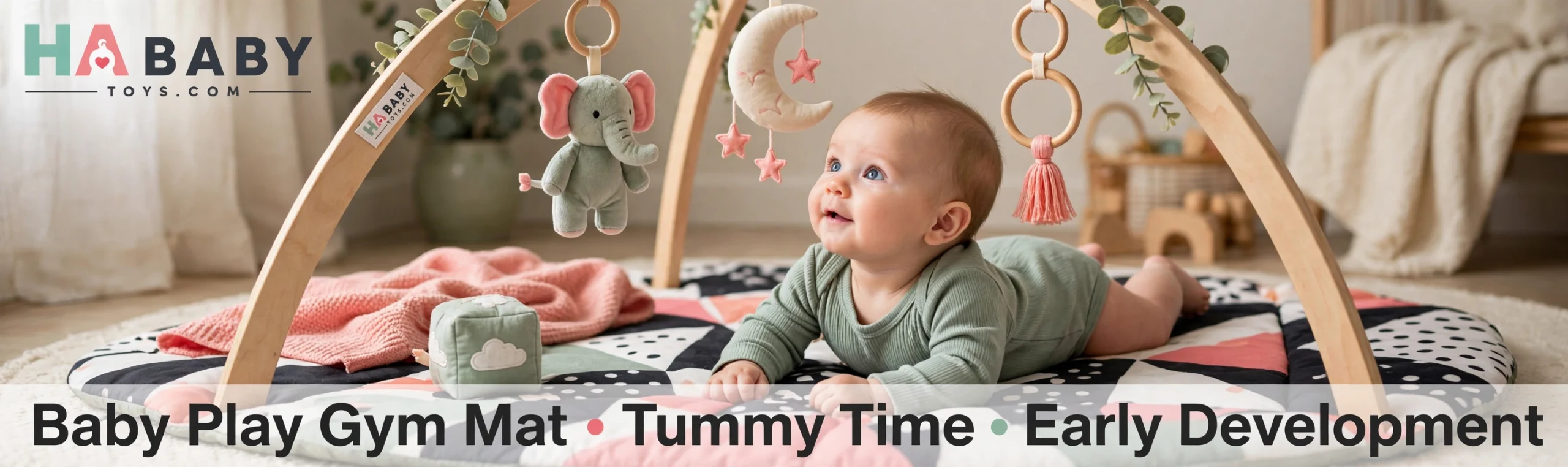
Parents can incorporate it into supervised play and tummy-time routines, provided the product’s design is suitable. It offers a comfortable, organized space for floor play and exploration.
What to check before ordering: Review the live product page for actual design, construction, included accessories, dimensions, and intended age range. If you have questions, visit the product and shopping questions page.
Note: Always verify the actual product features and safety details on the live listing before purchasing. Do not rely on marketing claims alone.
Explore the HA’BABY Baby Play Gym MatBundle Strategy: Build a Practical Baby Play Environment
Rather than pushing unnecessary accessories, explain how parents can create a useful play setup.
- A baby play gym mat as the main play area.
- A small number of age-appropriate toys, if not already included.
- A safe floor-play space.
- A simple cleaning and storage routine.
- Parent interaction through talking, singing, and face-to-face play.
If HA’BABY offers related products or bundles, introduce only products that are genuinely available and compatible. Do not suggest that parents need to buy multiple toys to support normal development. For more information, you can contact HA’BABY for product enquiries.
Quick Tips for Better Baby Playtime
- Choose a time when the baby is awake and comfortable.
- Keep tummy-time opportunities short at first.
- Get down to the baby’s eye level.
- Use one interesting toy at a time.
- Talk, smile, and interact during play.
- Follow the baby’s signals and pause when needed.
- Keep sleep and supervised play environments separate.
Baby Play Gym Anatomy
Padded Play Mat
Provides a comfortable, safe surface for floor play and tummy time.
Overhead Frame
Supports hanging toys and visual elements for exploration.
Hanging Toys
Encourage looking, reaching, and batting when positioned appropriately.
Visual Patterns
Provide interesting colours and designs for visual exploration.
Sensory Textures
Offer safe tactile experiences where included and securely attached.
Safe Play Area
Always keep the space clear, level, and supervised.
Frequently Asked Questions
What is a baby play gym mat used for?
A baby play gym mat is used to provide an organized area for supervised infant play. Depending on its design, it may offer hanging toys, visual patterns, textures, and opportunities for looking, reaching, and kicking.
When can I start using a baby play gym mat?
Parents should follow the manufacturer’s age recommendation and ensure the baby can use the product safely. Supervised play can begin during early infancy, but the product’s specific instructions take priority.
Does a baby play gym mat help with tummy time?
A suitable mat can provide a designated floor-play area for tummy time. The important factors are awake positioning, direct supervision, and a safe, appropriate surface. The mat itself does not guarantee developmental progress.
How long should a newborn do tummy time?
Parents can begin with short, manageable opportunities and increase gradually as the baby becomes comfortable. The AAP provides general guidance, but parents should discuss individual concerns or medical circumstances with their pediatrician.
What if my baby cries during tummy time?
Some babies initially dislike the position. Suggest short sessions, chest-to-chest play while the caregiver is fully awake, talking, and age-appropriate toys. Do not force the baby to continue when distressed.
Can my baby sleep on a play gym mat?
No. A play gym mat is not a substitute for a safe sleep surface. Babies should be placed on their backs for every sleep on a firm, flat, approved surface without loose bedding or toys.
What should I look for when buying a baby play gym mat?
Consider age suitability, stable construction, secure toy attachments, material information, cleaning instructions, and verified product specifications. Always inspect the product before use. You can also visit the product and shopping questions page for more information.
Conclusion — Make Everyday Playtime Count
Early play does not need to be complicated or expensive. A safe play area, short supervised tummy-time opportunities, suitable toys, and a parent’s attention can make everyday interactions meaningful.
Ready to create a dedicated play space for your baby? Explore the HA’BABY baby toy collection to compare options, or contact HA’BABY for product enquiries if you have specific questions. For more baby play and development guides, visit the HA’BABY blog.
Explore the HA’BABY Baby Play Gym Mat
2 Responses