
The safest way to use a baby accordion toy is simple: inspect it first, show your child where to hold the grips, demonstrate a slow push-and-pull movement, keep fingers away from the folding sections, supervise early play, and stop using the toy if any part becomes loose or damaged. That is the whole method in one sentence — the rest of this guide is the detail that makes it stick.
If you have just unboxed the toy and your toddler is already reaching for it, start with the 60-second checklist below. If you are still unsure what the toy actually is, read what a baby accordion toy is first, then come back here for the safe-use routine.
The 60-second safe start
- Inspect the toy for damage.
- Check the age guidance.
- Sit the child in a stable play position.
- Show where to hold it.
- Pull and push slowly.
- Keep fingers clear of folding sections.
- Use buttons gently.
- Keep sound at a comfortable level.
- Turn it off and store it after play.
The safe-use workflow in five moves — Check → Hold → Pull → Press → Store
Check
Look for damage or loose parts before every use.
Hold
Grip the intended handle areas only.
Pull
Open the accordion section slowly and smoothly.
Press
Use buttons gently, one at a time, if included.
Store
Turn it off and put it away safely.
↻ Repeat before every play session
Step 1: Inspect the toy before every use
This is the single most skipped step in the whole routine, and the one that prevents most accidents. A baby accordion toy has moving parts, a folding center, and often a battery compartment — three things that can degrade quietly over weeks of enthusiastic play.
Parents should check for:
- Cracks in the shell or grips
- Loose or wobbly buttons
- Torn accordion folds
- Sharp edges, especially along the fold seams
- Exposed wires on electronic models
- Loose decorative parts that could detach
- A damaged or loose battery cover
- Parts that no longer move smoothly
For the wider standards behind these checks, the U.S. Consumer Product Safety Commission’s toy safety guidance and Safe Kids Worldwide’s toy safety tips both explain what a well-made toy should and should not have. If you want to know what proper use looks like once the toy passes inspection, this guide on how to use a baby accordion toy safely is the companion piece.
Step 2: Follow the manufacturer’s age guidance
Do not assume a universal age. Baby and toddler toys can vary significantly in size, sound level, battery design, and moving parts, so the manufacturer’s stated age guidance matters more than the category label on the shelf.
Parents should check the following against their own child:
- Grip size — can your child actually hold the handles, or are they too wide?
- Small parts — any decorative pieces that could come off?
- Moving sections — is the fold action tight enough to pinch?
- Battery compartment — is it screwed shut, or just clipped?
- Sound intensity — is it comfortable at arm’s length?
For age-appropriate play expectations rather than product claims, the American Academy of Pediatrics’ toddler guidance on HealthyChildren.org and the CDC’s developmental milestones resource are both clear, non-commercial references.
Step 3: Start with seated play
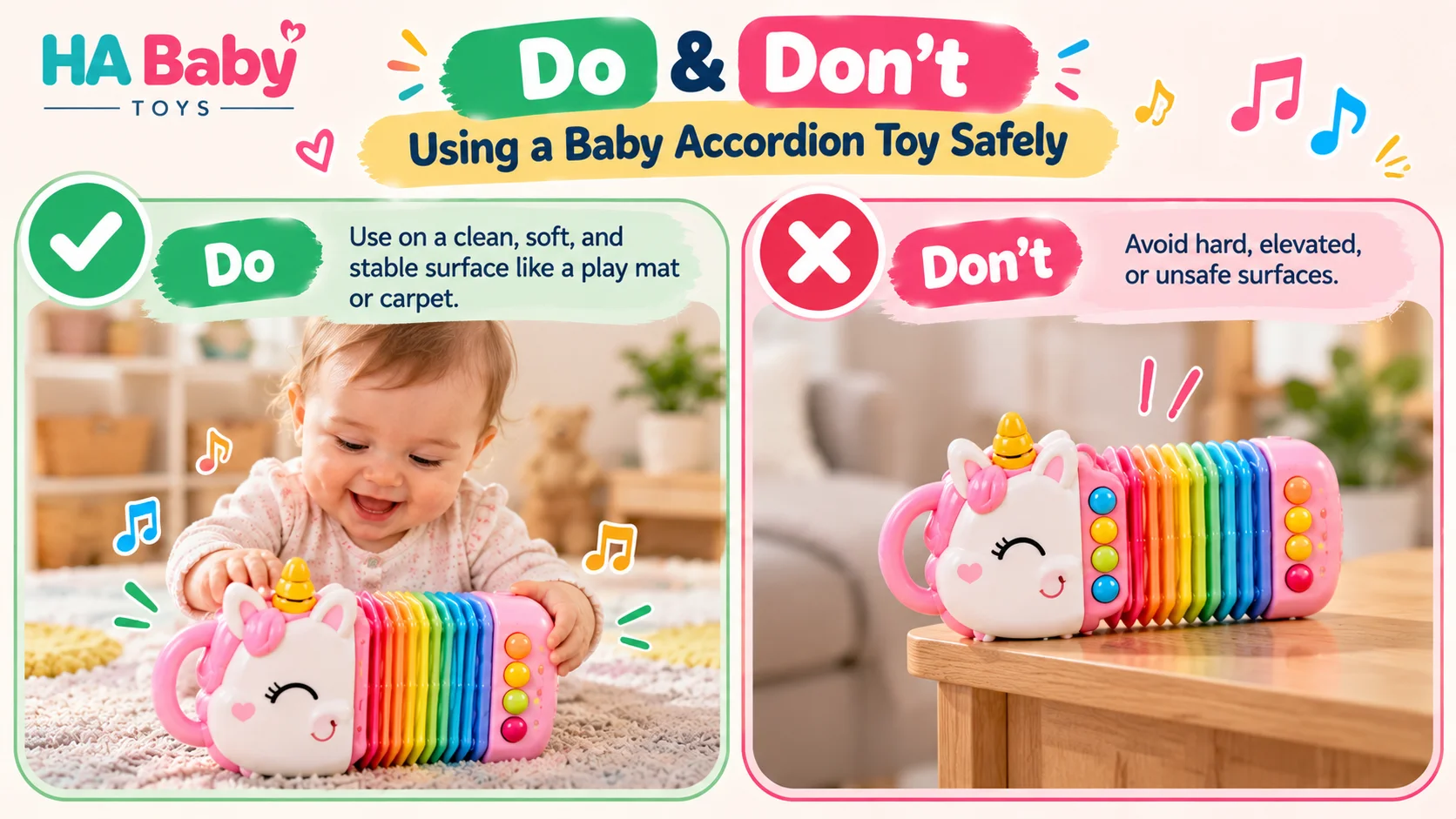
For first use, keep the child seated and the toy low. A floor mat, a parent’s lap, or a child-sized table all work. The point is not formality — it is that a seated child can focus on holding, pulling and pressing instead of balancing, walking, or climbing.
Standing play is not dangerous in itself, but it multiplies the risk: a child who pulls hard while walking backward is a child who falls onto the toy. Save standing play for later, once the movement is familiar and gentle.
Safe first-play position
Seated → toy centered → hands on grips → fingers clear
Step 4: Show the correct grip
Encourage the child to hold the main grip or handle areas rather than pinching or pulling the folding center. This one instruction reduces rough use more than any other.
Model it out loud, in three short phrases:
- Grip handles — both hands on the outside.
- Pull gently — slow and smooth.
- Stop, then push back — return the way it came.
Demonstrate it yourself first, then guide their hands into place. Toddlers copy far more reliably than they follow instructions, so your own slow pull is the real teaching tool.
Step 5: Teach slow push-and-pull movement
This is the heart of safe handling, and it is where most over-enthusiastic toddlers need redirecting. The toy is designed to stretch — but not to be stretched to its limit.
Recommend to yourself, and demonstrate to your child:
- Pull only until resistance increases
- Push back slowly
- Avoid jerking or yanking
- Avoid forcing the toy wider than intended
- Let the child copy the parent first
Pinch-point safety: the part parents underestimate
Folding or accordion-style sections may create areas where little fingers can get caught. This is not a defect — it is the nature of any bellows-style mechanism. The fix is positioning and supervision, not avoidance.
Tell children, and remind yourself:
- Keep fingers on the grips
- Avoid putting fingers between the folds
- Close the toy slowly
- Demonstrate where hands belong
Keep fingers clear
Green, amber and red zones
Step 6: Introduce buttons one at a time
If the toy includes buttons, resist the urge to demonstrate all of them at once. Frantic button pressing is the fastest route to a loud, chaotic session that ends in a lost toy or a startled child.
Instead:
- Show one button.
- Press it once.
- Pause and let the sound finish.
- Let the child try the same button.
The goal is not to stop exploration, but to make the first few minutes easy to understand. Once one button is familiar, add the next.
Step 7: Manage sound volume
If the toy produces music, check the following before you hand it over:
- Whether volume is adjustable
- Whether the speaker sits too close to the ear in normal play
- Whether the sound feels uncomfortable to you at arm’s length
- Whether the child becomes overstimulated or startled
Do not assume a volume control exists. Many simple musical toys have a single fixed volume, and some are louder than a parent expects. For general guidance on noise and young children’s hearing, the NHS hearing health information is a sensible reference point.
Do not hold the speaker against the ear
A musical toy should be used at normal play distance rather than pressed directly against the ear. This sounds obvious until you watch a toddler try to “listen closer.” Make it a house rule early and it stops being a battle later.
Step 8: Keep the toy away from water
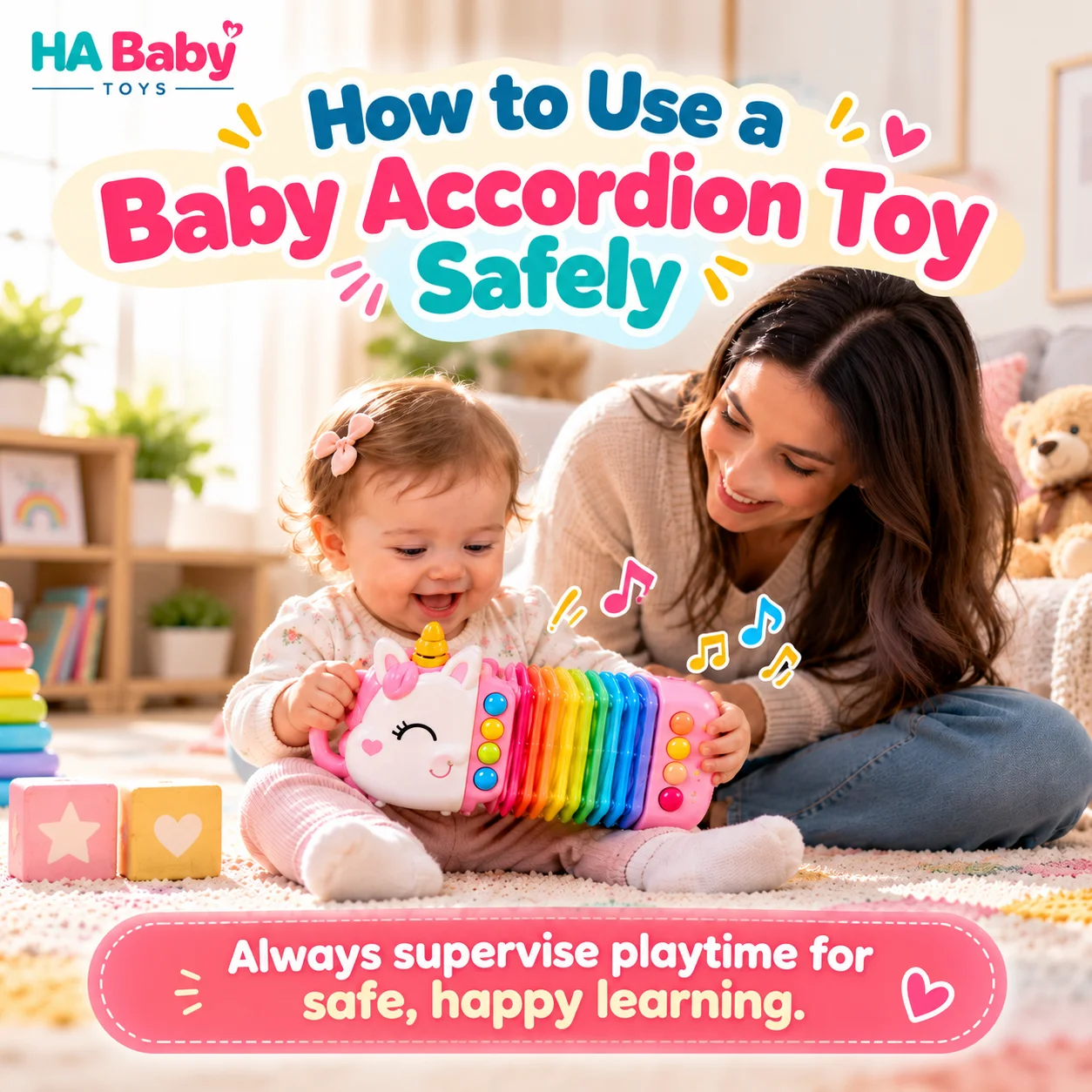
If the model is electronic, avoid the sink, the bath, wet hands, spills and outdoor rain. Musical toys and water are a poor combination unless the manufacturer explicitly says the toy is water-resistant.
A practical habit: the accordion toy lives in the living room or playroom, not the bathroom. If a child wants a bath toy, use a bath toy — not a battery-powered musical instrument.
Battery safety
This deserves its own attention because button batteries are a genuine hazard. Parents should:
- Use the correct battery type
- Secure the battery cover fully after every change
- Keep loose batteries away from children
- Replace leaking batteries immediately
- Remove batteries for long storage if the instructions say so
- Never let children open the compartment
For authoritative guidance on battery ingestion and safe storage, see the CPSC button battery safety center and Safe Kids Worldwide’s button battery tips. The Mayo Clinic’s child safety overview is also worth a two-minute skim.
Step 9: Use short, calm play sessions
There is no universal duration, and any guide that gives you a fixed number of minutes is guessing. Instead, use the child’s behaviour as the stop signal.
Stop when the child:
- Loses interest
- Starts pulling roughly
- Becomes frustrated
- Begins using the toy unsafely — standing on it, throwing it, or biting it
Short and calm beats long and chaotic every time. A five-minute session that ends well is more likely to be repeated tomorrow than a twenty-minute one that ends in tears.
The 5-minute first-use routine
For parents who want a script, here is a simple one. It works because it moves from inspection to imitation to independent play, without ever rushing.
Safe pretend concert play is easy to keep structured: the parent claps, the child presses a sound, the parent says “your turn,” the child performs, then you switch roles. It keeps musical play social, and it gives you a natural moment to redirect any rough pulling back into a gentle motion.
Can two children use it together?
Yes, but not simultaneously on the same toy. The best approach is one child using the toy while the other watches, claps, or dances — then switch. Avoid both children pulling the same accordion at once, because opposite forces on a folding section are exactly how fingers get caught.
If siblings genuinely want to play together, the “pretend band” setup works well: one child plays the accordion, another plays a drum or rattle, and they alternate. For more general play ideas and buyer context, see why choose a baby accordion toy.
What if something goes wrong? Quick troubleshooting
What if the child pulls too hard?
- Stop the toy movement.
- Show the normal range with your own hands.
- Demonstrate slower pulling.
- Resume only with gentle movement.
Do not encourage testing the maximum stretch, and do not pull back against the child — that turns the toy into a tug-of-war and increases the pinch risk.
What if the accordion section gets stuck?
- Stop pulling.
- Do not force it.
- Inspect for debris or damage.
- Follow the manufacturer’s guidance.
Do not dismantle the toy to fix it. A forced fold or a pried-open seam is how a repairable toy becomes a dangerous one.
What if the sound stops working?
- Check the power switch.
- Check battery orientation.
- Check the battery level.
- Check that the battery cover is seated correctly.
- Restart the toy if the instructions allow it.
If it still does not work, follow the manufacturer’s instructions. Do not open the casing.
What if a button gets stuck?
- Stop pressing hard.
- Turn the toy off.
- Check for visible debris.
- Do not pry with tools.
- Stop using it if the button remains jammed.
A jammed button that is forced will often crack the internal contact — and a cracked contact is a small-parts hazard. Treat a stuck button as a stop signal, not a challenge.
What if the toy is dropped?
- Turn it off.
- Inspect the shell.
- Check the folding section.
- Check the buttons.
- Check the battery cover.
- Resume only if undamaged.
Falls are the most common cause of hairline cracks in the grips, and hairline cracks are the most common cause of pinches. A thirty-second inspection after any drop is worth more than any warning label.
Cleaning and storing the toy
Cleaning
- Turn the toy off first.
- Wipe with a soft, slightly damp cloth.
- Keep water away from electronics and the battery compartment.
- Avoid soaking.
- Avoid harsh cleaners or solvents.
- Dry fully before storage.
Do not assume the toy is dishwasher-safe or bath-safe unless the manufacturer says so explicitly. A wipe-down is almost always enough.
Storage
- Close or relax the accordion section.
- Turn the toy off.
- Keep it dry.
- Avoid heavy objects on top of it.
- Store away from heat.
- Keep batteries secure.
A good rule: store it without leaving the accordion body under constant tension. A toy that lives stretched out will slowly lose its spring, and a slack fold is harder for a child to control.
Common mistakes to avoid — don’t do this
- Pulling as far as possible
- Closing it on fingers
- Pressing it against the ear
- Using it around water
- Letting two kids pull opposite sides
- Ignoring loose parts
- Leaving the battery cover unsecured
- Letting the child bite or chew it
- Continuing after damage
60-second safe-use checklist — before every session
- Toy is undamaged
- Battery cover is secure
- Child is seated or stable
- Hands stay on the grips
- Fingers stay out of the folds
- Pulling stays gentle
- Sound level is comfortable
- No water nearby
- Stop if anything jams
- Turn off after play
Ready to put this into practice? Explore the HA Baby Toys Baby Accordion Toy, browse the 3+ Years category for age-appropriate options, or visit the HA Baby Toys shop to compare musical toys side by side.
Safe-use FAQ
Tap any question to expand the answer. These are the questions parents actually ask after the first play session.
How do you use a baby accordion toy safely?
Inspect it first, check the age guidance, seat the child in a stable position, show them the grips, demonstrate a slow pull-and-push, keep fingers clear of the folding sections, use buttons gently, keep sound comfortable, and store it turned off. The full five-step workflow — check, hold, pull, press, store — is the short version.
Can children pinch their fingers in the accordion folds?
Folding sections can create pinch points, so yes, it is possible if fingers are placed between the folds while the toy closes. Keep hands on the grips, close the toy slowly, and never let a child close it with fingers inside. If a finger is caught, stop and open the toy slowly.
How hard should kids pull the toy?
Pull only until you feel resistance, then stop and push back slowly. Smooth movement is better than maximum movement. Avoid jerking, yanking, or forcing the toy wider than intended — that wears the folds and increases the pinch risk.
Can two children pull it together?
Not at the same time on the same toy. Have one child use it while the other watches, claps, or dances, then switch. Opposite forces on a folding section are a direct pinch risk.
Should the toy be held near the ear?
No. A musical toy should be used at normal play distance rather than pressed directly against the ear. If the toy has a fixed volume that feels loud at arm’s length, that is a sign to use it less, not closer.
Can it get wet?
Assume no unless the manufacturer explicitly says the toy is water-resistant. Keep it out of the bath, the sink, wet hands, spills and rain. For cleaning, wipe with a soft, slightly damp cloth and dry fully.
What should I do if the accordion section gets stuck?
Stop pulling, do not force it, inspect for debris or damage, and follow the manufacturer’s guidance. Do not dismantle the toy to free it — a forced fold is how a safe toy becomes a dangerous one.
What if a sound button stops working?
Check the power switch, battery orientation, battery level, and that the battery cover is seated correctly. Restart the toy if the instructions allow it. If it still does not work, follow the manufacturer’s instructions rather than opening the casing.
What should I do if the toy is dropped?
Turn it off, then inspect the shell, the folding section, the buttons, and the battery cover. Resume play only if it is undamaged. Hairline cracks in the grips are the most common result of a drop and the most common cause of pinches later.
How do I clean a baby accordion toy?
Turn it off, wipe with a soft, slightly damp cloth, keep water away from electronics and the battery compartment, avoid soaking, avoid harsh cleaners, and dry fully before storage. Do not assume it is dishwasher-safe.
How should it be stored?
Close or relax the accordion section, turn the toy off, keep it dry, avoid heavy objects on top, store away from heat, and keep batteries secure. Do not leave the accordion body under constant tension between sessions.
Does it need batteries?
It depends on the model. Baby accordion toys can be mechanical, battery-powered, or sound-button based. Check the power source, battery type, battery compartment, and whether batteries are included before buying.
What should parents check before play?
Cracks, loose buttons, torn folds, sharp edges, exposed wires, loose decorative parts, a damaged battery cover, and any part that no longer moves smoothly. If anything looks damaged, stop using the toy instead of letting the child continue pulling or pressing it.
What age is appropriate?
There is no single universal age. Suitability depends on the individual product, its recommended age, warnings and instructions. Check the manufacturer’s stated age guidance and your child’s own grip strength and play style. Browse the 3+ Years category for age-appropriate options.
Where can I buy the HA Baby Toys Baby Accordion Toy?
You can buy it directly from the HA Baby Toys Baby Accordion Toy product page. For more parent guides, browse the HA Baby Toys blog, and for common order and safety questions, check the HA Baby Toys FAQ. Retailers and larger-volume buyers can request a quote.
The short version
Safe use of a baby accordion toy comes down to four habits: inspect before play, keep hands on the grips and out of the folds, pull slowly and stop at resistance, and turn it off and store it properly afterwards. Everything else in this guide is detail on those four habits.
If you are still deciding whether the toy is right for your child in the first place, the buying case is covered separately in why choose a baby accordion toy. To see the full range, visit HA Baby Toys or browse the HA Baby Toys blog for more parent guides written in this same plain-English style.
About this guide: Written for parents, guardians and gift buyers supervising early play with an accordion-style musical toy. Product-specific details such as volume control, battery type and sound-linked movement vary by model — always confirm them on the individual product page and follow the manufacturer’s instructions. Safety guidance here is general in nature and does not replace manufacturer instructions or adult supervision.
One Response