
A baby accordion toy combines sound, movement and pretend musical play in one compact toy. Unlike a basic rattle, or a toy that only plays music automatically, an accordion-style toy may ask the child to hold, pull, push, press and listen — making it feel more interactive while still being far simpler than a real musical instrument. This guide explains, in plain terms, why that difference matters to a buyer.
If you are new to the category entirely, start with what a baby accordion toy is and return here for the buying decision.
Why parents may choose a baby accordion toy
- Combines movement and music
- More interactive than a passive sound toy
- Can work as a first instrument-themed toy
- Encourages simple pretend performance
- Easy to use in parent-child play
- Supports repeated pull, push and press actions
- Compact compared with larger musical toys
- Makes a colorful gift for music-loving kids
Best for: families looking for a simple musical toy that combines sound, hand movement and pretend instrument play — without the cost or complexity of a real instrument.
The play loop in five moves — Hold → Pull → Press → Hear → Perform
Hold
The child grips the toy in both hands.
Pull
The accordion-style body opens.
Press
Buttons or controls may trigger sounds.
Hear
The toy responds with music or sound.
Perform
The child pretends to play for a parent or sibling.
↻ Five actions, one toy — and a loop worth repeating
Benefit 1: It is more interactive than a basic sound toy
This is the clearest reason to choose one over a cheaper alternative. A passive musical toy usually asks for one action: press, then listen. That is fine for a baby, but a toddler outgrows it fast.
A baby accordion can involve a longer sequence:
Hold → Pull → Push → Press → Listen
The toy may offer more hand interaction than a simple button-only musical toy, and that extra step is what keeps a two- or three-year-old coming back to it. It is worth saying plainly: this is not a claim about development. It is a claim about engagement, which is what buyers actually care about.
For context on how age-appropriate play expectations shift at this stage, the American Academy of Pediatrics’ toddler guidance on HealthyChildren.org is a clear, non-commercial reference.
Benefit 2: It works as a first instrument-themed toy
A real accordion is expensive, heavy and difficult. A baby accordion toy is none of those things, but it still delivers the shape, the stance and the performance feeling that make instrument play appealing in the first place.
It can introduce:
- Instrument shape and how it is held
- Pretend performance
- Sound response to action
- Repeated, familiar music play
It can be a simple first introduction to instrument-themed play without requiring the complexity of a real accordion. That framing matters: it is a starting point, not a shortcut to musicianship. For a broader view of how music participation fits into early childhood, the National Association for the Education of Young Children (NAEYC) writes on music and play in a way that is honest and useful for buyers.
Baby accordion vs rattle
This is the most common comparison, because most households already own a rattle. Here is the honest side-by-side.
| Feature | Baby accordion toy | Rattle |
|---|---|---|
| Hand interaction | Pull, push, press | Shake |
| Musical theme | Strong | Low |
| Pretend instrument play | Yes | No |
| Complexity | Moderate | Very simple |
| Replay variety | Higher | Lower |
| Sound type | Music or sound effects possible | Rattle sound |
A rattle is still the better first sound toy for a baby under roughly nine months. The accordion becomes the better choice once the child can deliberately pull with one hand while holding with the other — usually somewhere in the toddler range. That developmental timing is worth checking against the CDC’s developmental milestones resource if you are unsure where your child sits.
Baby accordion vs toy piano
Baby accordion
- Handheld
- Push-pull movement
- Pretend accordion play
- More portable
Toy piano
- Key-based
- More stationary
- Often better for note-by-note pressing
- Suits sit-down play
Neither is universally better. Choose the accordion for movement, portability and performance play; choose the piano for seated note exploration.
Baby accordion vs toy drum
Accordion toy
- Pull and push interaction
- Buttons or music response
- More compact
- Quieter in motion
Toy drum
- Tapping
- Rhythm-heavy
- Larger movement
- Loud by design
The drum is a rhythm toy; the accordion is an instrument-shaped toy. If noise tolerance is a factor in your home, the accordion usually wins.
Quick decision
Which musical toy fits your child?
Benefit 3: It combines sound with physical interaction
Children may grip, pull, push, press and release — and then hear or feel a response. That combination can make the toy feel more participatory than simply listening to a melody that plays on its own.
This is also why the toy tends to hold attention in short bursts rather than long stretches. It asks something of the child. That is a feature, not a flaw: a five-minute interaction where the child is doing something beats a twenty-minute background melody where they are not.
Benefit 4: It can support cause-and-effect play
If buttons or movements trigger sounds, the toy offers a clear action-and-response loop. Examples include pressing a button and hearing a sound, pulling the toy and feeling movement, or pushing it and seeing a visual change.
The toy may provide opportunities for simple cause-and-effect play when an action produces an immediate response. That is a modest, accurate description — and it is exactly the kind of loop toddlers find satisfying. For wider context on how caregivers and young children interact around play, ZERO TO THREE’s resource on play and early development is a trustworthy starting point.
Benefit 5: Pretend performance adds replay value
A sound toy that only plays music has one use. A toy that a child can perform with has many. Children can perform for parents, pretend to join a band, stage a small “concert,” play along with songs, or use the toy as a prop in stories.
This is the benefit buyers underrate most. Replay value is not a feature listed on the box — it is the difference between a toy that gets used for a week and one that comes back out for a year.
Play ideas
One toy, many music games
Benefit 6: It makes parent-child play easy
Some toys need a rulebook. This one needs a five-step routine, and it can be repeated in under five minutes:
- Parent demonstrates one pull.
- Child copies.
- Parent presses a button.
- Child tries.
- Both clap or dance.
Low setup, repeatable, no instructions required. For a busy parent, that is the whole selling point.
Benefit 7: It can be used for sibling play
With two children, the toy works best in turns rather than in tandem. One child plays while the other dances; then switch roles. A pretend band works well, as does a copy-the-sound game.
Benefit 8: It suits short play sessions
This is a practical benefit for busy households. The toy is well suited to a five-minute music break, a quick pretend concert, a short dance game, a pre-dinner activity, or a parent-child play window. There is no need to prescribe exact session lengths — the toy works in whatever gap you have.
Benefit 9: Colorful character design adds appeal
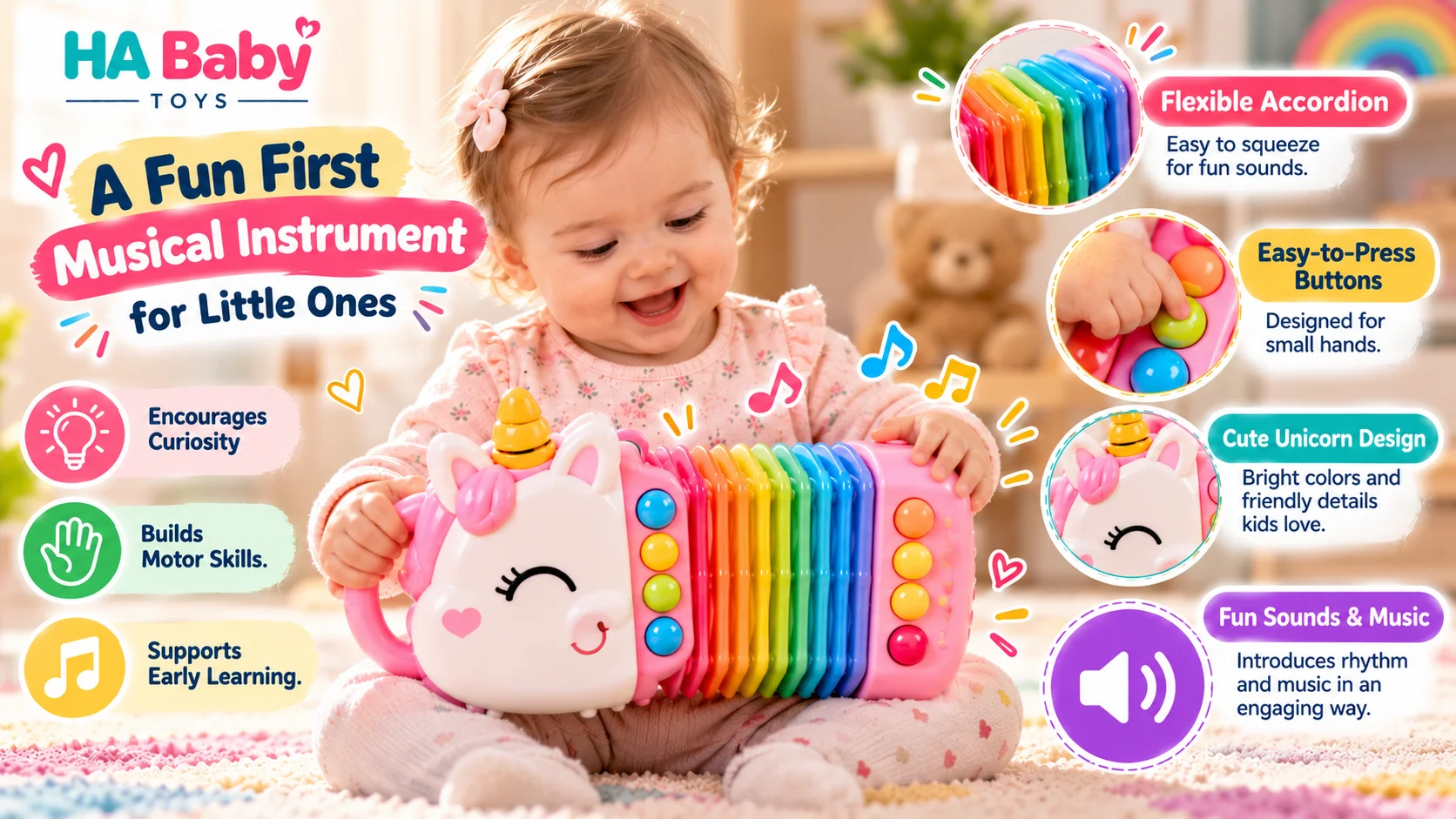
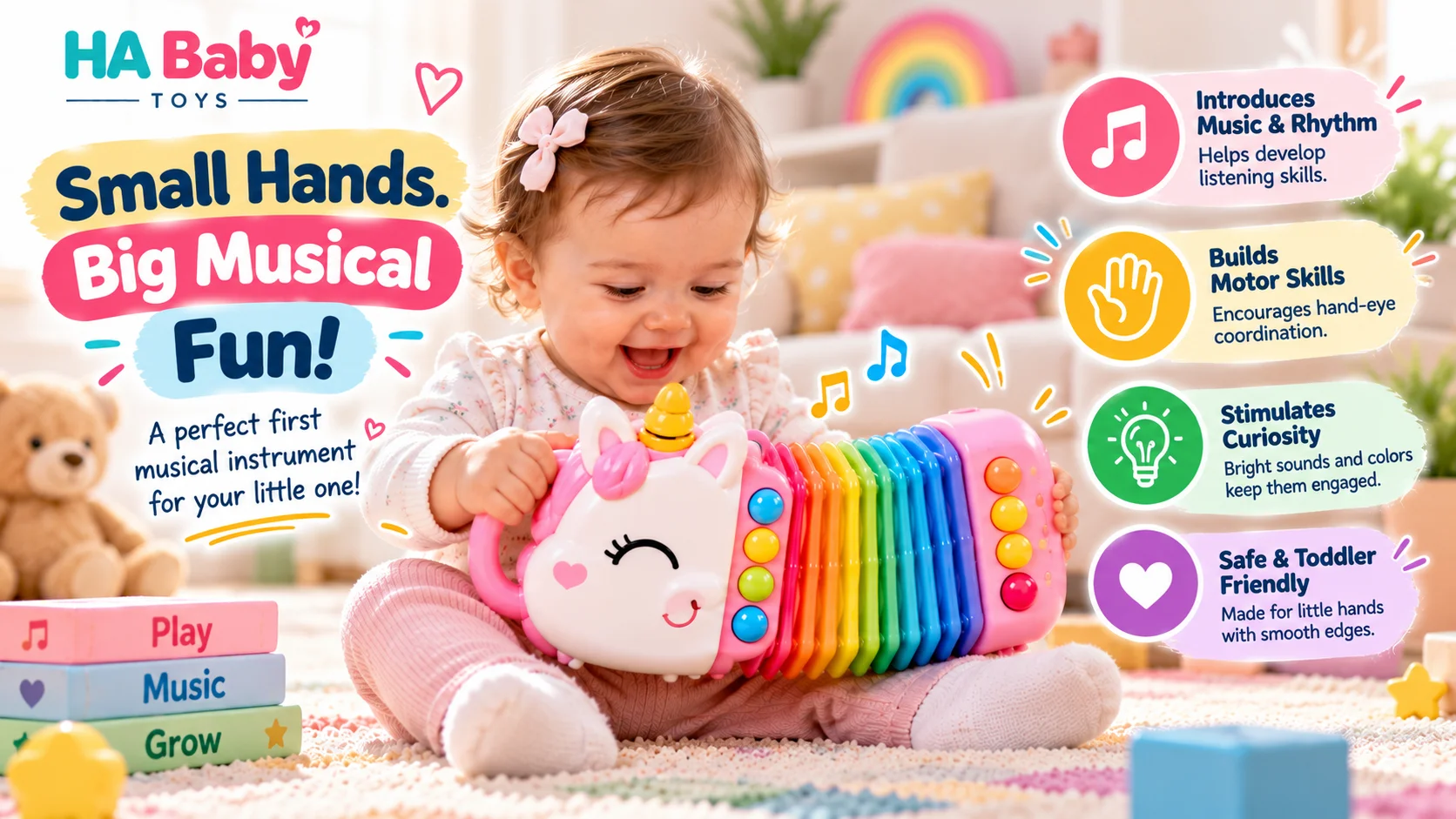
If the model has unicorn styling, that is not just decoration. It adds visual interest, strengthens gift appeal, works well for fantasy-themed play, and makes the instrument feel less formal and more like a character. A unicorn musical toy is often the version a child picks off the shelf themselves — and a toy the child chooses is a toy the child uses.
Benefit 10: It is gift-friendly
Possible occasions include birthdays, holidays, a first musical toy gift, a toddler gift, or a music-themed present. It may appeal most to children who already enjoy sound, buttons, colorful toys, or pretend musical play — which is a useful filter if you are buying for someone else’s child and cannot observe them directly.
If you are shopping by age rather than by toy type, the HA Baby Toys 3+ Years category is the fastest route to appropriate options.
Is it a sensory music toy? Is it really Montessori?
Two questions buyers ask, and both deserve a straight answer rather than a marketing one.
Is it a sensory music toy?
Possibly. Because it combines tactile movement and sound, some families may view it as a sensory-style music toy. Possible sensory elements include sound, movement, color, texture and repetition. What it should not be is a therapeutic claim — “sensory-style” describes the input, not a medical outcome.
Is it really Montessori?
A musical toy should not automatically be labeled Montessori just because it is simple or hands-on. That description is most appropriate when the toy and the play approach genuinely align with Montessori principles. If a listing uses the word with no explanation of how the design follows those principles, treat it as a label rather than a guarantee.
Can it encourage musical interest? Can it support hand coordination practice?
Careful wording matters here, so here is the careful version.
It can expose children to instrument-themed play and sound-making, which may make music feel familiar and fun. That is the accurate claim. “Builds musical intelligence,” “makes children smarter” and “develops perfect rhythm” are not claims this toy can support, and any listing that makes them should be treated with suspicion.
On coordination: the toy may involve gripping, pulling, pushing and button pressing. These actions can provide opportunities for repeated hand coordination during play. That is a description of what the toy asks for, not a promise of skill gains.
Who is this toy best for?
Who might prefer something else?
Another toy may be better if:
- You want a silent toy
- You prefer no batteries
- You want a real beginner instrument
- Your child dislikes musical sounds
- You want outdoor active play
- The manufacturer’s age guidance does not fit
Saying this plainly is not a weakness in the article — it is how you avoid a return and how you earn a buyer’s trust. Balanced content converts better than hype.
Safety is part of the buying decision
Before you compare features, compare the safety basics. Parents should check the manufacturer’s age guidance, grip size, the moving accordion section, possible pinch points, the battery cover, the sound level, any loose parts, and the general condition of the product.
For toy-safety standards and what a well-made toy should have, the U.S. Consumer Product Safety Commission’s toy safety guidance is authoritative, and Safe Kids Worldwide’s toy safety tips are a good plain-language companion. The Mayo Clinic’s child safety overview and Nemours KidsHealth’s toy safety page are both worth two minutes before checkout.
Before first use, read how to use a baby accordion toy safely — it covers grip, pull range, pinch prevention, sound and battery handling in the order you will actually need them.
What the toy cannot do
A baby accordion toy:
- Does not replace real music lessons
- Does not guarantee musical development
- Does not automatically qualify as Montessori
- Is not suitable for every age
- Should not be overstretched
- Should not be used if damaged
What it can offer:
- Music-themed play
- Sound interaction
- Push-pull movement
- Pretend performance
- Parent-child activity
Common buyer expectations vs reality
Tap each expectation to see the honest version.
Expectation: “It teaches children to play accordion.”
It is a toy inspired by an accordion, not formal instruction. It teaches the shape, the stance and the performance feeling — not technique.
Expectation: “Montessori means better.”
The label only matters if the toy truly fits Montessori principles. A simple, hands-on toy is not automatically Montessori, and a Montessori label is not automatically better for your child.
Expectation: “More sound means more learning.”
Music mainly adds entertainment unless the play is intentionally structured. The learning, such as it is, comes from the interaction — pulling, pressing, taking turns — not from the volume.
Expectation: “Baby toy means safe for every baby.”
Manufacturer age guidance still matters. A toy suitable for a three-year-old may have small parts, a moving fold, or a sound level that is not appropriate for a younger child.
60-second buyer checklist — choose the accordion toy if…
- Your child enjoys music
- You want a first instrument-themed toy
- You like push-pull interaction
- You want parent-child music play
- Pretend performance sounds fun
- You understand it is not a real accordion
- The sound setup suits your home
- The manufacturer’s age guidance fits
If that matches what you are looking for, explore the HA Baby Toys Baby Accordion Toy. To compare it with the wider range first, visit the HA Baby Toys shop or learn more about HA Baby Toys.
Buyer FAQ
Tap any question to expand the answer.
Why choose a baby accordion toy?
Because it combines sound, movement and pretend musical play in one compact toy. Unlike a rattle or a passive sound toy, it asks the child to hold, pull, push, press and listen — which tends to hold attention longer and gives more replay value.
Is a baby accordion a good first musical toy?
It can be a simple first introduction to instrument-themed play, especially for children who enjoy pressing, squeezing and listening to sounds. It is not a substitute for a real instrument and should not be presented as formal music education.
Is it better than a rattle?
For a toddler, usually yes — more interaction, more replay variety, and a stronger instrument theme. For a baby under roughly nine months, a rattle is still the better first sound toy because it is simpler and safer for that stage.
How is it different from a toy piano?
The accordion is handheld, uses push-pull movement, and suits performance play and portability. A toy piano is key-based, more stationary, and better for note-by-note pressing. Neither is universally better — they suit different play styles.
Can toddlers use it for pretend music?
Yes. Pretend performance is one of its strongest uses: performing for a parent, joining a pretend band, staging a small concert, or using the toy as a prop in stories. That is where most of the replay value comes from.
Is it a sensory music toy?
It may be described as a sensory-style music toy because it combines touch, movement and sound. That describes the input, not a therapeutic outcome. Avoid any listing that promises sensory or developmental gains from the toy alone.
Is a baby accordion toy Montessori?
Not automatically. A musical toy should not be labeled Montessori just because it is simple or hands-on. The description is appropriate only when the toy and the play approach genuinely align with Montessori principles.
Can siblings play with it?
Yes, in turns. One child plays while the other dances or claps, then they switch. Do not let both children pull the same accordion at once — opposite forces on a folding section are a pinch risk.
Does it help children learn music?
It can expose children to instrument-themed play and sound-making, which may make music feel familiar and fun. It does not provide formal music education, and it does not guarantee musical development.
Does it need batteries?
It depends on the model. Baby accordion toys can be mechanical, battery-powered, or sound-button based. Check the power source, the battery type, and whether the battery compartment is secured before buying.
Is it suitable for quiet play?
A musical toy is not automatically a quiet toy. Check whether the volume is comfortable and whether sound can be adjusted or switched off. Do not assume a volume control exists unless the listing says so.
What should parents check before buying one?
The manufacturer’s age guidance, grip size, the moving accordion section, possible pinch points, the battery cover, the sound level, any loose parts, and the general condition of the product. Before first use, read how to use a baby accordion toy safely.
Can it be a good birthday gift?
It is a colorful, self-explanatory musical toy that works well as a gift, provided the manufacturer’s age guidance fits the child. If you are unsure, buying from the 3+ Years category keeps you in age-appropriate territory.
What age is it suitable for?
There is no single universal age. Suitability depends on the individual product, its recommended age, warnings and instructions. Always check the manufacturer’s age guidance rather than assuming the category is universal.
Where can I buy the HA Baby Toys Baby Accordion Toy?
You can buy it directly from the HA Baby Toys Baby Accordion Toy product page. For more parent guides, browse the HA Baby Toys blog, and for common order and safety questions, check the HA Baby Toys FAQ. Retailers and larger-volume buyers can request a quote.
The short version for buyers
Choose a baby accordion toy if you want a first musical toy that asks for more than a single press — something a toddler can hold, pull, press and perform with. Skip it if you want a silent toy, a no-battery toy, or a real beginner instrument. It is not a replacement for music lessons and it is not automatically Montessori, but as an engaging, portable, gift-friendly first instrument-themed toy, it earns its place in the toy box.
If you are still weighing the category itself, the detail on what a baby accordion toy is pairs well with this guide. And if you have already decided, the HA Baby Toys Baby Accordion Toy is the direct next step. For more guides written in this same plain-English style, browse the HA Baby Toys blog.
About this guide: Written for parents, guardians and gift buyers comparing first musical toys. Product-specific details such as volume control, battery type and sound-linked movement vary by model — always confirm them on the individual product page and follow the manufacturer’s instructions. Safety guidance here is general in nature and does not replace manufacturer instructions or adult supervision.