
Kids Montessori Knives: Safe Food Prep & Learning Through Play
Children often want to do what adults do, especially when food is being prepared in the kitchen. But for parents, one question comes first: how can children participate without being exposed to unnecessary risks?
Expertly reviewed by the HA’BABY Child Development Team. We combine practical kitchen safety insights with a focus on age-appropriate, hands-on learning.
Table of Contents
- 1. Hero — Help Children Explore Food Preparation with Confidence
- 2. What Are Kids Montessori Knives?
- 3. Why Parents Introduce Children to Food Preparation
- 4. How to Choose the Right Montessori Knife for Your Child
- 5. Kids Montessori Knives vs. Ordinary Kitchen Knives
- 6. What Can Children Learn from Montessori Knife Activities?
- 7. Step-by-Step Guide to Introducing a Child to Food Preparation
- 8. Seven Easy Food-Preparation Activities for Children
- 9. Common Mistakes Parents Should Avoid
- 10. Who Should Use Kids Montessori Knives?
- 11. When Should Parents Introduce Child-Friendly Kitchen Tools?
- 12. HA’BABY Kids Cooking Knives — Product Guide
- 13. Food Hygiene and Kitchen Safety — What Parents Must Know
- 14. Frequently Asked Questions
- 15. Conclusion — Make Kitchen Learning Safe, Practical, and Enjoyable
Kids Montessori knives are child-oriented kitchen tools designed to introduce children to supervised food-preparation activities. Depending on the product, they may be intended for pretend play or selected real foods. Parents should check the manufacturer’s instructions, choose age-appropriate tools, and supervise children throughout every cutting activity.
Hero — Help Children Explore Food Preparation with Confidence
Children often want to do what adults do, especially when food is being prepared in the kitchen. They may want to cut a banana, prepare fruit for a snack, or help make a sandwich. But for parents, one question comes first: how can children participate without being exposed to unnecessary risks?
This is where Kids Montessori Knives come into the conversation. They are child-oriented tools designed to introduce children to practical food-preparation activities under adult supervision. When you explore HA’BABY educational toys, you will find options that support this kind of guided, hands-on learning.
This guide will help you understand the different types of child-friendly knives, how to choose the right one, and how to introduce food preparation safely. We will also look at practical activities, common mistakes, and food hygiene. If you want to explore related practical-life skills, you can read about wooden toy kitchen knives and practical-life skills. Let’s help children explore food preparation with confidence.
What Are Kids Montessori Knives?
When parents search for “Montessori knives,” they are generally looking for child-oriented cutting tools that allow children to participate in food preparation. These tools differ from ordinary kitchen knives in several important ways: handle size, grip, blade design, and intended use.
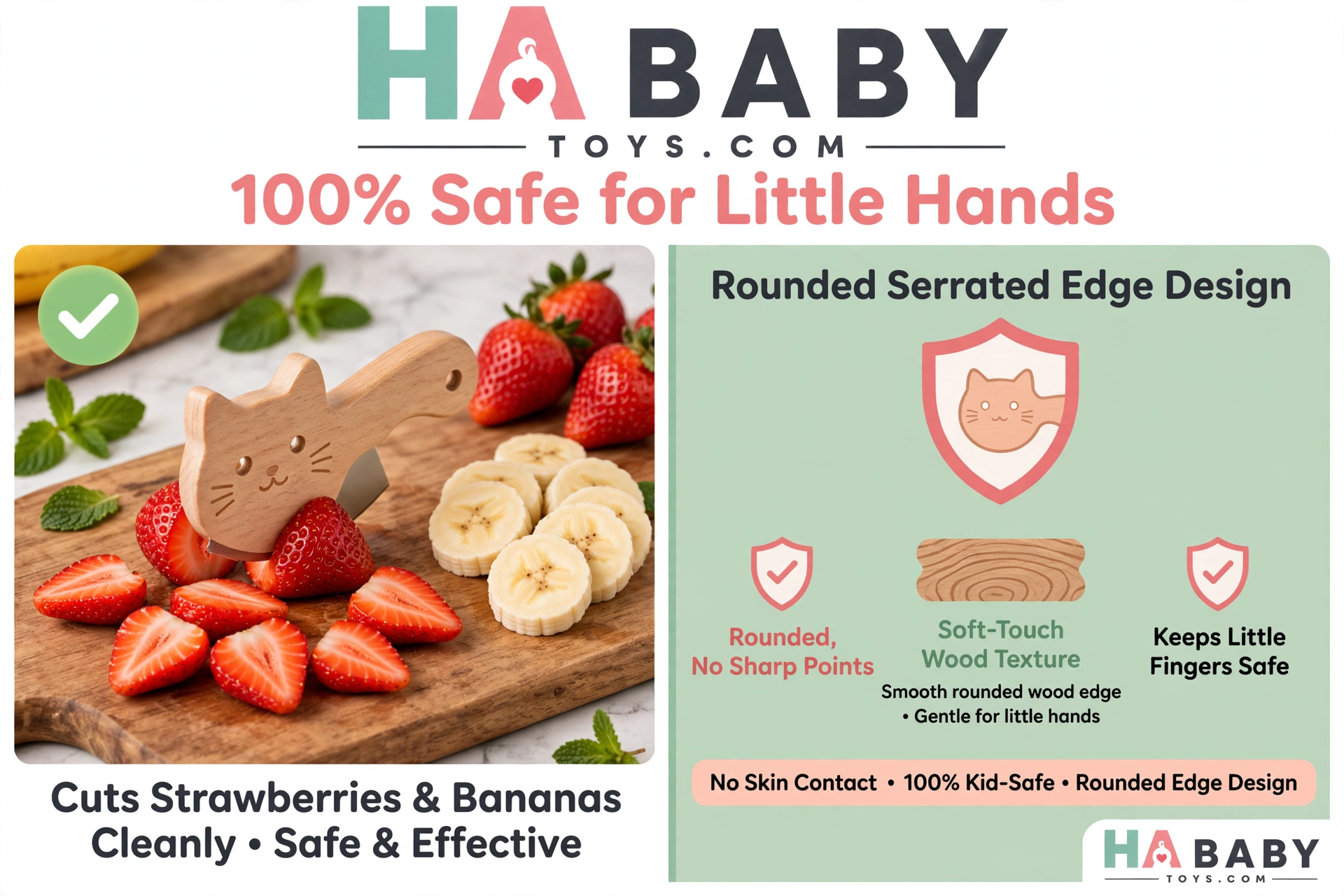
It is crucial to understand the difference between pretend kitchen play and actual food preparation. A toy knife used with pretend food is not automatically suitable for cutting real food. Likewise, a child-friendly food-preparation knife should never be described as completely risk-free.
| Tool type | Intended use | Important consideration |
|---|---|---|
| Pretend toy knife | Cutting pretend food | Not automatically suitable for real food |
| Blunt food-preparation knife | Selected soft foods, depending on design | Adult supervision is still necessary |
| Crinkle cutter | Cutting suitable soft foods into shapes | Check grip and cutting instructions |
| Standard kitchen knife | More advanced food preparation | Requires appropriate skills and close supervision |
The word “Montessori” alone does not establish safety, quality, or suitability. Parents should inspect the actual construction and manufacturer’s guidance. For a broader look at how these tools fit into everyday learning, you can explore the Montessori knife safety and food preparation guide.
Why Parents Introduce Children to Food Preparation
There are several practical reasons why parents introduce children to food preparation.
Fine Motor Practice
Holding food, gripping a suitable utensil, and performing controlled movements can give children opportunities to practise hand movements. The Alberta Health Services guidance on learning to use utensils explains how these skills develop gradually.
Hand-Eye Coordination
Children learn to look at the food and coordinate their movements while completing a task. This coordination is essential for everyday activities.
Independence
Simple food preparation can help children participate in everyday routines rather than always watching adults do everything. This builds confidence and a sense of contribution.
Following Instructions
Preparing a snack involves remembering steps, listening, and completing tasks in order. These are valuable cognitive and social skills.
Food Familiarity
Washing, touching, arranging, and preparing different foods can help children become more familiar with ingredients. This can reduce picky eating and encourage a positive relationship with food.
Parent-Child Interaction
Preparing a simple snack together creates opportunities for conversation and shared activity. The University of Illinois Extension’s guidance on children in the kitchen emphasizes matching tasks to children’s abilities.
How to Choose the Right Montessori Knife for Your Child
This is a high-value buyer-guide section. Parents searching for these products often need help deciding what to purchase.
Intended Use
Is the product designed for pretend play, cutting soft foods, or another specific purpose? Never assume these uses are interchangeable.
Blade Design
Parents should inspect the actual blade edge, tip, material, and manufacturer’s instructions. Avoid assuming that a blunt-looking blade cannot cause injury. The Penn State Extension’s guidance on using knives safely is a useful reference.
Handle Grip
Look for a handle that the child can hold comfortably and control without excessive force. A tool that is difficult to grip may reduce control.
Product Size
A tool should be appropriate for the child’s hands and the intended task.
Material and Construction
Discuss durability, cleaning instructions, food-contact suitability, and whether any parts could loosen or break. Do not claim a material is food-safe unless the manufacturer confirms it.
Cleaning and Maintenance
Tools used with food need appropriate cleaning and drying. Follow the manufacturer’s instructions.
Age and Supervision Guidance
Look for clear manufacturer recommendations. Age labels are useful, but the child’s actual abilities also matter.
Buyer checklist: Intended use is clearly stated. Product specifications are available. Handle is suitable for the child’s grip. Manufacturer provides cleaning instructions. Age guidance and warnings are clear. Adult supervision requirements are understood.
Kids Montessori Knives vs. Ordinary Kitchen Knives
Parents should not treat all cutting tools as equivalent.
| Comparison | Child-oriented food-preparation tool | Standard kitchen knife |
|---|---|---|
| Design | May be designed for specific child activities | Designed for general food preparation |
| Grip | May have a child-oriented handle | Usually designed for adult hands |
| Cutting ability | Depends on the specific product | Varies by knife type |
| Food suitability | Depends on manufacturer instructions | Depends on knife and food |
| Supervision | Required according to age, ability, and tool | Children require close supervision |
| Learning purpose | Introduces selected food-preparation tasks | Used for more advanced preparation |
A child-oriented knife is not automatically safe for every child or every food. The appropriate tool depends on the child’s coordination, understanding of instructions, and the specific task. The Alberta Health Services guidance on learning to use utensils explains how children gradually learn utensil skills and how adults can introduce suitable tools.
What Can Children Learn from Montessori Knife Activities?
The learning opportunities are practical and varied.
- Grip and control: Holding an appropriately sized tool.
- Coordination: Using both hands for different parts of a task.
- Sequencing: Following simple preparation steps.
- Observation: Noticing differences in food texture and shape.
- Responsibility: Helping clean and organize the workspace.
- Communication: Asking for help and following instructions.
Consider these real-life examples: washing a banana before preparation, placing fruit on a stable cutting surface, using a suitable tool under direct adult guidance, arranging prepared pieces on a plate, and helping clean the work area.
Do not make claims that every activity will produce the same developmental result. Children develop skills at different rates. A useful external reference is the Cwm Taf Morgannwg University Health Board’s guidance on learning to use cutlery, which discusses practice, demonstration, and the coordination involved in utensil use.
Step-by-Step Guide to Introducing a Child to Food Preparation
This section is practical enough for parents to follow.
- Begin with observation: Let the child watch an adult wash and prepare ingredients. Explain what each utensil does.
- Introduce simple kitchen responsibilities: Start with tasks such as washing produce, tearing lettuce, mixing ingredients, or arranging food.
- Explain the safety rules: Show the child where to stand or sit, how to wait for instructions, and why tools should never be handled casually.
- Choose an appropriate tool: Use only a tool specifically intended for the activity and appropriate to the child’s abilities. Read the instructions first.
- Choose suitable food: Start with food that the manufacturer identifies as appropriate for the tool. Do not assume a tool can cut hard vegetables or every type of fruit.
- Demonstrate before inviting participation: Show the child the task and explain what the adult is doing.
- Stay close and supervise: Maintain direct adult supervision throughout the activity. Stop if the child becomes distracted, frustrated, or unable to control the tool.
- Finish with cleaning: Show children how to wash hands, clean the work surface, and store the utensil safely.
The University of Nevada Cooperative Extension’s cooking guidance for young children recommends close supervision, appropriate tools, simple instructions, and patience.
Seven Easy Food-Preparation Activities for Children
Here are seven practical activities to try together.
Activity 1: Wash and Identify Fruits
Let children wash suitable fruits and identify their colors, shapes, and textures. No cutting is necessary. Learning opportunity: Observation and food familiarity.
Activity 2: Mash Soft Foods
Use a fork or suitable masher to mash soft foods such as bananas. This offers a simple opportunity to practise controlled hand movements. Learning opportunity: Fine motor control.
Activity 3: Prepare Soft Fruit
With an appropriate food-preparation tool and direct adult supervision, introduce a suitable soft fruit if the tool’s instructions allow it. Learning opportunity: Guided practical activity.
Activity 4: Make a Simple Fruit Bowl
Children can arrange prepared fruit pieces and help mix ingredients. Learning opportunity: Arrangement and mixing.
Activity 5: Prepare a Sandwich
Let children spread a suitable soft filling with an appropriate spreader and arrange prepared ingredients. Learning opportunity: Spreading and sequencing.
Activity 6: Build a Vegetable Salad
Children can add pre-prepared vegetables, count pieces, and mix ingredients. Learning opportunity: Counting and mixing.
Activity 7: Clean and Organize
Invite children to help wipe the table, return safe utensils, and put away ingredients with adult assistance. Learning opportunity: Responsibility and organization.
Common Mistakes Parents Should Avoid
This section targets parents who are uncertain about introducing cutting tools.
- Buying a knife only because it says Montessori: Check its actual purpose, design, and instructions.
- Assuming blunt means risk-free: Even blunt or child-oriented tools can cause injuries if misused.
- Starting with difficult foods: Hard or slippery foods may be unsuitable for a beginner or a particular tool.
- Leaving children alone: Do not leave a child unattended while using a cutting tool.
- Choosing the wrong handle size: A tool that is difficult to grip may reduce control.
- Rushing the learning process: Let children practise simpler kitchen tasks first.
- Ignoring hygiene: Clean hands, food, utensils, and surfaces are essential.
- Using pretend-play knives for real food: Only use tools for the purpose stated by their manufacturer.
Who Should Use Kids Montessori Knives?
Different groups may benefit from age-appropriate kitchen activities.
- Families who want children to participate in everyday food preparation.
- Parents interested in Montessori-inspired practical-life activities.
- Preschool teachers planning supervised food-related activities.
- Caregivers introducing children to basic kitchen responsibilities.
- Gift buyers looking for educational kitchen-related products.
Suitability is individual. Consider the child’s ability to follow instructions, control their movements, and understand basic safety rules. Children who are not ready to use a cutting tool can still participate. Washing produce, mixing, mashing, arranging ingredients, and tearing suitable foods are useful alternatives.
When Should Parents Introduce Child-Friendly Kitchen Tools?
Instead of giving one universal age, consider readiness.
- Ability to follow simple instructions.
- Ability to sit or stand in a stable position.
- Ability to use both hands together.
- Ability to remain focused on a short task.
- Understanding that kitchen tools are not toys to wave around.
- Need for adult supervision.
A gradual introduction to kitchen participation:
- Observation and simple tasks: Washing fruit, tearing leaves, and mixing ingredients.
- Guided practical activities: Mashing soft foods, spreading, and arranging ingredients.
- Supervised use of an appropriate cutting tool: Only when the child’s ability, the food, and the manufacturer’s instructions make the task suitable.
- Gradually more complex tasks: Introduced only as the child’s skills and safety awareness develop.
The University of Illinois Extension age-based kitchen guide is useful for supporting this discussion. It emphasizes that children’s tasks should match their age and skill level.
HA’BABY Kids Cooking Knives — Product Guide
If you are looking for child-oriented kitchen tools to introduce your child to supervised food preparation, the HA’BABY Kids Cooking Knives are a practical option. They are designed to support hands-on, practical-life activities in the kitchen.
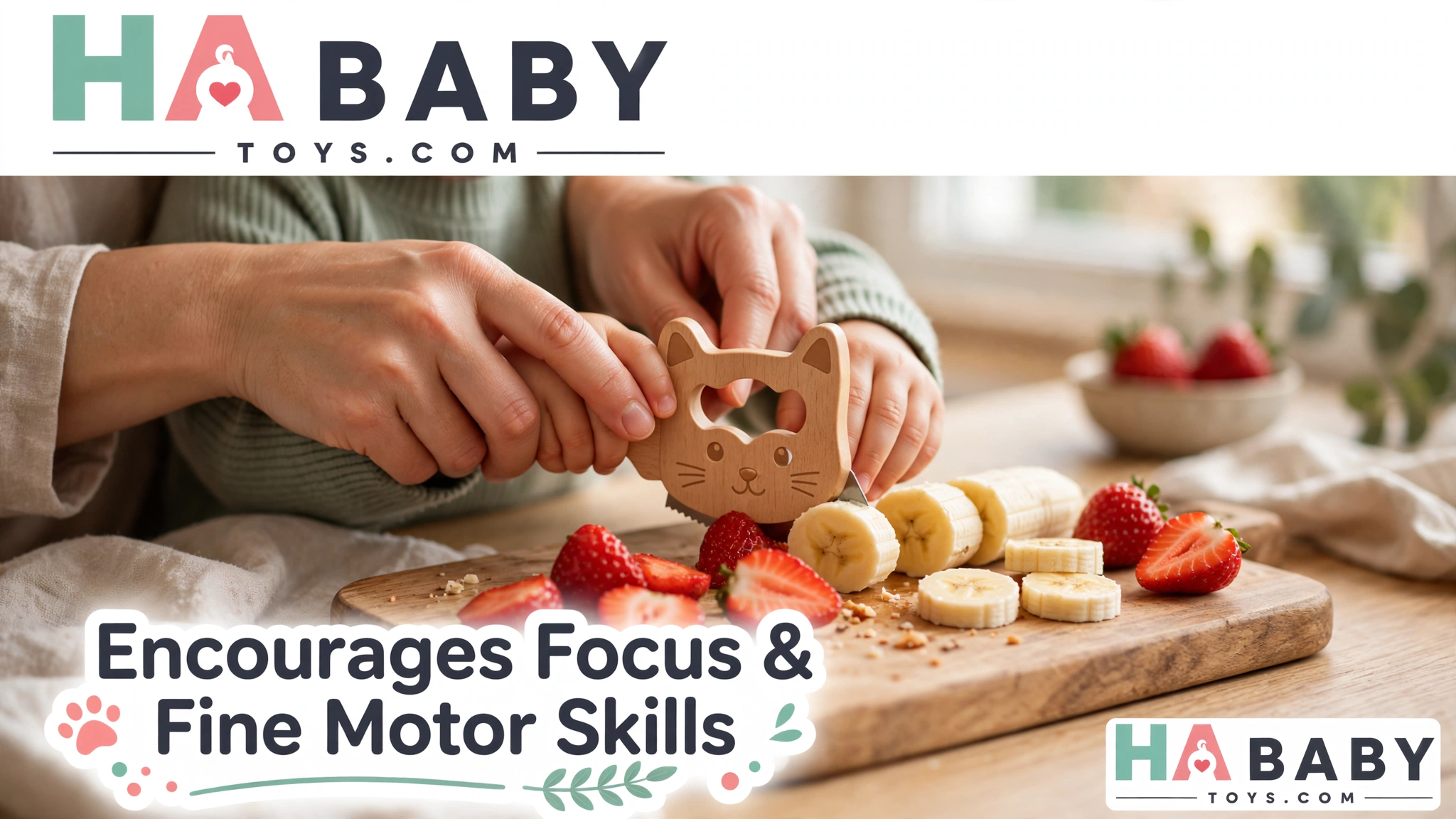
This product fits naturally into the gradual introduction process described above: observation, simple tasks, guided activities, and eventually supervised cutting.
What to check before ordering: Review the product page for actual product details, intended use, age guidance, and cleaning instructions. If you have questions, visit the HA’BABY product information page.
Note: Always verify the actual product features and safety details on the live listing before purchasing. Confirm whether the listing is for pretend-play tools, real food-preparation tools, or a combination.
Explore the HA’BABY Kids Cooking KnivesFood Hygiene and Kitchen Safety — What Parents Must Know
Food safety and tool safety are separate responsibilities. A child can use an appropriate tool and still be exposed to food hygiene risks if the workspace is not clean.
- Wash hands before and after food preparation.
- Wash fruits and vegetables thoroughly.
- Keep food-preparation surfaces clean.
- Separate raw meat and ready-to-eat foods.
- Store sharp utensils out of children’s reach.
- Supervise children throughout cutting activities.
- Use stable cutting surfaces.
- Follow the manufacturer’s cleaning instructions.
- Avoid damaged or loose utensils.
Useful references include the Rutgers Cooperative Extension — Kids in the Kitchen, the New South Wales Government — Involving Kids in the Kitchen, and the University of Illinois Extension — Kids in the Kitchen.
The Five Steps of Safe Food Preparation
1. Wash Hands
Clean hands before and after handling food.
2. Wash Produce
Rinse fruits and vegetables thoroughly.
3. Prepare Workspace
Use a stable, clean cutting surface.
4. Supervised Activity
Stay close and guide the child throughout.
5. Clean Up
Wash utensils, wipe surfaces, and store safely.
Frequently Asked Questions
What are Montessori knives for kids?
Montessori knives for kids are child-oriented kitchen or food-preparation tools intended to introduce children to practical activities. Their intended use varies by product, so parents should check whether a particular knife is designed for pretend play or actual food preparation.
Are Montessori knives safe for toddlers?
No cutting tool is completely risk-free. Suitability depends on the child’s abilities, the tool’s design, its intended use, and adult supervision. Parents should follow manufacturer age guidance and consider starting with non-cutting kitchen tasks.
At what age can children start using child-friendly kitchen knives?
There is no single age that applies to every child and every tool. Some children can participate in simple food preparation at a young age, but cutting tasks should be introduced according to ability, the tool’s instructions, and close adult supervision.
Can kids Montessori knives cut real fruits and vegetables?
Some child-oriented food-preparation knives are designed for selected foods, while pretend-play knives are not. Check the manufacturer’s instructions before using any product with real food. Never assume a toy knife can cut fruit or vegetables.
What foods should children start preparing?
Begin with simple activities such as washing fruit, mashing bananas, spreading soft ingredients, and arranging prepared food. If introducing cutting, choose only foods specifically suitable for the tool and the child’s current ability.
Do Montessori knives help develop fine motor skills?
Food-preparation activities can give children opportunities to practise gripping, controlled hand movements, and coordinating both hands. Results vary by child, and a knife is not the only way to practise these skills.
How do I choose the best kids’ Montessori knife?
Check the intended use, blade design, handle grip, construction, cleaning instructions, age guidance, and safety warnings. Choose a product that matches the child’s abilities rather than relying on marketing terms alone. You can also visit the HA’BABY product information page for more details.
Conclusion — Make Kitchen Learning Safe, Practical, and Enjoyable
Children can learn valuable everyday skills by participating in food preparation, but the process should be gradual and supervised. Start with simple tasks, choose suitable tools, follow product instructions, maintain food hygiene, and allow children to learn at their own pace.
Ready to introduce your child to more engaging kitchen activities? Explore educational toys to compare options, or contact HA’BABY for product enquiries if you have specific questions. For more educational play ideas, visit the HA’BABY blog.
Explore the HA’BABY Kids Cooking Knives
One Response