
Wooden Toy Kitchen Knives: Build Everyday Life Skills Through Play
Children notice more about everyday life than adults sometimes realize. They watch parents prepare meals, arrange ingredients, and serve food. Wooden toy kitchen knives can help bring those pretend cooking experiences to life.
Expertly reviewed by the HA’BABY Child Development Team. We combine pretend-play insights with a focus on age-appropriate, hands-on learning.
Table of Contents
- 1. Hero — Small Pretend Kitchen Activities, Meaningful Everyday Learning
- 2. What Are Wooden Toy Kitchen Knives?
- 3. Why Children Love Pretend Cooking
- 4. Seven Everyday Life Skills Children Can Explore Through Pretend Kitchen Play
- 5. Wooden Toy Kitchen Knives and Montessori-Inspired Learning
- 6. Wooden Toy Kitchen Knives vs. Plastic and Other Pretend Kitchen Accessories
- 7. Eight Pretend Kitchen Games for Children
- 8. How Parents Can Encourage Independent Pretend Play
- 9. Common Mistakes Parents Should Avoid
- 10. How to Choose Quality Wooden Toy Kitchen Knives
- 11. Who Can Enjoy Wooden Toy Kitchen Knives?
- 12. HA’BABY Kids Cooking Knives — A Pretend Kitchen Play Option
- 13. Toy Safety and Care for Wooden Kitchen Accessories
- 14. Frequently Asked Questions
- 15. Conclusion — Turn Everyday Routines into Imaginative Learning
Wooden toy kitchen knives are pretend-play accessories that let children recreate everyday food-preparation routines in a play environment. Through imaginative cooking, children can practise communication, organization, cooperation, creativity, and simple hand movements while exploring familiar household activities with age-appropriate toys and adult guidance.
Hero — Small Pretend Kitchen Activities, Meaningful Everyday Learning
Children notice more about everyday life than adults sometimes realize. They watch parents prepare meals, arrange ingredients, cut fruit, and serve food. Naturally, they often want to recreate these familiar moments through play. Wooden Toy Kitchen Knives can help bring those pretend cooking experiences to life.
Unlike real food preparation, which requires careful supervision and specific tools, pretend kitchen play offers a safe, imaginative space for children to explore everyday routines. When you explore HA’BABY pretend-play toys, you will find options that support this kind of creative, hands-on learning.
This guide focuses on the pretend-play side of kitchen activities: how children imitate adults, how pretend cooking supports everyday life skills, and how parents can encourage independent play. If you are looking for guidance on real food preparation and safety, you can read about choosing appropriate kitchen tools for children. Let’s turn everyday routines into imaginative learning.
What Are Wooden Toy Kitchen Knives?
Wooden toy kitchen knives are pretend-play accessories designed for use in toy kitchens and imaginative food-preparation games. They allow children to mimic the actions they see adults perform, such as slicing pretend vegetables, arranging ingredients, and serving imaginary meals.
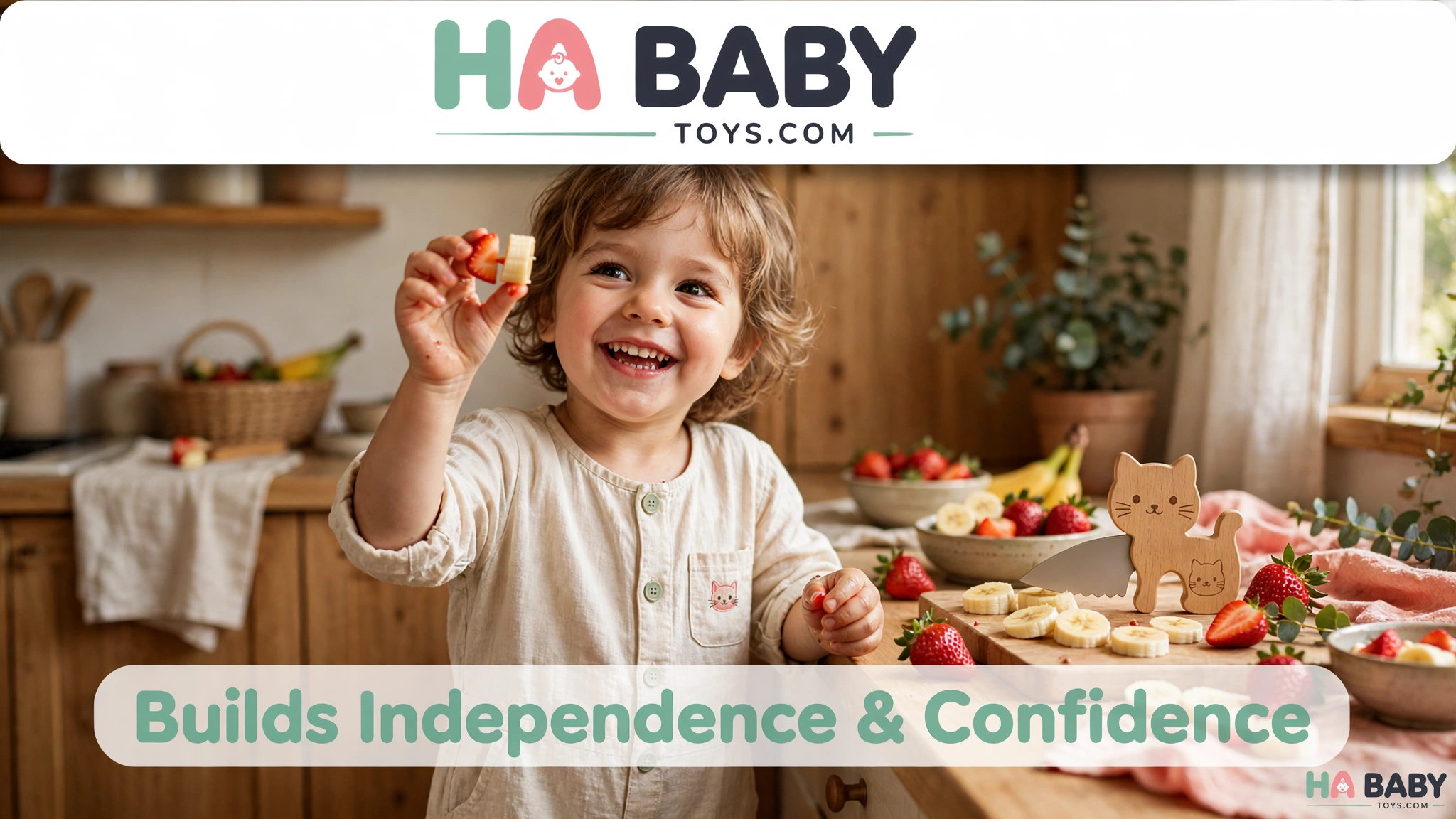
It is important to distinguish between pretend food preparation and actual food preparation. A wooden toy knife is not designed to cut real food. It is a prop for imaginative play.
| Tool | Main purpose | Typical play experience |
|---|---|---|
| Wooden toy kitchen knife | Pretend cooking | Recreating kitchen routines |
| Wooden pretend food | Imaginative food preparation | Cutting, serving, arranging |
| Toy chopping board | Pretend food preparation | Organizing a play workspace |
| Real child-oriented food knife | Actual food preparation, if designed for it | Supervised kitchen participation |
| Standard kitchen knife | Real food preparation | Not a pretend-play toy |
A wooden toy knife should be used only for its intended play purpose, not as a real food-preparation tool. For a broader look at the difference between pretend play and real food preparation, you can read about Montessori knife safety and food preparation.
Why Children Love Pretend Cooking
Pretend cooking is one of the most popular forms of imaginative play. Here is why children are so drawn to it.
Imitating Adults
Children often enjoy copying familiar household activities. Pretend cooking gives them a way to recreate routines they observe daily. The NAEYC’s resources on play-based learning highlight how imitation supports early development.
Making Their Own Decisions
Children can choose what to prepare, which pretend ingredients to use, and how to serve their food. This sense of control is empowering.
Creating Imaginary Situations
A simple play kitchen can become a restaurant, café, family dinner, or grocery shop. The possibilities are endless.
Playing with Others
Children can assign roles to parents, siblings, or friends and take turns being the cook or customer. This builds social skills and cooperation.
Repeating Familiar Routines
Children can recreate activities such as preparing breakfast, making a sandwich, or serving fruit. Repetition is a natural and valuable part of learning.
The value of pretend play comes from participation and exploration, not from the toy automatically teaching a skill. According to UNICEF’s guidance on learning through play, imaginative play is a cornerstone of early childhood development.
Seven Everyday Life Skills Children Can Explore Through Pretend Kitchen Play
This is the article’s central educational section. Pretend kitchen play offers rich opportunities for growth.
1. Understanding Everyday Routines
Children can recreate familiar routines such as preparing breakfast, arranging ingredients, and serving pretend meals. This helps them understand the sequence of daily life.
2. Organization
Sorting pretend ingredients, arranging utensils, and keeping a play kitchen organized can introduce simple organization habits. These skills transfer to real-life tasks.
3. Communication
Children can ask for ingredients, describe pretend meals, and communicate with their play partners. This builds vocabulary and social confidence.
4. Hand Movements and Coordination
Pretend slicing and arranging activities can give children opportunities to practise controlled hand movements. These are the same muscles needed for writing and other fine motor tasks.
5. Cooperation and Turn-Taking
Children can share pretend ingredients, take turns using accessories, and assign different roles. This is essential for social development.
6. Creativity and Imagination
Children can invent recipes, create imaginary restaurants, and decide what their pretend meals should include. This fosters creative thinking.
7. Responsibility Through Play
Children can pretend to prepare a meal, serve it, and clean up their play area afterward. This introduces the concept of responsibility in a fun, low-pressure way.
Wooden Toy Kitchen Knives and Montessori-Inspired Learning
Pretend kitchen activities connect naturally with Montessori-inspired practical-life learning. This approach emphasizes familiar everyday tasks, child participation and independence, repetition and practice, simple organization, learning through hands-on exploration, and opportunities for children to make choices.
It is important to note that not every wooden kitchen toy is an official Montessori material. A toy can be used in a Montessori-inspired activity without claiming it is certified or formally Montessori-approved. For a deeper look at how pretend play supports learning, you can read about toddler fruit preparation activities.
Wooden Toy Kitchen Knives vs. Plastic and Other Pretend Kitchen Accessories
Provide a balanced buying comparison.
| Feature | Wooden pretend knife | Plastic pretend knife | Real food-preparation knife |
|---|---|---|---|
| Intended purpose | Pretend play | Pretend play | Actual food preparation |
| Material | Wood, if verified | Plastic | Varies |
| Play experience | Role-play and imitation | Role-play and imitation | Supervised practical activity |
| Cleaning | Follow manufacturer instructions | Follow manufacturer instructions | Food-contact cleaning required |
| Safety considerations | Check finish, edges, splinters, and loose parts | Check damage and small parts | Requires appropriate skills and close supervision |
Wood is not automatically safer or better than plastic. Construction quality, smooth finishing, durability, age suitability, and manufacturer guidance matter more than simply choosing one material.
Eight Pretend Kitchen Games for Children
Make pretend play engaging with these simple games.
1. Pretend Fruit Salad Shop
Children select pretend fruits, arrange them, and serve a fruit salad. Everyday-life concept: Food preparation and serving.
2. Little Restaurant
One child becomes the chef while another plays the customer. Everyday-life concept: Role-playing and communication.
3. Family Breakfast
Recreate a familiar breakfast routine using pretend food. Everyday-life concept: Routine and sequencing.
4. Color Sorting Kitchen
Arrange pretend ingredients by color. Everyday-life concept: Organization and categorization.
5. Make-Believe Sandwich Shop
Choose pretend ingredients and assemble imaginary sandwiches. Everyday-life concept: Creativity and choice.
6. Kitchen Helper Challenge
Organize pretend utensils and return them to their places. Everyday-life concept: Responsibility and organization.
7. Family Dinner Preparation
Parents and children share pretend cooking roles. Everyday-life concept: Cooperation and teamwork.
8. Mini Grocery and Kitchen Game
Choose pretend ingredients from a play grocery area and bring them to the kitchen. Everyday-life concept: Planning and sequencing.
How Parents Can Encourage Independent Pretend Play
Parents can support children without taking over the play experience.
- Create a small, organized pretend kitchen area.
- Keep a limited number of accessories accessible.
- Demonstrate one pretend activity.
- Let children choose their own play scenario.
- Ask open-ended questions.
- Allow children to repeat activities.
- Encourage cleanup as part of the play routine.
Example questions: “What are you preparing today?” “Which ingredients do you need?” “Who will you serve this meal to?” “What should we prepare next?” “Where should the kitchen tools go after play?”
Parents should guide when needed, but allow children to direct much of the imaginative experience. The American Academy of Pediatrics’ guidance on play and toys supports this child-led approach.
Common Mistakes Parents Should Avoid
Avoid these mistakes to ensure a safe and enriching experience.
- Treating pretend kitchen accessories as real utensils.
- Assuming every wooden toy is automatically safe.
- Buying accessories without checking age recommendations.
- Ignoring splinters, rough edges, cracks, or loose parts.
- Expecting children to follow adult-designed recipes during pretend play.
- Correcting every imaginary decision.
- Forcing children to share before they are ready.
- Leaving small accessories where younger siblings may reach them.
How to Choose Quality Wooden Toy Kitchen Knives
This is a commercial-intent section. What should buyers check before purchasing?
Smooth Finishing
Inspect the surface for rough edges, splinters, and cracks. A well-finished wooden toy should feel smooth to the touch.
Construction
Look for secure, well-made construction and parts that do not loosen easily.
Size and Handling
Choose accessories that are appropriate for the child’s hands and intended play.
Material Information
Check what type of wood is used and whether the manufacturer provides finish or coating details.
Age Recommendations
Follow the manufacturer’s age guidance and warnings. The NAEYC’s developmentally appropriate practice emphasizes matching toys to the child’s stage.
Cleaning Instructions
Check whether the toy should be wiped clean or can be cleaned in another way. Do not assume wooden toys are dishwasher-safe or suitable for soaking.
Intended Use
Confirm that the item is a pretend-play toy rather than a real food-preparation tool.
Buyer checklist: Smooth surface with no visible splinters. No cracks or loose parts. Clear material information. Suitable size for the intended play. Manufacturer age guidance available. Clear cleaning instructions. Intended use clearly explained.
Who Can Enjoy Wooden Toy Kitchen Knives?
These pretend-play accessories appeal to a range of families.
- Children interested in pretend cooking.
- Families creating a pretend kitchen corner.
- Parents looking for screen-free indoor play.
- Preschool and early-learning environments.
- Gift buyers searching for pretend kitchen accessories.
A child’s interest and abilities vary. Some children prefer role-play, while others enjoy sorting, arranging, and building pretend food scenes. Always check the product’s official age guidance before purchasing.
HA’BABY Kids Cooking Knives — A Pretend Kitchen Play Option
If you are looking to add kitchen-themed accessories to your child’s pretend play, the HA’BABY Kids Cooking Knives are a practical option. They can help make pretend cooking more engaging and support role-play and everyday routine imitation.
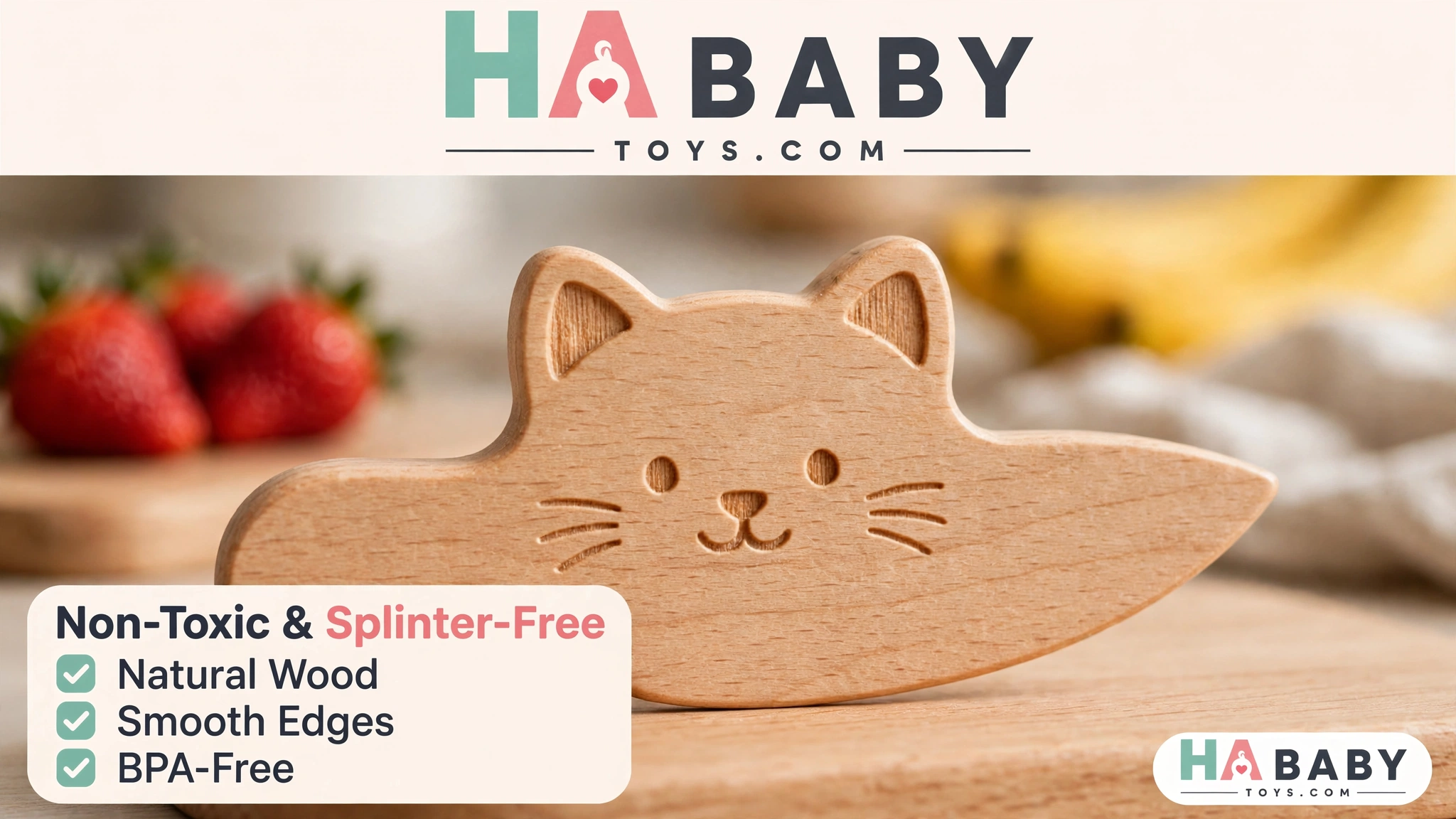
Parents can introduce them into a pretend kitchen setup and use them as a starting point for the games and activities described above.
What to check before ordering: Review the product listing for materials, components, dimensions, age recommendations, and safety information. If you have questions, visit the HA’BABY product information page.
Note: Always verify the actual product features and safety details on the live listing before purchasing. Confirm whether the product contains wooden knives before describing it as wooden.
Explore the HA’BABY Kids Cooking KnivesToy Safety and Care for Wooden Kitchen Accessories
Keep pretend-play accessories safe and in good condition.
- Inspect toys before each play session.
- Check for splinters and rough edges.
- Stop using damaged accessories.
- Follow age recommendations.
- Keep small pieces away from younger children when they pose a choking hazard.
- Clean according to manufacturer instructions.
- Store accessories in a dry, organized place.
- Keep pretend-play tools separate from real kitchen utensils.
Use authoritative safety references: the U.S. Consumer Product Safety Commission — Toy Safety, the CPSC — Toy Safety FAQs, and the CPSC — Small Parts and Choking Hazard Guidance.
From Pretend Cooking to Everyday Life Skills
Understanding Routines
Recreate familiar routines like preparing breakfast or serving meals.
Organization
Sort ingredients and arrange utensils in the play kitchen.
Communication
Ask for ingredients, describe meals, and talk with play partners.
Coordination
Practise controlled hand movements through pretend slicing.
Cooperation
Share ingredients, take turns, and assign roles.
Creativity
Invent recipes and create imaginary restaurants.
Frequently Asked Questions
What are wooden toy kitchen knives used for?
Wooden toy kitchen knives are generally pretend-play accessories used in toy kitchens and imaginative food-preparation games. Children can use them to imitate familiar kitchen routines, arrange pretend ingredients, and create imaginary meals. They should not be used for cutting real food unless a manufacturer specifically identifies the product as suitable for that purpose.
Are wooden toy kitchen knives safe for toddlers?
Safety depends on the product’s design, construction, age recommendation, and the child’s abilities. Parents should inspect for splinters, cracks, rough edges, and small detachable parts. Always follow the manufacturer’s instructions and supervise young children.
What skills can children explore through pretend kitchen play?
Pretend kitchen play offers opportunities to practise communication, imaginative thinking, organization, cooperation, turn-taking, and simple hand movements. Children can also recreate familiar household routines and make their own play decisions.
Are wooden kitchen toys better than plastic toys?
Neither material is automatically better. Quality, construction, finish, durability, age suitability, and cleaning instructions are more important than material alone. Parents should assess the actual product rather than relying on general claims about wood or plastic.
Can children use wooden toy knives to cut real fruit?
A pretend wooden toy knife should not be assumed suitable for cutting real fruit. Use it only for its stated purpose. For real food preparation, choose a tool specifically designed for that task and follow its manufacturer’s safety guidance.
How can parents encourage pretend cooking at home?
Create a small play kitchen area, provide suitable pretend food and accessories, demonstrate a simple scenario, and let children choose their own roles. Parents can participate by acting as customers, asking questions, and encouraging children to describe their imaginary meals. The HA’BABY product information page may have further details.
How do I choose good-quality wooden toy kitchen knives?
Check for smooth surfaces, secure construction, suitable size, clear age recommendations, material information, and cleaning instructions. Avoid products with visible splinters, cracks, loose components, or unclear safety information.
Conclusion — Turn Everyday Routines into Imaginative Learning
Children do not need complicated lessons to explore everyday life. A pretend kitchen, a few suitable accessories, and an interested parent can create opportunities for imagination, communication, and shared play. Pretend cooking encourages imitation and creativity, and wooden toy knives should be used for pretend play.
Parents should select age-appropriate, well-constructed toys and allow children to explore at their own pace. Ready to bring everyday kitchen-inspired play into your child’s routine? Explore children’s educational toys to compare options, or ask about product details if you have specific questions. For more pretend-play and learning ideas, visit the HA’BABY blog.
Explore the HA’BABY Kids Cooking Knives