
Microscope for Kids Age Guide: What Children Can Learn From Science Microscope Toys
Finding the right age to introduce children to microscopes. Children are naturally curious — they want to understand insects, plants, objects, and everything around them. But many parents wonder: “Is my child old enough for a microscope?” “Will they understand how to use it?” “Is this a toy or a real learning tool?” A microscope for kids is not only about seeing tiny objects — it introduces children to observation, discovery, science thinking, problem-solving, and creativity. The right age depends on interest, supervision, learning ability, and microscope design.
Parents looking for more educational toys can explore the complete collection at HA BABY Toys.
What This Guide Covers
- What Age Can Children Start?
- Microscope Learning by Age Group
- Ages 3–5: Early Exploration
- Ages 5–7: Young Explorer
- Ages 8–10: Young Scientist
- Ages 10+: Advanced Discovery
- What Children Learn
- Benefits at Every Stage
- Age-Based Activities
- STEM Learning at Every Age
- Signs Your Child Is Ready
- Choosing the Right Microscope
- HA BABY Kids Microscope Kit
- Parent Success Tips
- Interactive FAQ
What Age Can Children Start Using a Microscope?
There is no single age when every child is ready. Many children can begin exploring simple microscope activities during early childhood with adult guidance. Three factors matter more than age alone:
🌟 Interest
A curious child may enjoy science earlier — if they’re asking questions about nature, they’re already showing readiness.
🎯 Ability
Children should be able to hold objects carefully, follow simple instructions, and stay focused for short periods.
👨👩👧 Supervision
Younger children benefit from parent guidance. With supervision, even a 4-year-old can enjoy simple observation.
A beginner microscope should match the child’s development stage. Parents can learn more about choosing beginner-friendly options in: Beginner Microscope for Kids: A Parent’s Guide to Choosing the Right Science Toy.
Microscope Learning Guide by Age Group
Children learn differently at every stage — and a microscope can grow with their curiosity. Here’s what each age group can do, learn, and explore.
Ages 3–5: Early Exploration Stage
🌱 Early Exploration Stage
Discover colors, shapes, and textures through guided observation
- Colors and shapes recognition
- Simple observation skills
- Sensory learning through textures
- Basic science vocabulary
- Looking at large, safe objects
- Exploring textures and surfaces
- Learning basic science vocabulary (“big,” “small,” “round”)
- Parent-guided observation sessions
Ages 5–7: Young Explorer Stage
🔍 Young Explorer Stage
Learn how microscopes work and begin comparing objects
- How microscopes work
- Basic observation skills
- How to compare objects
- Simple science thinking
- Leaves — surface patterns and textures
- Flowers — petal structure and variety
- Fabric — different fibers and weaves
- Everyday objects — paper, salt, small materials
- Curiosity — asking more questions
- Focus — sustained attention on observation
- Questioning — “Why does this look like that?”
Ages 8–10: Young Scientist Stage
🧪 Young Scientist Stage
Perform simple experiments and record findings
- Perform simple experiments independently
- Record observations in a science journal
- Compare samples systematically
- Draw conclusions from observations
- Biology basics — plant and animal structures
- Materials science — natural vs synthetic
- Nature exploration — systematic observation
Ages 10+: Advanced Discovery Stage
🚀 Advanced Discovery Stage
Independent projects and deeper scientific exploration
- More detailed science projects
- Structured science journals
- Independent experiments from start to finish
- Higher magnification for detailed study
- Cell structures and microorganisms
- Prepared biology slides
- Comparative studies across samples
- Science fair projects and demonstrations
Microscope Learning Journey by Age
Tap each age stage to see what children learn
Explorer
Discover colors and textures
Observer
Learn basic science
Young Scientist
Perform experiments
Research Explorer
Create projects
Ages 3–5 — Explorer Stage
Children focus on colors, shapes, and textures through guided observation. Simple activities like looking at large objects build foundational sensory learning and introduce basic science vocabulary.
What Children Learn From Science Microscope Toys
A microscope delivers three core educational benefits — regardless of the child’s age.
Biology Understanding
Children explore plants, natural structures, and living things — building a foundational understanding of how the biological world is organized.
Observation Skills
They learn to look carefully, find differences, and identify patterns — skills that support every future learning challenge.
Scientific Thinking
Children practice the scientific process: Observation → Question → Testing → Discovery. Learn more in our guide: How Children’s Microscope Toys Introduce Kids to Biology and the Hidden World.
Benefits of Using a Microscope at Different Learning Stages
Different ages gain different benefits from microscope play. Here’s how each stage benefits.
🌱 Early Childhood
Develops curiosity and sensory learning through guided exploration.
🎯 Primary School
Develops science understanding, observation skills, and structured thinking.
🚀 Older Children
Develops research skills, experimentation habits, and independent learning.
Early learning experiences support children’s cognitive development, as emphasized by the NAEYC. The CDC Child Development resources also highlight the importance of hands-on discovery during early years.
Microscope Activities Based on Age
These age-appropriate activities help children engage with microscopes at their own level.
Younger Kids
Color Discovery: Observe different textures and colors — a playful sensory introduction.
Middle Age Kids
Nature Investigation: Explore leaves and flowers — real scientific observation.
Older Kids
Science Projects: Create observation journals and structured experiments.
For a full library of hands-on experiments, see Fun Science Experiments Kids Can Try With a Microscope Kit at Home.
How a Microscope Supports STEM Learning at Every Age
A microscope naturally integrates all four STEM subjects — regardless of the child’s age or stage.
🔬 Science
Understanding nature and living things.
💻 Technology
Using scientific tools to extend our senses.
⚙️ Engineering
Testing ideas and designing observations.
📐 Mathematics
Comparing measurements and patterns.
The STEM education resources from the U.S. Department of Education emphasize early STEM exposure as foundational for future learning. For a deeper look, see STEM Toys for Kids: How Microscope Science Kits Encourage Future Scientists.
Signs Your Child Is Ready for a Microscope
Interest matters more than exact age. Your child may enjoy a microscope if they:
Ask many questions about the world around them
Love exploring nature — collecting leaves, rocks, or insects
Enjoy collecting objects and small treasures
Like experiments and hands-on activities
Want to understand how things work
Can focus on one activity for at least a few minutes
Remember: Curiosity is the best readiness signal. If your child asks questions about nature, they’re ready — even if they’re younger than you expected.
Choosing the Right Microscope for Your Child’s Age
The best microscope is one that grows with your child. Here’s what to look for at different ages.
🌱 Younger Children Need
- ✓ Simple controls
- ✓ Durable, lightweight design
- ✓ Easy, guided activities
- ✓ Large viewing area
- ✓ Safe materials
🚀 Older Children Need
- ✓ Multiple magnification settings
- ✓ More exploration options
- ✓ Experiment materials and slides
- ✓ Higher learning challenges
- ✓ Independent operation
For a full breakdown, see 1200X Microscope for Kids Explained: Everything Parents Need to Know Before Buying.
HA BABY Kids Microscope Kit: Designed for Young Explorers
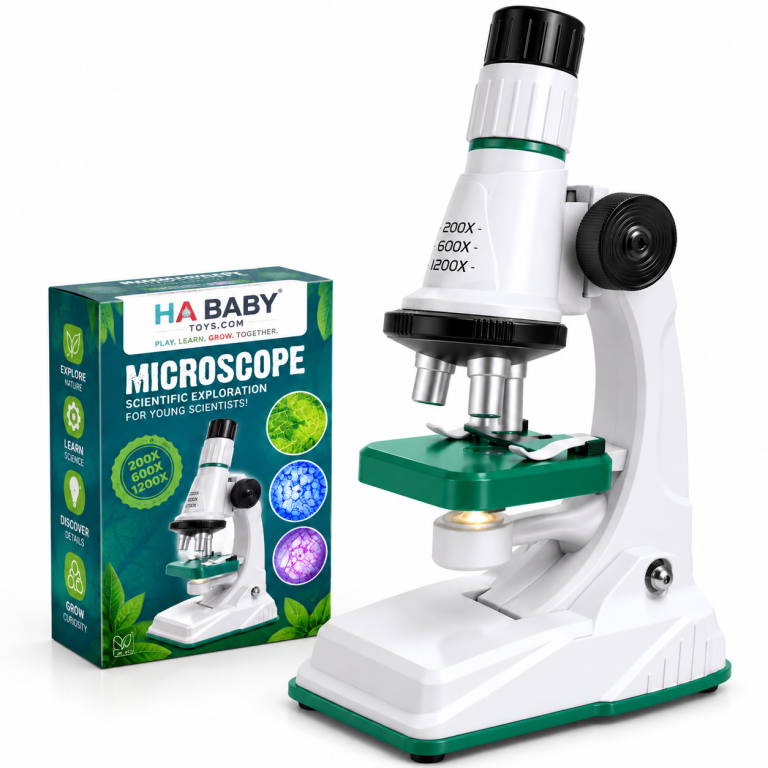
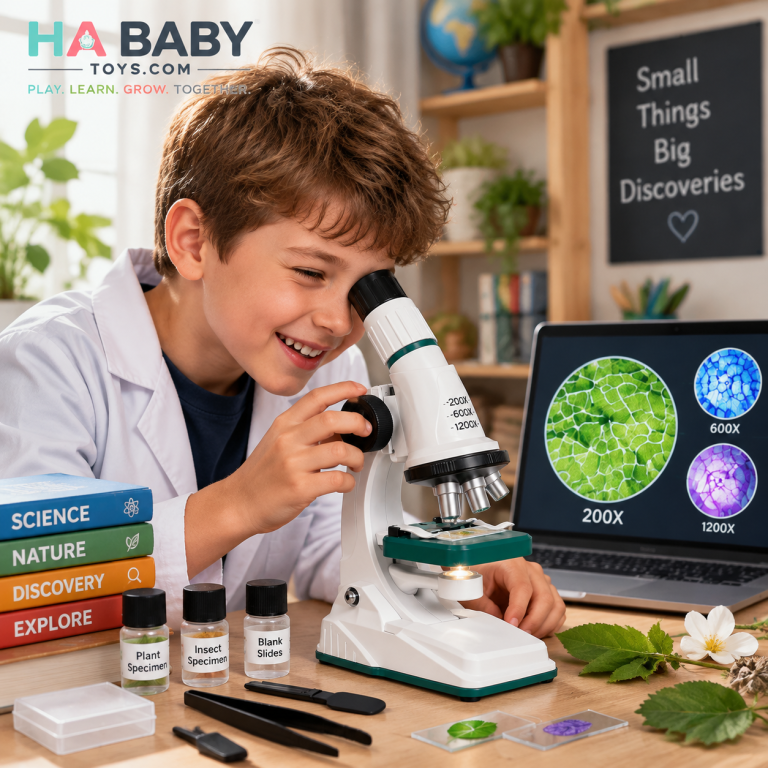
The HA BABY Kids Microscope Kit is created to introduce young learners to the exciting world of science — with design features that work across age groups.
HA BABY Kids Microscope Kit
- Beginner-friendly exploration for all ages
- 1200X magnification with lower settings for growth
- Hands-on science learning — active discovery
- Nature discovery built into every session
- STEM activities across all four subjects
- Safe, durable construction for young explorers
- Complete kit with slides and accessories
For readers who want to compare the wider range of educational products, the full shop is a useful next step. The HA Baby Toys blog also covers every aspect of science learning and early education.
How Parents Can Make Microscope Learning Successful
Four simple habits turn a microscope into a genuine family science practice.
Explore Together
Ask questions: “What do you notice?” — parent involvement deepens learning.
Avoid Giving All Answers
Let children discover — the discovery is what makes it stick.
Create Science Time
Make weekly activities a routine — consistency builds the science habit.
Encourage Recording
Create a science journal — drawings, observations, and questions.
Frequently Asked Questions
There’s no single “best” age — it depends on the individual child. Ages 3–5 enjoy simple color and texture observation with parent guidance. Ages 5–7 begin learning how microscopes work and comparing objects. Ages 8–10 can perform simple experiments and record findings. Ages 10+ handle advanced projects independently. The right age is whenever your child shows curiosity about the natural world.
Yes — with supervision and an age-appropriate microscope. A 5-year-old can learn how microscopes work, compare leaves and fabrics, and develop curiosity and focus through guided observation. The key is a beginner-friendly microscope with simple controls, plus parent supervision during every session.
Children learn biology (understanding plants, natural structures, and living things), observation skills (looking carefully, finding differences, identifying patterns), scientific thinking (the observation → question → testing → discovery cycle), and STEM skills across all four subjects. The NAEYC emphasizes that these skills are foundational for future learning.
Yes, with supervision and appropriate age recommendations. Choose microscopes designed specifically for children with safe materials, rounded edges, and clear instructions. Supervise children under 6 during experiments, especially when handling slides and small accessories. The CDC Child Development resources provide age-appropriate guidance.
The best beginner microscope has simple controls, easy focusing, comfortable viewing, and multiple magnification settings so children can start simple and grow. A 1200X maximum gives room to grow, while lower settings (40X–100X) make first experiences manageable. For a full guide, see Beginner Microscope for Kids: A Parent’s Guide.
Yes. A microscope naturally integrates all four STEM subjects: science (understanding nature), technology (using tools), engineering (testing ideas), and mathematics (comparing measurements). The STEM education resources emphasize early STEM exposure as foundational for future learning.
Four habits work well: explore together and ask questions (“What do you notice?”), avoid giving all the answers (let children discover), create regular science time (weekly activities), and encourage recording (science journals with drawings and questions). For a full library of activities, see Fun Science Experiments Kids Can Try With a Microscope Kit at Home.
Every Child Develops Curiosity at Their Own Pace
With the right microscope for kids, parents can turn everyday discoveries into exciting science learning experiences. Explore → Observe → Question → Discover
The Bottom Line: A Microscope That Grows With Your Child
There’s no single right age for a microscope. What matters is your child’s curiosity, their ability to follow simple instructions, and your willingness to guide them. A microscope can start as a simple observation tool at age 4 and grow into a serious science instrument by age 10 — if it’s the right microscope.
Whether you’re looking for an educational gift, a homeschool resource, or a way to reduce screen time while building genuine skills, a kids microscope is one of the smartest choices available. It turns curiosity into discovery — at every age.
For parents ready to explore one, the HA BABY Kids Microscope Kit product page is the natural next step. For deeper guidance on science learning and early education, explore the full HA Baby Toys blog library.