
Beginner Microscope for Kids: A Parent’s Guide to Choosing the Right Science Toy
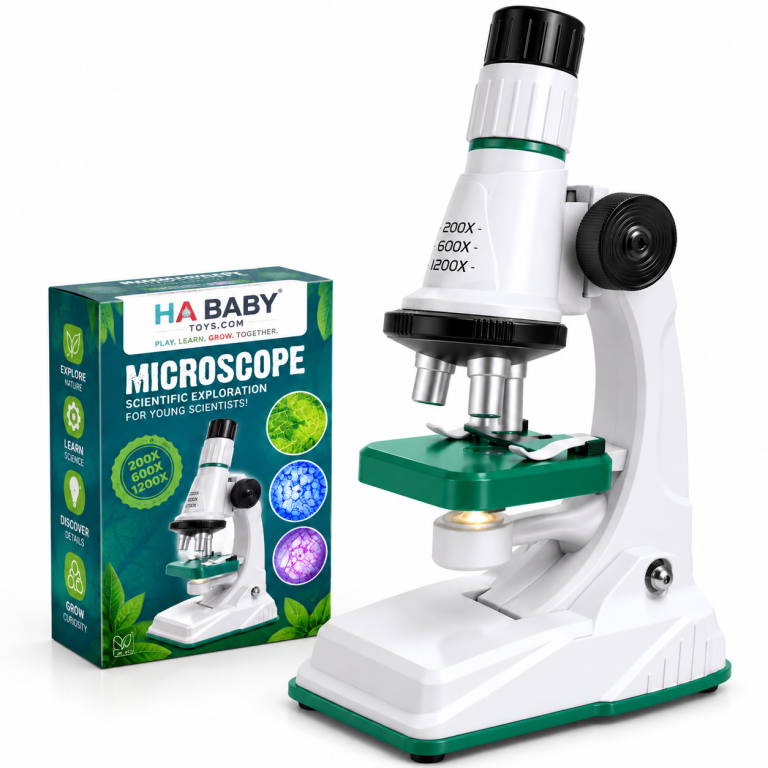
Choosing your child’s first microscope: a simple guide for parents. Buying an educational toy sounds easy until parents start comparing options. A quick search for a beginner microscope for kids shows hundreds of choices with different magnification levels, designs, features, accessories, and prices. This can make parents wonder: “Which microscope is actually suitable for my child?” The best beginner microscope is not always the one with the biggest number — it should be easy to use, safe for children, educational, fun to explore, and suitable for their age.
Parents can explore more educational products from HA BABY Toys.
What This Guide Covers
- What Makes a Microscope Beginner-Friendly?
- Understanding Magnification
- What Age Is Suitable?
- 7 Things to Check Before Buying
- Why It’s Better Than a Regular Toy
- How It Supports STEM Education
- Beginner Microscope Activities
- Builds Curiosity and Scientific Thinking
- HA BABY Kids Microscope Kit
- Common Buying Mistakes
- Interactive FAQ
What Makes a Microscope Beginner-Friendly for Kids?
Not all microscopes are created equal. A professional laboratory microscope is designed for adults — a beginner microscope for kids is designed for children. The difference matters more than most parents realize.
A beginner microscope should focus on three core areas.
Easy Operation
Children need simple controls, easy focusing, and comfortable viewing. A complicated microscope can reduce excitement because children struggle before making discoveries. If a child can’t get a clear image within a few minutes, they’ll lose interest — and the microscope ends up in a drawer.
Child-Friendly Design
Important features to look for: a lightweight body, stable base, easy sample placement, and safe materials. Children aren’t gentle with toys — a microscope that survives real use is one that gets used regularly.
Learning-Focused Features
A good beginner microscope encourages observation, experimentation, and discovery. It doesn’t just show children something — it invites them to investigate. Parents can understand more about children’s microscope learning in: Kids Microscope Kit Guide: How a 1200X Children’s Microscope Helps Young Explorers Discover Science.
Understanding Microscope Magnification Before Buying
Many parents see numbers like 100X, 400X, 800X, and 1200X — and assume bigger is better. It’s not that simple.
Magnification means how much larger an object appears through the lens. Higher magnification does not always mean better learning. Children also need clear viewing, easy focusing, and good lighting — because a blurry 1200X image is far less useful than a clear 400X one.
A 1200X microscope can provide exciting exploration opportunities for young learners when combined with beginner-friendly design. The key word is combined — magnification alone isn’t enough. For a full breakdown, see 1200X Microscope for Kids Explained: Everything Parents Need to Know Before Buying.
Quick rule: Choose a microscope that offers multiple magnification settings — so your child can start simple (40X–100X) and grow into higher magnification (400X–1200X) over time.
What Age Is Suitable for a Beginner Microscope?
Here’s an age-appropriate breakdown to help you match the microscope to your child’s stage.
👶 Ages 5–7
Focus: simple observation, colors, shapes, parent-guided activities.
Young children explore best with adult support. Choose a microscope with large controls and clear viewing.
🧒 Ages 8–10
Children can: perform simple experiments, record observations, compare samples.
At this age, kids can work semi-independently and start keeping a science journal.
👧 Ages 10+
Children can explore: more detailed science activities, independent projects.
Older kids benefit from higher magnification and more complex prepared slides.
Every child develops differently, so interest and curiosity matter more than age alone. A 6-year-old who is fascinated by nature might be ready for more than a 9-year-old who hasn’t shown interest yet. For a full breakdown, see Microscope for Kids Age Guide: What Children Can Learn From Science Microscope Toys.
Parent Buying Checklist: Choose the Right Kids Microscope
Tap each card to see what to check
Magnification
Understand viewing power
Lighting
Clear observations
Child-Friendly Design
Easy for beginners
Experiment Support
More discoveries
Learning Value
Build scientific thinking
Magnification — Understand Viewing Power
Look for a microscope with multiple magnification settings. This lets children start simple and grow into higher magnification as their skills develop. A 1200X maximum gives room to grow, but lower settings (40X–100X) matter most for beginners.
7 Important Things Parents Should Check Before Buying a Kids Microscope
Here’s the checklist that separates a microscope your child will actually use from one that collects dust.
1️⃣ Ease of Use
A child should operate it comfortably — simple controls, easy focusing.
2️⃣ Magnification Range
Choose suitable magnification — multiple settings for growth.
3️⃣ Lighting Quality
Good lighting improves visibility — essential for clear observation.
4️⃣ Stability
A stable microscope makes observation easier — wobbling ruins the experience.
5️⃣ Accessories
Useful accessories (slides, tools) improve learning significantly.
6️⃣ Build Quality
Durability matters — children aren’t gentle with toys.
7️⃣ Educational Value
The microscope should encourage exploration — not just look impressive on a shelf.
Why a Beginner Microscope Is Better Than a Regular Toy
Traditional toys provide fun, but science toys provide discovery, investigation, and learning. Here’s how the two compare.
| Feature | Normal Toy | Beginner Microscope |
|---|---|---|
| Purpose | Entertainment | Learning + discovery |
| Activity | Playing | Exploring |
| Skills | Imagination | Observation + thinking |
| Learning | Limited | Continuous |
For a deeper comparison, see Kids Microscope Kit vs Traditional Toys: Why Science Toys Create Better Learning Experiences.
How a Kids Microscope Supports STEM Education
A microscope naturally integrates all four STEM subjects at once — which is why it’s one of the most efficient educational toys available.
🔬 Science
Understanding nature through direct observation.
💻 Technology
Using scientific tools to extend human senses.
⚙️ Engineering
Testing ideas and designing experiments.
📐 Mathematics
Comparing patterns and sizes — practical math.
The importance of STEM education is highlighted through the U.S. Department of Education resources. For a deeper look, see STEM Toys for Kids: How Microscope Science Kits Encourage Future Scientists.
Beginner Microscope Activities Parents Can Try at Home
Four simple activities turn a microscope into a family science practice.
Leaf Investigation
Observe patterns and textures — the perfect first activity.
Fabric Comparison
Compare cotton, wool, and different materials.
Nature Collection
Explore safe natural objects from the backyard.
Science Journal
Record drawings, discoveries, and questions.
For more hands-on ideas, see Fun Science Experiments Kids Can Try With a Microscope Kit at Home. The National Geographic Kids resources offer endless inspiration.
How a Microscope Builds Curiosity and Scientific Thinking
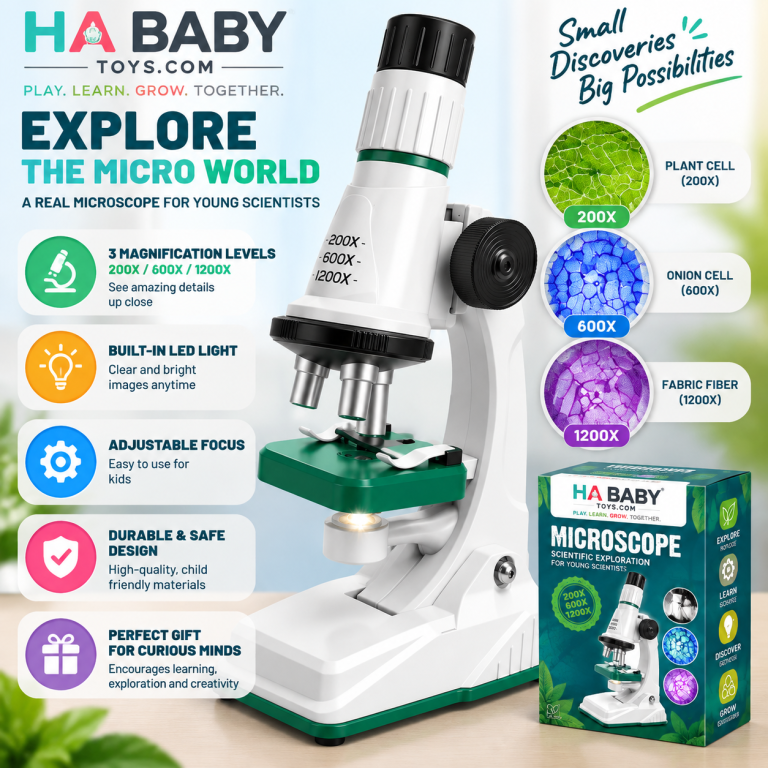
A microscope teaches children the same thinking process scientists use every day.
👀 Observation
“What do I see?” — careful looking.
❓ Questions
“Why does this happen?” — curiosity in action.
🧪 Experiment
“How can I learn more?” — testing ideas.
✨ Discovery
“What did I find?” — learning through results.
Benefits extend far beyond science: critical thinking, patience, creativity, and confidence. Learn more in our guide: How a Kids Microscope Kit Builds Curiosity, Creativity, and Scientific Thinking. The NAEYC emphasizes that hands-on exploration is the most effective way young children learn.
HA BABY Kids Microscope Kit: A Beginner-Friendly Choice for Young Explorers
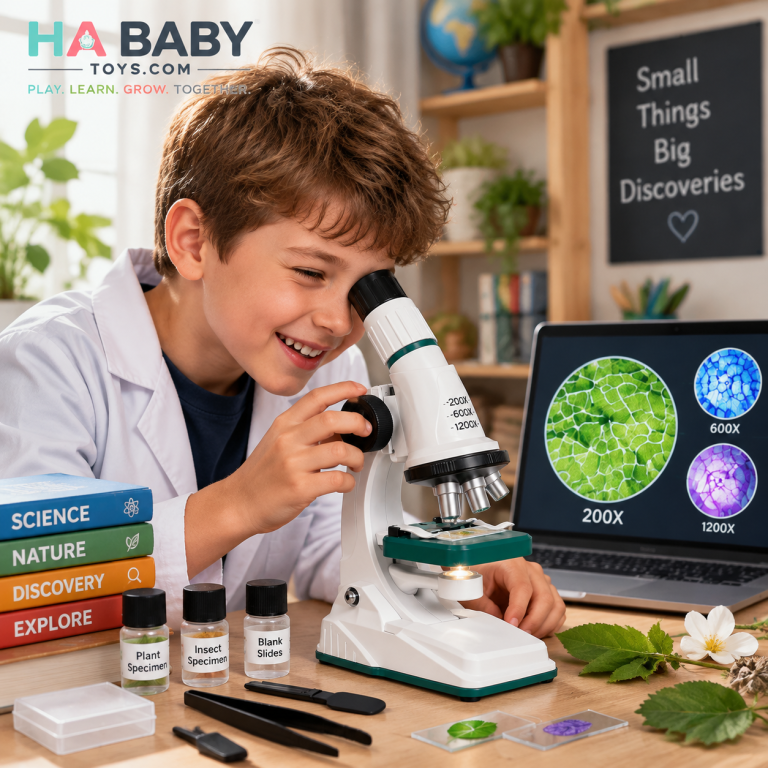
The HA BABY Kids Microscope Kit is designed for children who want to explore science in an easy and enjoyable way — combining beginner-friendly design with real scientific capability.
HA BABY Kids Microscope Kit
- Beginner-friendly science exploration
- 1200X magnification with lower settings
- Hands-on learning — active discovery
- STEM activities across all four subjects
- Educational entertainment — not just a toy
- Safe, durable construction for young explorers
- Complete kit with slides and accessories
For readers who want to compare the wider range of educational products, the full shop is a useful next step. The HA Baby Toys blog also covers every aspect of science learning and early education.
Common Mistakes Parents Make When Buying a Kids Microscope
These four mistakes account for most disappointing microscope purchases. Avoid them and you’ll choose well.
Choosing Only Based on Magnification
More numbers do not always mean better. A blurry 1200X image is worth less than a clear 400X one. Balance magnification with ease of use.
Ignoring Ease of Use
Children need simple operation. If the microscope is too complicated, your child will struggle before making discoveries — and lose interest.
Buying Without Considering Age
Choose according to your child’s ability. A microscope that’s too advanced will frustrate; one that’s too simple will bore.
Forgetting Learning Purpose
A microscope should create discovery. If it’s just a fancy object with no real learning value, it won’t get used.
Frequently Asked Questions
The best beginner microscope for kids is one with beginner-friendly features: simple controls, easy focusing, child-friendly operation, safe materials, and durable construction. It should offer multiple magnification levels so children can start simple and grow into higher magnification. For a full breakdown, see the Best Microscope for Kids guide.
With supervision, children can start using microscopes from around age 5. Ages 5–7 do best with basic observation and simple magnification. Ages 8–10 can handle simple experiments and recording findings. Ages 10+ can use higher magnification for detailed exploration. The CDC Child Development resources provide useful reference points for developmental milestones.
Yes — provided the microscope also offers lower magnification settings. A 1200X maximum gives room to grow, while lower settings (40X–100X) make first experiences manageable. Beginners should always start at lower magnification and work up. For a full explanation, see 1200X Microscope for Kids Explained.
Check seven key features: ease of use (simple controls, comfortable viewing), magnification range (multiple settings for growth), lighting quality (good illumination improves visibility), stability (stable base), accessories (slides and tools), build quality (durable construction), and educational value (encourages exploration). Use the 7-point checklist in this guide as your pre-purchase reference.
Yes. A microscope introduces children to biology through direct observation — they see plant cells, insect wings, leaf structures, and prepared biology slides. This makes biology tangible and memorable rather than abstract. The National Geographic Kids resources offer endless inspiration for biology exploration.
Yes, with supervision and appropriate age recommendations. Choose microscopes designed specifically for children with safe materials, rounded edges, and clear instructions. Supervise young children (under 6) during use, especially when handling slides and small accessories. The NAEYC recommends age-appropriate toys and close supervision for young children.
Yes — a microscope makes an excellent educational gift. It works beautifully for birthdays, school projects, holiday gifts, and curious children. Unlike ordinary gifts that lose appeal quickly, a microscope keeps giving: every observation leads to new questions and new discoveries. For more on this, see Why a 1200X Children’s Microscope Is the Perfect Educational Gift.
Choosing Your Child’s First Microscope Doesn’t Need to Be Confusing
With the right beginner microscope, children can turn curiosity into exploration and discover the excitement of science. Explore → Observe → Question → Discover
The Bottom Line: Choose Beginner-Friendly, Not Just Big Numbers
Choosing your child’s first microscope doesn’t need to be confusing. Focus on beginner-friendly design, multiple magnification settings, good lighting, durable construction, and real educational value. Do that, and you’ll pick a microscope your child will actually use — and learn from.
Whether you’re looking for an educational gift, a homeschool resource, or a way to reduce screen time while building genuine skills, a beginner microscope for kids is one of the smartest choices available. It turns curiosity into discovery — and discovery into a lifelong love of science.
For parents ready to explore one, the HA BABY Kids Microscope Kit product page is the natural next step. For deeper guidance on science learning and early education, explore the full HA Baby Toys blog library.
One Response