
1200X Microscope for Kids Explained: Everything Parents Need to Know Before Buying
Understanding 1200X microscope for kids before making a purchase. When parents search for a microscope for children, they often see numbers like 100X, 400X, 800X, or 1200X. These numbers can make buying decisions confusing. A microscope is not just about a bigger number — the best choice depends on your child’s age, learning purpose, ease of use, educational value, and safety.
Parents searching for educational toys can explore more learning products at HA BABY Toys.
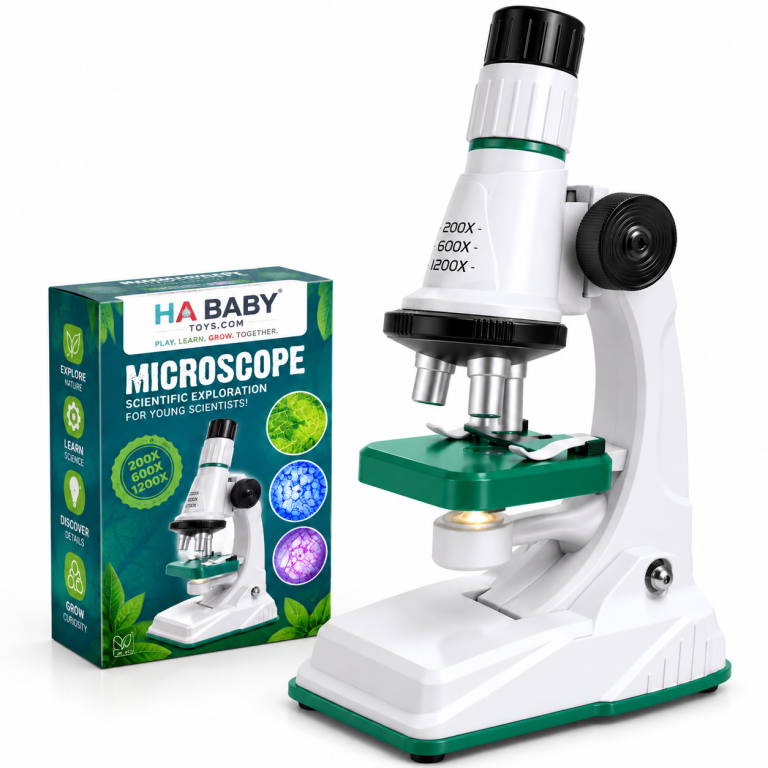
What This Guide Covers
What Does 1200X Mean in a Kids Microscope?
Magnification means how many times larger an object appears through the microscope compared with normal eyesight. A tiny object that cannot normally be seen clearly can become visible through microscope lenses.
Here’s the practical breakdown every parent needs.
Magnification Levels Explained Simply
Tap each level to see what it’s used for
Low Magnification (e.g., 40X–100X)
Best for beginners and younger children.
- Larger objects and basic observation
- Leaf veins and textures
- Fabric fibers and paper structure
- Building first confidence with the microscope
Best for: Ages 5–7, first microscope experiences.
Medium Magnification (e.g., 400X)
A versatile middle ground for growing explorers.
- Details, patterns, and textures
- Plant cells and prepared biology slides
- Salt and sugar crystals
- Structured experiments and recording observations
Best for: Ages 8–10, structured science activities.
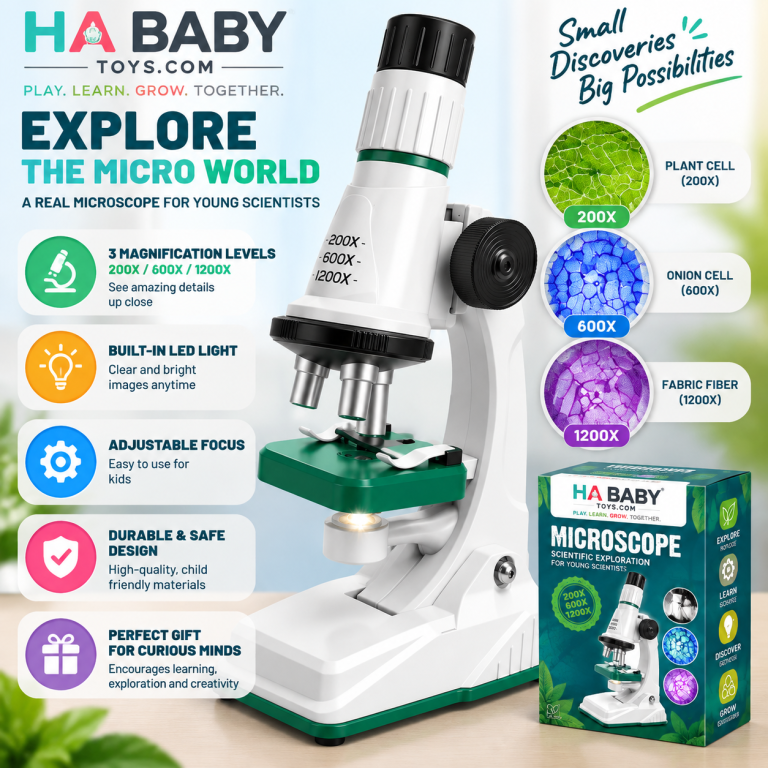
1200X Magnification
Suitable for exploring tiny details in beginner science activities and educational observation.
- Exploring tiny details of prepared slides
- Beginner science activities with adult guidance
- Educational observation and comparison
- Room to grow as your child’s skills develop
Important: Higher magnification isn’t automatically better. A 1200X microscope should also offer lower settings so beginners can start simple.
For a complete parent-friendly breakdown of what 1200X really means, see our dedicated guide: Kids Microscope Kit Guide: How a 1200X Children’s Microscope Helps Young Explorers Discover Science.
What Can Kids See With a 1200X Microscope?
The best way to understand magnification is to see what children actually observe. Here are the most engaging discovery categories.
Nature Exploration
Leaves: patterns, textures, and plant structures. Flowers: shapes and surface details. Insects: external structures. The National Geographic Kids resources offer endless nature observation inspiration.
Everyday Objects
Fabric fibers, paper texture, salt crystals, and small materials all reveal fascinating hidden structures. Children quickly learn that ordinary objects are extraordinary under magnification.
Children can explore more hands-on ideas in our guide: Fun Science Experiments Kids Can Try With a Microscope Kit at Home. The Smithsonian Science Education Center also emphasizes inquiry-based science learning from an early age.
Is a 1200X Microscope Good for Beginners?
Yes — provided it’s designed for beginners. A good beginner microscope should provide three things.
Easy Operation
Simple focusing, easy sample placement, and comfortable viewing. If a child can’t get a clear image within a few minutes, they’ll lose interest.
Learning-Friendly Design
Children need simple controls, clear instructions, and safe handling. A microscope built for adults, even a small one, won’t work for a 6-year-old.
Parent Support
Parents can guide children through first experiments. You don’t need to be a scientist — just curious alongside your child. The NAEYC emphasizes that guided discovery is one of the most effective ways young children learn.
For a complete breakdown, see Beginner Microscope for Kids: A Parent’s Guide to Choosing the Right Science Toy.
1200X Microscope vs Regular Toys: Why Science Toys Create Better Learning
Both options have value — but they create different experiences. Here’s how they compare.
| Normal Toys | 1200X Microscope |
|---|---|
| Entertainment focused | Discovery focused |
| Short-term interest | Long-term curiosity |
| Passive playing | Active learning |
| Limited questions | Scientific thinking |
Educational toys create opportunities for children to develop curiosity — and curiosity is the engine of all future learning. For a deeper comparison, see Kids Microscope Kit vs Traditional Toys: Why Science Toys Create Better Learning Experiences.
How a 1200X Kids Microscope Supports STEM Education
STEM education focuses on developing skills that combine science, technology, engineering, and mathematics. The importance of STEM education is highlighted by the U.S. Department of Education STEM resources. Here’s how a microscope naturally integrates all four.
🔬 Science
Children observe nature, materials, and biological structures — building real scientific knowledge.
💻 Technology
Children learn to use scientific equipment and understand how tools extend human senses.
⚙️ Engineering
Children practice testing and experiment design — the core of engineering thinking.
📐 Mathematics
Children compare size, shape, and patterns — practical math skills in action.
STEM Learning Wheel
For a deeper look, see STEM Toys for Kids: How Microscope Science Kits Encourage Future Scientists. The National Science Foundation also emphasizes early STEM exposure.
Important Features Parents Should Check Before Buying a Kids Microscope
Here’s the five-point buyer checklist that separates a good microscope from a frustrating one.
Magnification Range
Numbers matter, but they’re not everything. Look for multiple settings so your child can start simple and grow.
Build Quality
Durability and child-friendly design matter. A microscope that breaks easily won’t last past the first week.
Lighting System
Good lighting improves observation. A built-in LED light makes a real difference for young children.
Accessories
Slides, tools, and experiment materials extend learning significantly. A complete kit is worth more than a bare microscope.
Age Suitability
Choose according to your child’s interest and ability. A microscope that’s too advanced will frustrate; one that’s too simple will bore.
The CDC child development resources provide useful reference points for what children can understand at different ages.
Benefits of 1200X Microscope for Child Development
A microscope supports four key areas of child development.
🔍 Builds Curiosity
Children ask questions and explore answers — the foundation of all learning.
🎯 Improves Focus
Microscope activities require patience and sustained attention.
🎨 Encourages Creativity
Children create their own experiments and decide what to observe.
👀 Develops Observation
Children learn to notice details that others miss.
For a deeper look, see 10 Amazing Benefits of Using a Microscope for Kids During Early Science Education.
How Parents Can Make Microscope Learning More Fun at Home
Three simple habits turn microscope use into a genuine family science practice.
Science Discovery Journal
Children record observations and draw what they see.
Nature Collection
Collect safe objects from walks and observe them together.
Family Science Time
Parents explore together — curiosity is contagious.
The NASA Kids’ Club and National Geographic Kids both offer excellent free resources for extending science exploration beyond the microscope.
HA BABY Kids Microscope Kit: A Smart Choice for Young Explorers
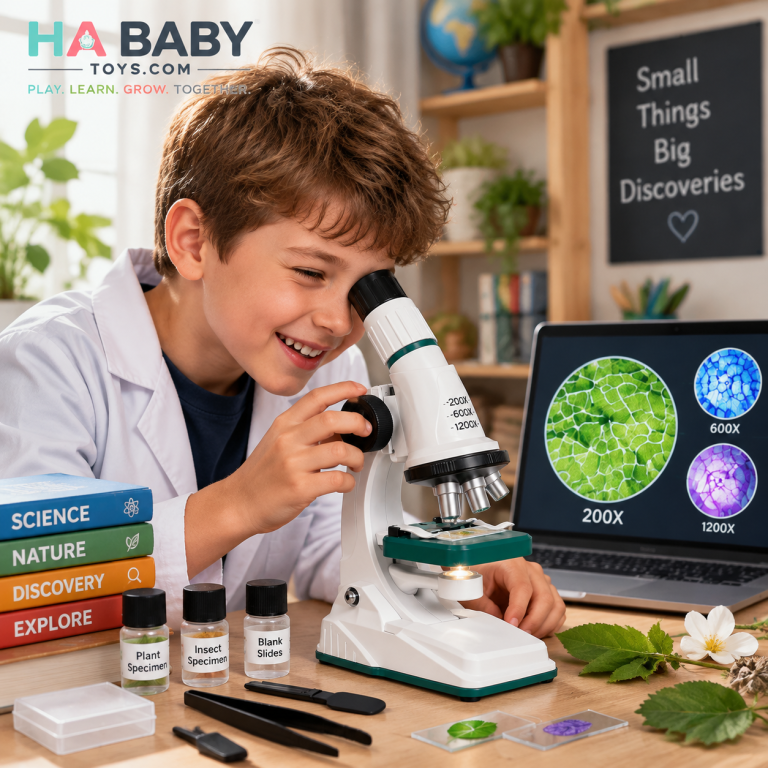
The HA BABY Kids Microscope Kit gives children a practical way to explore science through observation. Here’s what to check on the product page and match against your own requirements.

HA BABY Kids Microscope Kit
- Designed for beginners — simple controls
- 1200X magnification with lower settings
- Complete science exploration kit
- Supports STEM learning across all four subjects
- Safe, durable, child-friendly construction
- Excellent educational gift value
- Includes slides and accessories
For readers who want to compare the wider range of educational products, the full shop is a useful next step. The HA Baby Toys blog also covers every aspect of science learning and early education.
Common Mistakes Parents Make When Buying a Kids Microscope
These four mistakes account for most disappointing microscope purchases. Avoid them and you’ll choose well.
Higher number does not always mean better experience. A 1200X microscope without lower settings will frustrate a beginner.
Children need simple operation. If focusing takes too long or the controls are complicated, the microscope won’t get used.
Match the product with your child’s ability. A microscope that’s too advanced or too simple won’t hold interest.
The best science toy encourages learning. Look for kits with slides, instructions, and experiment ideas — not just a lens.
Frequently Asked Questions
1200X means the microscope can make an object appear up to 1,200 times larger than it would appear to the naked eye. In practice, this lets children explore tiny details like cell structures and fine surface textures on prepared slides. However, beginners should start at lower settings (40X–100X) and work up — a 1200X maximum is best understood as “room to grow.”
Yes — if it offers multiple magnification levels. The best beginner microscopes include lower settings (40X–100X) so children can start simple, then move up to higher magnification as their skills develop. A microscope that only offers 1200X will frustrate beginners. For a full guide, see Beginner Microscope for Kids: A Parent’s Guide.
Children can observe leaf veins, fabric fibers, paper texture, salt crystals, plant cells, insect wings, and prepared biology slides. What they can see depends on the magnification setting and the sample. The National Geographic Kids resources offer endless inspiration for what to explore.
With supervision, kids microscopes are suitable from around age 5. Ages 5–7 do best with basic observation and simple magnification. Ages 8–10 can handle simple experiments and recording findings. Ages 10+ can use higher magnification for detailed exploration and science projects. The CDC child development resources provide useful reference points.
Yes — a microscope makes an excellent educational gift. It works beautifully for birthdays, school projects, holiday gifts, and curious children. Unlike ordinary gifts that lose appeal quickly, a microscope keeps giving: every observation leads to new questions. For more on this, see Why a 1200X Children’s Microscope Is the Perfect Educational Gift.
Yes. A microscope naturally integrates all four STEM subjects: science (observing nature and materials), technology (using scientific tools), engineering (testing and experiment design), and mathematics (comparing size, shape, and patterns). The U.S. Department of Education STEM resources emphasize early STEM exposure as foundational for future learning.
Check five key features: magnification range (does it offer multiple settings?), build quality (durable and child-friendly?), lighting system (good LED lighting improves observation), accessories (slides, tools, experiment materials), and age suitability (match the microscope to your child’s ability). For a full buyer’s guide, see Beginner Microscope for Kids: A Parent’s Guide.
Help Your Child Move From Asking Questions to Discovering Answers
The HA BABY Kids Microscope Kit makes science exciting, interactive, and easy to explore at home. Observe → Question → Experiment → Discover
The Bottom Line: Confidence Comes From Understanding
A 1200X microscope for kids isn’t about the biggest number — it’s about the right combination of beginner-friendly design, multiple magnification settings, and real educational value. When you understand what 1200X actually means, the buying decision becomes simple.
Choose a microscope that matches your child’s age, offers lower settings for beginners, includes slides and experiment materials, and is built for real hands-on use. Do that, and you’ll have a science toy that grows with your child — and a young explorer who never stops asking questions.
For parents ready to explore one, the HA BABY Kids Microscope Kit product page is the natural next step. For deeper guidance on science learning and early education, explore the full HA Baby Toys blog library.
One Response