
How to Use a Montessori Hammer Toy for Early Learning, Motor Skills & Sensory Play
You already have the toy — or you are considering it. Here is exactly how to use it in simple, age-appropriate ways without overthinking playtime.
Babies and toddlers learn through simple repetition: reaching, grasping, tapping, watching, listening, copying, and trying again. You do not need a complicated learning routine. The HA Baby Toys Montessori Hammer Toy can be used for more than simple hammering. Parents can turn it into a short early-learning activity involving movement, sound, animal recognition, turn-taking, and sensory exploration.
Start in 3 steps
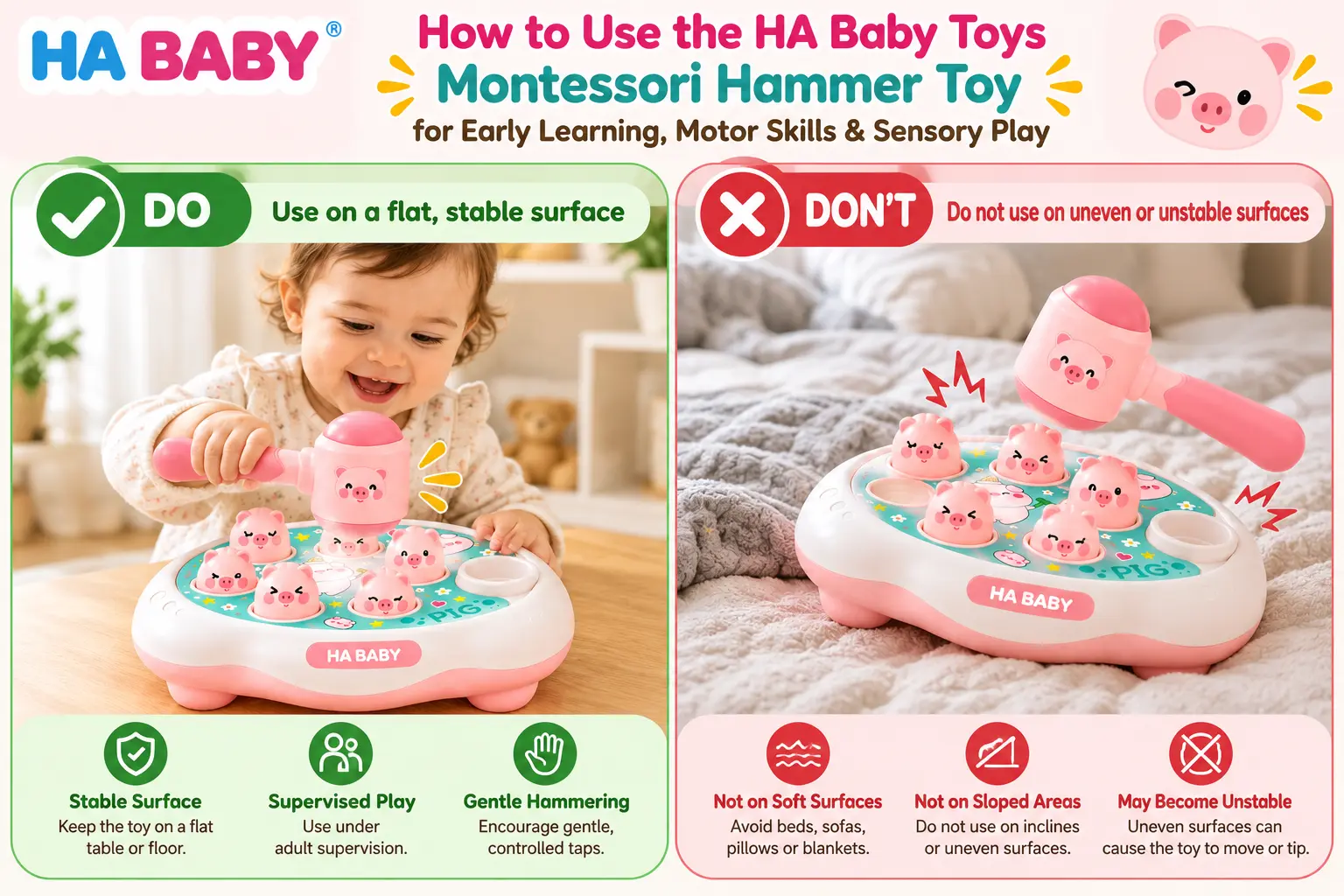
- Place the toy on a stable surface.
- Demonstrate one gentle tap.
- Give your child time to explore and repeat the action.
How the Learning Loop Works
The Play & Learn Path behind every session
See
The child notices the colorful animal or target.
Reach
They extend their arm toward the hammer or toy.
Grip
They hold the hammer with a controlled hand.
Aim
They attempt to guide it toward a target.
Tap
They perform the action and make contact.
React
They see movement or hear feedback, then repeat.
See → Reach → Grip → Aim → Tap → React → Repeat
First-Time Setup: How to Introduce the Toy
Before any activity, set up the environment so the first session feels calm and easy for both of you.
Choose a calm play area
Use the floor or another stable, safe play surface. Avoid positioning the toy where it can easily slide away.
Let your child inspect it
Do not immediately force the hammer into their hand. Let them touch the toy, look at the animal characters, explore textures, hear the sounds, and move different parts.
Demonstrate slowly
Use one clear action. Say “Tap.” Then pause.
Hand over the hammer
Allow the child to experiment on their own terms.
Keep language simple
Use short phrases: “Tap the frog.” “Your turn.” “Again?” “Where is the duck?”
Stop before frustration
The goal is enjoyable exploration, not completing a lesson.
If you are still deciding what this type of toy actually does, start with the guide explaining what a Montessori baby hammer toy is and how the Duck, Frog & Pig puzzle game works.
Activity 1: Basic Hammering for Hand-Eye Coordination
Basic Hammering
The foundation activity — simple, repeatable, satisfying.
Parent setup
Position the toy directly in front of the child. Demonstrate one slow tap. Then say: “Your turn.” Avoid moving the child’s hand constantly. Let them attempt the movement.
What the child is practicing
- Reaching
- Grip
- Arm movement
- Visual tracking
- Aiming
- Repetition
Reaching, grasping, and coordinated movement are skills that develop gradually during infancy and toddlerhood, and simple play activities can give children opportunities to practice them. The CDC developmental milestone resources note that children reach these skills at different rates, which is why short, low-pressure practice works best.
Activity 2: “Find and Tap the Animal”
Find and Tap the Animal
Adds early language learning to the physical action.
How to play
Ask: “Where is the duck?” Then: “Tap the duck.” Repeat with the frog and the pig.
Adapt for age
- Younger babies: the parent names the animal.
- Older toddlers: ask them to identify it themselves.
Expand the game
- “What sound does a duck make?”
- “What color is the frog?”
- “Can you find the pig?”
Talking during play is more than decoration. ZERO TO THREE and the National Association for the Education of Young Children (NAEYC) both highlight responsive interaction — talking, naming, and responding — as one of the most powerful ways to support early language and brain development.
Activity 3: Copy My Tap
Copy My Tap
A simple imitation game that builds rhythm and attention.
How to play
Parent taps once. Child tries once. Then tap twice, pause, and see whether the child copies. Keep it simple and gradually add variations.
Variations to try
- One tap
- Two taps
- Slow tap
- Fast tap
This introduces rhythm and imitation without presenting it as formal education. Imitation is a key part of early learning, and the Harvard Center on the Developing Child describes these back-and-forth interactions as “serve and return” — the everyday exchanges that build brain architecture.
Activity 4: Left Hand / Right Hand Exploration
Left Hand / Right Hand Exploration
Let hand preference develop naturally — do not force it.
How to play
Place the hammer where either hand can reach it. Allow the child to switch hands naturally. Children may experiment with different grips and hand positions during early play.
What to watch for
- Reaching with either hand
- Switching grip mid-play
- Stabilizing the toy with one hand
- Testing a two-handed hold
There is no need to correct which hand a child uses. Hand preference often emerges gradually, and forced switching can make play feel like a test rather than exploration.
Activity 5: Sensory Play
Sensory play is about offering different kinds of input during the same activity. A hammer toy naturally combines several.
The four sensory channels
Visual input
Bright shapes, characters, and movement.
Auditory input
Sound created by tapping or toy reactions.
Tactile input
Holding the hammer, touching surfaces, pressing or tapping components.
Movement input
Arm and wrist movement while reaching and striking.
Sensory Play Challenge
Try each of these during one short session and notice how your child responds.
- One quiet tap
- One louder tap
- Slow movement
- Fast movement
- Touching before tapping
- Naming what happens
This is play, not therapy. A hammer toy is not a treatment for sensory processing differences — it is simply a rich, multi-sensory activity that many children enjoy.
Activity 6: Cause-and-Effect Game
“I do something → something happens.”
The core cognitive lesson behind every tap.
How to narrate it
- “You tapped it.”
- “It moved!”
- “You did it again.”
This gives the child a simple, repeatable connection between action and outcome.
The guide on why parents choose Montessori hammer toys for babies and toddlers explores these play benefits in more detail, including how cause-and-effect understanding fits into the wider picture of early development.
Age-Based Play Guide
These are general play ideas, not developmental requirements. Children develop at different rates, and the World Health Organization and the NHS baby development guidance both stress that milestone timing varies widely.
Around 6–9 Months
- Looking at the toy
- Touching the pieces
- Reaching toward the hammer
- Watching a parent demonstrate
- Listening to sounds
Around 9–12 Months
- Assisted hammer holding
- Simple tapping attempts
- Animal naming by parent
- Watching cause and effect
Around 12–18 Months
- Independent tapping
- Find-the-animal games
- Copying one tap
- Simple turn-taking
Around 18–24 Months
- Counting taps
- Animal sounds
- Color naming
- “My turn, your turn”
- Two-step instructions
These are general play ideas, not developmental requirements. Children develop at different rates.
The 10-Minute Hammer Toy Routine
For busy parents who want a simple, repeatable session that fits real life.
- Minute 1–2: Free exploration — let your child look and touch.
- Minute 3–4: Demonstrate tapping — show one simple action.
- Minute 5–6: Animal game — “Where is the frog?”
- Minute 7–8: Copy my tap — try one or two taps.
- Minute 9: Turn-taking — “My turn. Your turn.”
- Minute 10: Finish positively — say “All done!”
Parents who want more session ideas can also browse the HA Baby Toys learning and parenting blog.
What If My Child Doesn’t Use the Toy “Correctly”?
Babies do not need to use every toy exactly as intended
They may:
- Hold the hammer upside down
- Bang the floor instead of the pegs
- Touch the animals instead of tapping
- Watch the parent instead of joining in
- Switch activities quickly
That can still be exploration. Instead of repeatedly correcting them, demonstrate again and give them another chance.
What If My Child Loses Interest Quickly?
Possible reasons
- They are tired
- They are hungry
- They are overstimulated
- They are interested in something else
- The activity has lasted too long
- The skill is currently too difficult
Quick fixes to try
- Try a shorter session
- Use only one animal
- Demonstrate instead of instructing
- Try again another day
Parent-Child Interaction Ideas
These games take seconds to set up and need nothing but you, your child, and the toy.
“My Turn, Your Turn”
Excellent for simple social interaction and patience.
“Find the Frog”
Animal recognition through pointing and naming.
“Tap and Say”
Say the animal name after each tap to link word and action.
“Count the Taps”
One, two, three — count out loud as you go.
“Fast and Slow”
Compare movement speed and introduce tempo.
“Copy Me”
Parent demonstrates a small sequence, child tries to repeat it.
“Where Did It Go?”
Point to different characters and ask the child to find them.
“Animal Sounds”
Pair each animal with its sound for a mini performance.
The Skill Map
What a simple hammering session can quietly practice
Movement
Arm, wrist, and hand control through repeated tapping.
Vision
Tracking the hammer and target with the eyes.
Listening
Noticing the sound the action creates.
Touch
Feeling textures and gripping the handle.
Language
Animal names, colors, and action words.
Attention
Focusing on one simple task for a short stretch.
Imitation
Copying a parent’s tap or sequence.
Problem Solving
Testing different actions to see what changes.
What Parents Should Say During Play
Less talking, better talking. Simple phrases keep play easy and responsive instead of turning it into a test.
Instead of this
- “Come on, hit that one properly.”
- “No, not there. Try again.”
- “You’re doing it wrong.”
- “Look at me. Watch. Watch!”
Try this
- “Tap.”
- “Frog.”
- “Again?”
- “You found it.”
- “My turn.” / “Your turn.”
- “One, two.”
This approach mirrors what the American Academy of Pediatrics recommends for early learning: warm, responsive, back-and-forth interaction rather than instruction or correction.
Safety Before Every Play Session
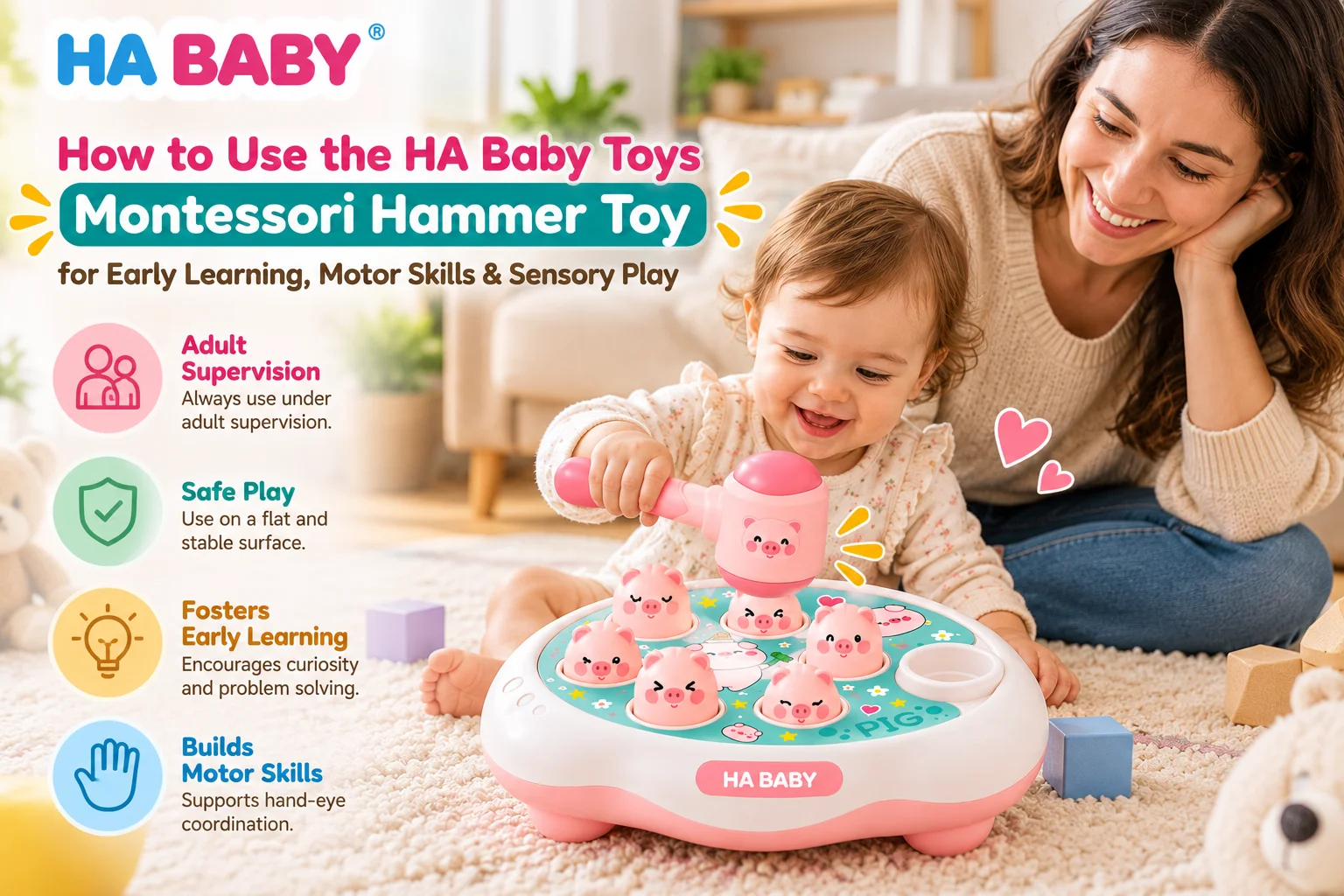
Quick safety checklist
- Inspect the toy for damage before use
- Check for loose or detachable components
- Follow the manufacturer’s age guidance
- Supervise play, especially under 18 months
- Keep the play surface stable and clear
- Stop using any damaged toy immediately
- Follow the product’s cleaning instructions
The U.S. Consumer Product Safety Commission provides current guidance on toy hazards and recalls, so parents can also check official safety information when evaluating children’s products. HealthyChildren.org from the American Academy of Pediatrics covers safe play and toy selection in more detail.
How to Clean and Store the Toy
Always follow the actual manufacturer care instructions for your specific product. General tips that apply to most wooden and plastic toys include:
- Wipe surfaces after play where permitted
- Avoid harsh cleaners unless approved
- Dry completely before storage
- Store the hammer with the toy so it is not lost
- Inspect regularly for wear
Do not invent material-specific cleaning instructions. Check the product page or packaging for the exact guidance for your toy.
Common Mistakes Parents Make
Mistake 1: Turning play into a test
Avoid repeatedly asking the child to “get it right.” Play should feel like exploration, not assessment.
Mistake 2: Playing too long
Short sessions can be more effective than forcing continued play. Stop while it is still fun.
Mistake 3: Demonstrating too quickly
Slow movements are easier to observe. One slow tap teaches more than five fast ones.
Mistake 4: Giving too many instructions
Use one direction at a time. “Tap the frog” is clearer than a three-step request.
Mistake 5: Expecting immediate results
Skills take repetition. A child may need many sessions before a tap lands where they intended.
Mistake 6: Comparing children
Children develop at different rates. Compare your child to their own progress, not to another toddler.
Fast Troubleshooting Table
If something is not working, find the problem and try the matching fix.
| Problem | Try This |
|---|---|
| Child ignores hammer | Let them explore the toy first |
| Child hits too hard | Demonstrate gentle tapping |
| Child gets frustrated | Simplify the activity |
| Child loses interest | End the session and return later |
| Child only watches | Continue demonstrating |
| Child prefers animals | Turn it into an animal naming game |
| Child uses both hands | Let them explore naturally |
Want to see the Duck, Frog & Pig hammer toy in person?
Explore the HA Baby Toys Shop →Frequently Asked Questions
How do I introduce a hammer toy to my baby?
Place it on a stable surface, let your child inspect it, demonstrate one slow tap, then hand over the hammer and let them experiment.
Should I show my baby how to use the hammer first?
Yes — one slow demonstration helps. After that, pause and let them try. Avoid taking over repeatedly.
What if my baby only plays with the hammer and ignores the toy?
That is still exploration. Holding, waving, and banging the hammer is part of learning how it works. Keep the board nearby and reintroduce it later.
How long should a toddler play with a hammer toy?
Follow your child’s attention span. For many toddlers that is 5 to 15 minutes, sometimes less. Short, frequent sessions work better than one long forced session.
Can I use a hammer toy for sensory play?
Yes. It naturally combines visual, auditory, tactile, and movement input. Name what is happening to add a language layer.
Can this toy support hand-eye coordination practice?
Yes. The child must look at a target, plan a movement, and strike it. That visual-motor loop is a core way hand-eye coordination develops in the toddler years.
How can I use the animal characters for learning?
Ask “Where is the frog?” or “What does the pig say?” to turn hammering into a naming and vocabulary game.
What words should I use during play?
Keep it short and warm: “Tap.” “Frog.” “Again?” “Your turn.” “One, two.” Avoid long instructions.
Can I use the toy for counting activities?
Yes. Tap and count out loud: one, two, three. This links movement with early number language.
What if my toddler hits too hard?
Demonstrate gentle tapping and use the word “gentle.” If it continues, pause the session briefly and try again later.
Should I correct my child when they use the toy differently?
Not constantly. Exploration is part of learning. Demonstrate again and give them another chance rather than correcting every movement.
How often can we play with it?
There is no fixed limit. Short daily sessions, or a few times a week, both work well. Follow your child’s interest.
How should I clean and store it?
Follow the product’s care instructions. Wipe where permitted, dry completely, and store the hammer with the board so pieces stay together.
What safety checks should I make before play?
Inspect for damage, check for loose parts, follow the age guidance, supervise closely, and keep the play surface stable. The HA Baby Toys FAQ also covers product and safety questions.
Where can I find more HA Baby Toys activities?
Visit the HA Baby Toys blog for more play guides. Retailers and larger buyers can request a quote from HA Baby Toys.
You Do Not Need a Complicated Learning Routine
Using a Montessori hammer toy does not require a curriculum, a schedule, or special training. It requires a stable surface, one slow demonstration, and the patience to let your child try, miss, and try again.
Start with the Quick Start steps. Add one activity at a time. Follow your child’s lead, keep your language short, and stop before frustration sets in. That is the whole method — and it works.
For more hands-on ideas that fit real life, HA Baby Toys focuses on baby and toddler play products built around interactive everyday play.