
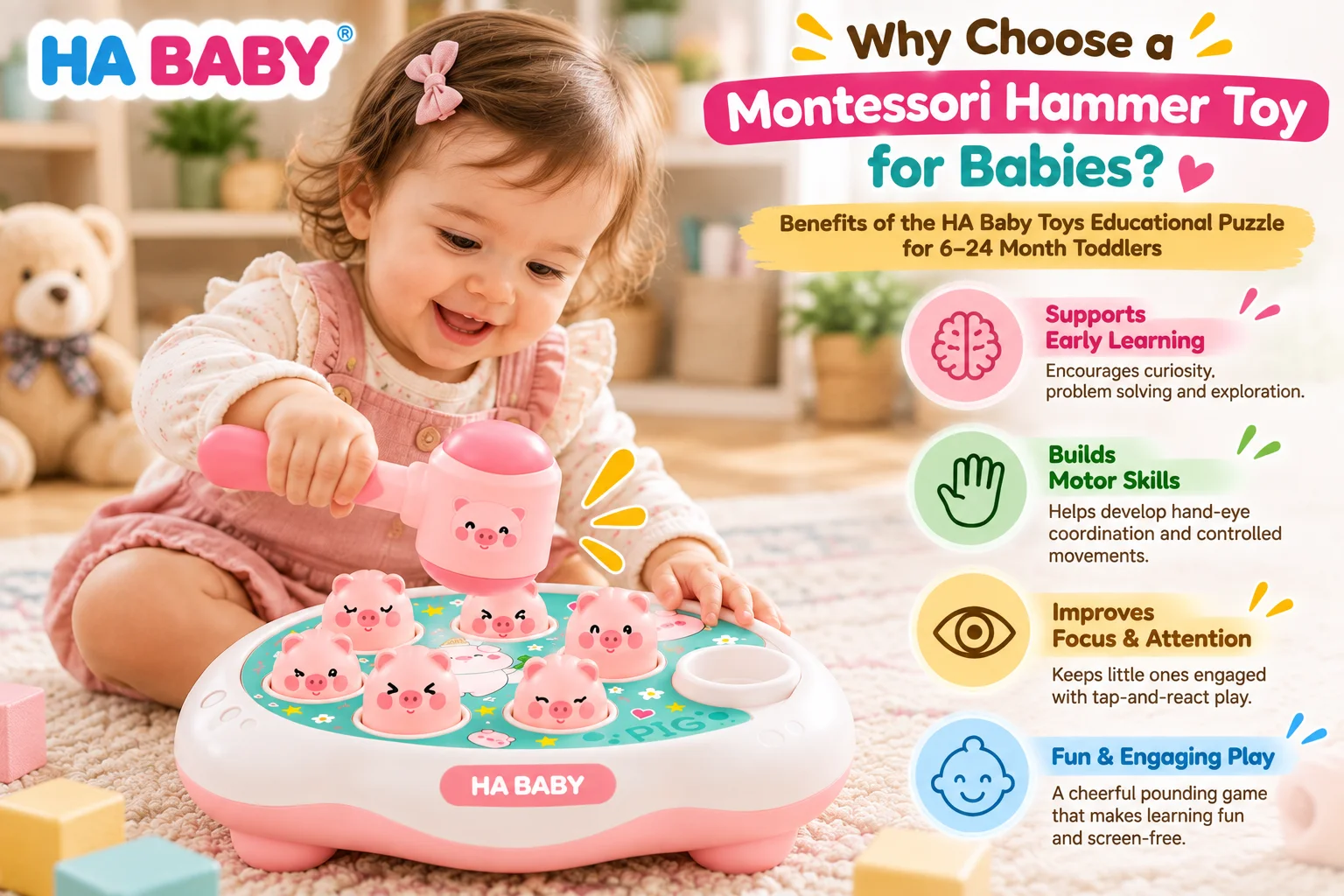
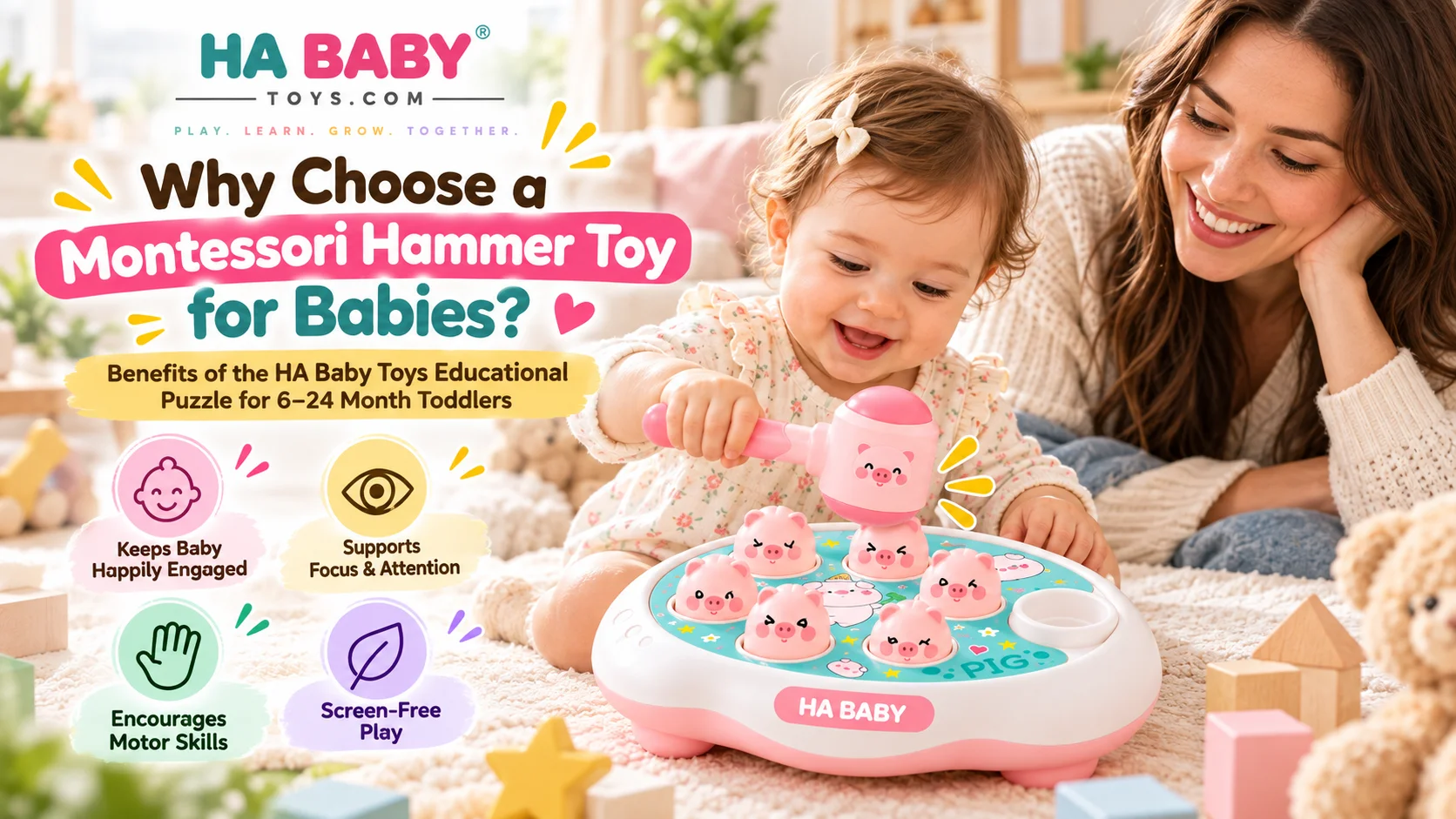
Why Choose a Montessori Hammer Toy for Babies? Benefits of the HA Baby Toys Educational Puzzle for 6–24 Month Toddlers
If you are choosing between rattles, electronic toys, stacking toys, puzzles, and activity toys, a Montessori-style hammer toy can stand out because it asks the child to actively participate. Instead of only pressing a button and watching a result, the child can reach, grip, aim, tap, listen, observe, and repeat.
There are hundreds of baby toys available. The honest question is not “is this toy good?” but “does this toy offer the kind of play my child actually needs right now?” The HA Baby Toys Duck, Frog & Pig puzzle is a good example of a toy built around that idea: it combines hammering, matching, animal recognition, and sensory feedback in one simple activity.
Quick Answer
A Montessori-style hammer toy may be a good choice if you want a toy that combines:
- Active hand movement
- Cause-and-effect play
- Sensory feedback
- Animal recognition
- Repetition
- Parent-child interaction
- Simple early learning games
If you are new to this toy category, first read the guide explaining what a Montessori baby hammer toy is and how the Duck, Frog & Pig puzzle game works.
Why Parents Choose It
Eight benefits behind one simple toy
HA Baby Toys Hammer Puzzle
One toy, many small learning moments
Move
Encourages active physical interaction instead of passive watching.
Aim
Gives the child opportunities to practice directing movement toward a target.
Tap
Creates a simple action the child can repeat.
Listen
Sound provides immediate sensory feedback.
Watch
The child can observe what happens after an action.
Repeat
Repetition lets children practice familiar movements.
Name
Animal characters can become simple language prompts.
Explore
Children can interact with the toy in several different ways.
Benefit 1: Active Play Instead of Passive Entertainment
Active vs passive toys
Different toys serve different purposes — but active play asks more of the child.
A passive toy might mainly:
- Flash lights
- Play music automatically
- Require minimal movement
A more interactive toy may require the child to:
- Reach
- Hold
- Move
- Aim
- Tap
- React
Different toys serve different purposes, but toys that require active participation can offer children more opportunities to practice movement and experimentation. The American Academy of Pediatrics’ HealthyChildren.org discusses play as an important part of healthy child development, and the AAP’s early childhood resources consistently emphasize hands-on, responsive play over passive entertainment.
Benefit 2: Hand-Eye Coordination Practice
The visual-motor loop
See → Move → Aim → Tap → Adjust → Try again
Hammering play creates a simple visual-motor challenge. The child sees a target and attempts to guide the hammer toward it. The movement may not be accurate at first, but repeated attempts create opportunities to practice coordination.
What the child is practicing
- Reaching toward a specific point
- Gripping a handle with control
- Directing movement toward a target
- Adjusting after a miss
- Trying again with more accuracy
This is not a claim that the toy “improves motor development” as a guaranteed outcome. A hammer toy provides opportunities to practice the kind of movement that supports coordination over time. The CDC developmental milestone resources describe these skills as developing gradually, and the Raising Children Network notes that babies learn coordination through everyday play, not through formal instruction.
Benefit 3: Cause-and-Effect Learning
“I tap → something happens”
One of the strongest reasons to choose a hammer toy.
Cause-and-effect play is simple but powerful. The child performs an action and observes an immediate response. That connection can encourage curiosity and repetition.
Examples of cause and effect in this toy
- Tap → movement
- Tap → sound
- Push → reaction
- Repeat → same or different result
Resources from the Harvard Center on the Developing Child explain how responsive experiences help build early brain architecture, and ZERO TO THREE describes cause-and-effect exploration as a core way infants learn that their actions matter.
Benefit 4: Sensory Exploration
Four sensory channels in one activity
Visual
Animal characters, colors, shapes, and movement.
Auditory
Sound from the toy or hammering action.
Tactile
Holding the hammer and touching the toy.
Movement
Arm, wrist, hand, and body positioning.
Sensory Snapshot
One toy can involve:
- 👀 Looking
- 👂 Listening
- ✋ Touching
- 🖐 Gripping
- 💪 Moving
- 🧠 Observing
A hammer toy is not a treatment for sensory-processing conditions. It is simply a multi-sensory activity that many children enjoy.
Benefit 5: Repetition Without Complicated Rules
Tap → Observe → Repeat
Younger children often do not need complicated games.
The basic loop can be enough. Parents do not need flashcards, long instructions, formal lessons, or complex setup. The toy works because the action is simple and the result is immediate.
For Busy Parents
You do not need to turn every toy into a lesson. A few minutes of simple supervised play can be enough to create opportunities for interaction and exploration.
Benefit 6: Animal Recognition and Early Language
From naming to questions
The Duck, Frog & Pig design turns hammering into a language game.
Start with simple naming
- “Duck.”
- “Frog.”
- “Pig.”
Progress to questions
- “Where is the frog?”
- “What sound does the pig make?”
- “Can you find the duck?”
This makes the toy more than a hammering activity. The National Association for the Education of Young Children (NAEYC) and UNICEF Parenting both emphasize that talking, naming, and responding during play are among the simplest and most effective ways to support early language.
Benefit 7: Parent-Child Interaction
Simple shared games
One of the most persuasive reasons to choose this type of toy.
My Turn, Your Turn
Parent taps once, then passes the hammer.
Find the Animal
Ask the child to locate the frog.
Copy Me
Tap once or twice and invite imitation.
Count Together
“One, two, three.”
Animal Sounds
Make a duck or pig sound together.
For step-by-step activity ideas, see the guide on how to use the HA Baby Toys Montessori hammer toy for early learning, motor skills and sensory play.
Benefit 8: A Toy That Can Change With the Child
This is a very strong buying argument. The same toy can be used differently over time, which means it does not become “finished” after a few weeks.
Around 6–9 Months
Main focus
- Looking
- Touching
- Listening
- Reaching
- Parent demonstration
Around 9–12 Months
Main focus
- Holding
- Assisted tapping
- Watching cause and effect
- Animal recognition
Around 12–18 Months
Main focus
- More independent hammering
- Copying
- Finding animals
- Simple turn-taking
Around 18–24 Months
Main focus
- Counting taps
- Animal sounds
- Color naming
- Simple instructions
- Pretend play
Age ranges are general activity suggestions, not developmental requirements. Children develop at different rates.
Montessori Hammer Toy vs Electronic Push-Button Toy
A fair comparison helps you decide. Electronic toys have their place, and many are well-designed. The question is whether the type of play they encourage matches what you want right now.
| Feature | Hammer Activity Toy | Simple Electronic Toy |
|---|---|---|
| Requires active movement | Often high | Varies |
| Cause and effect | Yes | Usually |
| Repetition | Yes | Yes |
| Parent participation | Easy to add | Possible |
| Open-ended play ideas | Several | Depends on design |
| Animal naming games | Yes with this design | Depends |
| Screen required | No | Usually no |
| Battery dependence | Depends on product | Often |
Montessori Hammer Toy vs Basic Rattle
A rattle and a hammer toy are not competitors. They serve different purposes at different stages.
| Feature | Basic Rattle | Hammer Activity Toy |
|---|---|---|
| Grasping | Excellent | Good |
| Shaking and listening | Excellent | Limited |
| Targeting and aiming | Limited | Strong |
| Tapping | Limited | Strong |
| Cause and effect | Simple | Layered |
| Matching or puzzle-style play | None | Possible |
Is This Toy Right for Us? — 5-Question Buyer Check
This is a buying and play-preference guide, not a developmental assessment. Answer honestly and see a quick suggestion.
1. Does your child enjoy tapping, banging, or moving objects?
2. Do you want a toy that encourages active participation?
3. Would you like one toy to support several simple play ideas?
4. Do you prefer screen-free play?
5. Do you want something you can use together?
Your Result
Who This Toy Tends to Suit
Different buyers come to this toy for different reasons. See which one sounds most like you.
This is not an official Montessori material and does not carry Montessori endorsement. It is a Montessori-inspired toy that shares some of the same principles: active participation, repetition, and child-led exploration.
Keep Expectations Realistic
A good buying decision comes from knowing both what a toy offers and what it does not. Here is the honest version.
A hammer toy does not:
- Guarantee developmental progress
- Replace caregiver interaction
- Replace professional developmental advice
- Interest every child equally
- Act as a developmental test
What it can offer:
- Opportunities for movement
- Repetition
- Sensory interaction
- Parent-child play
- Simple early-learning games
Safety as a Buying Factor
Before buying any toy for a baby or toddler, check these points. They matter more than marketing claims.
What to check before you buy
- Age suitability on the product page and packaging
- Product condition on arrival
- Loose or detachable parts
- Sharp edges or rough surfaces
- Signs of breakage or wear
- Cleaning requirements
- Supervision needs
- Recall information for the brand or product type
Parents comparing children’s toys can also consult official toy-safety and recall guidance from the U.S. Consumer Product Safety Commission. For health-focused advice, HealthyChildren.org from the American Academy of Pediatrics covers safe play and toy selection in detail.
Before You Buy, Ask:
- Does my child enjoy active play?
- Does the toy require the child to do something?
- Can we use it in more than one way?
- Is the age guidance appropriate?
- Can I inspect and clean it easily?
- Will I actually use it with my child?
- Does it match my child’s interests?
- Is it suitable for my intended gift recipient?
If this type of activity matches what you are looking for, you can explore available products in the HA Baby Toys shop.
Why It Can Work as a Gift
A hammer toy is a common gift choice because it feels useful, not just cute. Common occasions include:
- First birthday
- Baby shower
- Holiday gift
- Toddler birthday
- Grandparent gift
- Early-learning gift
For buyers shopping across the 6–24 month stage, always compare the manufacturer’s stated age guidance with the child’s current abilities and interests. A toy that fits one 10-month-old may not fit another until closer to 14 months.
How to Get More Value From the Toy
A toy often becomes more useful when the parent changes the activity rather than replacing the toy immediately. This one can be used for:
- Hammering
- Animal naming
- Counting
- Color recognition
- Turn-taking
- Sound imitation
- Copying movements
- Simple instructions
Parents looking for more ideas can browse the HA Baby Toys learning and parenting blog, which covers play ideas, sensory activities, and development-friendly routines.
Ready to compare options for your child or gift recipient?
Explore the HA Baby Toys Shop →Frequently Asked Questions
Why choose a Montessori hammer toy for a baby?
Because it asks the child to actively participate rather than passively watch. The child reaches, grips, aims, taps, listens, observes, and repeats — all within a simple activity that does not require batteries, screens, or complicated setup.
What are the benefits of a baby hammer toy?
Common benefits include active movement, hand-eye coordination practice, cause-and-effect learning, sensory feedback, repetition, animal recognition, and opportunities for parent-child interaction.
Can a hammer toy support hand-eye coordination practice?
It can provide opportunities for practice. The child sees a target, plans a movement, and attempts to strike it. Accuracy usually improves with repetition over many sessions.
Are hammer toys good for sensory play?
They can be. Many combine visual, auditory, tactile, and movement input in one activity. That multi-sensory feedback is part of what makes the toy engaging for babies.
What age is a hammer toy suitable for?
Many hammer toys are designed for roughly 6 to 24 months, but this varies by product. Always check the specific product page and packaging for the manufacturer’s age guidance.
Can a 12-month-old use a hammer toy?
Many 12-month-olds can hold a small hammer and attempt a tap with supervision. At this stage, exploration and repetition matter more than accuracy.
Can toddlers learn animal names with this toy?
Yes. The Duck, Frog & Pig design gives you natural prompts: “Where is the frog?” “What sound does the pig make?” This turns hammering into a simple language game.
Is a hammer toy better than an electronic toy?
Not universally. Different toys serve different purposes. A hammer toy usually requires more active movement, while electronic toys often provide music or lights automatically. The right choice depends on the kind of play you want to encourage.
Does a Montessori toy need to be wooden?
No. Montessori-inspired toys are defined more by how they are used — active, hands-on, child-led, and repetition-friendly — than by their material. Wood is common, but not required.
Is this an official Montessori material?
No. This is a Montessori-inspired toy, not an official Montessori material. It shares some principles, such as active participation and repetition, but it is not part of the formal Montessori curriculum.
Can this toy be used for parent-child play?
Yes, and this is one of its strengths. Simple games like “My Turn, Your Turn,” “Find the Animal,” and “Copy Me” turn the toy into a shared activity rather than solo play.
Is a hammer toy a good first-birthday gift?
It can be a strong first-birthday gift because it is active, simple, and grows with the child. Just match it to the child’s current stage and check the product’s age guidance before gifting.
How long can children keep using this type of toy?
Many children use it differently across the 6–24 month stage. Early on it is about looking, reaching, and tapping. Later it becomes animal naming, counting, and turn-taking.
What safety checks should parents make?
Check the age guidance, inspect for loose or damaged parts, confirm there are no detachable small pieces that pose a choking risk, and review the cleaning instructions. Supervise play, especially for babies under 18 months.
Where can I find more HA Baby Toys activities?
Visit the HA Baby Toys blog for more play guides. For product and ordering questions, see the HA Baby Toys FAQ. Retailers and larger buyers can request a quote from HA Baby Toys.
The Buyer’s Bottom Line
If you are comparing dozens of educational toys and unsure which claims actually matter, a Montessori-style hammer toy is a reasonable option to consider. It combines active movement, cause-and-effect play, sensory feedback, animal recognition, and shared parent-child interaction in one simple activity.
It is not magic, and it will not suit every child equally. But if you want a screen-free, hands-on toy that your child can grow into over many months, it is a low-risk, high-value choice. For more hands-on play ideas, HA Baby Toys focuses on baby and toddler play products designed around interactive everyday play.