
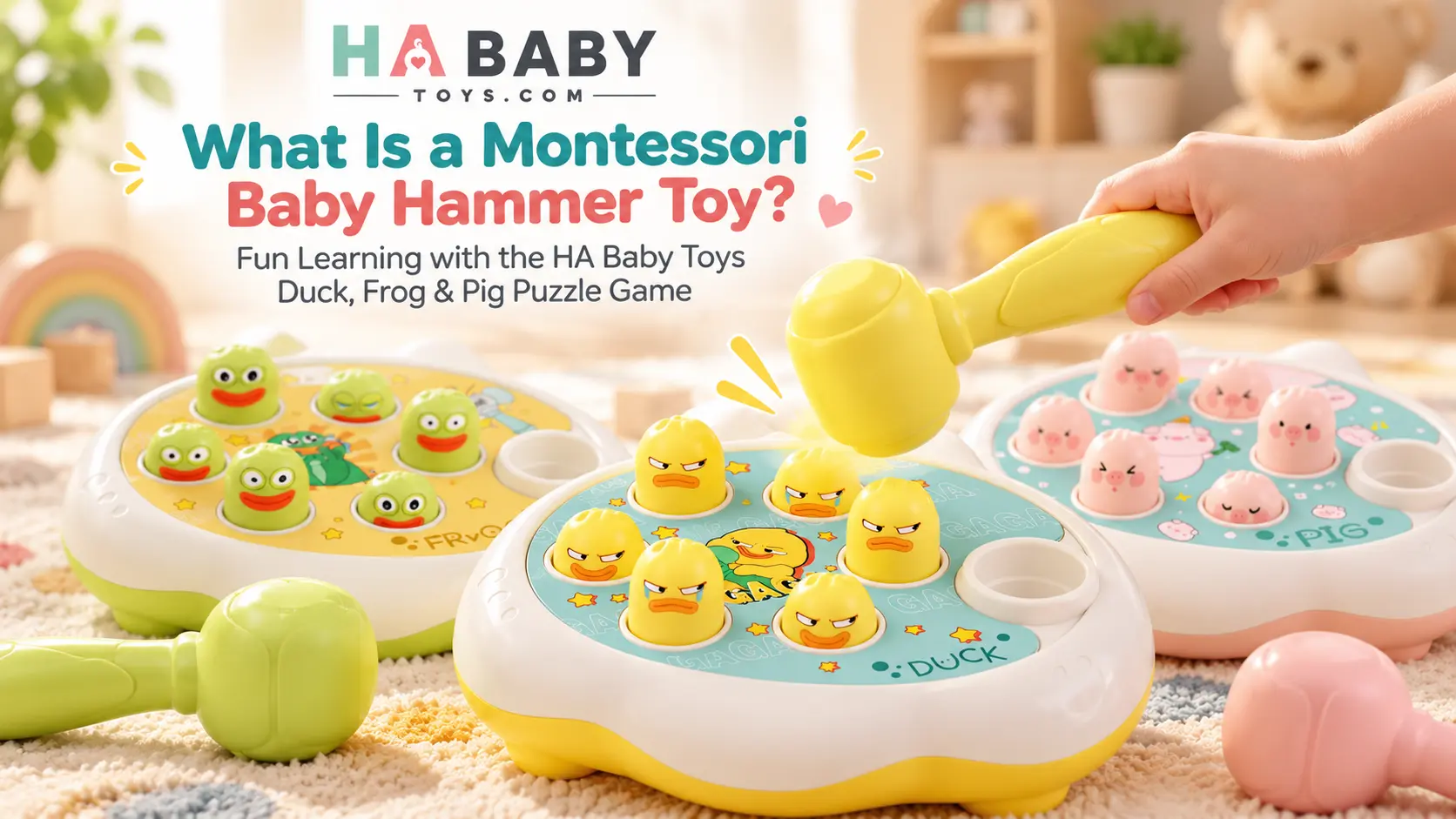
What Is a Montessori Baby Hammer Toy? Fun Learning with the HA Baby Toys Duck, Frog & Pig Puzzle Game
If you are staring at dozens of baby toys and wondering which one is actually fun, educational, and simple enough for your child to enjoy, a Montessori-style hammer toy can be an easy place to start.
Most parents do not need another complicated gadget. They need something that works in the real world: a toy a baby can grab, tap, drop, and come back to without instructions. The HA Baby Toys Duck, Frog & Pig Montessori Hammer Toy is built around that idea — a simple hammering, matching, sensory, and cause-and-effect activity that grows with your child.
What is a Montessori baby hammer toy?
A baby hammer toy is a hands-on activity toy that encourages children to tap, hit, push, observe movement, hear sounds, and repeat actions. Depending on the design, it may support hand-eye coordination, grasping, cause-and-effect understanding, sensory exploration, and early problem-solving.
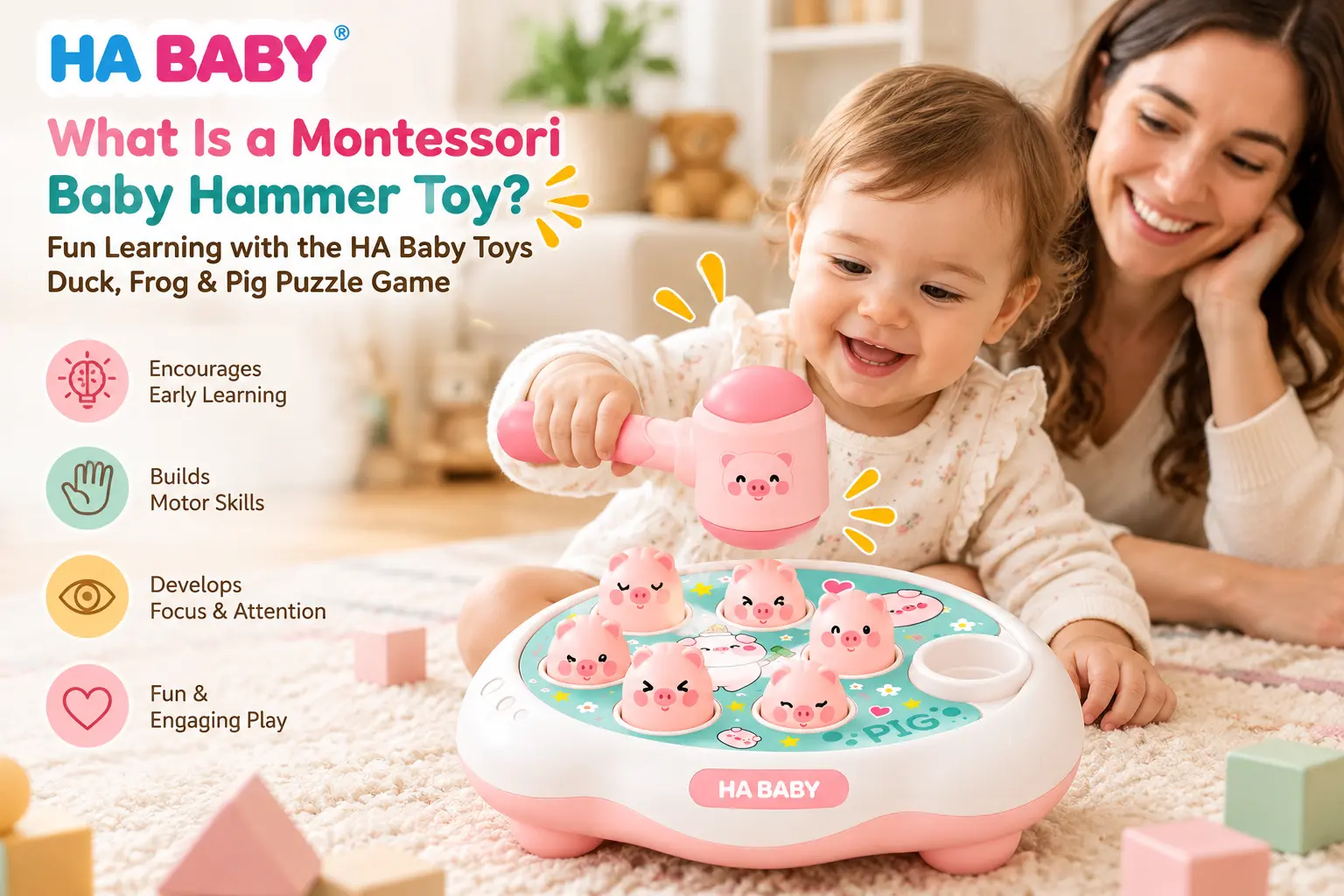
The HA Baby Toys Duck, Frog & Pig Montessori Hammer Toy combines hammering play with colorful animal characters and an interactive puzzle-style activity.
See How It Works
The learning loop behind every tap
Tap
The child holds the hammer and strikes the play area.
Watch
The child observes the movement or reaction they caused.
Hear
Sound provides immediate, satisfying feedback.
Repeat
The child tries again and gradually improves control.
Hand movement → Contact → Reaction → Curiosity → Repetition → Skill practice
What Makes a Hammer Toy “Montessori-Style”?
It is worth being honest here. Not every colorful plastic toy is an authentic Montessori material, and that is fine. Montessori-inspired toys generally emphasize active participation, repetition, practical movement, independence, and learning through direct interaction. Hammering play fits comfortably inside that approach.
Parents who want a deeper explanation can read the guide on why Montessori hammer toys can support early play and development, which breaks down the theory in plain language.
Hands-On Learning
Children learn by touching, moving, tapping, and experimenting. The National Association for the Education of Young Children (NAEYC) describes play as the primary way young children make sense of the world, and a hammer toy is pure, physical play.
Cause and Effect
“When I hit this part, something happens.” That single realization is a milestone in cognitive development. The CDC developmental milestones track cause-and-effect understanding as a key marker in the first two years.
Repetition
Babies often enjoy repeating the same action many times. Repetition is not boredom — it is how the brain strengthens neural pathways, a process the Harvard Center on the Developing Child describes as “serve and return” interaction.
Independent Exploration
The toy does not require complicated instructions. A child can pick it up and start working almost immediately, which builds confidence and reduces dependence on an adult to “run” the play.
Simple Problem Solving
Children begin figuring out where to hit, how hard to tap, and what happens next. These small experiments are the earliest form of problem-solving.
Meet the Duck, Frog & Pig Play Characters
The animal characters are what turn a plain hammering board into a language and matching game. Each one gives you a natural talking point during play.
On a laptop, hover over each card to reveal a play prompt. On a phone or tablet, tap the card to see the same idea.
What Skills Can Babies Practice?
This is where a hammer toy earns its place in the toy rotation. It quietly stacks several developmental skills into one activity.
Hand-Eye Coordination
The child sees a target and tries to move the hammer toward it. This visual-motor loop is a foundational skill.
Grasping and Hand Control
Holding a toy hammer encourages a controlled, purposeful grip rather than a random grab.
Cause-and-Effect Learning
The child begins connecting an action with a result — the core of early reasoning.
Sensory Exploration
The toy can combine visual stimulation, movement, touch, and sound in one experience.
Attention and Focus
Repeated tapping gives children a simple task to concentrate on, which stretches attention span.
Early Problem Solving
Children experiment with different actions — harder, softer, faster, slower — to see what changes.
Bilateral Coordination
One hand may stabilize the toy while the other operates the hammer, an early two-handed skill.
Language and Naming
Animal names, colors, and action words (“tap,” “again”) build vocabulary naturally during play.
The American Academy of Pediatrics emphasizes the importance of play in children’s development, while resources from the Harvard Center on the Developing Child explain how responsive experiences help build developing brain architecture. A hammer toy is a small, practical way to deliver that kind of responsive experience at home.
Is This Toy Right for My Child? — 3-Question Check
This is a buying and play-preference guide, not a developmental assessment. Answer honestly and see a quick suggestion.
1. Does your child enjoy tapping or banging objects?
2. Are you looking for a toy that encourages active play?
3. Do you want something that combines sound, movement, and hand activity?
Your Result
How to Use the Toy Step by Step
You do not need a lesson plan. Keep the first sessions short and follow your child’s interest.
Let your child explore
Allow the child to look at and touch the toy before you show anything. Let them turn it over and feel the pieces.
Demonstrate one tap
Show how the hammer is used — slowly, once. Then pause and let them take over.
Let the child try
Avoid constantly correcting. A messy tap that lands near the peg is still a success.
Name what is happening
Say “Tap!” “Duck!” “Again!” Naming the action builds language alongside motor skills.
Add simple learning games
Ask the child to find different animals, or to tap the frog instead of the pig.
Keep sessions short
Stop when the child loses interest. Short, happy sessions beat long, forced ones.
For more activity ideas, see the complete guide on how to use the HA Baby Toys Montessori hammer toy for early learning, motor skills and sensory play.
Age-Based Play Ideas
These are general play suggestions, not developmental benchmarks. The World Health Organization and the NHS baby development guidance both note that children reach milestones at different rates.
Around 6–12 Months
- Touching and holding the hammer
- Watching a parent demonstrate
- Reaching for the pegs
- Listening to the tap sound
- Parent-led demonstration
Around 12–18 Months
- Guided tapping with hand-over-hand help
- Animal identification (“Where’s the duck?”)
- Simple imitation of a parent’s tap
- Repeated movement and resetting the board
Around 18–24 Months
- “Find the frog” games
- “Tap two times” counting
- Color naming
- Turn-taking with a parent
- Pretend animal sounds
Children develop at different rates. Age ranges here are general play suggestions, not developmental benchmarks.
The Development Wheel
Hover or tap each segment to see what it means
Montessori Hammer Toy vs Ordinary Noise Toy
A fair comparison helps you decide. A basic noise toy has its place, but it usually asks less of the child.
| Feature | Hammer Activity Toy | Basic Noise Toy |
|---|---|---|
| Child actively participates | Yes | Sometimes |
| Hand movement required | High | Low–Medium |
| Cause and effect | Strong | Usually |
| Repetition | Yes | Yes |
| Matching / puzzle possibilities | Possible | Limited |
| Parent-child games | Many | Moderate |
8 Parent Play Ideas That Take Seconds to Set Up
You do not need new equipment for these. Just you, your child, and the hammer toy.
Find the Animal
“Can you find the frog?” Let them point, then tap it together.
Copy My Tap
Parent taps once, then the child tries to copy. Build up to two taps.
Animal Sound Game
“What does the pig say?” Pair the sound with a tap for a mini performance.
Color Hunt
“Can you find something else in the room with this color?” Stretches the game beyond the toy.
Slow and Fast
Tap slowly, then quickly. This introduces tempo and self-control.
My Turn, Your Turn
Introduce turn-taking. It is an early social skill disguised as a game.
Count the Taps
Tap one, two, three. Count out loud as you go.
Name and Tap
Say the animal name before tapping. This links word to action.
Safety First: What to Check Before and During Play
Most parents worry about small parts, loose pieces, and paint. Here is the practical version of that checklist.
- Always supervise hammer toy play, especially with children under 18 months.
- Follow the age recommendation on the product page and packaging.
- Inspect the toy regularly for damaged, loose, or broken components.
- Check for small parts that could detach, and keep them away from younger siblings.
- Clean according to the product-specific care instructions on the packaging or product page.
- Choose toys that match your child’s current stage, not the stage you hope they reach next.
The U.S. Consumer Product Safety Commission provides parents with guidance on toy safety, recalls, age suitability and potential hazards when choosing children’s products. For health-focused advice, HealthyChildren.org (from the American Academy of Pediatrics) also covers safe play and toy selection in detail.
60-Second Baby Toy Checklist
Before you buy any toy, run it through these questions. It takes less than a minute.
- Can my child interact with it rather than just watch it?
- Is the activity simple enough for my child to understand?
- Can it encourage repeated play, not one-and-done use?
- Is it appropriate for my child’s age and stage?
- Can I use it for parent-child interaction?
- Does it combine more than one type of activity?
- Can I easily inspect and clean it?
Parents who want to compare available options can browse the HA Baby Toys shop after reviewing the checklist.
Who Might Like This Toy Most?
If any of these sound like you, a hammer-style activity toy is a reasonable bet.
If you want to see how the brand approaches baby and toddler play overall, HA Baby Toys focuses on baby and toddler play products designed around interactive learning and everyday play. Parents exploring more play ideas can also browse the HA Baby Toys learning and parenting blog.
Before You Buy: A Quick Decision Box
Choose this style of toy if:
- Your child enjoys tapping and movement.
- You prefer active play over passive entertainment.
- You want a simple parent-child activity.
- You like toys that can be used in several ways.
Consider another activity if:
- Your child currently dislikes hammering or loud sounds.
- You are specifically looking for quiet bedtime play.
- You need a toy designed for a very different developmental stage.
Ready to see the Duck, Frog & Pig hammer toy for yourself?
Explore the HA Baby Toys Shop →Frequently Asked Questions
What is a Montessori baby hammer toy?
It is a hands-on activity toy that lets a child tap, push, and repeat an action. Montessori-inspired versions emphasize active participation, repetition, and independent exploration rather than passive entertainment.
What does a baby learn from hammering toys?
Common skills include hand-eye coordination, grasping, cause-and-effect understanding, sensory exploration, attention, and early problem-solving. The learning happens through repetition, not through instruction.
At what age can babies play with hammer toys?
Many hammer toys are designed for roughly 6 to 24 months, but this varies by product. Always check the age recommendation on the specific product page and packaging, and supervise younger babies closely.
How do I introduce a hammer toy to my baby?
Let them explore the toy first, then demonstrate one slow tap. Pause and let them try. Keep the first sessions very short and stop when interest fades.
Can hammer toys support hand-eye coordination?
Yes. The child must look at a target, plan a movement, and strike it. That visual-motor loop is one of the core ways hand-eye coordination develops in the toddler years.
Are hammer toys sensory toys?
They can be. Many combine visual stimulation (colors, movement), touch (gripping the handle), and sound (the tap). That multi-sensory feedback is what makes the activity engaging for babies.
Can I use the Duck, Frog & Pig characters for animal learning?
Absolutely. Ask “Where is the frog?” or “What does the pig say?” to turn hammering time into a naming and vocabulary game. It costs nothing and adds a layer of language learning.
How long should a toddler play with a hammer toy?
Follow your child’s attention span. For many toddlers that is 5 to 15 minutes at a time, sometimes less. Short, frequent sessions work better than one long forced session.
How can parents play together with the toy?
Try “Copy My Tap,” “Find the Animal,” “Count the Taps,” or “My Turn, Your Turn.” These games add social interaction, language, and turn-taking to the activity.
What should I check before giving a hammer toy to my child?
Check the age recommendation, inspect for loose or damaged parts, confirm there are no detachable small pieces that pose a choking risk, and review the cleaning instructions. Supervise play, especially for babies under 18 months.
Can this type of toy be given as a first-birthday gift?
It can be a strong first-birthday gift because it is active, simple, and grows with the child. Just match it to the child’s current stage and check the product’s age guidance before gifting.
Where can I learn more about HA Baby Toys?
For ordering, product and general questions, visit the HA Baby Toys FAQ. Retailers, distributors or larger buyers can request a quote from HA Baby Toys.
The Short Version for Busy Parents
A Montessori-style hammer toy is not magic. It is simply a well-designed, hands-on activity that matches how babies actually learn: by doing, repeating, and watching what happens. If you are unsure what to buy and want something that supports motor skills, cause-and-effect thinking, and shared play without screens or batteries, it is a smart, low-risk choice.
Start with short sessions. Follow your child’s lead. Name what they are doing. And when they lose interest, put it away and come back tomorrow. That is the whole method — and it works.