
How a Kids Microscope Kit Builds Curiosity, Creativity, and Scientific Thinking
Turning children’s natural curiosity into scientific discovery. Children are naturally curious. They touch objects, ask questions, collect small things, and want to understand how the world works. However, many modern toys provide entertainment without encouraging deep thinking. A kids microscope kit changes the way children see the world — moving them from “I wonder what this is?” to “Let me investigate and find out.”
Parents searching for educational toys can explore more learning products from HA BABY Toys.
What This Guide Covers
Why Curiosity Is the Foundation of Scientific Learning
Curiosity is where science begins. Every scientist starts with a question — why are leaves different? Why do fabrics look different? Why do objects have different textures?
A microscope encourages children to ask What? Why? and How? — and then actually go find out. Curiosity development through observation happens when children explore hidden details, discover patterns, compare objects, and create their own questions.
The NAEYC emphasizes that young children learn best through hands-on exploration that invites questions. A microscope is one of the simplest ways to invite those questions every single day.
How a Kids Microscope Kit Develops Scientific Thinking
Scientific thinking follows a simple, repeatable process. A microscope makes that process concrete — and repeatable — for children as young as 5.
1. Observation
Children look carefully at objects. A leaf appears simple — under magnification, it reveals patterns.
2. Asking Questions
Children start thinking: “Why does this look different?” — the question that fuels all science.
3. Testing Ideas
Children compare different leaves, materials, and textures to see what changes and what stays the same.
4. Discovering Answers
Children develop confidence through exploration — the discovery is theirs, and that matters.
This process builds critical thinking, problem solving, and logical reasoning. Learn more in our guide: How Children’s Microscope Toys Introduce Kids to Biology and the Hidden World.
How Microscopes Encourage Creativity in Children
Creativity is not only drawing or art. Scientific creativity means creating ideas, designing experiments, and finding new possibilities.
Science Journal Activity
Children can draw observations, write discoveries, and compare results — turning a microscope session into a real research project.
Create Mini Research Projects
“My Leaf Investigation,” “My Fabric Discovery,” “My Backyard Science Collection” — these mini projects give children ownership of the learning process and build genuine scientific habits.
The National Geographic Kids and NASA Kids’ Club sites both offer endless inspiration for extending creative science exploration.
Building STEM Skills Through Microscope Exploration
STEM education encourages integrated learning across science, technology, engineering, and mathematics. The U.S. Department of Education STEM resources emphasize early STEM exposure as foundational for future learning.
🔬 Science Skills
Learning biology, nature, and materials through direct observation.
💻 Technology Skills
Using scientific equipment — understanding how tools extend our senses.
⚙️ Engineering Skills
Testing and experimenting — designing what to observe and how.
📐 Mathematics Skills
Comparing size, shape, and patterns — practical math in action.
STEM Learning Wheel
For a deeper look, see STEM Toys for Kids: How Microscope Science Kits Encourage Future Scientists. The National Science Foundation also emphasizes early STEM exposure.
Everyday Things Kids Can Explore With a Microscope
The best part of a microscope is that the samples are everywhere. Here are the two most engaging categories.
Nature Discoveries
Leaves: plant structures and patterns. Flowers: natural designs. Insects: external features. Nature becomes a science lab.
Household Discoveries
Fabric: different fibers. Paper: texture differences. Salt crystals: patterns and shapes. Everyday objects become extraordinary under magnification.
For more hands-on ideas, see Fun Science Experiments Kids Can Try With a Microscope Kit at Home. The Smithsonian Science Education Center also emphasizes inquiry-based science learning from an early age.
Why Hands-On Learning Is Better Than Passive Screen Time
Many children spend increasing time with tablets, phones, and games. Hands-on toys encourage physical interaction, real-world exploration, and active thinking. A microscope creates screen-free scientific entertainment — the kind of activity that leaves children energized rather than drained.
The CDC child development resources highlight hands-on, guided discovery as central to healthy early development. Science toys deliver both, with a bonus: parents often learn alongside their children.
How a Kids Microscope Kit Improves Important Life Skills
Microscope work builds four life skills that extend far beyond the science table.
Patience
Children learn that discoveries take time — and that waiting for the right focus is part of the process.
Focus
They carefully adjust and observe — sustained attention practiced in a genuinely engaging way.
Confidence
Finding something new creates achievement — and that achievement builds real self-belief.
Communication
Children explain discoveries to parents, practicing language, sequencing, and description.
| Skill | How Microscope Helps |
|---|---|
| Curiosity | Encourages questions |
| Focus | Requires careful observation |
| Creativity | Creates experiments |
| Confidence | Builds discovery skills |
For a deeper look, see 10 Amazing Benefits of Using a Microscope for Kids During Early Science Education.
Kids Microscope Kit vs Ordinary Toys: A Learning Comparison
Both options have value — but they create different experiences. Here’s how they compare.
| Ordinary Toys | Kids Microscope Kit |
|---|---|
| Entertainment only | Learning + fun |
| Short usage time | Long-term exploration |
| Passive activity | Active discovery |
| Limited questions | Scientific thinking |
Not all toys need to teach academics — but educational toys provide additional developmental value. For a deeper comparison, see Kids Microscope Kit vs Traditional Toys: Why Science Toys Create Better Learning Experiences.
From Curiosity to Scientist
Tap each stage to follow the learning journey
Observe
Look closely
Explore
Discover hidden details
Think
Ask scientific questions
Experiment
Test ideas
Discover
Build confidence
Observe — Look Closely
Scientific learning starts with observation. A microscope gives children something worth looking at closely — and the tools to do it properly. Even a simple leaf becomes a subject of real study.
Why HA BABY Kids Microscope Kit Is Designed for Young Explorers
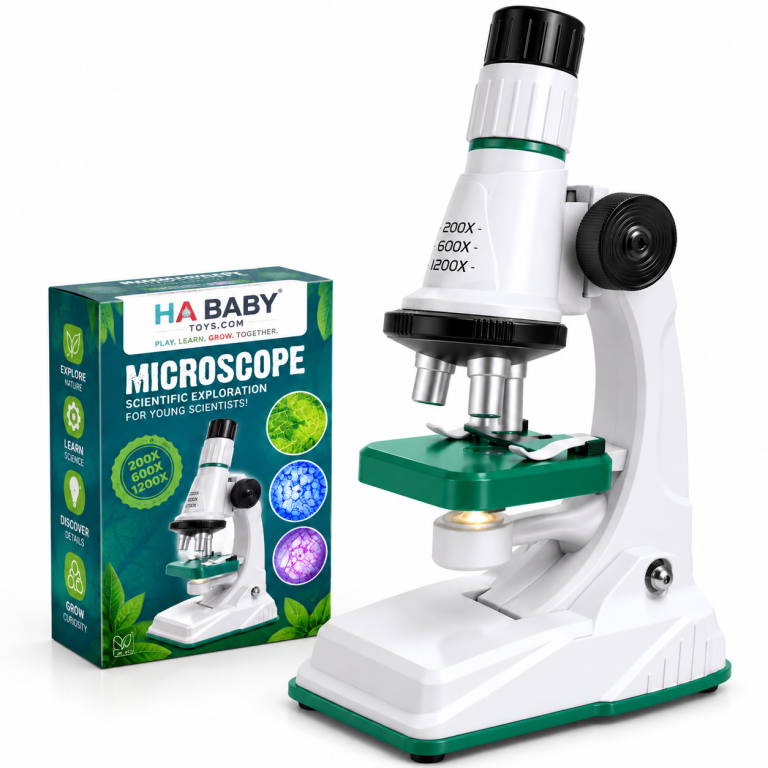
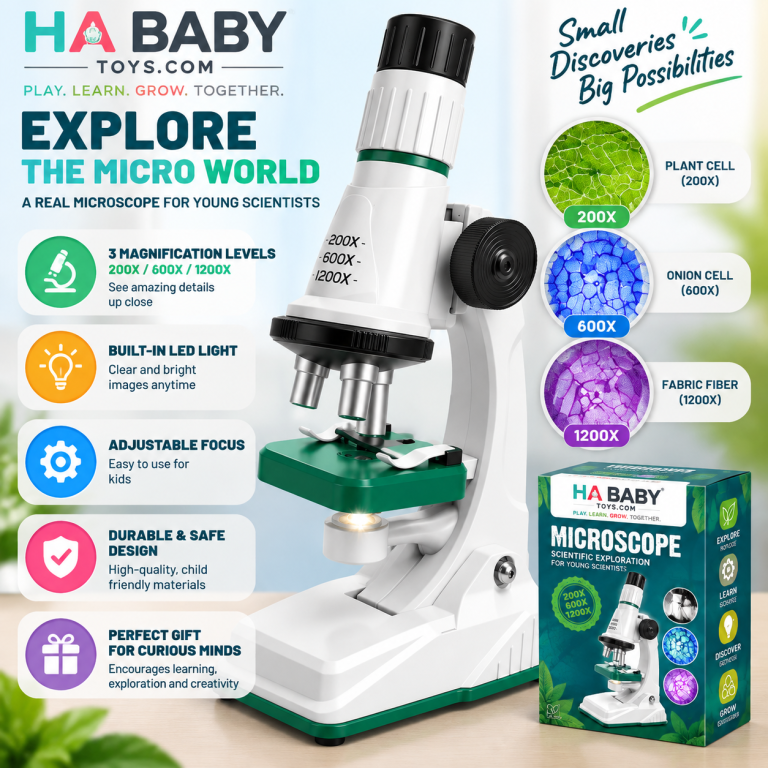
The HA BABY Kids Microscope Kit helps children experience science through exploration, observation, experiments, and discovery. Explore the product and introduce children to hands-on science learning.
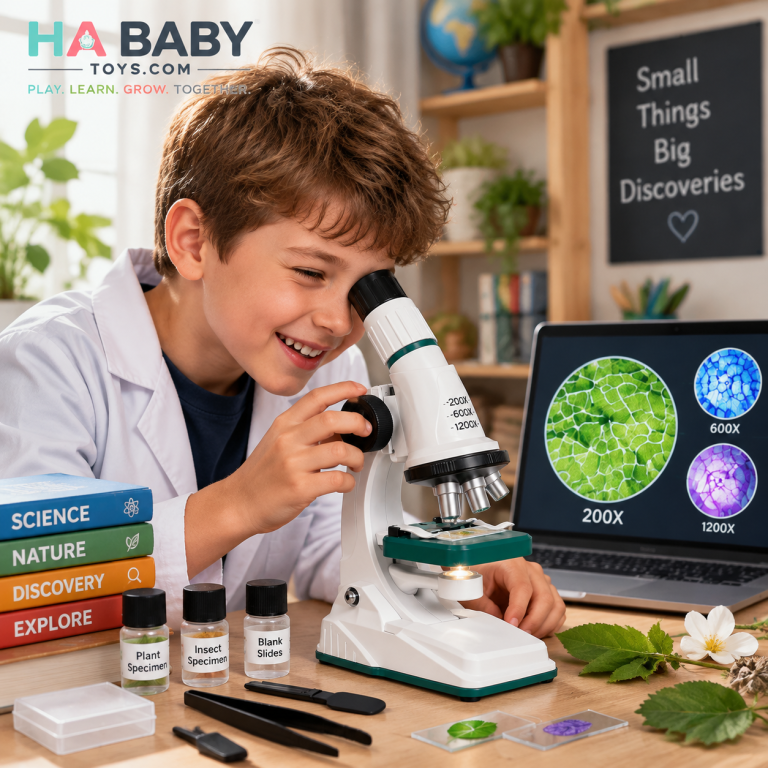
HA BABY Kids Microscope Kit
- 1200X magnification for detailed exploration
- Beginner-friendly design with simple controls
- Science activities included for structured discovery
- Strong educational value for STEM learning
- Supports curiosity, creativity, and scientific thinking
- Safe, durable, child-friendly construction
- Complete kit with slides and accessories
For readers who want to compare the wider range of educational products, the full shop is a useful next step. The HA Baby Toys blog also covers every aspect of science learning and early education.
How Parents Can Make Microscope Learning More Exciting
Three simple habits turn microscope use into a genuine family science practice.
Create Science Time
Set weekly discovery sessions — consistency builds the habit.
Ask Questions
Instead of giving answers, ask: “What do you notice?”
Encourage Recording
Create science journals — children draw and write their discoveries.
For more inspiration, see From Curiosity to Discovery: How Kids Microscope Kits Make Science Fun. The Britannica Kids and Science Magazine also offer excellent reference materials.
Frequently Asked Questions
A kids microscope kit improves curiosity by making discovery-based learning a daily habit. Children see that ordinary objects contain hidden details worth investigating — and that every question has an answer they can find themselves. That discovery cycle is what sustains curiosity long after the first session.
Yes. Scientific creativity means creating ideas, designing experiments, and finding new possibilities. Children who use a microscope learn to ask their own questions, choose what to observe, and design their own mini research projects. The National Geographic Kids resources offer endless inspiration for creative science exploration.
Children develop scientific thinking, focus, patience, observation skills, and communication. They also build confidence through discovery and learn practical STEM skills across science, technology, engineering, and mathematics. The CDC child development resources highlight hands-on, guided discovery as central to healthy early development.
Yes — provided it’s designed for beginners. Beginner-friendly designs include simple controls, easy focusing, comfortable viewing, and multiple magnification settings so children can start simple and grow. For a full breakdown, see Beginner Microscope for Kids: A Parent’s Guide to Choosing the Right Science Toy.
Kids can explore nature (leaves, flowers, insects, seeds) and household objects (fabric fibers, paper texture, salt crystals). They can also investigate prepared biology slides. What they can see depends on the magnification level and the sample. For activity ideas, see Fun Science Experiments Kids Can Try With a Microscope Kit at Home.
Science toys are important for STEM learning because they make abstract concepts concrete. A microscope naturally integrates all four STEM subjects: science (observing nature), technology (using scientific tools), engineering (testing and experiment design), and mathematics (comparing size, shape, and patterns). The U.S. Department of Education STEM resources emphasize early STEM exposure as foundational for future learning.
Yes — a microscope makes an excellent educational gift. It works beautifully for birthdays, school projects, holiday gifts, and curious children. Unlike ordinary gifts that lose appeal quickly, a microscope keeps giving: every observation leads to new questions and new discoveries. For more on this, see Why a 1200X Children’s Microscope Is the Perfect Educational Gift.
Transform Curiosity Into Discovery
Every child has a natural desire to explore. A kids microscope kit transforms simple curiosity into scientific discovery, creativity, and lifelong learning. Observe → Explore → Think → Experiment → Discover
The Bottom Line: A Learning Tool, Not Just a Toy
A kids microscope kit is not just another toy. It is a learning tool that builds curiosity, creativity, and scientific thinking — three skills that shape how children approach every future challenge. From the first time a child focuses on a leaf under magnification, the world becomes bigger, not smaller.
Whether you’re looking for a birthday gift, a homeschool resource, or a way to reduce screen time while building genuine skills, a kids microscope kit is one of the smartest choices available. It turns curiosity into discovery — and discovery into a lifelong love of learning.
For parents ready to explore one, the HA BABY Kids Microscope Kit product page is the natural next step. For deeper guidance on science learning and early education, explore the full HA Baby Toys blog library.
2 Responses