
How Children’s Microscope Toys Introduce Kids to Biology and the Hidden World
Discovering the hidden world beyond human eyes. Children are naturally curious explorers — they look at insects, leaves, flowers, and everyday objects and often ask: “Why does this look like this?” “What is inside this?” “How does nature work?” However, many children only observe the world from the surface. A children’s microscope toy changes that experience by allowing young explorers to see details that are invisible to the naked eye. A simple leaf becomes a scientific discovery. A piece of fabric becomes a lesson about materials. A flower becomes an introduction to biology.
Parents searching for educational learning products can explore more options at HA BABY Toys.
What This Guide Covers
- What Are Children’s Microscope Toys?
- How They Introduce Biology
- The Hidden World Kids Discover
- 10 Things Kids Can Explore
- Building Early Biology Knowledge
- Powerful STEM Learning Tools
- Biology Activities at Home
- Microscopes vs Screen-Based Learning
- Choosing the Right Microscope
- HA BABY Kids Microscope Kit
- Interactive FAQ
What Are Children’s Microscope Toys?
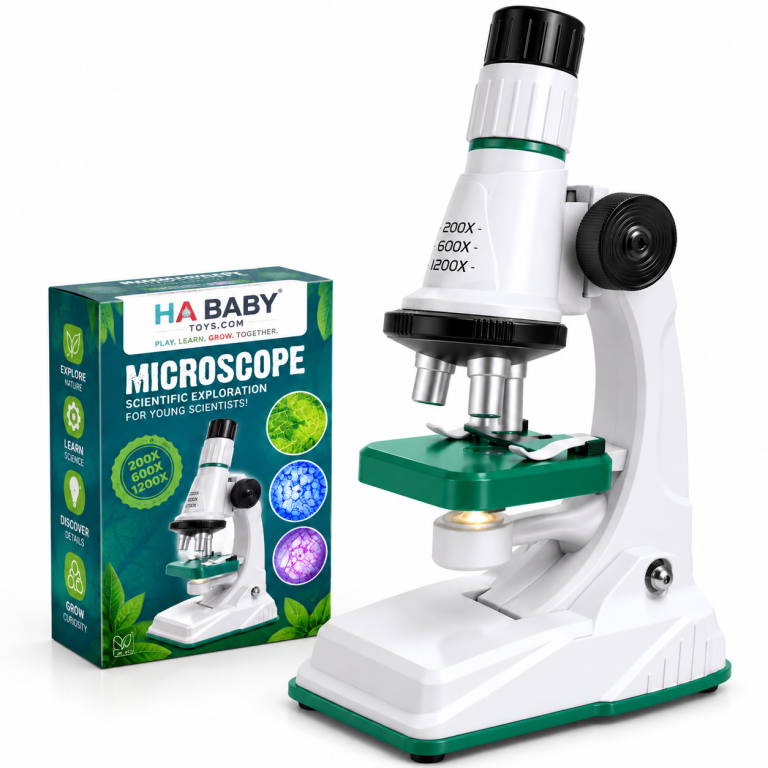
Children’s microscope toys are beginner-friendly scientific tools designed to introduce young learners to observation and discovery. Unlike professional laboratory microscopes, kids microscopes focus on easy handling, simple operation, safe exploration, and learning through play.
Here’s the difference between a normal toy and a microscope science toy.
🧸 Normal Toy
Provides entertainment, imagination, and short activities.
🔬 Microscope Science Toy
Provides investigation, experimentation, discovery, and learning.
Parents can also understand the complete benefits of microscope learning through: Kids Microscope Kit Guide: How a 1200X Children’s Microscope Helps Young Explorers Discover Science.
How Microscope Toys Introduce Children to Biology
Biology is the study of living things — and a microscope brings that study to life at a child’s scale. Children can explore plants through leaves, flowers, and seeds, learning about patterns, structures, and natural designs.
Small Organisms
Children can learn about microorganisms through prepared educational slides. This isn’t just theory — they see the microscopic world directly, which makes biology tangible rather than abstract.
Materials Around Them
Hair, fabric, and paper all become biology lessons when magnified. A microscope transforms normal objects into biology lessons. The National Geographic Kids resources offer endless inspiration for what children can explore next.
The Hidden World Children Discover Through Microscopes
A child sees a leaf every day. Without a microscope: “It is just green.” With a microscope: they discover tiny patterns, surface structures, and different textures they never imagined.
Microscopes develop attention to detail, scientific observation, and curiosity. Learn more in our guide: How a Kids Microscope Kit Builds Curiosity, Creativity, and Scientific Thinking.
10 Things Kids Can Explore With a Microscope Toy
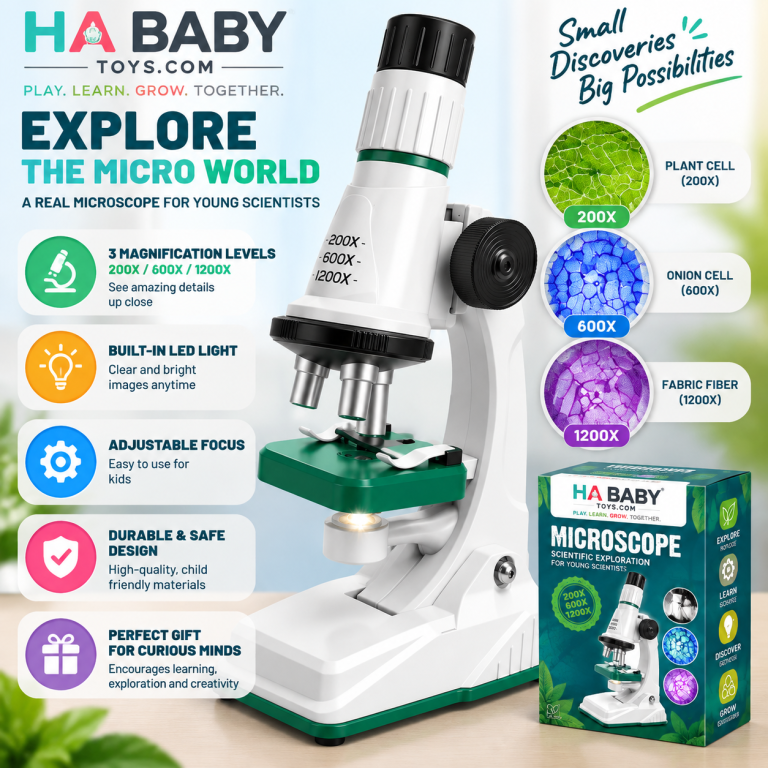
Here are the ten most engaging specimens children can explore — all from home or the backyard.
1. Leaves
Plant structures and patterns
2. Flowers
Natural designs
3. Fabric
Different fibers
4. Paper
Surface textures
5. Salt Crystals
Shapes and patterns
6. Sand
Different particles
7. Feathers
Natural structures
8. Seeds
Plant biology
9. Everyday Materials
Compare objects
10. Prepared Slides
Scientific observation
For more hands-on ideas, see Fun Science Experiments Kids Can Try With a Microscope Kit at Home.
How Microscope Toys Build Early Biology Knowledge
A microscope toy develops four foundational science skills — the same ones real biologists use.
👀 Observation
Children learn to look carefully — noticing details that others miss.
🔬 Classification
They compare differences between objects, materials, and organisms.
❓ Investigation
They ask questions about what they see — and then find answers.
📓 Documentation
They record findings — drawings, notes, and observations.
This is the scientific method in action: Observation → Question → Experiment → Discovery. The National Science Foundation emphasizes that early science exposure builds the thinking patterns that support lifelong learning.
Why Microscope Toys Are Powerful STEM Learning Tools
A microscope is one of the few toys that naturally integrates all four STEM subjects at once.
🔬 Science
Biology exploration — observing living things and natural materials.
💻 Technology
Using scientific equipment — understanding how tools extend our senses.
⚙️ Engineering
Testing ideas — designing what to observe and how to investigate.
📐 Mathematics
Comparing sizes and patterns — practical math in action.
The U.S. Department of Education STEM resources emphasize early STEM exposure as foundational for future learning. For a deeper look, see STEM Toys for Kids: How Microscope Science Kits Encourage Future Scientists.
From Ordinary Object to Biology Discovery
Tap each stage to follow the transformation
Ordinary Object
Looks ordinary
Microscope
Magnifies hidden details
Discovery
Learn biology
Knowledge
Develop scientific thinking
Ordinary Object — Looks Ordinary
A leaf on the ground looks like nothing special. But to a young scientist, it’s a mystery waiting to be explored. Every discovery starts with noticing something ordinary.
How Parents Can Create Biology Learning Activities at Home
Three simple habits turn a microscope into a genuine family science practice.
Nature Explorer Activity
Collect a leaf, a flower, and small safe objects together.
Science Journal
Children record drawings, observations, and questions.
Family Discovery Time
Parents ask: “What do you notice?” “What is different?”
The NASA Kids’ Club and National Geographic Kids both offer excellent free resources for extending biology exploration beyond the microscope.
Children’s Microscope Toys vs Screen-Based Learning
Modern children spend more time with screens than ever before. Microscopes offer an alternative that encourages physical interaction, real-world exploration, and active thinking — the opposite of passive consumption.
The CDC Child Development resources highlight hands-on, guided discovery as central to healthy early development. Science toys deliver exactly that — with a bonus: parents often learn alongside their children.
Choosing the Right Children’s Microscope Toy
Here’s what to check before buying.
🔍 Magnification
Why 1200X attracts young learners — and why lower settings matter too.
🎯 Easy Controls
Important for beginners — simple focus and clear viewing.
🛡️ Safety
Child-friendly design with rounded edges and safe materials.
🧰 Accessories
Slides and tools improve the experience — a complete kit is better.
For a full breakdown, see 1200X Microscope for Kids Explained: Everything Parents Need to Know Before Buying.
HA BABY Kids Microscope Kit: Bringing Biology Discovery Home
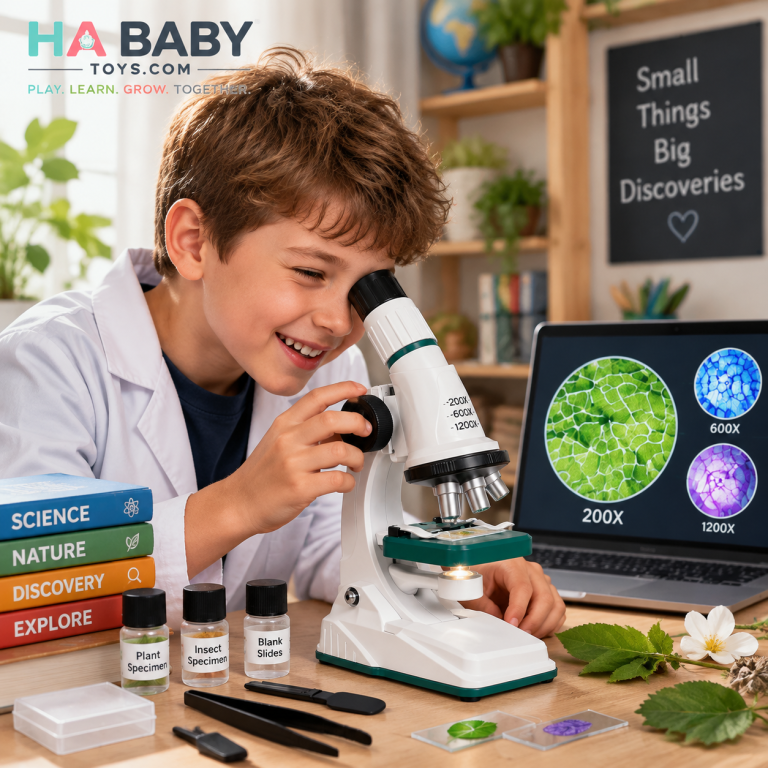
The HA BABY Kids Microscope Kit helps children explore biology concepts, nature discovery, scientific observation, STEM learning, and independent exploration — all through hands-on play.
HA BABY Kids Microscope Kit
- Introduces biology concepts through real observation
- Beginner-friendly design with simple controls
- 1200X magnification for detailed discovery
- Hands-on exploration of nature and everyday objects
- Supports STEM learning across all four subjects
- Safe, durable construction for young explorers
- Complete kit with slides and accessories
For readers who want to compare the wider range of educational products, the full shop is a useful next step. The HA Baby Toys blog also covers every aspect of science learning and early education.
Frequently Asked Questions
Children learn biology, observation skills, and scientific thinking through direct experience. They see how living things are structured, discover hidden patterns in nature, and practice the same scientific process real biologists use: observe, question, test, discover. The National Science Foundation emphasizes that this kind of early science exposure builds thinking patterns that support lifelong learning.
Yes — beginner-friendly design is what makes children’s microscope toys different from laboratory microscopes. They include simple controls, easy focusing, comfortable viewing, and multiple magnification settings so children can start simple and grow. For a full guide, see Beginner Microscope for Kids: A Parent’s Guide.
Kids can observe leaves, flowers, fabric, paper, salt crystals, sand, feathers, seeds, everyday materials, and prepared biology slides. What they can see depends on the magnification level and the sample. The National Geographic Kids resources offer endless inspiration for what to explore next.
A microscope helps biology learning by making hidden structures visible. Children see cell patterns, plant veins, insect wings, and fabric weaves directly — rather than just reading about them. This makes biology tangible and memorable. The Smithsonian Science Education Center emphasizes inquiry-based science learning from an early age.
With supervision, children’s microscopes are suitable from around age 5. Ages 5–7 do best with basic observation and simple magnification. Ages 8–10 can handle simple experiments and recording findings. Ages 10+ can use higher magnification for detailed exploration. The CDC Child Development resources provide useful reference points.
It depends on what you want from a toy. Normal toys provide entertainment; a microscope provides learning plus entertainment. Science toys add real developmental value — curiosity, observation, critical thinking, and hands-on skill building. For a detailed comparison, see Kids Microscope Kit vs Traditional Toys.
Yes. A microscope naturally integrates all four STEM subjects: science (biology exploration), technology (using scientific equipment), engineering (testing ideas), and mathematics (comparing sizes and patterns). The U.S. Department of Education STEM resources emphasize early STEM exposure as foundational for future learning.
Yes — the HA BABY Kids Microscope Kit is designed for young explorers. It combines 1200X magnification with a beginner-friendly design, includes slides and accessories, and supports biology discovery, STEM learning, and independent exploration. It’s an excellent choice for birthdays, school projects, and homeschool science activities.
Every Child Has a Hidden Scientist Waiting to Explore
A children’s microscope toy turns everyday objects into exciting discoveries and helps young minds understand the hidden world of biology. Observe → Magnify → Discover → Understand
The Bottom Line: A Window Into Biology
A children’s microscope toy does more than entertain — it introduces children to biology through direct observation. From the first time a child focuses on a leaf under magnification, the natural world becomes a laboratory.
Whether you’re looking for an educational gift, a homeschool resource, or a way to reduce screen time while building genuine skills, a children’s microscope toy is one of the smartest choices available. It turns curiosity into discovery — and discovery into a lifelong love of biology.
For parents ready to explore one, the HA BABY Kids Microscope Kit product page is the natural next step. For deeper guidance on science learning and early education, explore the full HA Baby Toys blog library.
2 Responses